
10 Best Business Fiber Internet Providers in Columbus Georgia
Fast, dependable internet is no longer a luxury for Columbus companies it’s the backbone of cloud apps, VoIP calls, card readers, and every file your team shares.
Yet coverage across the Fountain City still looks uneven. Cable hugs nearly every curb, but true fiber reaches only four out of ten business addresses, according to a February 2026 coverage audit by FindBetterInternet.
Change is accelerating. According to the Ledger-Enquirer, AT&T lit up 12,500 additional fiber locations in south Columbus in late 2023, bringing its city-wide fiber footprint to roughly 25,000 sites and signalling a broader tide of upgrades.
That momentum makes 2026 the right moment to reassess your connection. We spent weeks auditing every business-grade ISP serving the 319xx ZIP codes scoring them on symmetrical speed, uptime guarantees, coverage, contract flexibility, support, and value-add perks. The result is a ranked field guide to the ten providers most worth your time for making data-driven decisions.
Read on to see which vendors to call first, what to ask, and how to choose a primary line or a rock-solid backup that keeps your operation humming. Each section is crisp and scannable, so you can jump straight to the details that fit your address and budget.
How we ranked the providers

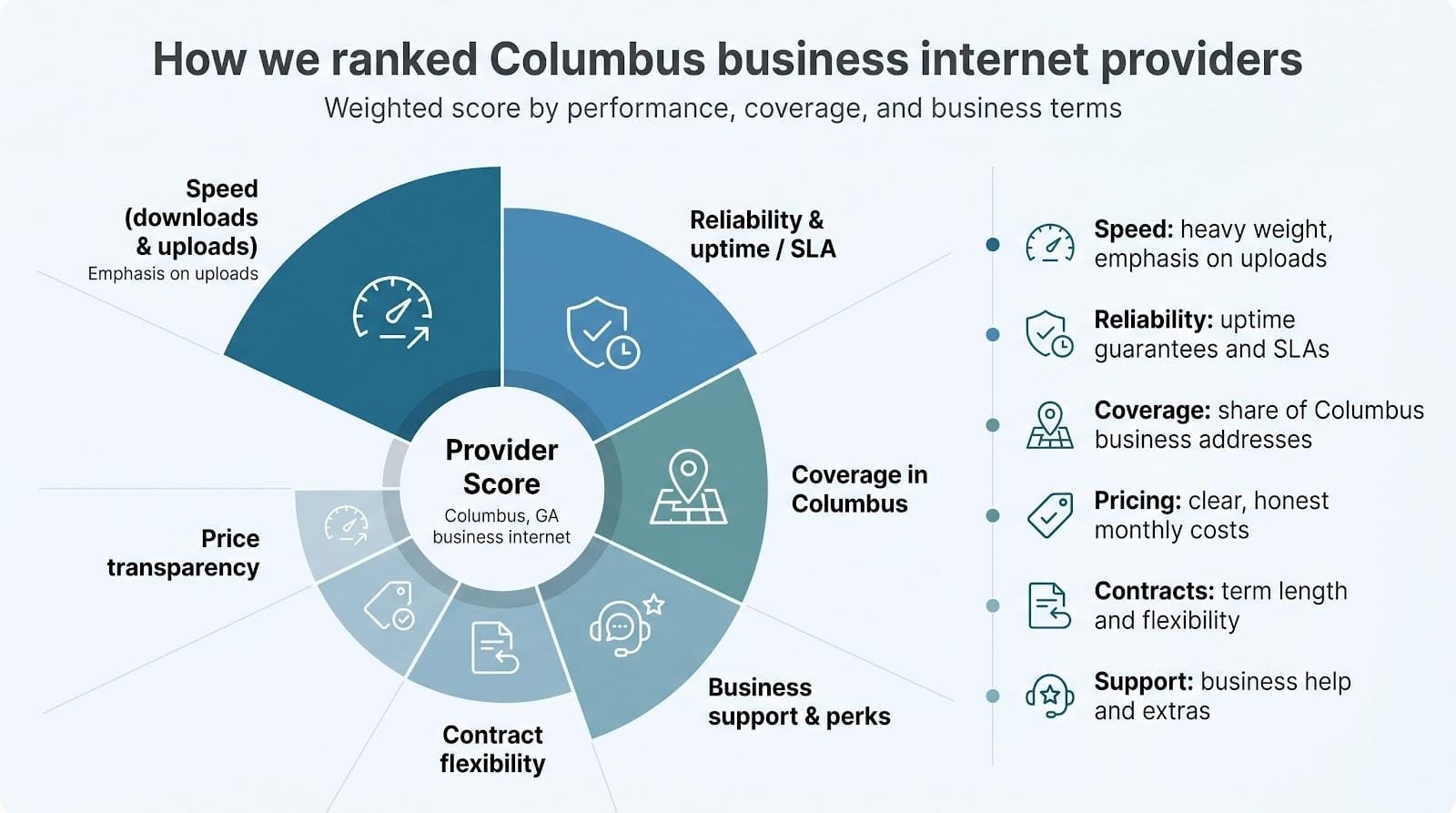
We scored each ISP on the factors that matter when the network stalls at 3 pm while customers watch. Speed carried the most weight because slow uploads choke cloud backups. Reliability and formal uptime guarantees followed, along with how much of Columbus each provider reaches.
Price transparency, contract flexibility, and business support completed the rubric. We tallied the scores and let the data set the ranking; no paid placements, no favorites, just real-world value.
1. WOW! Business: best overall local pick
Most Columbus offices start their search with WOW, and for good reason. Flexible plans, a three-year price-lock guarantee, and a 60-day satisfaction window perks spelled out by the Columbus, GA Business Internet Provider sweeten the proposition before speed even enters the conversation. The company’s hybrid fiber-coax network reaches about 90 percent of business addresses, the widest footprint of any provider in the city.
That reach usually puts a technician on-site within a week. Plug in the modem and you will see 300 to 1,200 Mbps downloads the same day. Uploads top out near 50 Mbps on coax, still faster than every DSL line in town and plenty for daily cloud backups.
WOW’s biggest strength is cost control. Entry-level plans sit near $100 a month, and new three-year agreements include a three-month bill credit. Contracts are plain-English, equipment fees are modest, and surprise surcharges are rare.
Support stays local and quick. Call after hours and you reach a Columbus-based rep who can dispatch someone from the Knology Way office instead of sending you through a national queue. That hometown touch keeps independent retailers and creative studios loyal because they cannot wait days for a fix.
Drawbacks: limited upload symmetry and no SLA. If your team moves large video files upstream or hosts servers in-house, the 50 Mbps cap feels tight. Reliability on coax is solid but not guaranteed; firms with strict uptime targets still need fiber.
Bottom line: choose WOW when you want gig-class downloads at cable pricing and technicians who know the local grid. Run it as a primary line for everyday workloads, then add a wireless or fiber backup if real-time uploads keep the lights on.
2. AT&T Business Fiber: fastest symmetrical speeds
If your office sits inside AT&T’s fiber footprint, you reach a different class of connectivity. Speeds climb to 5 Gbps in both directions, so large CAD files, nightly backups, and real-time video calls share the pipe without fighting for bandwidth.
Coverage is no longer a downtown-only perk. In late 2023, AT&T added 12,500 new fiber locations in south Columbus, pushing its total past 25,000 and edging city-wide availability toward 40 percent.
Reliability matches the speed. Business plans carry a 99.9 percent uptime guarantee, proactive monitoring, and four-hour repair targets. When a backhoe cuts a cable, your ticket jumps to the front of the line.
Pricing starts near $60 for 300 Mbps and reaches about $300 for the full 5 Gig. You pay extra for symmetry and the SLA. Contracts are usually 12 months, shorter than most telecom terms, and static-IP bundles are available for hosted servers or VPNs.
Drawbacks: availability is still a coin toss north of Midtown and in older industrial pockets. Installs can take a month when a new drop is needed, so plan ahead. Support feels corporate; you trade local charm for enterprise polish.
Choose AT&T Business Fiber when upload speed drives revenue design agencies, healthcare imaging, or any team that streams 4K meetings all day. Pair it with a wireless backup for true bulletproof uptime, and bandwidth worries fade.
3. Spectrum Business: no-contract flexibility with built-in failover
Sometimes you need solid bandwidth without a long commitment. That is Spectrum’s strength. The company’s Business Internet Gig plan delivers up to 940 Mbps down and 35 Mbps up, and, crucially, it ships with zero-term commitment. You can upgrade, downgrade, or cancel whenever your strategy or budget shifts.
Download performance holds steady. Field tests across East Columbus record 800-plus Mbps during business hours, enough to stream security cameras, sync cloud drives, and keep a dozen Zoom tiles clear. Uploads trail true fiber, yet 35 Mbps still beats legacy DSL and stays stable under DOCSIS 3.1.
Reliability improves with Spectrum’s Invincible Internet add-on. For a small fee the modem pairs with an LTE router and an eight-hour battery, so card terminals keep running even if a pole falls.
Freedom is the headline perk. Monthly rates sit slightly above promo-heavy coax plans, but there are no early-termination penalties or auto-renew surprises. That flexibility helps seasonal retailers, pop-up offices, or startups that may pivot inside a year.
Watch for two quirks. First, prices rise after the first twelve months, so set a reminder to renegotiate. Second, fiber-backed symmetry is only available through Spectrum Enterprise at custom pricing. Standard coax uploads feel tight for video production houses or data-heavy SaaS teams.
Choose Spectrum Business when you value contract agility, need a turnkey cellular backup, and your workflow leans download-heavy. Pair it with a wireless or fiber secondary if symmetrical uploads ever move from “nice to have” to mission-critical.
4. Mediacom Business: citywide reach when others cannot serve
Mediacom is often overlooked, yet its coax lines cover more of greater Columbus than Spectrum and AT&T combined. If your shop sits in a pocket where the big names decline, Mediacom is the cable crew likely to send a truck and light up the address.
Speeds match the best of coax: up to 1 Gbps down and 50 Mbps up. That is plenty for cloud point-of-sale, dozens of cameras, and routine file sharing. Most plans bundle a managed Wi-Fi 6 gateway and basic cybersecurity software, so you skip a store visit and broadcast a guest network in minutes.
Pricing stays straightforward. Expect about $100 for 300 Mbps and a little above $200 for the full gig, both on one-year terms. Mediacom often waives install fees and includes a 30-day satisfaction guarantee, a quiet vote of confidence in its plant.
Service quality depends on neighborhood load. In freshly upgraded areas the connection hums. In older nodes peak-hour congestion can trim throughput, so run a 5 pm speed test on day one and keep screenshots as proof if performance drifts.
Customer care has improved but still trails the local charm of WOW. Tickets route through a regional center, and you may need to push for escalation during an outage. Field techs live nearby, and on-site repairs usually land within 24 hours.
Mediacom shines when geography or landlord rules block other options. Use it as a reliable primary line in industrial parks west of downtown or as a budget-friendly backup behind fiber. Monitor peak-time speeds and renegotiate each year to keep the rate card honest.
5. EarthLink Business: concierge service across multiple networks
EarthLink does not own fiber under Columbus streets; instead, it acts as a matchmaker. The company taps whichever backbone serves your exact address often AT&T Fiber, sometimes local coax, occasionally fixed wireless then wraps it with one bill, a static IP, and a support team that returns calls.
That broker model removes a common headache. When you move, you no longer spend days comparing coverage maps or decoding telco fine print. One EarthLink rep checks every carrier, prices the plans, and explains the pros and cons. If you run multiple locations, they bundle those circuits into one invoice and a unified help-desk number.
Performance mirrors the underlying network. Where fiber is present you get symmetrical gigabit or even 5 Gig; where only cable reaches you see the familiar gig down, 50 up profile. Either way, EarthLink monitors the line and pushes the carrier when something blinks, saving you from the first-level script of “reboot the modem.”
The trade-off is cost. Expect to pay roughly 10 percent above going direct, a premium that funds the service layer. For many owners that extra fee is worth avoiding carrier ping-pong, especially during an outage when every minute offline hurts revenue.
Choose EarthLink when customer service outranks raw price, or when you manage several sites on different ISPs and want one point of contact to coordinate installs, static IPs, and cut-over dates across whatever infrastructure the new address offers.
6. Southern Light Fiber: dedicated 10 Gbps for mission-critical workloads
Every city keeps a carrier of last resort for firms that count downtime in lost millions. In Columbus that role belongs to Southern Light (now part of Uniti Fiber). This is not broadband; it is a private point-to-point circuit delivered at 1 Gbps or 10 Gbps with a 99.99 percent uptime SLA and an engineer on call.
Availability is scarce. Only about 2 percent of business addresses are on net, but if your building sits on their ring the install is nearly plug-and-play. Southern Light sends a dedicated wavelength straight to its core, so your packets never mingle with residential traffic or slow during peak hours.
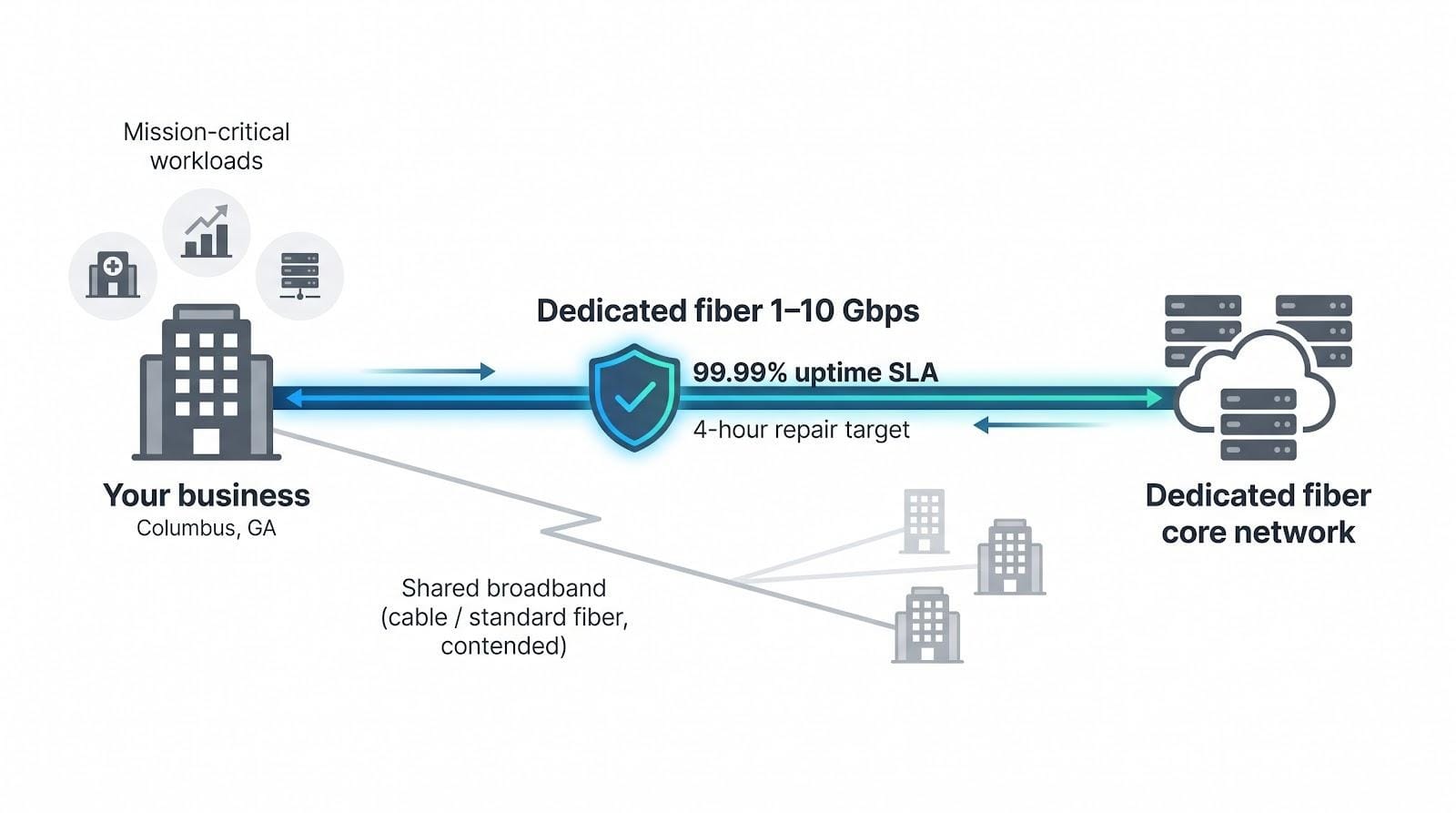
Price matches the exclusivity. A symmetrical gig costs close to $1,000 per month on multi-year terms that recoup the lateral built years ago. Ten-gig circuits climb several thousand, yet large campuses often come out ahead by replacing multiple lower-speed lines and the trouble that comes with them.
Beyond raw bandwidth you buy certainty. The carrier offers redundant paths, a four-hour mean time to repair, and direct access to a network operations engineer who knows your circuit ID. Financial traders, regional hospitals, and data-heavy SaaS firms value that support when every second offline hurts the balance sheet.
Southern Light is unnecessary for a five-person law office but priceless for organizations that cannot flinch. If you see their fiber panel in your telco closet, request a quote. Even if you choose cheaper primary bandwidth, a smaller Southern Light circuit makes an excellent diverse backup because it follows different streets and splices than mass-market providers.
7. Windstream Kinetic Business: fiber for the outskirts
Leave the city limits and you will start seeing Windstream tags on utility poles. Kinetic’s state-funded buildouts now give parts of northern Muscogee County and nearby towns symmetrical gigabit fiber where DSL once crawled.
Plans stay simple. Pay about $65 a month for 500 Mbps or around $100 for the full gig, and cancel any time. There is no long-term contract, no data cap, and a three-year price lock that protects you from the year-two jump common in cable promos.
Each install arrives with a Wi-Fi 6 gateway and basic DDoS protection, so one device powers office and guest networks from day one. Windstream lists 99.9 percent reliability, and field reports show fiber uptime meets that mark. Local technicians handle truck rolls, a perk of serving smaller communities where reputation matters.
Watch the geography. Inside Columbus proper your address likely belongs to AT&T, so Kinetic will not be available. If fiber has not reached your street, Windstream falls back to VDSL that tops out near 100 Mbps. Always confirm the technology before you sign.
Pick Windstream Kinetic when you operate on the city fringe, dislike contracts, and want fiber performance without metro pricing. It also works as an affordable backup for urban offices that want carrier diversity without another three-year term.
8. T-Mobile 5G Business Internet: instant bandwidth for pop-ups and backups
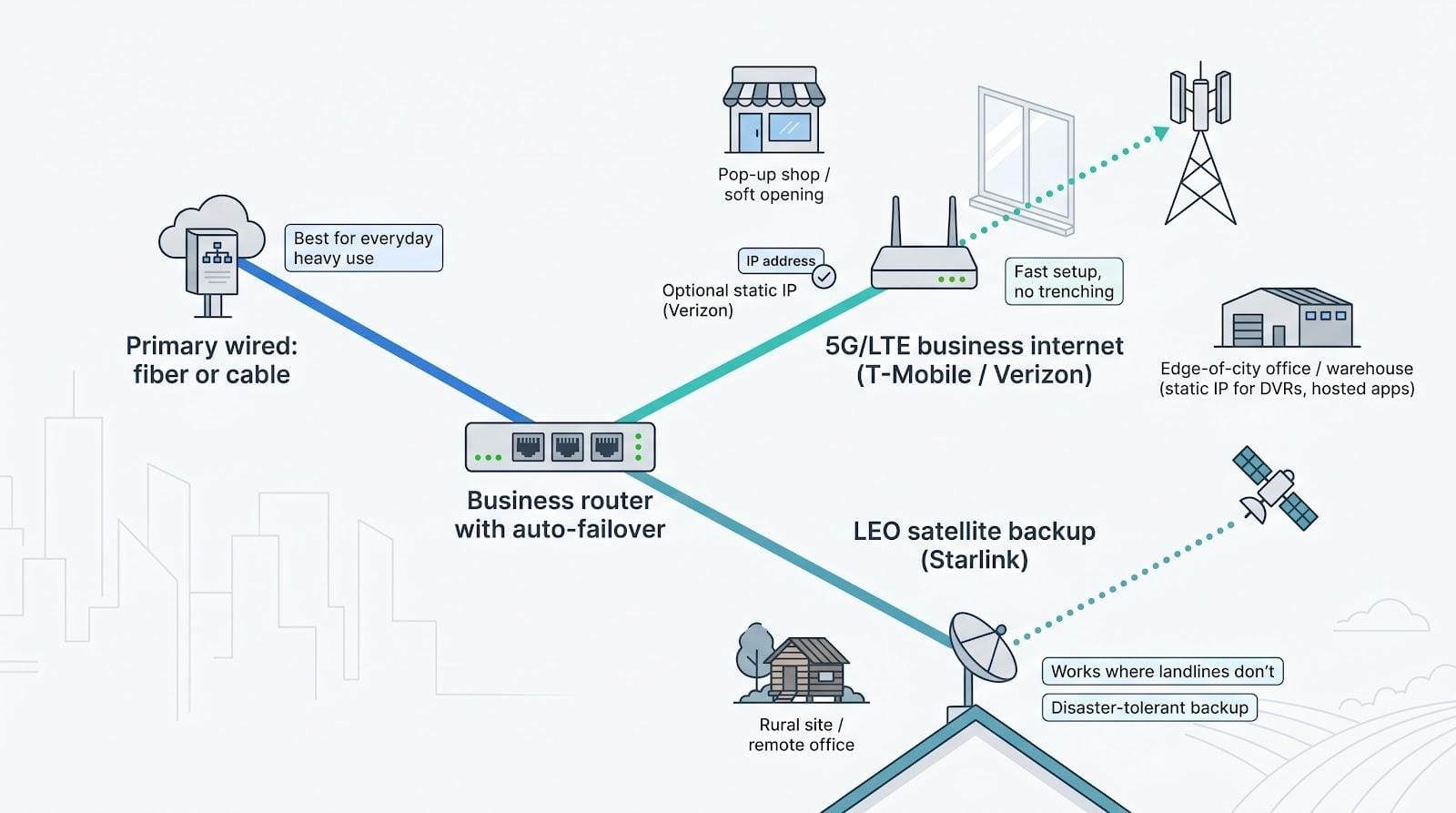
When a landlord stalls fiber construction or you need connectivity by Friday’s soft opening, T-Mobile’s tabletop gateway can fill the gap. Plug it in, aim it toward a window, and within fifteen minutes your laptops often see 100 to 300 Mbps downloads on the same mid-band 5G network that blankets Columbus.
The plan costs a flat $50 a month, taxes and equipment included, and you can cancel when the wired line arrives. Data is unlimited, so you may stream training videos, sync a cloud POS, or run a weekend flash sale without worrying about overage charges.
Uploads hover near 20 Mbps and latency sits around 40 ms, enough for Zoom and Shopify, though video editors will feel the ceiling. Because traffic passes through carrier-grade NAT, you do not receive a public IPv4 address, so hosting inbound services requires a VPN or relay.
Performance hinges on signal strength. Downtown storefronts usually see full bars and near-cable speeds, while metal-framed warehouses on the edge of town may need an external antenna. Run a speed test during the free trial, and if numbers lag, return the box.
T-Mobile works as a primary link for lightweight operations such as food trucks, construction trailers, or boutique pop-ups, and as an inexpensive backup that activates when coax fails. Pair it with an auto-failover router to keep revenue flowing through most last-mile mishaps.
9. Verizon Business Internet: static-IP wireless for wider reach
Verizon’s fixed-wireless gateway competes directly with T-Mobile but adds two perks business admins value: stronger suburban coverage and an optional static IPv4 address for inbound traffic.
Speeds stay familiar, around 100 to 300 Mbps down and 20 Mbps up in most Columbus ZIP codes, and the network reaches rural pockets where 5G fades. If your office already sees a solid LTE signal, Verizon can often activate service on that same tower within a day.
Setup is simple. Self-install kits arrive overnight; place the router near a window, plug it in, and you are online in minutes. The “Pro” tier includes a technician-mounted external antenna for metal buildings that weaken cellular bars.
Static IP is the marquee feature. A small monthly fee delivers a routable address, essential for remote-access DVRs, hosted apps, or vendors that whitelist traffic. T-Mobile lacks this option, so Verizon appeals to IT teams that need direct inbound reach.
Plans range from about $70 to $200 a month, with discounts for customers who already use Verizon Wireless. Contracts are optional, though a two-year term locks in the lower promotional rate.
Choose Verizon when cellular coverage is strong, a true public IP matters, or you want carrier diversity in your failover stack. It is not the cheapest wireless pipe in town, but the static-IP option and broad footprint justify the premium for many edge-of-city sites.
10. Starlink Business: broadband anywhere the sky is clear
When miles of pine forest or Army training grounds separate you from the nearest cable node, Starlink can fill the gap with a dish, a router, and a clear view of the southern sky. Within an hour a remote office often jumps from single-digit DSL to about 150 Mbps downloads and 20 Mbps uploads, enough to stream training videos, run cloud point-of-sale, and push nightly backups.
Equipment costs start near $350, and service begins at $55 a month for basic backup, while high-capacity tiers approach $500. That math looks different when trenching fiber would cost tens of thousands. You also gain resilience that landline ISPs cannot match: because traffic travels through space, local fiber cuts and power poles pose little threat as long as your generator runs.
Latency sits in the 30–50 ms range, welcome news for satellite users used to half-second delays. Video calls feel natural, and SaaS dashboards refresh quickly. Short dropouts can occur during satellite hand-offs, so trading desks still prefer terrestrial links, but most business apps do not notice the brief blips.
Two limits matter. First, there is no public IPv4 address; traffic leaves through Starlink’s carrier-grade NAT, so inbound services need a cloud relay or VPN. Second, heavy rain can trim speeds for a few minutes, so serious operations keep a cellular hotspot as backup.
Choose Starlink Business when landlines are unavailable, construction budgets are tight, or you want a disaster-tolerant secondary circuit. For farms, rural event venues, and field-engineering trailers near Fort Moore, it is often the only practical broadband option and a surprisingly fast one.
Compare at a glance
You have the deep dives above, but sometimes a quick reference is easier. The matrix below distills each provider into the facts that guide most buying calls: technology, top symmetrical speed, contract style, static-IP availability, uptime promises, and how many Columbus addresses each one can reach.
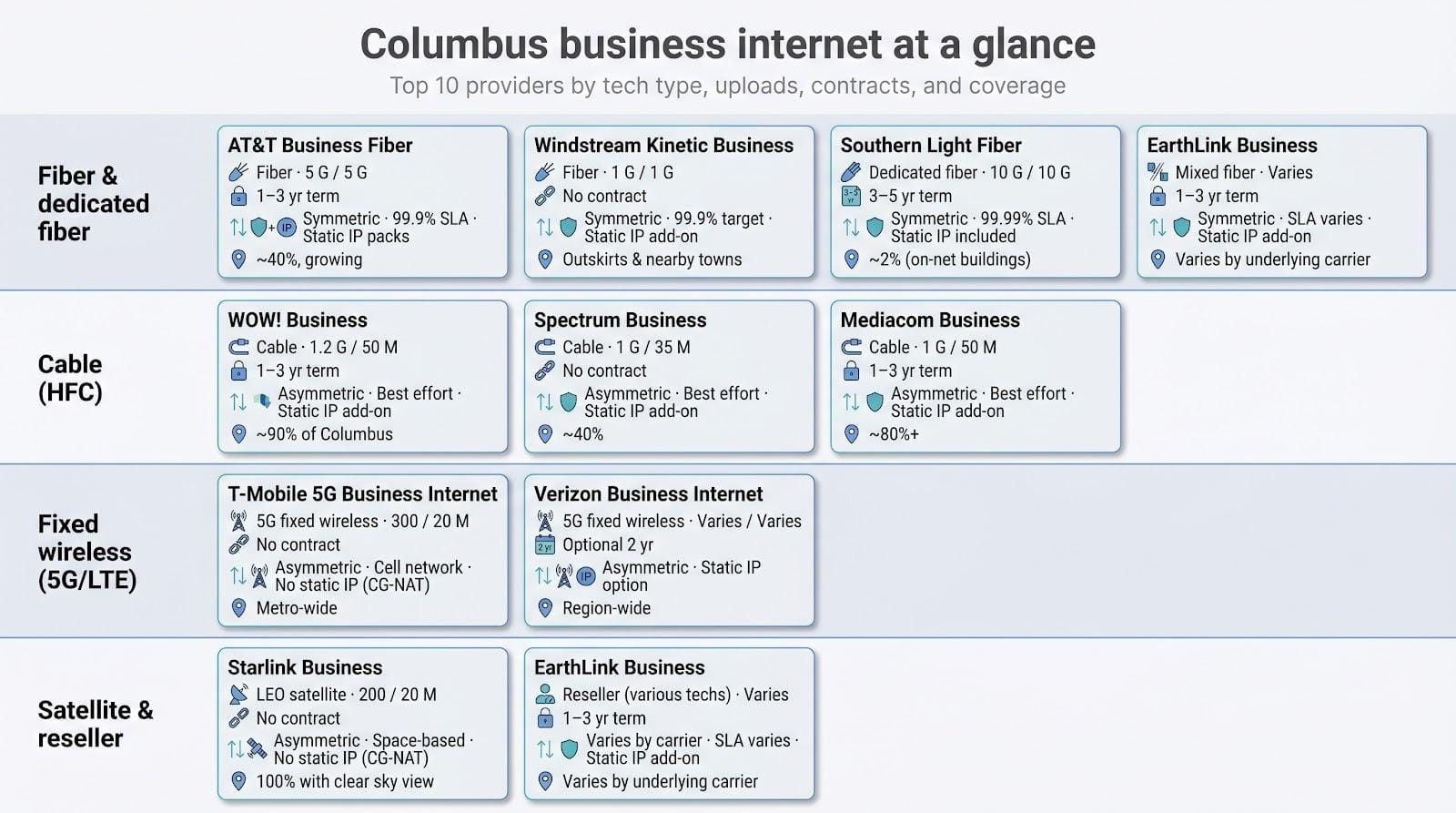
*Coverage estimates combine February 2026 FCC fabric data and BroadbandNow provider maps.
With the table in hand you can line up candidates quickly. If symmetrical uploads or an SLA top your list, underline AT&T or Southern Light. If contract freedom matters more, slide to Spectrum or T-Mobile. When geography blocks everything else, remember that Starlink keeps packets moving as long as the dish sees the sky.
Find your fastest path
Still unsure after the table? Walk through this short checklist.
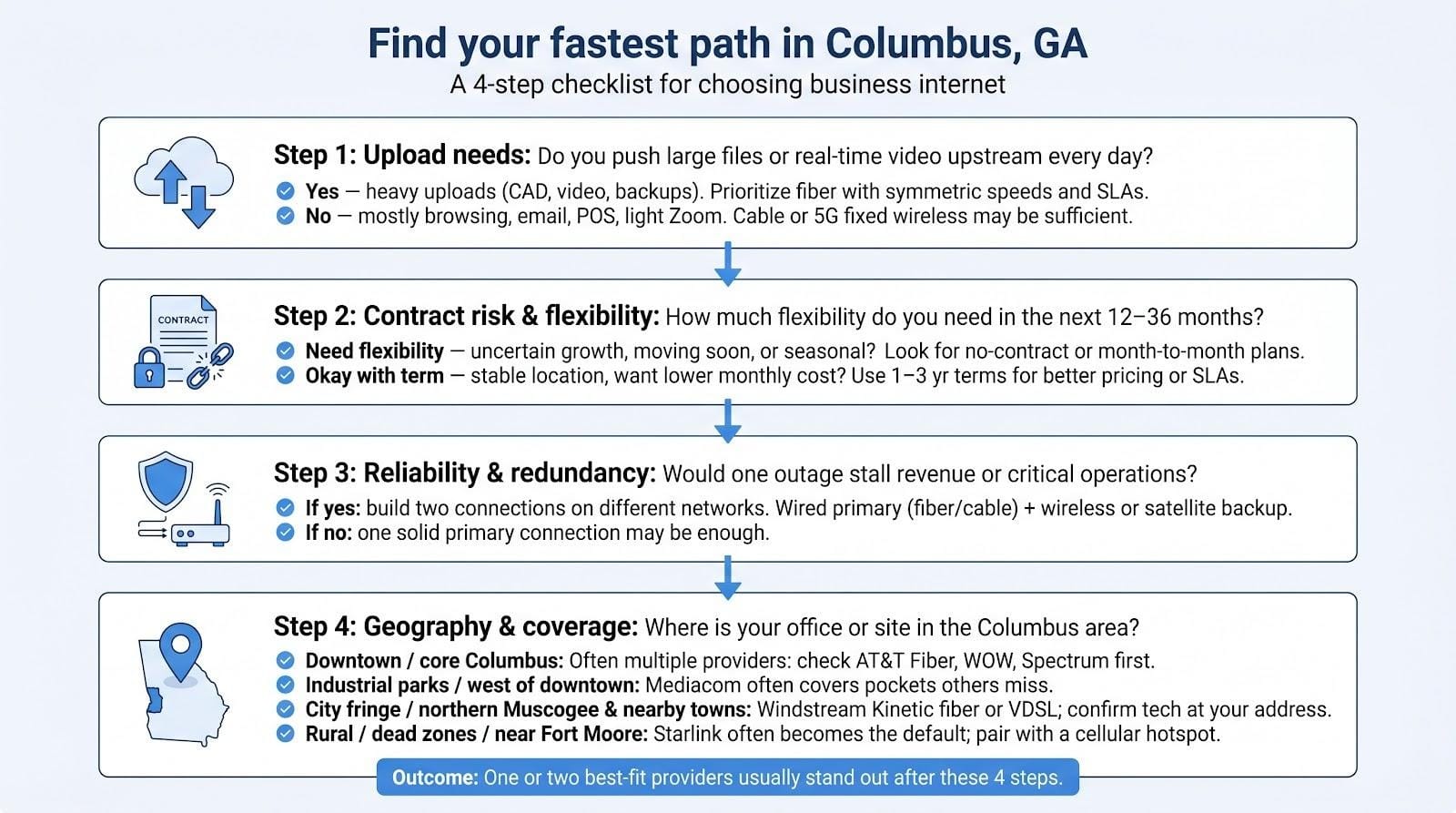
Start with uploads. If your team pushes gig-sized files upstream every day, fiber is the answer. Check your address with AT&T first. If it shows green, schedule the install. No fiber? Decide whether symmetrical speed is mission critical or simply nice to have. If it is critical, ask Southern Light or EarthLink for a dedicated circuit. The premium often pays for itself in saved hours.
Next, weigh contract terms. Need the freedom to cancel in six months? Spectrum’s no-term coax or T-Mobile’s month-to-month 5G provides that breathing room. Willing to commit to save cash? WOW’s three-month credit or AT&T’s annual fiber plan stretches the budget.
Now, confirm reliability. If one outage would stall revenue, build two connections. Pair a wired primary (fiber if possible, cable if not) with a wireless or satellite backup on a different network. A low-cost T-Mobile box or Starlink dish keeps card terminals online even when a squirrel chews through coax.
Finally, consider geography. Downtown lofts see many choices; edge-of-county shops may have only Mediacom or Windstream on the wire. In true dead zones Starlink becomes the default. Always verify with each provider’s address tool before choosing.
Answer those four checkpoints upload need, contract risk, uptime tolerance, and location and the best provider usually becomes clear within minutes.
Your buying checklist
Before you call a sales rep, run through this quick pre-flight. A few minutes here can save hours of follow-up.
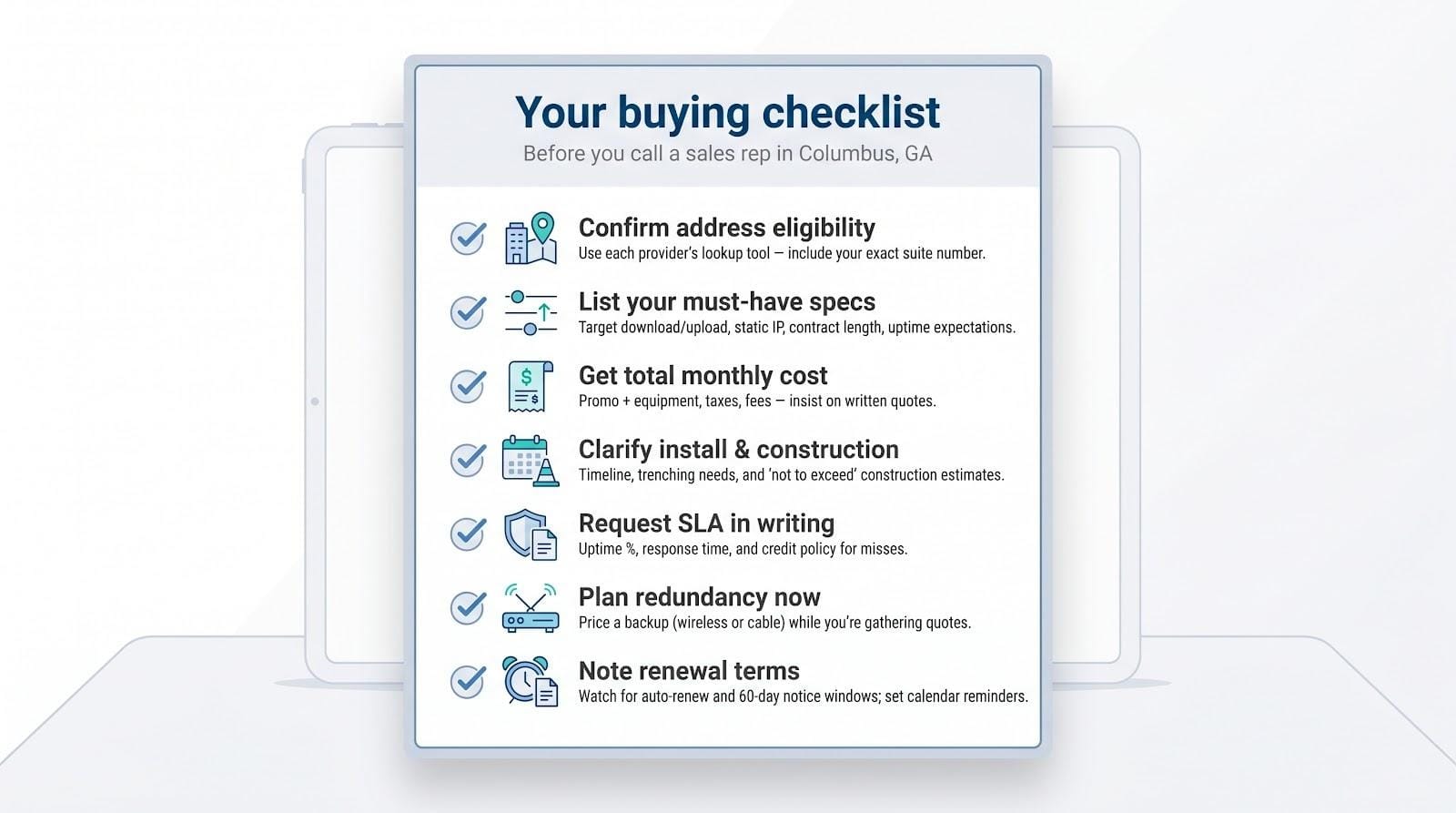
- Confirm address eligibility. Enter the exact suite number into each provider’s lookup tool. Coverage can change floor to floor in a multi-tenant building.
- List your must-have specs. Note target download and upload speeds, a static IP if you host services, contract length, and any uptime guarantee you expect. Starting with specifics keeps the call focused.
- Ask for the total monthly cost, not just the promo rate. Include equipment rental, taxes, and regulatory fees. Request a written quote so you can make a true side-by-side comparison.
- Clarify installation timelines and any construction fees. If fiber trenching is required, press for a written “not to exceed” quote and an estimated completion date.
- Request the SLA in writing. Check the uptime percentage, response time for outages, and the credit policy if targets are missed.
- Plan redundancy now, not after the first outage. Price a secondary connection (wireless or cable) while you are already gathering quotes; bundling backup early often lowers the overall bill.
- Note renewal terms. Many contracts auto-extend with a 60-day notice window. Set a calendar reminder in year two so you can renegotiate before rates increase.
Complete these steps and you will start negotiations knowing what you need, what you will pay, and how to hold the provider accountable once service begins.