
Accenture: A Comprehensive Interview Preparation Guide to Success
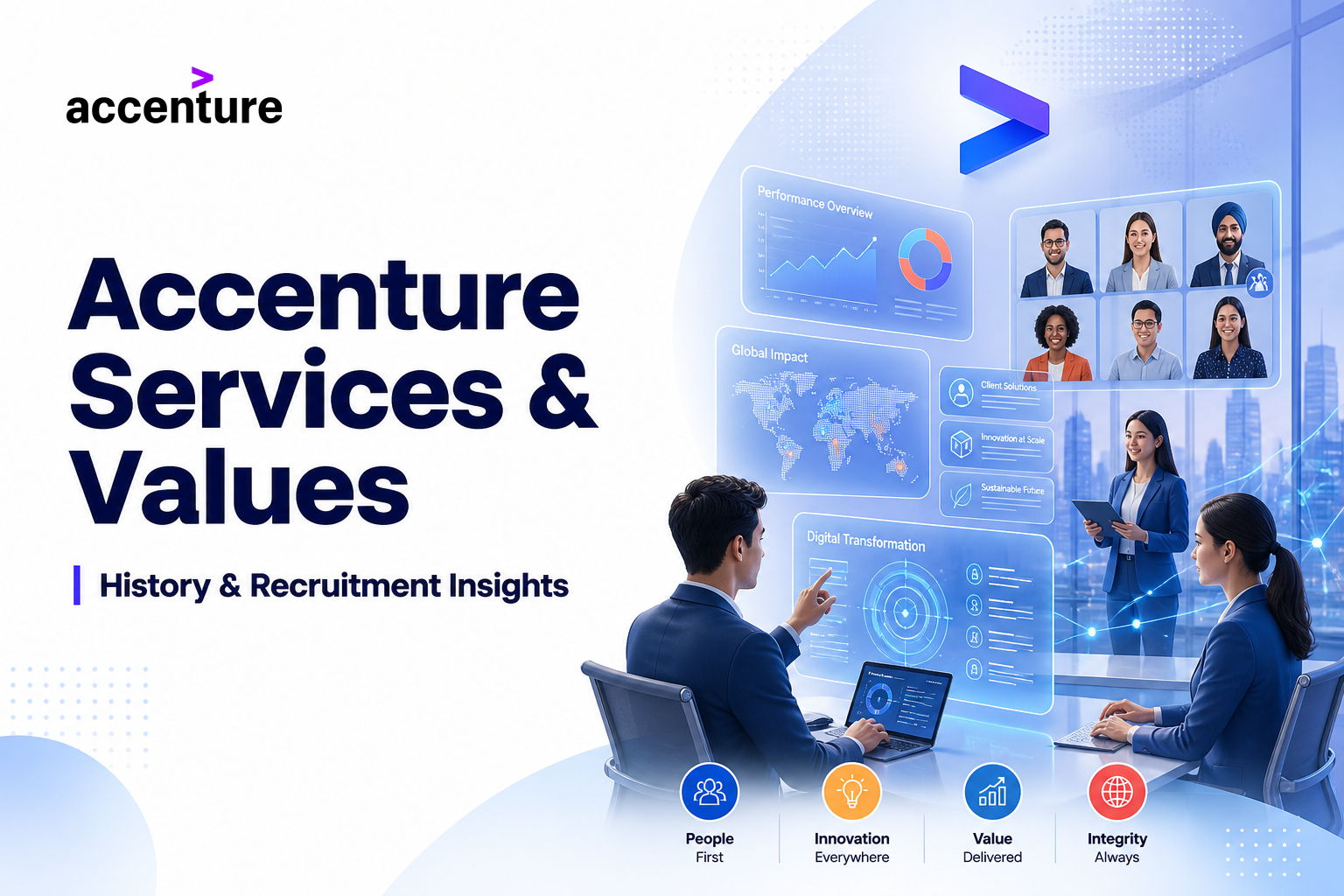
Accenture is a global professional services company known for combining consulting, technology, operations, digital engineering and experience-led services for large enterprises and public-sector organisations. In fiscal 2024, Accenture reported revenue of $64.9 billion and a workforce of approximately 774,000 people, serving clients in more than 120 countries (Accenture Annual Reports). Its scale, cross-industry reach and long-standing technology partnerships make it a major employer for consulting, cloud, data, cybersecurity, engineering and business operations roles.
Accenture’s market position is distinctive because it does not operate as only an IT services firm or only a strategy consultancy; it connects board-level advisory, implementation, managed services and creative customer experience work. For students and professionals, understanding Accenture’s business model is useful because hiring processes often test both technical capability and business problem-solving.
1. Company Overview
About Accenture
Accenture is one of the world’s largest professional services companies, with capabilities across strategy, consulting, technology, operations, Industry X and Accenture Song. The company works with clients across industries such as banking, communications, consumer goods, healthcare, public services, retail, energy and manufacturing, helping them modernise technology platforms, improve business processes and adopt new digital operating models.
About
| Attribute | Details |
|---|---|
| Founder | Clarence DeLany |
| Industry Type | IT Services, Consulting, Strategy |
| Founded | 1989 |
| Headquarters | Dublin, Ireland |
Company History
Accenture’s history can be viewed in three broad eras: its consulting roots inside Arthur Andersen, its growth as Andersen Consulting, and its modern phase as Accenture plc. The timeline below highlights major public milestones from official company history and investor materials.
| Year | Milestone |
|---|---|
| 1950s | Founding era: Arthur Andersen’s consulting practice began building a technology consulting identity through early business computerisation projects, including work connected to General Electric’s payroll processing systems (Accenture history). |
| 1989 | Growth era: Andersen Consulting was established as a separate business unit, creating the direct predecessor to Accenture (Accenture history). |
| 2001 | Modern era: Andersen Consulting changed its name to Accenture and completed its initial public offering on the New York Stock Exchange under the ticker symbol ACN (Accenture Annual Reports). |
| 2009 | Modern era: Accenture became Accenture plc, an Ireland-incorporated public limited company, as reflected in its public investor reporting (Accenture Annual Reports). |
| 2019 | Modern era: Julie Sweet became Accenture’s chief executive officer, a leadership transition documented on Accenture’s official leadership profile pages (Accenture leadership profile). |
| 2024 | Modern era: Accenture reported fiscal 2024 revenue of $64.9 billion and approximately 774,000 people globally, reinforcing its position as a large-scale global professional services company (Accenture Annual Reports). |
2. Mission, Vision & Values
Accenture’s culture is built on six core values that guide the company’s approach to business and employee engagement:
- Client Value Creation: Accenture is dedicated to helping clients become high-performance businesses by delivering consistent value and fostering long-term relationships.
- One Global Network: Leveraging a vast network of global insights, Accenture collaborates across borders to provide top-tier services to clients around the world.
- Respect for the Individual: Accenture values diversity and inclusion, ensuring that every employee is treated with respect and their unique contributions are valued.
- Best People: Accenture is committed to attracting, developing, and retaining the best talent, fostering a culture of excellence and mutual support.
- Integrity: The company upholds the highest ethical standards, ensuring transparency and honesty in every aspect of its business.
- Stewardship: Accenture is focused on building a stronger company and contributing positively to society, ensuring sustainable growth for future generations.
3. Products and Services
Accenture’s offerings are organised around consulting-led transformation, technology implementation, managed operations, digital engineering and customer experience. Its official services portfolio includes major business groups and specialist capabilities across cloud, cybersecurity, data and AI, supply chain, sustainability, finance, talent, learning and technology transformation (Accenture services).
Strategy & Consulting
- Strategy: Helps organisations define growth choices, operating models, cost transformation plans, digital business models and market-entry priorities. Example use cases include a bank redesigning its digital lending strategy and an Indian retail chain planning expansion through omnichannel commerce.
- Finance and Risk Management: Supports finance transformation, enterprise performance management, compliance, risk analytics and modernisation of finance operations. Example use cases include GST-linked reporting automation for a large enterprise and credit-risk model governance for a lending business.
- Supply Chain: Focuses on supply chain resilience, planning, sourcing, logistics, fulfilment and analytics. Example use cases include demand forecasting for a grocery delivery platform and inventory visibility for an automotive components manufacturer.
- Sustainability: Helps companies work on decarbonisation, ESG reporting, circular economy models and sustainable operations. Example use cases include emissions tracking for a cement producer and sustainable packaging strategy for an FMCG brand.
- Talent and Organization: Covers workforce transformation, change management, HR operating models, skills strategy and organisational design. Example use cases include reskilling employees for generative AI adoption and redesigning performance processes after a merger.
- Zero-based Transformation: Applies zero-based budgeting and operating-model redesign to improve cost visibility and reinvestment discipline. Example use cases include rationalising vendor spend for a telecom company and redesigning back-office costs for a consumer goods business.
Technology
- Cloud: Supports cloud strategy, migration, modernisation, cloud-native development and platform operations. Example use cases include migrating a hospital network’s applications to a secure cloud platform and modernising a logistics company’s shipment-tracking systems.
- Data and AI: Covers data platforms, analytics, artificial intelligence, responsible AI and generative AI solutions. Example use cases include fraud detection for UPI-linked payment flows and product recommendation models for a fashion marketplace.
- Cybersecurity: Helps organisations protect identity, applications, cloud workloads, operational technology and enterprise networks. Example use cases include securing Aadhaar-based e-KYC workflows and strengthening ransomware resilience for a manufacturing plant.
- Emerging Technology: Works on newer enterprise technologies where business adoption is still evolving, such as advanced automation and next-generation digital platforms. Example use cases include blockchain-based traceability for exports and computer-vision quality checks on a production line.
- Ecosystem Partners: Uses alliances with major technology providers to implement enterprise platforms and industry solutions. Example use cases include deploying a CRM platform for a life insurance company and implementing an ERP rollout for a multi-state distributor.
- Technology Transformation: Helps clients modernise architecture, engineering practices, IT delivery, enterprise platforms and technology operating models. Candidates preparing for these roles may find the Accenture engineering interview questions and answers useful for role-specific preparation.
Operations
- Managed Services: Provides ongoing management of business processes, technology platforms, cloud environments, security operations and industry-specific functions. Example use cases include running finance operations for a multinational company and managing customer support workflows for a travel platform.
- Learning: Supports enterprise learning strategy, digital learning platforms, content development and workforce skilling programmes. Example use cases include training bank employees on new compliance processes and creating product training for a large pharma sales team.
Industry X
- Digital Engineering and Manufacturing: Helps companies design, engineer, manufacture and maintain products using digital tools, connected systems and intelligent operations. Example use cases include connected vehicle engineering for an auto OEM and predictive maintenance for metro rail equipment.
- Infrastructure and Capital Projects: Supports planning, delivery, controls and digital management of large infrastructure and capital programmes. Example use cases include project controls for a renewable energy park and digital dashboards for an airport expansion project.
Accenture Song
- Marketing and Experience: Focuses on customer experience, brand, design, content, digital marketing, service design and personalisation. Example use cases include redesigning a food delivery app’s loyalty journey and improving onboarding for a digital banking app.
- Sales and Commerce: Helps organisations improve sales channels, commerce platforms, pricing, digital marketplaces and customer engagement. Example use cases include scaling D2C commerce for an Indian beauty brand and improving dealer ordering for a two-wheeler manufacturer.
- Metaverse: Supports immersive experience design, digital twins, virtual collaboration and extended reality use cases where they fit business needs. Example use cases include virtual product demos for real estate buyers and immersive safety training for refinery workers.
4. Key Competitors of Accenture
Accenture competes with global consulting firms, technology services companies and digital transformation specialists across strategy, operations, cloud, data, AI, cybersecurity and managed services. The closest competitors vary by client need: a banking cloud migration may bring in IBM or TCS, while a board-level operating model project may involve Deloitte or Capgemini.
IBM Consulting
IBM Consulting is one of Accenture’s strongest competitors in enterprise technology transformation, especially where clients need hybrid cloud, AI, automation and systems integration expertise.
- Overview: IBM Consulting is the consulting and professional services arm of IBM, positioned around business transformation powered by technology (IBM Consulting).
- Services: It provides strategy, experience design, technology consulting, application services, cloud transformation, data and AI, cybersecurity and business process operations.
- Market Position: IBM is particularly strong in large enterprise accounts, regulated industries, mainframe-linked modernization, hybrid cloud environments and AI-led business transformation.
Deloitte
Deloitte competes with Accenture in strategy, consulting, technology implementation, risk advisory and enterprise transformation programs, often targeting C-suite-led change initiatives.
- Overview: Deloitte is a global professional services network with consulting offerings across business, technology and industry transformation (Deloitte Consulting).
- Services: Its consulting work covers strategy, operations, human capital, technology, enterprise applications, cloud, analytics, risk transformation and industry-specific advisory.
- Market Position: Deloitte is strong in board-level advisory and transformation programs where consulting, tax, audit-adjacent knowledge, risk and technology execution need to be coordinated.
Capgemini
Capgemini is a major competitor in consulting, technology services, engineering, cloud, data and digital transformation, with a strong presence in Europe and global delivery markets.
- Overview: Capgemini describes its work across strategy and transformation, applications and technology, engineering, cloud, data and AI, and operations (Capgemini Services).
- Services: It offers digital consulting, application development, cloud migration, enterprise platform implementation, intelligent industry services, cybersecurity and business operations.
- Market Position: Capgemini often competes closely with Accenture on large transformation deals that require both consulting expertise and offshore delivery strength.
Tata Consultancy Services
Tata Consultancy Services is a major India-headquartered competitor for Accenture, especially in IT services, application development, infrastructure management, cloud, data and enterprise platforms.
- Overview: TCS provides technology services and consulting across industries through offerings grouped around consulting, cloud, cybersecurity, data and analytics, enterprise solutions and cognitive business operations (TCS What We Do).
- Services: Its services include application development and maintenance, ERP implementation, cloud transformation, digital engineering, automation, analytics, cybersecurity and managed services.
- Market Position: TCS is highly competitive in large-scale delivery, long-term managed services contracts and enterprise technology modernization, particularly for global clients using India-based delivery capacity.
Infosys
Infosys competes with Accenture in digital transformation, consulting, enterprise applications, cloud, data, AI, cybersecurity and managed services, especially for clients seeking strong engineering and global delivery capabilities.
- Overview: Infosys lists service areas across application development, cloud, consulting, data analytics, digital experience, engineering, enterprise agile, cybersecurity and business process management (Infosys Services).
- Services: Its offerings include digital consulting, application modernization, cloud migration, enterprise platform implementation, AI and automation, cybersecurity, data engineering and BPM services.
- Market Position: Infosys is a strong competitor for technology-led transformation programs where clients need scalable delivery, engineering execution and cost-efficient global service models.
5. Corporate Social Responsibility (CSR)
Accenture frames CSR as part of responsible business: creating value while considering people, clients, communities, partners and the environment. Its public responsible-business disclosures cover areas such as environmental sustainability, inclusion and diversity, ethics and compliance, human rights, data privacy and supplier standards (Accenture Responsible Business).
Workforce Skilling and Employability
Accenture supports career-readiness, digital-skilling and employability work through its corporate citizenship efforts. For candidates, this reflects the company’s emphasis on continuous learning, adaptability and practical technology capability.
Environmental Sustainability
Accenture publishes environmental sustainability commitments and progress as part of its responsible-business reporting. Interview answers can connect this to greener cloud choices, energy-efficient operations and sustainable technology delivery.
Inclusion and Diversity
Accenture’s inclusion and diversity work focuses on building a workplace where people from different backgrounds can participate and grow. Candidates should be ready to discuss inclusive teamwork, respectful communication and collaboration across cultures.
Ethics and Compliance
Accenture’s responsible-business approach includes ethics, compliance and professional conduct. In interviews, this matters because client work often requires confidentiality, transparent communication, proper escalation and respect for policy.
Data Privacy and Responsible Technology
Accenture works with enterprise clients where data privacy, security and responsible technology practices are central to delivery. Candidates should understand secure handling of customer data, role-based access and ethical use of automation or AI tools.
Responsible Supply Chain
Accenture’s responsible-business disclosures include supplier-related expectations. This connects to real consulting and technology work because large transformation programs depend on vendors, procurement discipline and accountable delivery practices.
Community Impact and Volunteering
Community programs and employee volunteering form an important part of Accenture’s citizenship work. A strong interview example could show how you used a technical, teaching or coordination skill to solve a practical community problem.
6. Interview Process & Selection Rounds
Accenture does not publish one universal selection sequence for every role, country and hiring channel. For India campus and fresher technology roles, candidates should prepare for a sector-standard flow: application screening, online assessment, possible coding or communication evaluation, technical or domain interview and HR discussion.
The exact round names, duration and eligibility instructions should be taken from the recruiter email or the live job description. For a deeper India campus breakdown, use the Accenture campus placement guide for online test pattern and preparation strategy; engineering candidates can also practise with Accenture engineering interview questions and answers.
7. Eligibility Criteria
Accenture does not use one public eligibility grid that applies to every campus drive, fresher role and experienced role. The reliable rule is to follow the degree, stream, batch, location, work-authorisation and assessment instructions shown in the specific job posting or campus invite; candidates can verify live openings on Accenture Careers India job search.
8. Required Skills & Tools
Accenture hires across technology, consulting, analytics, operations and corporate functions, so the best preparation depends on the target role. For common entry-level technology and analyst roles, build strong fundamentals first, then add tools that help you solve business problems clearly and securely.
9. Salary, CTC & Benefits
Salary figures are intentionally not listed here because a reliable, current, role-wise India CTC range is not available in Accenture’s public job listings. For live openings, use the Accenture India job search and confirm compensation directly with the recruiter before accepting an offer.
When you receive an offer, compare more than the headline CTC. Ask for the breakup of fixed pay, variable pay, joining bonus, shift or location allowance, retirals, insurance deductions, notice-period buyout, probation terms and the exact work location.
| CTC Component to Verify | Why It Matters |
|---|---|
| Fixed pay | Determines the predictable monthly in-hand salary before statutory deductions and taxes. |
| Variable pay | May depend on company, project, team or individual performance conditions. |
| Joining bonus or retention bonus | Often comes with clawback conditions if you leave before a specified period. |
| Shift, travel or location allowance | Can affect take-home pay if the role involves night shifts, client location work or hybrid deployment. |
| Benefits and insurance | Confirm coverage, dependents, employee contribution and any waiting periods in the offer or HR documents. |
10. Work Culture & Employee Reviews
Public employee reviews on AmbitionBox’s Accenture reviews page commonly discuss learning opportunities, brand value, structured processes and exposure to large client projects. Reviews also show that day-to-day experience can vary by project, manager, shift timing, client deadlines and team allocation.
For interview preparation, treat this as a practical signal: Accenture can suit candidates who are comfortable with process-driven delivery, documentation, stakeholder communication and continuous upskilling. During interviews, be ready to explain how you handle changing requirements, distributed teams, client feedback and tight release timelines.
Freshers should ask about training duration, technology stream allocation, relocation, shift expectations and bench policy. Experienced candidates should clarify project type, billability expectations, performance metrics, reporting structure and whether the role is delivery, consulting, product engineering, analytics or operations focused.
11. How to Apply (Step by Step)
Campus applicants should prepare differently from lateral candidates because the process may include online assessments, communication rounds and role-fit interviews. Use this Accenture campus placement guide covering roles, test pattern and selection strategy if you are applying through college hiring.
Before submitting, customise your resume for the exact role. For example, a Java developer resume should highlight APIs, Spring Boot, SQL and debugging projects, while a data analyst resume should highlight SQL, Excel, Python, dashboards and business interpretation.
12. Office Locations in India
Accenture’s India presence spans major technology, consulting and delivery hubs; candidates should confirm the exact work location in the job description and offer letter. Public office information is available through Accenture’s India contact page.
Location can influence commute, hybrid expectations, shift timing and client alignment. If you are relocating, ask about reporting office, joining location, temporary remote work rules and whether the project could require movement to another city.
13. Career Opportunities at Accenture
Job Profiles and Departments
Accenture describes its work across service areas such as Strategy, Consulting, Technology, Operations, Industry X and Song on its official services page. Career paths vary by business unit, but most roles reward strong delivery ownership, communication and continuous skill growth.
- Technology and Software Engineering: Roles include application development, cloud engineering, testing, DevOps, enterprise platforms and full-stack delivery. Progression can move from associate or analyst roles to specialist, team lead, architect, manager and delivery leadership. Engineering candidates can strengthen role-specific preparation with these Accenture interview questions for engineering roles.
- Data, AI and Analytics: Roles may cover data engineering, business intelligence, machine learning, marketing analytics and decision science. Growth usually depends on SQL depth, statistical thinking, cloud data tools, stakeholder communication and the ability to convert business problems into analytical outputs.
- Strategy and Consulting: Consultants work on business transformation, operating models, process improvement, technology adoption and industry-specific problem solving. Candidates progress by building domain expertise, client-facing communication, structured problem solving and presentation skills.
- Operations and Business Process Services: These roles support finance, procurement, supply chain, customer service, content, risk, compliance and industry operations. Career growth often comes through process expertise, quality ownership, automation awareness, team handling and client performance metrics.
- Industry X and Engineering Services: Opportunities may involve digital manufacturing, connected products, industrial software, embedded systems, product lifecycle management and smart operations. Candidates with mechanical, electronics, industrial or software backgrounds can grow into solution design, domain consulting and delivery management roles.
- Accenture Song and Digital Experience: Roles can include digital marketing, experience design, content, commerce, customer analytics and creative technology. Progression depends on campaign understanding, user experience thinking, platform skills, storytelling and measurable business impact.
Growth and Development
- Skill-based learning: Accenture’s careers messaging emphasises learning and development through role-relevant skills, technology training and career mobility on its official India careers page. Candidates should show interviewers how they learn new tools quickly and apply them in projects.
- Certification-led growth: Cloud, security, data, enterprise platforms and agile certifications can support movement into specialised delivery or consulting roles. Pick certifications that match your project goals rather than collecting unrelated badges.
- Project mobility: Large firms often have multiple client accounts and domains, so strong performance can help employees move from support-heavy work to development, analytics, consulting or leadership tracks over time. Ask how internal movement works for the role you are accepting.
- Mentoring and feedback: Growth is faster when employees actively seek code reviews, business feedback, stakeholder inputs and manager coaching. In interviews, share examples where feedback improved your work, not just examples where everything went right.
- Leadership readiness: As roles become senior, Accenture candidates are assessed less on only technical answers and more on ownership, estimation, risk handling, client communication, team coordination and business impact. Prepare examples using metrics, timelines and trade-offs.
14. Future Outlook and Strategic Plans
Accenture’s confirmed strategic direction is centred on helping clients reinvent with technology, data, AI, cloud, industry platforms and measurable business value. In fiscal 2024, the company reported new bookings of $81.2 billion and stated that generative AI new bookings reached about $3.0 billion, showing that AI-led transformation has become a material part of its client demand pipeline (Accenture FY24 Annual Report).
AI-Led Reinvention
Accenture’s forward strategy places generative AI, responsible AI and data-led reinvention at the centre of enterprise transformation. For candidates, this means more work around AI adoption, process redesign, data foundations, model governance, automation and human-AI collaboration. Accenture’s public AI services positioning focuses on moving clients from experimentation to scaled business impact, not only building models but also redesigning workflows, talent models and operating structures around AI (Accenture Data and AI services).
- Expanding client work in generative AI, responsible AI, data engineering, analytics and intelligent automation.
- Embedding AI skills into consulting, technology, operations, industry and functional delivery teams.
Cloud, Platforms and Ecosystem Partnerships
Accenture continues to position cloud as a foundation for reinvention because AI, analytics, cybersecurity, application modernisation and digital channels depend on scalable technology architecture. Its cloud services cover migration, modernisation, cloud-native engineering, industry cloud and managed cloud operations. The company also works through a large alliance ecosystem, which is relevant for candidates preparing for roles involving enterprise platforms, hyperscalers, ERP, CRM, data platforms and cybersecurity implementation (Accenture Cloud services).
- Supporting clients with cloud migration, application modernisation and cloud operations.
- Delivering transformation through technology alliances and platform-based implementation models.
Industry Reinvention and 360° Value
Accenture uses the term “360° Value” for a broader performance model that considers value for clients, people, shareholders, partners and communities, not only near-term financial results. This matters in interviews because Accenture often frames client work around business outcomes: revenue growth, productivity, customer experience, sustainability, inclusion, resilience and trust. Candidates should prepare examples that connect technology or analytics decisions to business value, not just tools or code (Accenture 360° Value).
- Linking transformation projects to measurable client outcomes and stakeholder value.
- Using industry knowledge to tailor technology, operations and consulting solutions.
Continuous Learning and Talent Reinvention
Accenture’s talent strategy is closely linked to reskilling because client needs are changing quickly in AI, cloud, data, cybersecurity and digital operations. In March 2024, Accenture announced LearnVantage with a planned $1 billion investment over three years to help clients and their people build skills for the AI economy (Accenture Newsroom, March 2024). For candidates, this signals that learning agility is not a soft add-on; it is part of the delivery model.
- Building workforce skills in AI, data, cloud and digital transformation areas.
- Prioritising learning agility, certification readiness and role-based upskilling.
Responsible Business, Trust and Sustainability
Accenture’s future plans also emphasise responsible business practices, ethical technology use, inclusion and sustainability-linked value. The company’s Code of Business Ethics sets expectations around integrity, respect, compliance, confidentiality, data protection and responsible decision-making (Accenture Code of Business Ethics). Interview answers should therefore show judgement: how you handle client data, manage ambiguity, escalate risks, work respectfully with diverse teams and balance speed with quality.
- Applying ethical decision-making and data protection practices in client delivery.
- Supporting transformation that considers trust, inclusion, resilience and long-term value.
15. Frequently Asked Questions
How can freshers apply for Accenture jobs in India?
Freshers should use Accenture’s official careers portal to search openings and submit applications online (Accenture India job search). Campus opportunities, off-campus drives and role names can change by hiring cycle, so candidates should rely on the current job description rather than older screenshots or forwarded messages.
What is usually tested in Accenture campus hiring?
The assessment format can vary by role and year, but campus candidates commonly prepare for aptitude, communication, coding fundamentals, problem-solving and interview discussion. For a role-wise breakdown of preparation areas, use the Accenture campus placement test and selection strategy guide.
Does Accenture hire candidates from non-CS or non-IT backgrounds?
Yes, but eligibility depends on the specific job description, business requirement and hiring channel. Non-CS candidates should show evidence of job-relevant skills such as programming basics, SQL, cloud fundamentals, analytics, business process understanding, testing or domain knowledge through projects, certifications or internships.
How should engineering candidates prepare for Accenture interviews?
Engineering candidates should revise core programming, data structures basics, OOP, DBMS, software testing, SDLC and project explanation. They should also prepare behavioural examples around teamwork, deadlines, learning agility and client orientation; the Accenture engineering interview questions guide is a useful next step for practice.
What skills matter most for Accenture technology roles?
For entry-level technology roles, candidates should focus on clean problem-solving, basic coding, database concepts, debugging, communication and willingness to learn new platforms. For experienced roles, the job description usually decides the priority: cloud, data engineering, AI, cybersecurity, ERP, CRM, automation, testing or industry-specific implementation.
Does Accenture conduct only technical interviews?
No. Candidates may face technical, managerial, HR or role-fit discussions depending on the position and hiring stage. Strong answers combine technical clarity with examples of ownership, collaboration, ethical judgement and adaptability in project situations.
How can candidates avoid fake Accenture job offers?
Candidates should apply through Accenture’s official careers website and verify any communication that asks for money, unusual personal information or unofficial payment. Genuine employers do not need candidates to pay a fee to receive an offer letter, training seat or interview slot.
16. Conclusion
Accenture has grown into a global professional services company built around consulting, technology, operations, digital transformation and managed services. Its current direction is shaped by AI-led reinvention, cloud modernisation, industry platforms, responsible business and continuous learning. The company’s values and 360° Value approach make it important for candidates to think beyond tools: Accenture looks for people who can solve business problems, work with clients, learn quickly and act responsibly in complex delivery environments.
For candidates, Accenture offers exposure to large-scale transformation work across industries, technologies and functions. The best preparation combines technical depth, communication skill, business awareness and clear examples from projects, internships or work experience. Treat every application as role-specific: read the job description carefully, prepare evidence for each required skill and connect your answers to client impact.
Key Takeaways for Aspiring Accenture Candidates
- Research and Preparation: Study the exact role, current hiring channel and Accenture’s official careers information before applying or attending an interview.
- Cultural Alignment: Prepare examples that show integrity, respect, learning agility, collaboration and comfort with client-facing work.
- Technical Competency: Build role-relevant skills in coding, SQL, cloud, data, AI, testing, cybersecurity or enterprise platforms, depending on the job description.
- Industry Awareness: Understand how Accenture uses AI, cloud, data and operations to help businesses improve productivity, customer experience and long-term value.
