
Accenture: Supply Chain Functional Architect Interview Guide
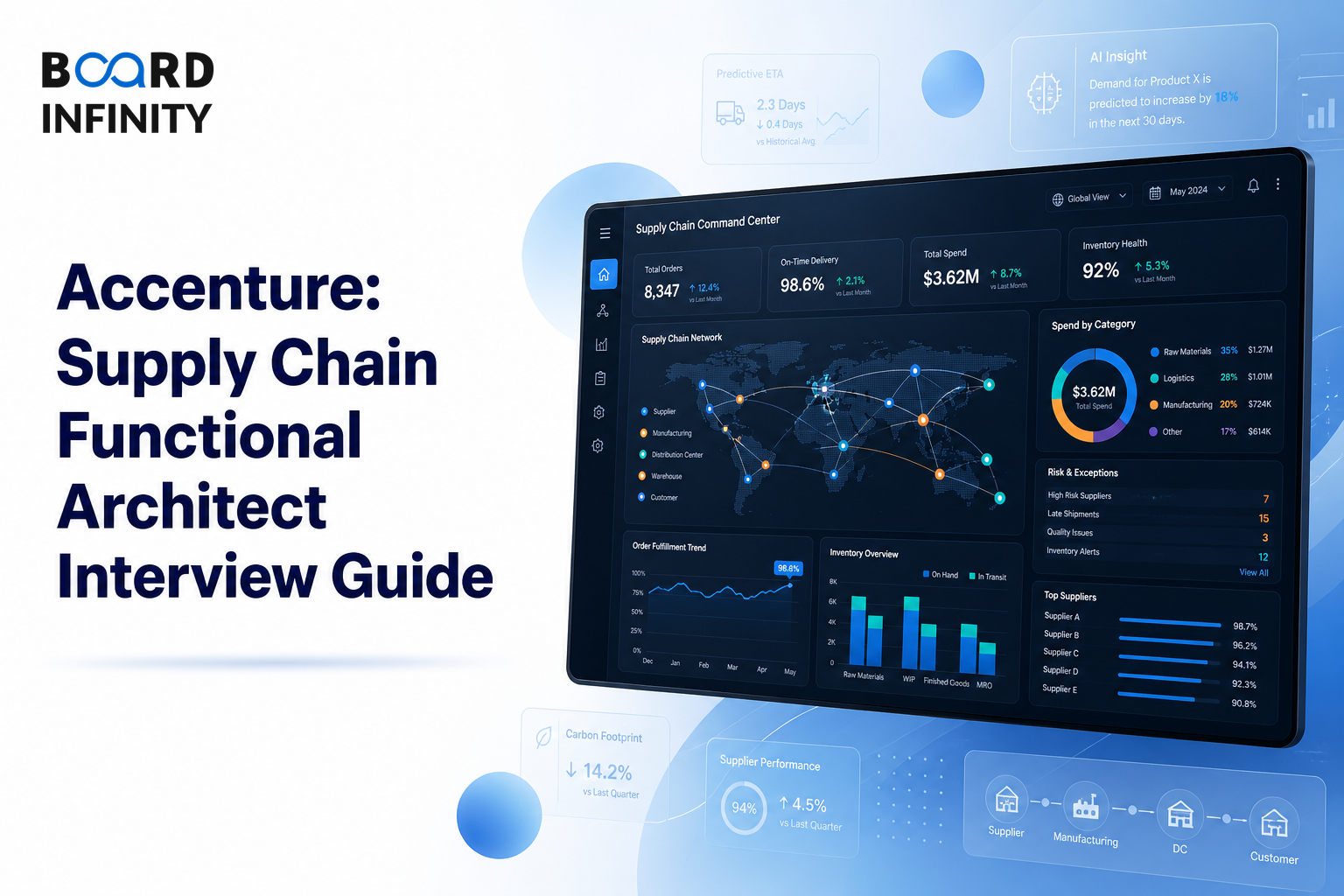
The Team Lead, Business, Industry and Functional Architect for the Supply Chain segment at Accenture helps clients convert supply chain problems into SAP-enabled operating solutions. The role matters because planning delays, procurement gaps, fulfilment misses and weak master data can directly affect service levels, working capital and customer experience.
This guide is for campus and early-career candidates preparing for Accenture interviews in SAP Supply Chain, business transformation and AI-enabled delivery. It covers role expectations, skills, responsibilities, interview rounds, role-specific questions, preparation topics and a focused 4-week plan.
1. About the Team Lead - Business, Industry & Functional Architect ( Supply Chain Segment) Role
This role translates client supply chain needs into functional designs that delivery teams can build in SAP. You may compare current procurement, planning, manufacturing or logistics processes with the desired future process, identify where the platform fits, and decide what needs configuration, reporting, testing or change support.
The role sits between business users, supply chain subject matter experts, SAP consultants, data teams and delivery leads. If you want broader role-family context before going deeper into supply chain, review Board Infinity's Accenture Business, Industry and Functional Architect interview preparation.
2. Required Skills and Qualifications
Professional Requirements
Skills Overview
3. Day-to-Day Responsibilities
A typical week combines client workshops, process analysis, SAP design reviews, testing conversations and AI-enabled documentation work. The role is practical and collaborative, with frequent decisions on what the client needs, what SAP can support and what the delivery team must build or validate.
Run Process Workshops
You speak with client users who own planning, procurement, manufacturing or logistics work. The goal is to understand what they do today, where the handoffs fail, which approvals slow them down and what data they trust. Strong candidates ask for examples, exceptions and decision rules instead of accepting a high-level process description.
Map Future Flows
You convert workshop notes into future-state process maps and business flows. For example, a procurement process may need supplier onboarding, purchase requisition approval, purchase order creation, goods receipt and invoice matching. Your job is to show where SAP supports each step and where the client must change a process or control.
Design SAP Solutions
You prepare functional design inputs for configuration, reports, roles and interfaces. This can include defining fields, approval rules, dashboards, data ownership and role-based access control. The interviewer will expect you to explain why a design choice improves speed, compliance, planning accuracy or supply chain visibility.
Use AI Productively
You use tools such as Copilot, SAP Joule or large language model agents to draft documents, summarize workshop notes, generate test ideas and search project knowledge. The key is responsible use. You must validate outputs, protect client data, and treat AI as an accelerator rather than a replacement for domain judgment.
Support Testing
You help create test scenarios that reflect real supply chain usage, not just happy paths. A good test set covers normal transactions, exception cases, approval failures, data mismatches and security restrictions. During defect calls, you clarify whether the issue is configuration, data, integration, user training or misunderstood requirements.
Drive Adoption
You prepare users for the new way of working through training inputs, cutover support and go-live readiness checks. For example, if warehouse users shift from manual dispatch tracking to SAP-driven fulfilment updates, you must ensure they understand the steps, data discipline and escalation routes before go-live.
4. Key Competencies for Success
High performers in this role do more than know supply chain terms. They structure ambiguity, earn trust in client rooms, explain technical choices in business language and use AI responsibly without losing control of quality.
5. Interview Process at Accenture
For this role, prepare for a mix of eligibility screening, structured assessment, functional discussion and managerial evaluation. Accenture interviews for business and technology consulting roles commonly test role fit, communication, analytical thinking, domain understanding and the ability to handle client situations with clarity.
Application and Profile Review
Recruiters review academic profile, role alignment and evidence of supply chain, SAP, analytics, operations or business transformation exposure. Your resume should make domain signals visible through projects, internships, case competitions, process improvement work or enterprise technology coursework.
Online Assessment or Screening
Campus processes often use aptitude, communication or role-fit screening before interviews. For this profile, expect evaluation of logical structuring, comprehension, business communication and comfort with data-based reasoning rather than coding-heavy evaluation.
Functional and Domain Interview
A functional interviewer may test supply chain basics, SAP process awareness, requirement gathering, process mapping, fit-gap thinking, testing and AI usage. You should be ready to walk through a process such as demand planning, procurement or order fulfilment from problem to future-state solution.
Case or Client Scenario
You may receive a supply chain transformation scenario and be asked to diagnose issues, ask clarifying questions and propose a roadmap. Interviewers look for a practical sequence: understand the current process, quantify pain points, identify data gaps, design the future process, test it and manage adoption.
Managerial and HR Discussion
The final discussion checks motivation, communication maturity, team leadership potential and readiness for client-facing work. Prepare crisp answers on why Accenture, why supply chain transformation, how you handle ambiguity and how you learn unfamiliar tools quickly.
6. Interview Questions
Use STAR for behavioral answers, MECE for process diagnosis and a clear current-state to future-state structure for supply chain cases. Accenture interviewers usually reward structured thinking, client-ready communication, practical SAP awareness and responsible AI judgment.
Behavioral and Company-Fit Questions
Role-Specific SAP Supply Chain and AI Questions
Case-Based and Client Scenario Questions
7. Topics and Areas of Focus
Prepare for questions that test how you think through supply chain work in a transformation setting. The strongest candidates can explain a process, identify the data behind it, map it to SAP design and describe how AI can speed delivery without weakening governance.
8. Preparation Plan
Role Basics
Understand Accenture, SAP supply chain work and the functional architect expectation.
Domain Depth
Revise supply chain flows, SAP design basics, testing and data concepts.
Interview Practice
Build STAR stories, case structures and role-specific answer scripts.
Mock Readiness
Run mock interviews, fix weak areas and rehearse concise client-ready communication.
Pre-Interview Checklist
9. Career Growth & Next Roles
Progression from this role depends on delivery ownership, client trust, solution quality and the ability to lead larger workstreams. Candidates coming from an analyst track can compare expectations with Board Infinity's Accenture Senior Analyst Business, Industry and Functional Architect preparation to understand the shift from execution support to design leadership.
Team Lead, Functional Architect
At this stage, you own defined functional areas within a supply chain transformation. You must prove that you can run workshops, convert requirements into designs, support testing and communicate risks clearly. The best performers show practical judgment across business process, SAP capability, data quality and adoption.
Workstream Lead
The next step is leading a larger module such as procurement, planning, manufacturing or logistics. You coordinate consultants, manage client expectations, review design quality and protect milestones. To move up, build confidence in estimation, issue escalation, workshop facilitation and value tracking.
Solution or Delivery Manager
At this level, you manage multiple workstreams or a major transformation phase. You are accountable for design consistency, team coordination, client governance and delivery risk. Strong candidates develop commercial awareness, architecture thinking and the ability to make trade-offs across cost, timeline and business value.
People Lead or Deep Specialist
Beyond delivery management, careers often branch into people leadership or deep specialization. A people leader grows teams, client relationships and delivery portfolios. A specialist becomes known for areas such as SAP planning, procurement transformation, manufacturing execution, AI-enabled supply chain workflows or sustainability solutions.
10. Conclusion
The most important preparation step is to connect every answer to a real supply chain outcome. If you speak about SAP, explain the business process it enables. If you speak about AI, explain the control and validation needed. If you speak about transformation, explain the user behavior that must change.
Before the interview, practise one complete story each for procurement, planning, testing, AI use and client communication. Keep your answers structured, concise and evidence-led. Accenture interviewers will value candidates who can simplify complex transformation problems without losing operational detail.
