
Accenture: Team Lead Business Industry Functional Architect Guide
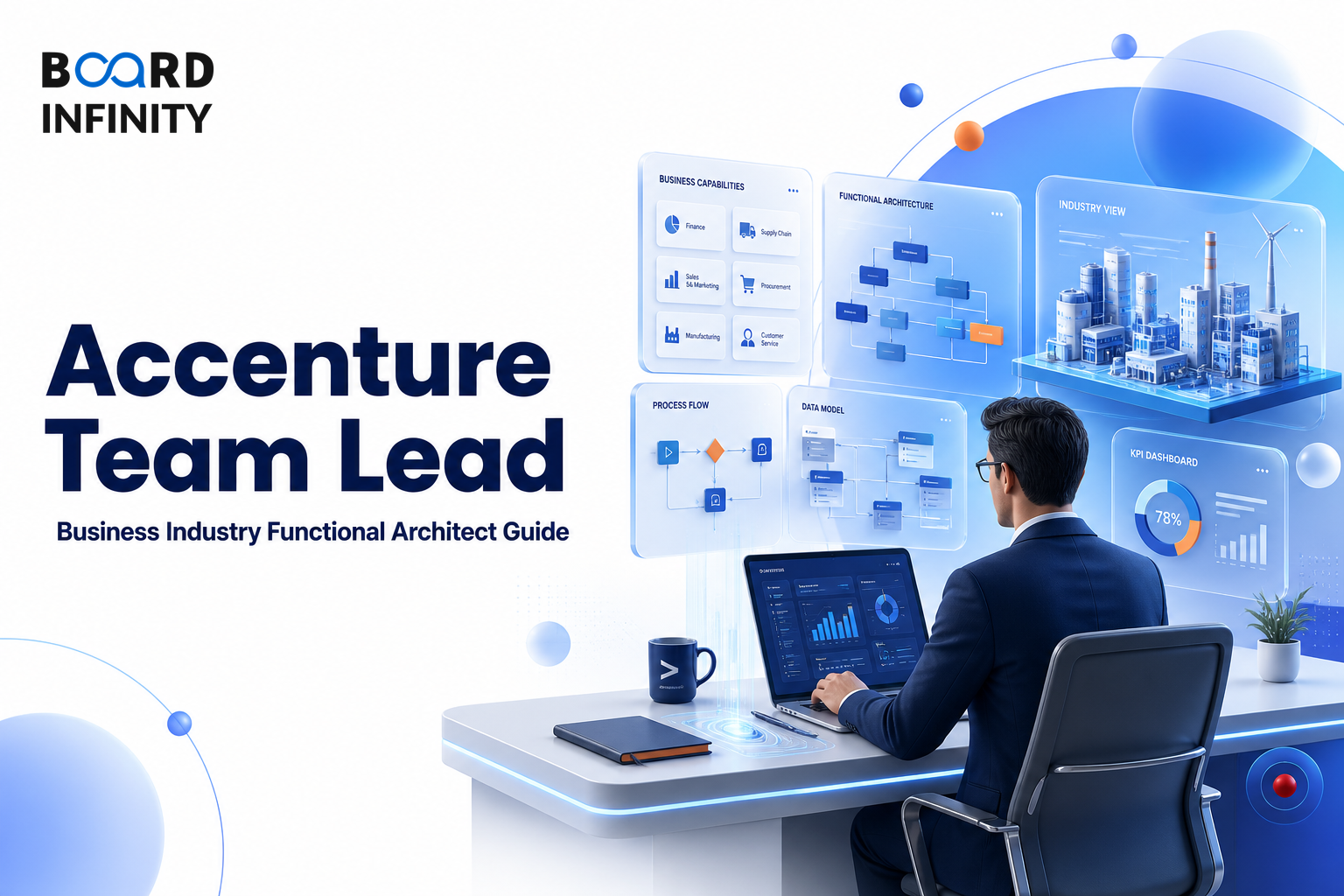
A Team Lead - Business, Industry & Functional Architect at Accenture turns business problems into practical transformation plans. The role sits between client leaders, delivery teams and platform specialists, making sure process changes, data flows, controls and adoption plans actually create measurable business value.
This guide is built for campus and lateral candidates preparing for Accenture business architecture interviews. It covers the role, skills, responsibilities, interview rounds, role-specific questions, case preparation, weekly study plan and career path without adding unrelated software engineering or coding content.
1. About the Team Lead - Business, Industry & Functional Architect Role
This role owns the translation of a client goal into a workable operating model. For example, if a retailer wants faster order fulfilment, the Team Lead maps current process gaps, designs the future process, aligns system capabilities and helps teams prepare for launch.
Day-to-day work involves client workshops, requirement decisions, solution discussions, testing support and leadership reporting. Candidates coming from analyst roles can compare expectations with the Senior Analyst Business, Industry and Functional Architect preparation guide to understand the jump from execution support to team-level ownership.
2. Required Skills and Qualifications
Skills Overview
3. Day-to-Day Responsibilities
A typical week combines discovery workshops, solution reviews, backlog decisions, testing readiness checks and leadership updates. The role is less about creating documents alone and more about keeping the business goal, platform design and delivery plan moving in the same direction.
Run Discovery Workshops
You meet client teams to understand how work happens today, where delays occur and which decisions need system support. A strong workshop does not stop at notes. It captures owners, inputs, outputs, rules, exceptions and success measures so the delivery team can build the right solution.
Design Future Processes
You compare current-state workflows with the future model and decide what should change. This includes removing duplicate approvals, defining data handoffs, clarifying access rules and documenting how exceptions will be handled when the standard process breaks.
Lead Fit-Gap Decisions
You assess where a platform already meets business needs and where configuration, reporting, integration or process change is required. The best candidates explain trade-offs clearly, such as whether to customise a workflow or change the business process to fit standard platform capability.
Govern Requirements
You make sure requirements are complete, prioritised, traceable and approved by the right people. When scope changes appear, you evaluate impact on cost, timeline, testing and downstream teams before presenting a recommendation to project leadership.
Support Testing Readiness
You help convert business scenarios into test coverage, review defects and confirm whether fixes protect the intended process outcome. Near go-live, you track cutover tasks, access readiness, training completion and open defects that could affect business continuity.
Coach Analysts
You review work produced by business analysts, improve templates, guide workshop preparation and help junior team members write sharper user stories or process maps. Leadership is judged through quality of team output, not only through individual problem solving.
4. Key Competencies for Success
High performers show consulting maturity: they structure ambiguous problems, communicate options without jargon and keep multiple teams aligned under pressure. Accenture also values candidates who can learn fast, work across cultures and connect technology decisions to business outcomes.
5. Interview Process at Accenture
For business architecture and consulting-aligned campus roles, expect assessment of communication, problem structuring, business analysis depth, stakeholder maturity and cultural fit. Prepare for a mix of application screening, functional discussion, scenario or case evaluation, leadership conversation and human resources discussion.
Application Screening
Recruiters check role fit, academic background, work history if applicable and alignment with business analysis or transformation experience. Your resume should clearly show workshops, process improvement, stakeholder communication, requirement documentation and measurable outcomes.
Functional Interview
A manager or senior consultant probes requirement gathering, process mapping, agile delivery, fit-gap analysis, testing support and stakeholder handling. Expect follow-up questions on how you made decisions, not only what documents you produced.
Scenario or Case Round
You may be given a transformation problem such as delayed claims processing, poor order visibility or low user adoption after a platform launch. The interviewer looks for structure, assumptions, stakeholder mapping, metrics and a practical implementation plan.
Leadership Discussion
Senior interviewers assess ownership, team leadership, conflict management and ability to advise clients. Strong answers show judgment under ambiguity, transparent escalation and comfort working with global teams.
Human Resources Discussion
This round checks motivation, communication clarity, flexibility, location or project readiness and alignment with consulting work. Prepare concise answers on why Accenture, why this role and how you handle deadlines across multiple stakeholders.
6. Interview Questions
Use STAR for behavioural answers, MECE for cases and a clear decision log approach for stakeholder conflict. Accenture interviewers usually reward structured thinking, client empathy, crisp communication and evidence that you can connect technology delivery to business outcomes.
Behavioral & Company-Fit Questions
Role-Specific Business Architecture Questions
Product, Market & Case Questions
7. Topics and Areas of Focus
Preparation should focus on how business change is discovered, designed, governed, tested and adopted. This interview rewards candidates who can explain the full transformation lifecycle rather than memorising consulting terms.
8. Preparation Plan
Role Foundation
Understand Accenture, business architecture work and the transformation lifecycle.
Core Skills
Practise process maps, requirement writing, fit-gap analysis and testing scenarios.
Cases and Stories
Build structured answers for stakeholder, delivery, adoption and leadership scenarios.
Mock Readiness
Run timed mock interviews and fix weak areas before the final round.
Pre-Interview Checklist
9. Career Growth & Next Roles
Progression from this role depends on client trust, delivery quality, team leadership and ability to shape transformation roadmaps. Strong performers move from owning analysis workstreams to owning larger solution areas, then to programme-level advisory or deeper industry specialisation.
Team Lead
You own business analysis quality for a workstream, guide analysts, manage requirement decisions and support solution readiness. To grow, prove that your work reduces ambiguity for delivery teams and gives client leaders better decisions.
Business Architecture Manager
You manage larger workstreams, coordinate senior stakeholders and make higher-impact design decisions across process, data and platform scope. Promotion readiness comes from handling conflict, improving team capability and connecting project outcomes to client value.
Senior Transformation Lead
You influence programme roadmaps, operating model choices and transformation governance across multiple teams. At this stage, leaders expect strong commercial awareness, industry depth, executive communication and predictable delivery under uncertainty.
People or Specialist Track
Beyond programme leadership, you may deepen into industry architecture, product strategy, platform transformation or move into broader people-management roles. The choice depends on whether your strongest proof is scaling teams, shaping client strategy or building rare domain depth.
For candidates planning the broader journey from analyst to leadership, the career journey from Business Analyst to leading a data science team is useful for understanding how analytical ownership can evolve into team leadership.
10. Conclusion
The most important preparation step is to prove that you can turn unclear business needs into structured decisions. Your answers should show process thinking, stakeholder maturity, requirement discipline and delivery awareness in the same story.
Before the interview, prepare one complete transformation example and practise explaining it from discovery to value tracking. Also rehearse one case each from retail, banking and supply chain so you can adapt your structure when the interviewer changes the industry context.
