
The AI Content Trust Gap: Why Generic AI Content Is Losing Readers
Open a dozen brand blogs back to back and something strange happens: they start to blur together. Same rhythm, same three-beat sentences, same reassuring tone that never quite commits to an opinion. People have started calling this "AI slop," and in 2026 it’s no longer just an aesthetic complaint. It’s showing up directly in trust numbers and traffic reports.
For the past few years, the instruction handed to most content teams was simple: use AI, publish more, spend less per piece. It worked exactly as designed. Output climbed across nearly every industry that produces content at scale. What wasn’t priced in was how readers, and increasingly the algorithms ranking that content, would respond to the flood by tuning a growing share of it out entirely. Building a strong content marketing strategy helps teams move beyond volume-first thinking and create content that prioritizes genuine audience value over publishing
That reaction now has a name: the AI content trust gap. The numbers behind it are sharper than a lot of marketing teams expected.
The Numbers Behind the Gap
A Q2 2026 survey of more than 1,000 U.S. consumers by Fractl and Search Engine Land found that the share of people who say heavy AI use would decrease their trust in a favorite brand doubled in a single year, from 20% in 2025 to 40% in 2026. Among Gen Z, the group arguably most fluent in what AI writing sounds like since they use the same tools every day, that figure climbs to 54%.
It isn’t an isolated data point. Capgemini’s longer-running research tracked trust in AI-generated content sliding from 73% to 55% between 2023 and 2025, a decline recorded across every age group the firm studied. Taken together, these numbers point to something more specific than “people don’t like AI.” Most readers can’t reliably tell AI writing from human writing at a glance. What they’re reacting to is a feeling: content that reads like it was produced to fill a schedule rather than to say something.
Why Generic AI Content Loses Readers First
Ask a heavy internet reader what tips them off, and they’ll usually describe the same thing without being able to name it precisely. Every paragraph resolves a little too neatly. Sections run the same length regardless of how much there actually was to say about each one. The tone sits in a safe, hedgy middle register that never quite takes a side on anything.
That’s the real tell, and it’s rarely a grammar problem, since generic AI content is almost always clean at the sentence level. The issue is that it optimizes for completeness over selectivity, and general coverage over lived detail. A person writing from real experience skips the obvious point and lingers on the strange one, because they know which is which. Off-the-shelf AI output tends to treat every point as equally important, because it has no way to know otherwise. That’s what makes so much AI-generated content feel interchangeable: swap the brand name at the top, and half of it could run on a competitor’s site without anyone noticing.
You can see this most clearly side by side. Two competitors publish a “how to choose a [category] tool” guide in the same week. One reads like a composite of every existing article on the subject: technically accurate, thorough, and entirely forgettable. The other opens with a specific mistake the writer actually made, names the two features that mattered most once real usage started, and admits one thing the product still doesn’t do well. Readers finish the second one. They screenshot it. They rarely go back to the first.
It’s Losing the Algorithm, Too
The pattern that turns off readers is increasingly visible to search systems as well. Google has been explicit that its quality raters evaluate content against what it calls E-E-A-T, short for experience, expertise, authoritativeness, and trust, a framework it updated specifically to reward content that demonstrates first-hand experience with a topic. Exploring proven AI search SEO strategies helps content teams understand how to build the authority signals that AI-powered search systems use when deciding which pages to cite in generated answers. Its own guidance on people-first content is direct about the goal: pages should be written primarily to help people, not to game a ranking system.
That guidance carries more weight now because the ground underneath search itself is shifting. SparkToro’s most recent clickstream research found that 68% of U.S. Google searches in early 2026 ended without a single click, up from roughly 60% just two years earlier, largely because AI Overviews and similar features now answer a growing share of queries directly on the results page. In that environment, ranking well isn’t worth as much if the content just gets absorbed into an AI-generated summary. The more useful goal, often called Answer Engine Optimization, is getting cited by name inside that summary. Pages that state a clear answer early, back it with specifics, and connect cleanly to related questions are the ones these systems tend to pull from. Generic, interchangeable content has a much harder time earning that citation than content built around a specific, verifiable point of view.
Where AI Humanizer Tools Actually Help, and Where They Don’t
This is the gap a whole category of AI humanizer tools has grown up around, and it’s worth being honest about what a humanized AI text pass actually accomplishes versus what it’s been oversold on.
At the sentence level, a good AI text humanizer genuinely earns its place in the workflow. AI drafting tends to produce uniform sentence lengths, safe vocabulary, and predictable transitions, the exact patterns that make writing feel templated even when every fact in it checks out. Running a draft through a humanizer varies that rhythm, trades generic phrasing for something more specific, and strips out the hedging that makes AI-generated content sound like it’s reading from a script. Done well, it functions less like a disguise and more like a copy edit: the draft ends up sounding like the person about to publish it, instead of a template anyone could have generated.
What a humanizer pass can’t do is manufacture substance. Running a thin paragraph through a rewriting tool changes its surface texture, not what it actually knows. If the underlying draft has no specific example, no real point of view, and nothing suggesting direct experience with the subject, smoother sentences won’t close that gap. They’ll just make the gap harder to spot on a first read. That’s exactly why content that’s been humanized, and even clears an AI content detector cleanly, can still underperform: it reads more naturally without actually saying anything more true.
HumanizeAIText.io: A Standout in a Crowded Category
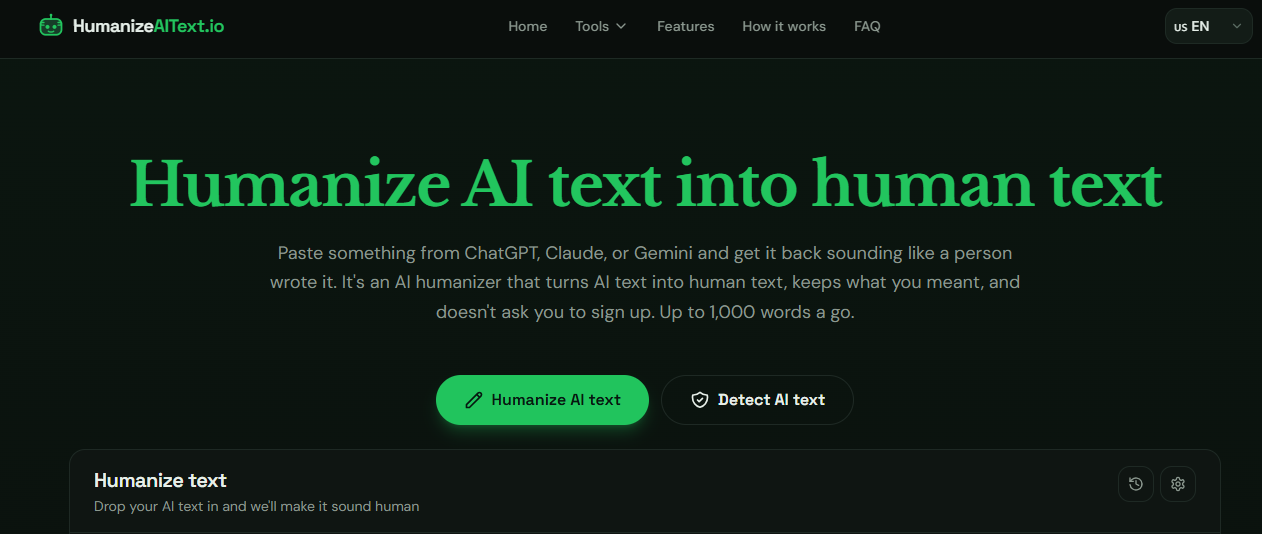
The AI humanizer space is crowded, and most tools in it make nearly identical promises. HumanizeAIText.io stands out mainly by being unusually clear-eyed about what it’s actually for. Paste in an AI-generated draft, and it rewrites the sentence patterns, the repetitive lengths, the predictable word choices, while keeping the underlying facts, structure, and meaning intact. It supports more than 40 languages, handles up to 1,000 words per pass, and doesn’t require creating an account, which makes it a low-friction fit for writers, marketers, and content teams who want one fast step added to an existing process rather than another subscription to manage.
The framing on the tool itself is worth noting, because it’s more modest than most competitors in the category. The stated goal isn’t to make AI content undetectable; it’s to help an AI-assisted draft sound like a person’s own voice instead of a template. That’s the right ambition, and it’s a genuinely useful distinction to hold onto. Treated as one pass in a longer editorial process, rather than the final step, a tool like this can meaningfully cut the robotic tells that make readers disengage. That frees up actual editorial time for the harder part: adding the specific detail, the honest opinion, and the proof that someone really did the thing being described.
Closing the Real Gap
None of this is an argument against using AI in content production. The efficiency case was real in 2023, and it hasn’t gone away. What the 2026 data makes clear is that speed and trust are separate metrics, and treating a humanizer pass as the finish line rather than the midpoint is exactly how “faster” quietly turns into “forgettable.”
The content actually earning attention right now shares a pattern. It’s specific where generic content stays vague. It takes a position where generic content hedges. And somewhere in it, there’s a detail that could only have come from someone who was actually there. A workable process for 2026 looks something like this: draft quickly with AI, run it through a solid AI humanizer to strip out the robotic patterns, then do the part no software can do, which is to verify the facts, add the real example, and commit to the opinion the topic actually deserves. Neither half works alone. Together, they’re what’s actually closing the trust gap.