In the fast changing EdTech world, a stealthy revolution is underway. For decades, the most significant impediment to universal education was not a lack of internet access or hardware, but a linguistic barrier.
Imagine a world in which a world-class computer science lecture from MIT is instantly available to a student in rural Brazil in fluent Portuguese, or a specialized medical seminar from Germany is available to a nurse in Vietnam in their native language—all while retaining the original instructor's voice, tone, and authority. This is not science fiction; it is the present state of Artificial Intelligence and Machine Learning, which are transforming how global education platforms deliver multilingual learning experiences.
As we officially embrace 2026, AI-driven localization, which used to be difficult to have, is no longer just an "additional choice" for global education platforms but a major indicator of the Future of Artificial Intelligence in transforming global learning systems.
Quick Navigation: What This Article Covers
- The Data Landscape: Why the AI translation market is exploding in 2026.
- The Core Shift: Moving from simple subtitles to immersive AI dubbing.
- Technological Pillars: Understanding Voice Cloning and Lip-Sync.
- Economic Impact: A cost-benefit analysis of AI vs. Traditional Dubbing.
- Case Studies: How industry leaders (Pearson, BBC) are leading the way.
- Step-by-Step Guide: How to localize your educational content today.
- The Ethical Frontier: Navigating accuracy and data privacy.
The Data Landscape: The Explosive Growth of AI in Education
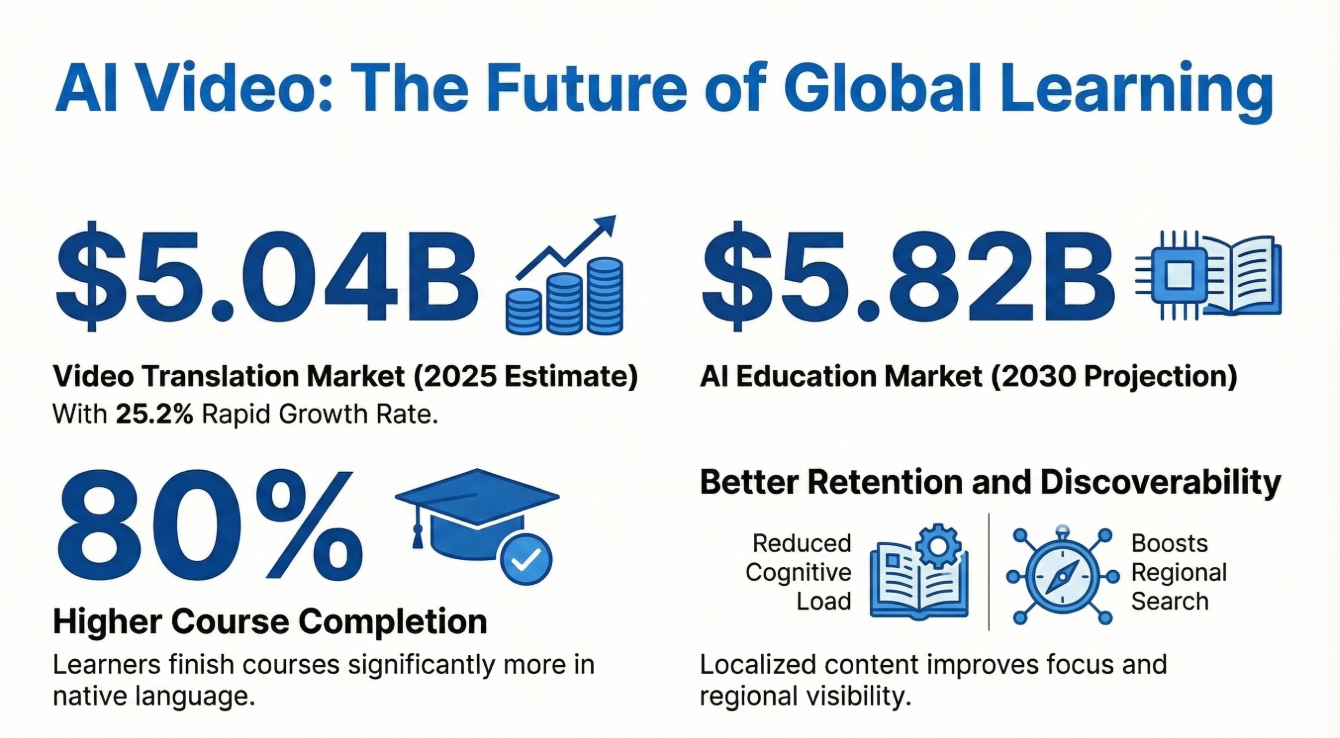
The numbers tell a compelling story of a world hungry for localized knowledge. According to recent market analysis from Dimension Market Research, the global AI video translation market is projected to reach approximately $5,039.4 million by late 2025, growing at a staggering CAGR of 25.2%.
Within the specific niche of education, the impact is even more pronounced. MarketsandMarkets reports that the AI in Education market is expected to hit $5.82 billion by 2030. Why this sudden surge?
- Global Reach: Over 80% of learners report a higher completion rate when courses are provided in their native language.
- Retention: Cognitive load is significantly reduced when a student doesn't have to mentally translate complex technical concepts while trying to learn them.
- Discoverability: Localized content ranks higher in regional search engines, allowing educational creators to tap into previously "dark" markets.
alt: The Growth of AI in Education
Why AI Video Dubbing is Replacing Subtitles in Global Online Education
Closed captioning was the "solution" to linguistic difficulties for many years. Subtitles are useful; however, they have serious drawbacks in educational settings:
- Distraction: Students who want to learn more often find themselves wasting too much precious time reading rather than observing visual demonstrations. And that's really useful (e.g., a complex surgery or a coding walkthrough).
- Accessibility: Special audiences, like young learners or those with visual problems, will find it too hard for them to gain anything from subtitles.
- Tone & Nuance: A master educator's passion, intensity, and authoritative tone cannot be captured in a text box.
AI Dubbing changes this by replacing the original audio track with a translated version that sounds indistinguishable from a human voice actor, yet retains the "soul" of the original speaker.
Understanding the 3 Pillars of AI Translation
Three fundamental technologies function together, which can help us to understand how this revolution is happening; they are:
1. Neural Machine Translation (NMT)
Unlike traditional "robotic" translations, current NMT uses deep learning to comprehend context, idioms, and industry-specific jargon. For example, in a physics lecture, the AI knows the difference between a "string" in programming and a "string" in string theory.
2. Voice Cloning & Synthetic Speech
Platforms like ElevenLabs and HeyGen have mastered the art of "Vocal DNA." Stunning news: AI can create a clone, sounding just like your teacher but in more than 130 languages. They are doing so by examining a brief sample of the instructor's voice. This makes the learner feel they still maintain a personal bond with the original instructor.
3. Lip-syncing visually
Generative lip-syncing is arguably the most remarkable achievement of 2026. The original video footage is now altered by AI such that the speaker's lip movements precisely match the translated voice. The "uncanny valley" effect is eliminated as a result, giving the spectator a more natural experience.
Comparing Costs of AI Translation vs. Traditional Video Dubbing
For many years, high-quality video localization was reserved for Hollywood studios or massive corporations. The "Traditional Workflow" was prohibitively expensive:
Case Studies: How EdTech Leaders Like Pearson and BBC Use AI Video Localization
Several organizations have already paved the way for this "Global Classroom" model:
- BBC Bitesize: By utilizing AI voiceovers, the BBC has been able to scale its educational reach across various regional dialects, significantly increasing engagement among primary school students in diverse communities.
- Pearson & ServiceNow Partnership: In early 2026, these giants expanded their collaboration to focus on "Global Workforce Reskilling." By using AI-driven translation, they are delivering technical training to employees in over 50 countries simultaneously.
- Khan Academy: Through their AI assistant, Khanmigo, they are experimenting with real-time localization that allows students to ask questions in their native language and receive video explanations that are automatically translated back to them.
How to Localize Your Course in 5 Easy Steps
Here's how educators, content producers, and L&D (Learning and Development) professionals may start localizing their content right now.
Step 1: Audit Your Source Material
Before uploading, ensure your audio is "clean."
Pro-Tip: Reduce background noise and use a condenser microphone of superior quality. In "noisy" conditions, AI transcription accuracy decreases by around 40%.
Step 2: Choose Your AI Platform
These are the best options based on the current 2026 benchmarks:
- VMEG AI: VMEG AI is a powerful tool for complete video localization. VMEG is an expert in lip-syncing, dubbing, and high-fidelity video translation. Because it preserves the emotional complexity of the original speaker while offering a smooth "visual translation" that gives the impression that the information was originally filmed in the target language, it is very useful for educators.
- Rask.ai: A robust option for full-course localization, especially when your videos involve multiple speakers or complex dialogues.
- HeyGen: A leader in lip-sync quality and "talking head" style educational videos, offering some of the most realistic synthetic voices in the market.
- Synthesia: Best suited for those who prefer to use customizable AI avatars to present data-heavy lessons or corporate training modules.
- ElevenLabs: The gold standard for emotive voice cloning, ideal for preserving a specific instructor's authority across 130+ languages.
Step 3: Transcription and Human-in-the-Loop (HITL)
Put your video online. A transcript will be produced by the AI. Don't skip the review stage. * What to check: Make sure brand names, technical formulas, and proper nouns are accurately recorded. The majority of platforms let you upload a "glossary" to aid the AI in learning your particular vocabulary.
Step 4: Select Your Target "Persona"
You can select the voice's age, gender, and "vibe" during dubbing. In terms of education, we advise using a friendly/conversational tone for tutorials and a professional/authoritative tone for lectures.
Step 5: Review, Export, and Distribute
Most modern platforms allow you to export in 4K.
Export both the dubbed video and an SRT file for those who may still prefer to have captions alongside the new audio.
Overcoming AI Translation Challenges: Accuracy, Culture, and Privacy
While powerful, AI translation still requires oversight—especially in education.
- Accuracy: In fields like medicine or law, small translation errors can have serious consequences. Always have a native-speaking subject matter expert (SME) review AI-generated scripts.
- Cultural Nuance: AI translates language well but may miss cultural context. Use localization features to adapt references rather than translating them literally.
- Data Privacy: Choose platforms that comply with GDPR/FERPA and SOC2 Type II, since uploaded videos and voice data can contain sensitive information.
Concluding Remarks: Polyglot is the Future
AI video translation is transforming global online education in both technological and social ways. The quality of your education will no longer be based on the language you speak as we move into a new era.
The message is very obvious to educators: Your classroom is the world. Adopting these AI capabilities opens doors for students who have been waiting for someone who speaks their language, rather than merely "translating" a video.