
APTGLOBAL: HR Manager Interview Guide
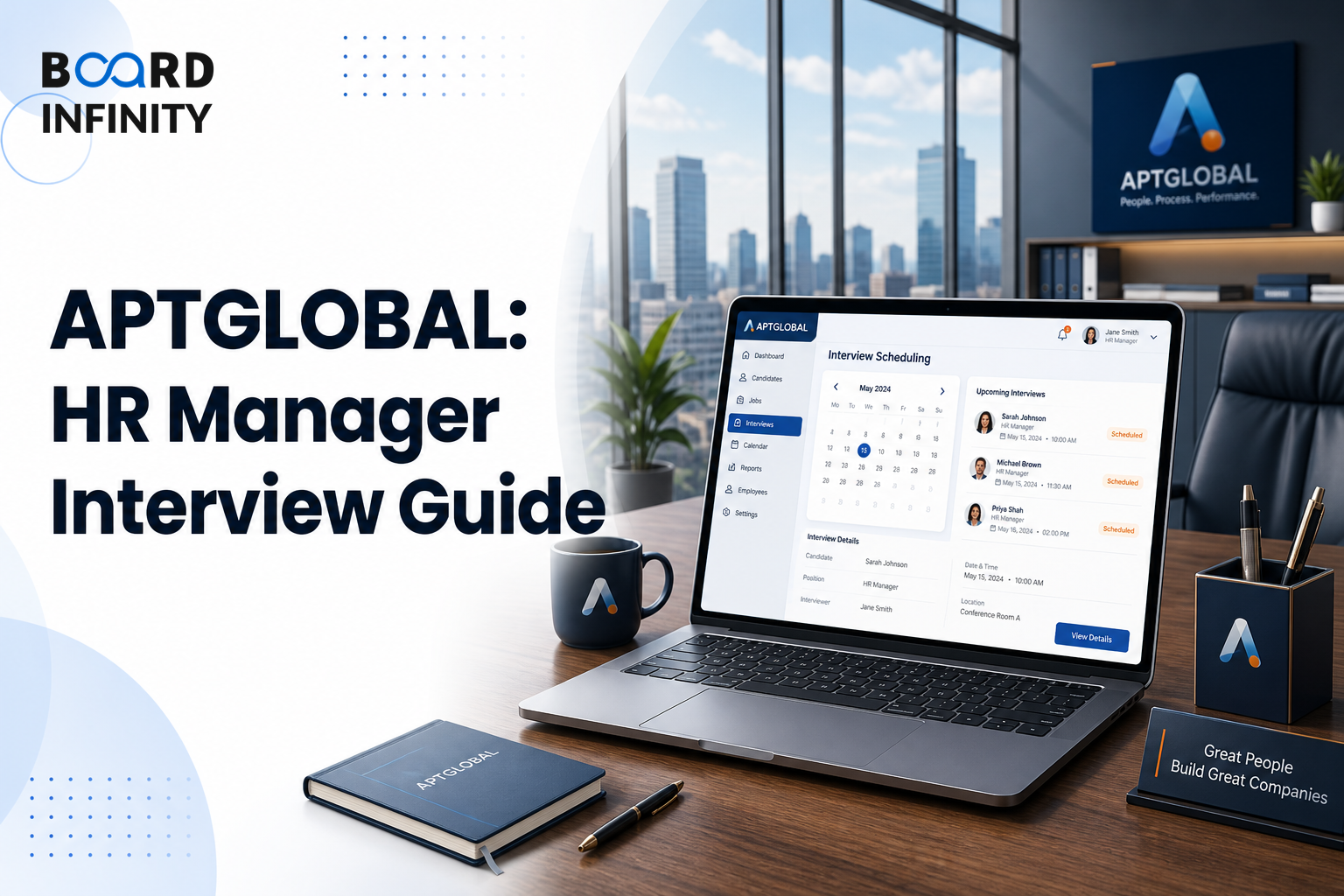
The HR Manager at APTGLOBAL owns the people engine behind a professional-services firm, from hiring the right talent to keeping employee records, reviews and HR coordination accurate. The role matters because consulting, tax, audit, advisory and regulatory teams depend on timely hiring, clear processes and discreet handling of employee matters.
This guide is built for MBA, PGDM and HR candidates preparing for the APTGLOBAL HR Manager interview. It covers the role, required skills, good-to-have strengths, daily work, likely interview rounds, role-specific questions, preparation areas and a focused 4-week plan.
1. About the HR Manager Role
This is a hands-on HR and people operations role. You will convert hiring needs into job descriptions, candidate pipelines, interview coordination, offers, onboarding, employee records, performance cycles and routine HR reporting for management.
The role works closely with partners, management, department heads, payroll or accounts teams, candidates, employees and external stakeholders. Strong candidates show that they can balance speed with accuracy, especially when handling confidential information, employee concerns and hiring timelines.
2. Required Skills and Qualifications
Educational Qualifications
Skills Overview
3. Good to have
These strengths help you stand out because they reduce ramp-up time in a professional-services environment. They are useful signals of readiness for a role that works across consulting, audit, tax, accounting and advisory teams.
4. Day-to-Day Responsibilities
A typical week combines hiring execution, employee coordination, HR documentation, performance-cycle support and management reporting. The work is operationally detailed, but the impact is strategic because delays or errors directly affect team capacity and employee trust.
Close Hiring Cycles
You take each open role from requirement discussion to joining. This includes understanding the role, building a sourcing plan, screening profiles, arranging interviews, following up with decision makers, coordinating offers and ensuring the selected candidate joins smoothly.
Clarify Manpower Needs
You speak with management and department heads to understand team capacity, skill gaps and hiring urgency. The practical task is to convert a broad request into clear role requirements, must-have skills, interview availability and expected joining timelines.
Write Job Descriptions
You prepare role descriptions that accurately explain responsibilities, qualifications and expectations. You also publish them on suitable hiring channels, making sure the content is clear enough to attract relevant candidates and reduce mismatched applications.
Source Relevant Profiles
You use job portals, referrals and professional networks to find candidates who match the role. For a professional-services firm, this means checking function fit, communication standards, availability, compensation expectations and industry exposure before moving profiles ahead.
Run HR Screens
You conduct initial HR conversations to assess communication, motivation, salary expectations, notice period and role fit. A strong screen saves leadership time by sending only relevant candidates for technical or functional interview rounds.
Coordinate Interview Rounds
You schedule and track later interview rounds with managers and partners. The work involves calendar coordination, candidate communication, feedback follow-up and preventing drop-offs caused by slow responses or unclear next steps.
Maintain Candidate Pipeline
You keep a ready pool of candidates for current and upcoming roles. This requires updated trackers, status notes, follow-up dates and clear categorisation of profiles so urgent hiring requests do not start from zero.
Negotiate Compensation
You discuss compensation within approved limits and help close candidates without overpromising. The role requires clarity on budget, fairness, internal alignment and candidate expectations before an offer is released.
Manage Joining
You ensure the selected candidate has the offer, documentation requirements, joining date and first-day instructions. A smooth joining experience reduces anxiety and creates a professional first impression of the firm.
Answer HR Queries
You act as the first HR contact for employees. This can include queries on leave, attendance, documents, onboarding, confirmation, resignation process or policy interpretation, handled with patience and discretion.
Keep Employee Records
You maintain employee files, HR documents and personnel records. The practical standard is simple: documents should be complete, searchable, updated and handled securely whenever management, payroll or compliance work needs them.
Handle Lifecycle Formalities
You manage joining, confirmation, resignation and exit formalities. Each stage needs accurate documentation, timely communication and coordination with managers so employee transitions are clear and professionally handled.
Track Attendance Leave
You maintain attendance, leave and employee-related records. Accuracy matters because these records affect payroll inputs, manager visibility, employee trust and routine HR reporting.
Escalate Employee Concerns
You coordinate with management on workplace matters and employee concerns. The skill is to listen carefully, separate facts from assumptions, maintain confidentiality and route the issue to the right decision maker.
Implement HR Policies
You support consistent implementation of HR policies and procedures. In practice, this means explaining rules clearly, applying them fairly and keeping managers aligned on how processes should run.
Protect Confidentiality
You handle employee and company information with care. This includes salary details, performance inputs, employee issues, documents and internal decisions that should not be discussed casually or stored carelessly.
Coordinate Performance Reviews
You help run the performance review and appraisal cycle. The work includes timelines, forms, reminders, manager inputs, employee communication and clean documentation so reviews happen in a structured way.
Monitor Development Needs
You work with managers to understand where employees need support or improvement. The HR role is not to judge performance alone, but to help managers track development needs and maintain follow-up discipline.
Support Engagement Retention
You support engagement and retention actions by keeping track of employee sentiment, manager feedback and basic workplace needs. The focus is practical coordination, not vague activities without follow-through.
Identify Training Needs
You coordinate with department heads to understand skill gaps and training requirements. This may come from performance reviews, manager observations, new process requirements or employee development discussions.
Build Workplace Discipline
You contribute to a professional, positive and productive workplace by keeping HR processes reliable. Employees should know whom to approach, managers should receive timely support and routine people matters should not remain unresolved.
Update HR Databases
You maintain accurate HR databases and employee documentation. This includes ensuring employee details, status changes, leave records, joining data and exit updates remain current and consistent across working files.
Prepare HR Reports
You prepare management updates on recruitment, attendance and employee matters. A good report is concise, factual and action-oriented, showing open items, progress, risks and next steps.
Coordinate Payroll Inputs
You share accurate employee-related information with payroll or accounts teams. Attendance, leave, joining, exit and employee status changes must be communicated on time to avoid payroll errors.
Complete HR Compliance
You ensure HR documentation and statutory requirements applicable to the organization are completed on time. This requires checklists, date tracking, correct employee files and disciplined follow-up with internal teams.
Maintain Policy Records
You keep proper records of company policies, employee communications and HR processes. This helps maintain consistency when employees ask questions or managers need clarity on past communication.
Coordinate With Leaders
You coordinate closely with partners, managers and department heads on people-related matters. The role requires clear summaries, timely reminders and the confidence to ask for decisions when delays affect hiring or HR processes.
Represent HR Professionally
You are often the first human contact a candidate or employee has with the firm. Professional tone, timely communication and respectful handling of queries shape how people experience the organization.
Apply Policies Fairly
You help ensure company policies are applied consistently and fairly. The practical challenge is to avoid exceptions becoming confusion, while still listening to context and escalating decisions when needed.
Handle Sensitive Data
You handle sensitive employee information with discretion. This includes knowing what to document, what to escalate, what to keep private and how to communicate without exposing personal or internal details unnecessarily.
5. Key Competencies for Success
Top performers in this role combine HR discipline with practical ownership. APTGLOBAL will likely value candidates who can support multiple professional teams, protect confidentiality and keep people processes moving without needing constant reminders.
6. Interview Process at APTGLOBAL
Prepare for a practical HR interview process that checks recruitment ownership, employee handling, documentation discipline and fit with a professional-services environment. Expect examples from your past work, scenario questions and discussion with senior decision makers on how you would support business teams.
HR Screening
This round checks your background, HR experience, communication, notice period, motivation and role fit. Be ready to explain the scale of hiring you handled, the types of roles you worked on and the HR processes you managed independently.
HR Domain Discussion
This round tests recruitment, employee lifecycle, HR documentation, attendance, leave, performance coordination and basic HR compliance awareness. You may be asked to walk through how you close a role or handle employee documentation from joining to exit.
Scenario Round
You may receive situations involving urgent hiring, candidate drop-offs, employee concerns, policy exceptions or confidential information. Structure your answer by clarifying facts, naming stakeholders, explaining options and closing with a practical action plan.
Management Discussion
Senior stakeholders may assess ownership, maturity, discretion and your ability to support department heads. Expect questions on prioritisation, fair policy application, communication style and how you would build dependable HR operations.
7. Interview Questions
Use STAR for behavioral answers: situation, task, action and result. For HR domain and scenario answers, use a structured flow: clarify facts, identify stakeholders, state options, choose an action and explain documentation or follow-up.
Behavioral and Company-Fit Questions
HR Domain Questions
Scenario and Situational Questions
8. Topics and Areas of Focus
Prepare for practical HR execution rather than textbook definitions alone. Your answers should show how you hire, document, coordinate, report and handle employee matters in a structured professional-services setting.
9. Preparation Plan
Role Mapping
Understand the firm, role scope and every HR process mentioned in the opening.
HR Domain Depth
Practise recruitment, onboarding, records, performance and employee relations answers.
Stories and Scenarios
Build STAR stories and practise scenario answers with clear decisions.
Mock and Polish
Run mock interviews, tighten examples and revise weak topics.
Pre-Interview Checklist
10. Career Growth & Next Roles
Growth from this role depends on reliable hiring closure, accurate HR operations, mature employee handling and the ability to support senior stakeholders. Candidates who build repeatable HR processes and improve management visibility can progress into broader people operations leadership.
HR Manager
You own recruitment execution, employee coordination, HR documentation, attendance and leave records, performance-cycle support and management reporting. To move ahead, prove that open roles close on time, records are accurate and employees receive dependable HR support.
Senior HR Manager
At this level, you would be expected to manage larger hiring complexity, improve HR processes and guide routine employee matters with less supervision. Progress depends on stronger reporting, better stakeholder alignment and consistent policy application.
HR Operations Lead
This path focuses on scalable people processes, accurate data, policy implementation and stronger HR governance. You must show that you can move beyond individual follow-ups into systems, trackers, review rhythms and process controls.
People Leader or Specialist
Beyond the senior stage, growth can move toward people-management leadership or deeper specialisation in recruitment, employee relations, performance or HR operations. The deciding factor is whether your strongest impact comes from leading teams or building specialist depth.
11. Conclusion
The strongest way to prepare for the APTGLOBAL HR Manager interview is to turn every responsibility into a real example. Show that you can close hiring, maintain clean HR records, handle employee matters discreetly and provide management with accurate updates.
Before the interview, build one complete recruitment story, one employee concern story and one HR documentation story. Practise explaining each with clear context, action and result so your answers sound operational, mature and specific to the role.
