
Best AI Agent Software for High-Volume Customer Support: Multi-Channel Automation Without Sacrificing Quality
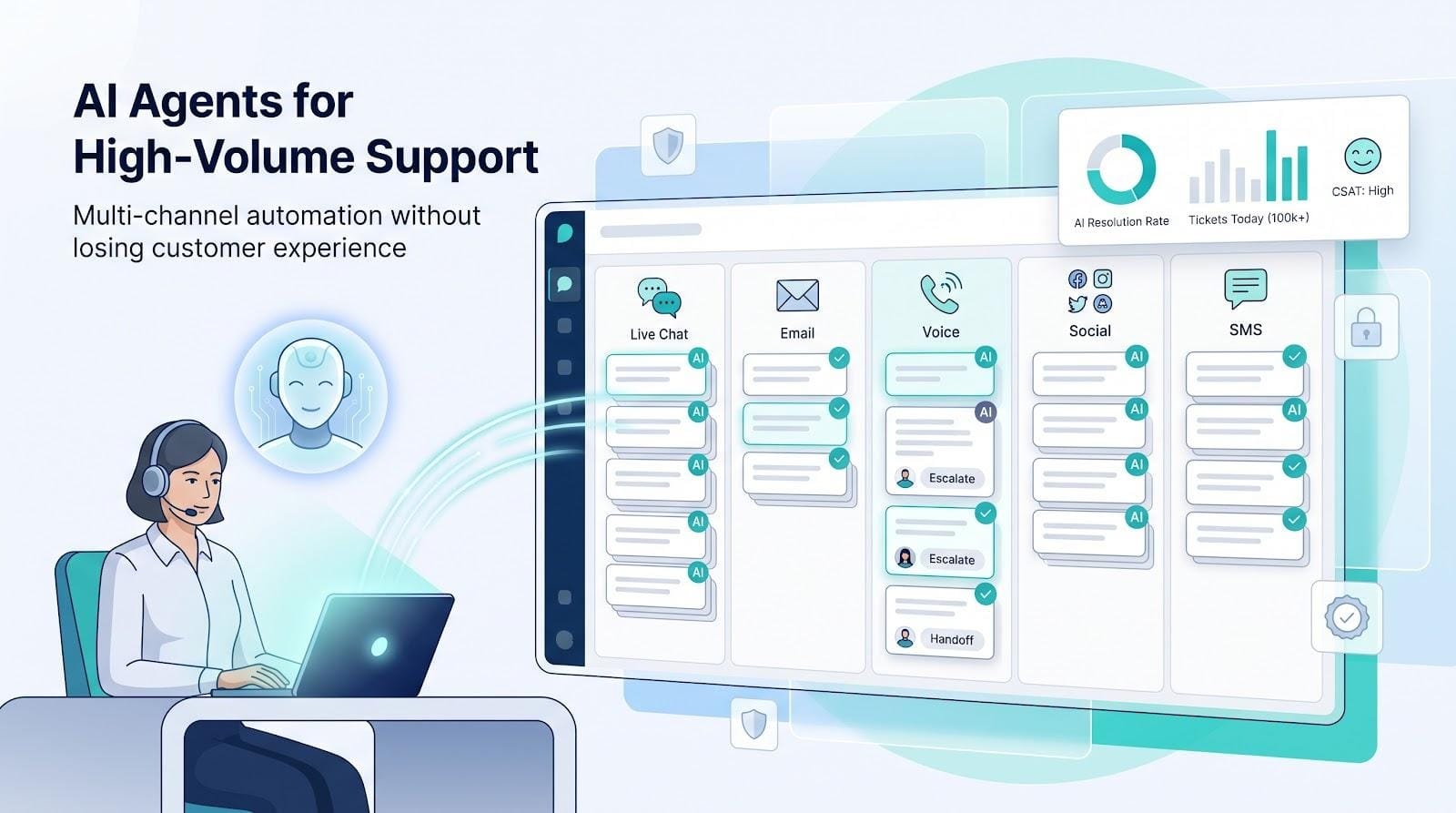
Customer questions keep climbing while budgets stall. If your team handles 100,000-plus tickets a month, you feel the squeeze. Yet 64 percent of consumers say they prefer companies skip AI for service (Gartner, July 9 2024). They’ve run into bots that dodge the issue or trap them in loops. The next wave is different: agentic AI that completes tasks refunds, account updates then hands tricky cases to humans with full context (cxfoundation.com). In this guide we rank ten platforms already proving that blend. A quick security note: vendors such as Comm100 never feed your data into shared models a promise we spotlight later.
How we picked the winners
We set out to rank platforms with proof, not hype. Here is the playbook every tool had to pass.
First, each product needed at least one deployment handling 100,000-plus monthly interactions. We verified those claims through case studies, public earnings calls, and analyst notes.
Next, we scored six factors from one to five, giving extra weight to the first two because automation without accuracy only shifts the pain.
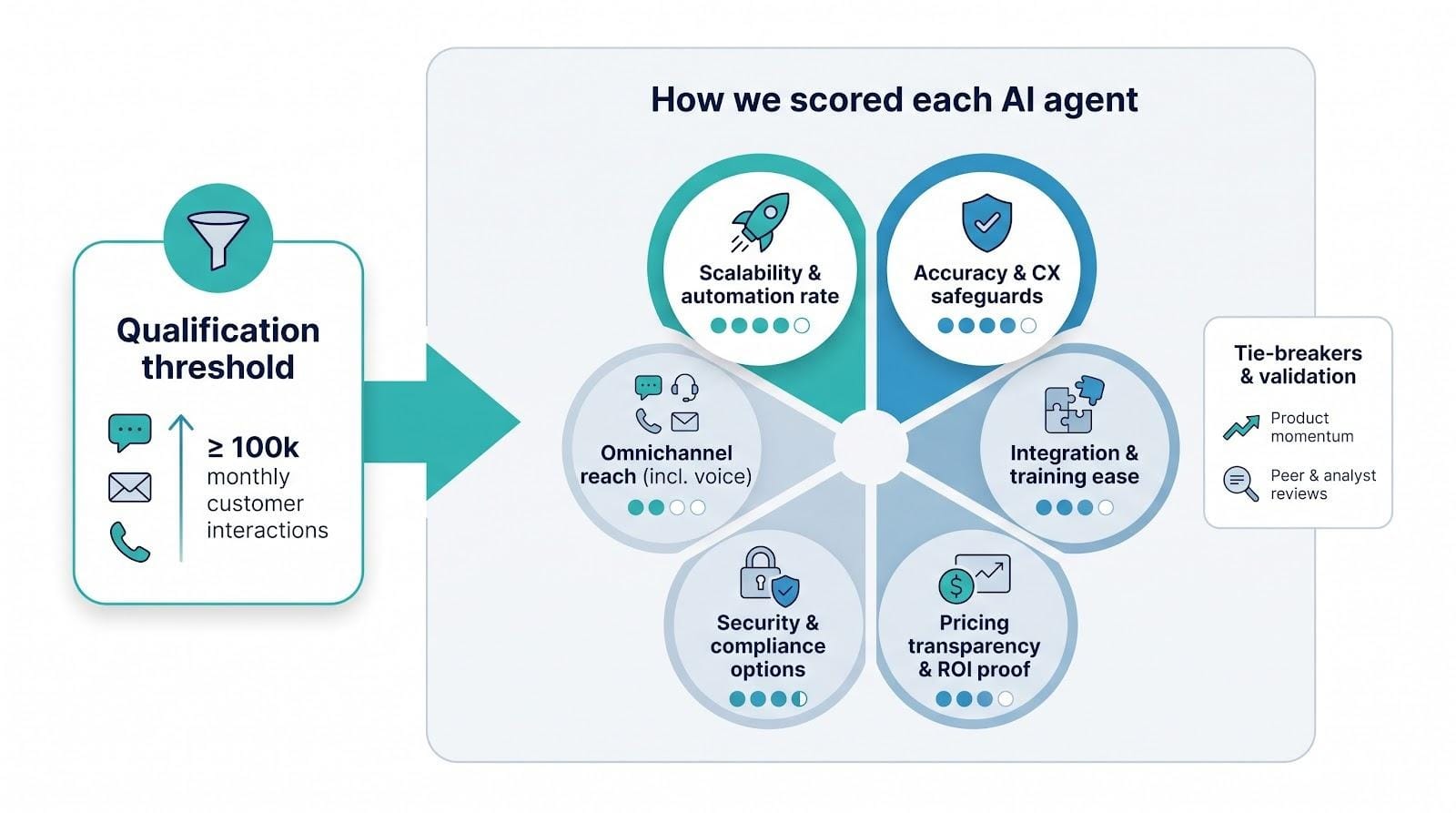
- Scalability and real-world automation rate
- Accuracy and customer-experience safeguards
- Omnichannel reach, including voice
- Integration depth and ease of ongoing training
- Security and compliance options (Comm100’s data-isolation stance set the benchmark)
- Pricing transparency and hard ROI proof
We averaged the scores, broke ties with recent product momentum, and cross-checked the order against peer reviews plus analyst commentary on the move toward true “agentic” AI. The result is a list you can trust when the ticket queue towers overhead.
Compare at a glance
Sometimes you only need the cheat sheet. The table below sets the ten finalists side by side so you can spot the best fit in seconds.
*Ballpark only; vendors revise tiers often.
Scan the rows, mark the two or three that match your must-haves, and keep reading for the details.
1. Comm100: scale, security, and a single pane of glass
Imagine funneling every chat, email, text, and social DM into one dashboard, then letting an AI teammate clear 80 percent of routine work before a human even looks at the queue. Field deployments of Comm100's AI agent for customer support confirm that benchmark, with teams automating up to 80% of inbound queries straight out of the gate. That’s Comm100’s job.
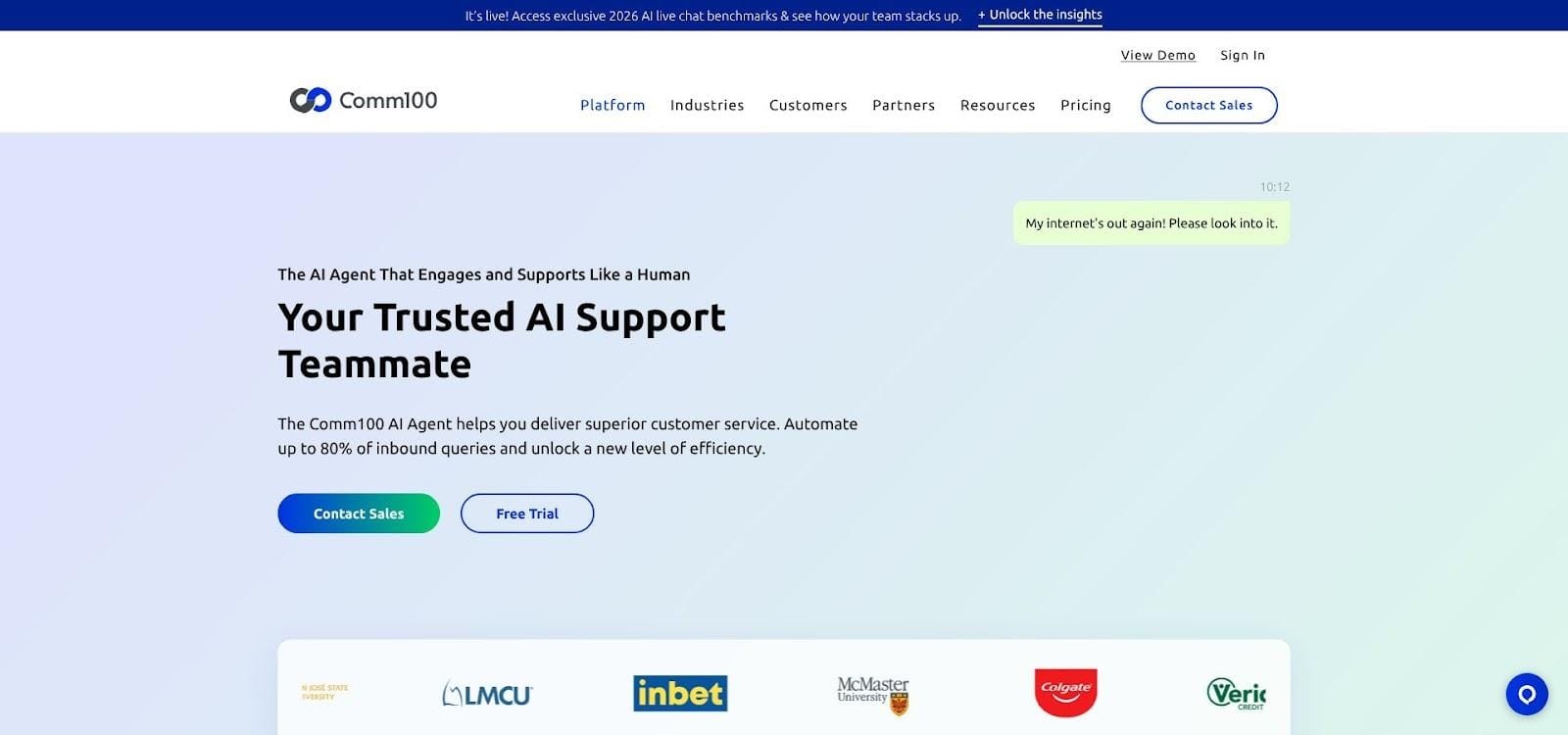
Comm100 AI Agent Single Pane of Glass Screenshot.
The product started as live-chat software, so the agent console feels proven rather than patched in. Today the AI Suite adds an “AI Agent” for hands-off resolutions, a Copilot that drafts replies in real time, and AI QA that spot-checks every exchange. Together they trim hours from each shift while keeping quality steady at scale.
Comm100 stands out when compliance anxiety runs high. Hospitals, universities, and government agencies count on its SOC 2 and HIPAA credentials, plus the option to install on-prem. Understanding what is cybersecurity helps support leaders evaluate how platforms like Comm100 protect customer data and maintain compliance in regulated industries. The Trust Center promise, that customer data never trains any outside model, turns privacy officers into quick allies.
Setup is straightforward: connect your knowledge base, pick the channels you need, and set confidence thresholds for escalation. Most teams see measurable deflection within weeks, and pricing scales with usage instead of punishing extra human seats.
If you juggle sensitive data and traffic spikes, Comm100 gives you room to breathe without trade-offs.
2. Zendesk AI: native power for teams already on Zendesk
When your support team already runs on Zendesk, switching platforms just to add AI is like swapping engines mid-flight. Zendesk AI avoids that pain by weaving automation into the tools your agents use every day.
Answer Bot is the star. It scans incoming tickets, predicts intent, and serves relevant knowledge-base articles in seconds, deflecting a large share of low-complexity requests. When the bot stalls, the same engine triages the ticket, tags urgency, and suggests a macro so a human can reply in one click. The hand-off stays inside the familiar ticket view.
Scale is proven; global brands push millions of interactions through Zendesk without hesitating. Voice, chat, email, and socials all travel the same omnichannel pipeline, so customers choose the channel and you keep unified reporting.
Pricing stays simple: remain on the Enterprise tier, activate the AI add-on, and you’re live. For companies deeply invested in Zendesk, this is the fastest way to modern automation.
3. Intercom Fin: GPT-4 brains without a platform switch
Fin brings ChatGPT-style conversation to the helpdesk you already run. Connect your knowledge base, flip a toggle, and Fin starts handling web or in-app chats within minutes. No data migration, no agent retraining, only instant coverage.
Fin’s depth sets it apart. Beyond explaining your refund policy, it can process the refund by calling Stripe or Shopify, then confirm the action in the same thread. That autonomy deflects about 76 percent of tickets, freeing agents for complex work.
Because Fin inherits Intercom’s conversational DNA, replies stay friendly and on brand. Admins set tone and confidence thresholds in a straightforward dashboard, so the bot knows when to escalate. Usage-based pricing per resolution ties cost to results, making it an easy sell for growth-stage SaaS teams.
4. Ada: no-code muscle for high-volume B2C brands
Your support team craves automation but dislikes waiting on dev sprints. Ada hands them the keys. Its drag-and-drop interface lets non-technical managers build, adjust, and launch chat flows in hours, not weeks. The payoff is an AI agent that speaks 100+ languages and covers web, mobile, SMS, WhatsApp, and voice calls from a single brain.
Scale is Ada’s specialty. Airlines, telcos, and fast-fashion retailers route hundreds of thousands of chats through the platform each month and still reach 70 to 80 percent self-resolution. When customers ask “Where is my order?” Ada pulls live tracking data; when they request a refund, the bot calls your payment API and confirms on the spot. No human copy-pasting needed.
Because admins own the content, updates match the business clock: flash sale tomorrow, policy change next week, all set. Pricing sits in the enterprise tier, but the deflection math works for any brand swamped by repetitive B2C questions.
5. Kore.ai: voice-first firepower for the contact center
Text bots are table stakes. The real backlog lives on phone lines, where customers dial in with complex needs. Kore.ai meets that gap with a voice engine built to replace legacy IVR trees with natural conversation.
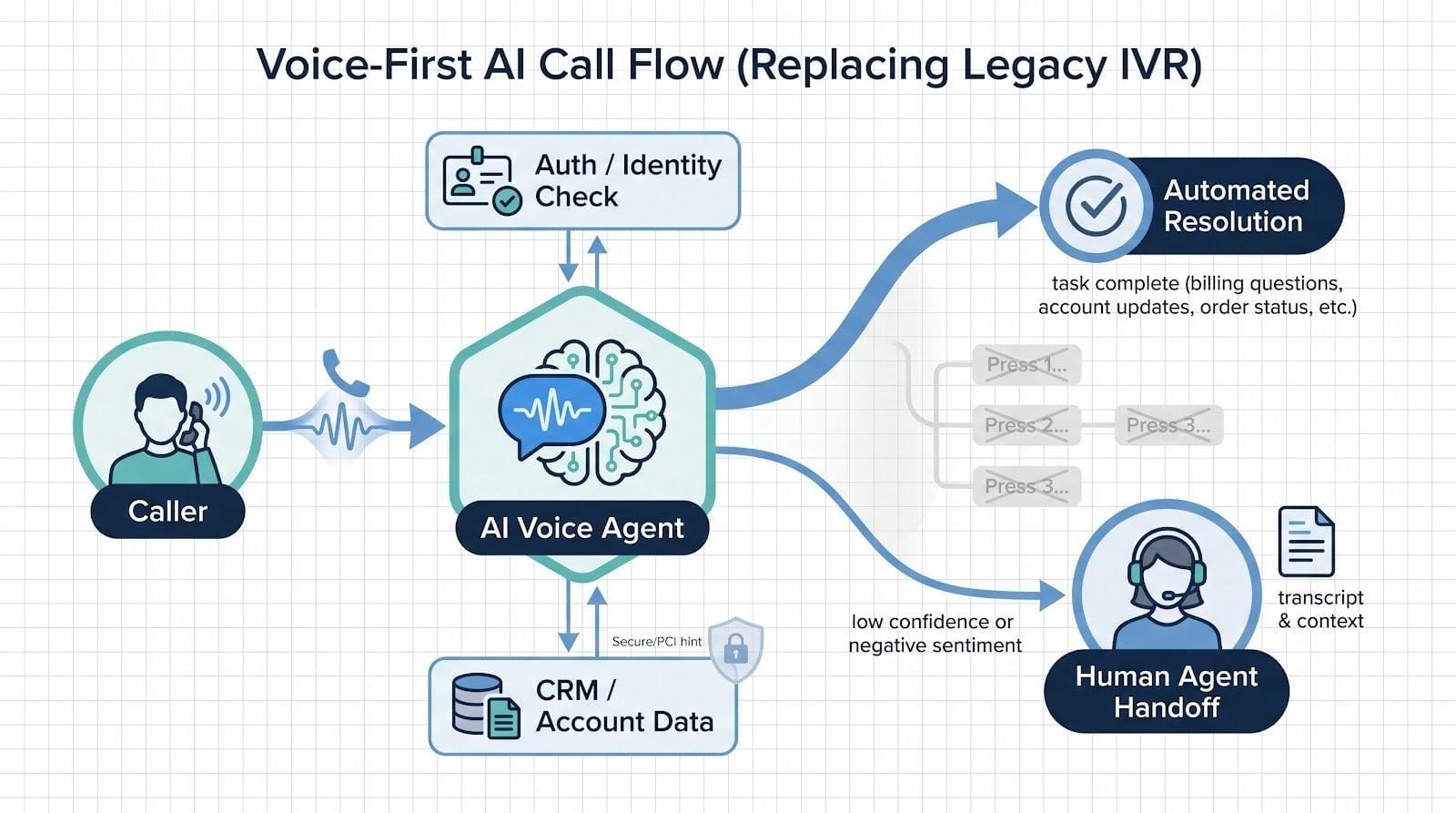
Ask a billing question and the bot responds, confirms identity, pulls the account from your CRM, and guides the caller to resolution without the “Press 4 for anything else” grind. If sentiment dips or the caller hesitates, Kore routes to a human and sends the full transcript so no one repeats details.
Inside, you get a workshop, not a toy. Teams can mix Kore’s NLU with GPT-4 or domain models, then test each flow in a governance dashboard before launch. Banks and insurers value the on-prem option and PCI compliance, while retailers prefer the pay-per-use voice model for holiday spikes without giant licenses.
Choose Kore when call volumes dwarf chat and you need reliable tooling to automate spoken support at scale.
6. IBM Watson Assistant: enterprise flexibility with decades of AI experience
Some teams just need a chatbot; highly regulated enterprises need an AI framework they can bend to every policy and corner case. That is Watson Assistant’s lane.
IBM lets you host on its cloud or your own servers, critical for banks and government agencies where data residency is non-negotiable. You can plug Watson into an IVR, a kiosk, or a mobile app, then load industry starter packs so it already speaks telco or insurance on day one.
Control runs deep. Teams fine-tune intents, build conditional logic, and connect to Watson Discovery or any REST API to fetch live data mid-conversation. The trade-off is ramp-up time expect weeks rather than hours but the reward is a bot that handles millions of interactions without drifting off script.
Pricing is usage based, so the meter rises only when demand does. If your developers value guardrails more than quick setup, Watson hands you both the wheel and the seat belt.
7. Freshdesk Freddy: all-in-one helpdesk with an AI copilot
Sometimes the easiest route to AI is staying inside the helpdesk you already pay for. Freshdesk’s Freddy module plugs into every inbox, call, and social message that lands in the queue, then trims minutes from each reply.
Freddy Chatbot sits on your site or app, handles the basics, and converts unknown questions into new knowledge-base drafts so gaps close fast. Meanwhile, Freddy Copilot watches agents type and offers full reply suggestions, relevant articles, or next-best actions before they hit send. Teams report double-digit handle-time drops without changing workflows.
Because Freshdesk bundles ticketing, voice, and chat, metrics roll up in one dashboard, with no awkward system stitching required. SMBs like the value: adding the Freddy AI Copilot to a paid plan unlocks the full suite for roughly what rivals charge for chat alone. At high volumes that pricing efficiency can fund a larger customer-success push instead of more headcount.
8. Botpress: open-source freedom for developer-led teams
Not every company wants a boxed product. If your engineers crave root access, Botpress gives them full control. The core platform is open source, so you can inspect every line, host it anywhere, and connect any LLM or API you prefer.
The visual flow builder helps non-coders map dialogues, while a built-in code editor lets developers add custom logic and database calls. That mix means marketing can tweak copy while engineering automates refunds or device diagnostics behind the scenes.
Cost control is the other draw. Self-host Botpress on your own cloud and the only metered line item is GPU time for whichever model you connect. At six-figure conversation counts, that often undercuts SaaS chatbots by a wide margin. The trade-off is ownership: uptime, scaling, and security stay on your ops team’s shoulders.
Choose Botpress if customization outranks convenience and you have the engineering capacity to shape an AI agent around your workflows.
9. Aisera: pre-trained skills for rapid ROI
When tickets explode overnight, you cannot wait months to teach a bot your playbook. Aisera arrives with a library of pre-built skills—password resets, order tracking, subscription changes, and dozens more—so it starts resolving issues on day one.
Its workflow engine is the core advantage. A customer types “I need a refund,” the AI authenticates the user, triggers a return in your ERP, emails a label, and closes the ticket, all without human input. Zoom relied on that autonomy during pandemic surges and shaved support effort across millions of users.
Aisera also doubles as an agent-assist layer. If confidence drops, it hands the thread to a human while suggesting replies and knowledge links, cutting handle time when full automation is not possible. Dashboards track containment and surface new intents so the system keeps learning.
Pricing matches outcomes: you pay per successful resolution, aligning vendor incentives with your KPIs. For leaders who want enterprise-grade automation fast, Aisera delivers breathing room in record time.
10. Yuma AI: e-commerce automation that pays for itself
Online stores face a flood of “Where is my order?” and return requests. Yuma addresses that surge with agents trained for retail.
Connect your Shopify or Gorgias account and the bot instantly pulls product data, order history, and shipping status. A shopper types an order number in chat; Yuma checks the carrier, surfaces live tracking, and sends an update within seconds. In a pilot with EvryJewels, this precision drove 89 percent ticket automation and cut cost per contact from $5.50 to just $2.
Yuma also spots revenue chances. If a shopper asks about sizing, the bot recommends in-stock variants; if a subscription nears expiry, it offers a discount to keep the purchase alive. Those nudges turn support from cost center to quiet sales channel.
Pricing starts around $850 a month, far lower than another round-the-clock human shift. For e-commerce leaders seeking savings and incremental revenue, Yuma delivers measurable ROI at checkout.
Honorable mentions to explore
A few strong contenders narrowly missed the top ten but still deserve a spot on your short-list.
Typewise fits European teams where strict data privacy and GDPR stewardship rule the day. If you serve several languages from one queue, its Swiss architecture stands out.
Genesys DX with Google Dialogflow suits voice-heavy contact centers already running on Genesys Cloud. The combo brings Google’s NLU to every call without replacing your CCaaS stack.
Rasa offers another open-source path. Built in Python, it rewards teams that value transparency and fine intent control over turnkey ease.
Cresta focuses on real-time agent assist, not full deflection. It plugs into your contact center, reads incoming messages or listens to calls, and drafts answers so humans reply in half the time.
Microsoft Copilot Studio (formerly Power Virtual Agents) is the natural pick for companies deep in the Microsoft 365 and Dynamics ecosystem. Licensing bundles often make its incremental AI cost almost invisible.
If any description matches your reality, schedule a demo and test each one with your own tickets before you commit.
Five trends shaping AI support in 2026 and beyond
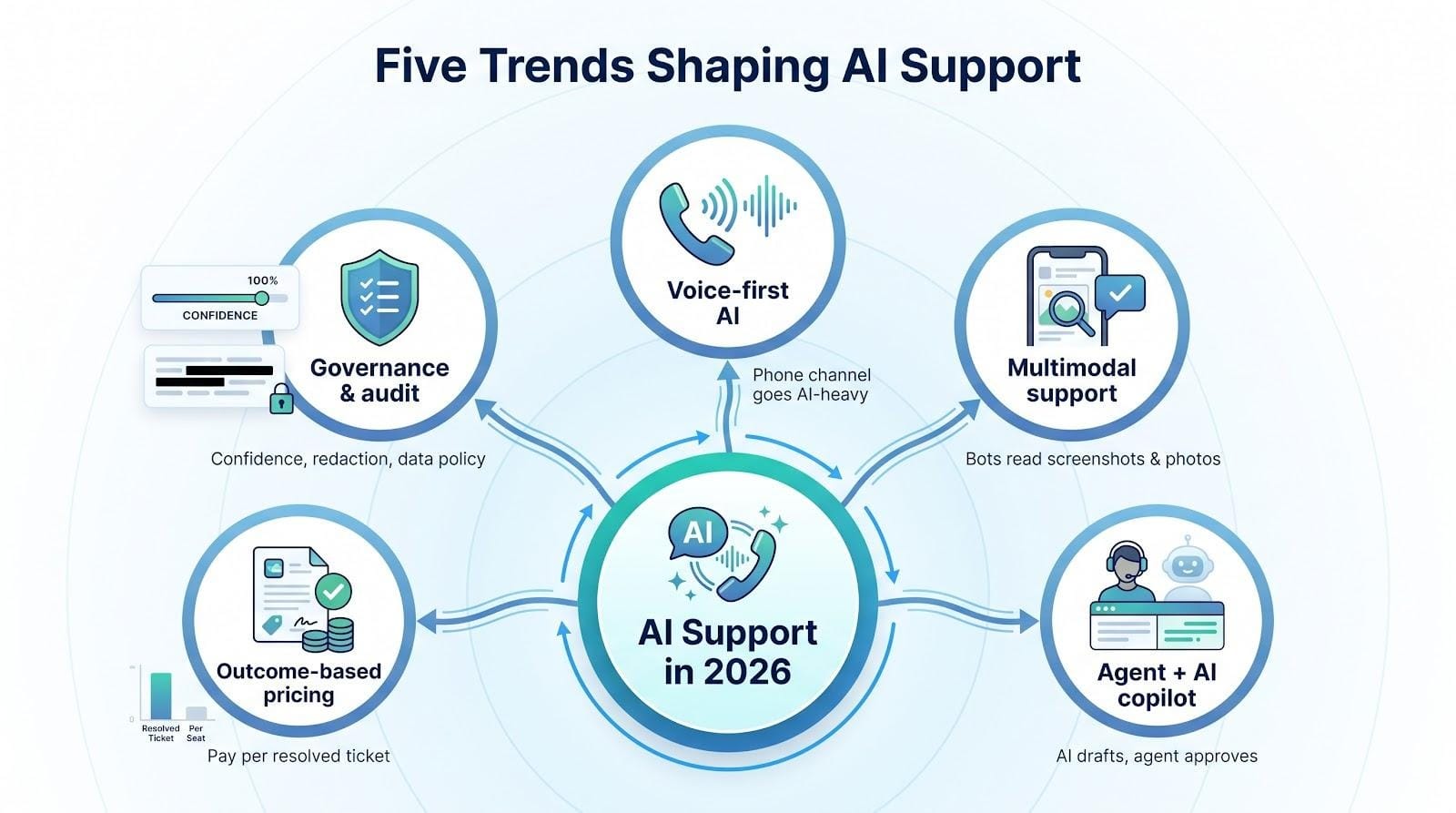
Voice is closing the gap with chat. New agentic platforms let callers speak naturally, handle mid-sentence interruptions, and still complete a task from start to finish. At the current pace, the phone channel could shift from human-heavy to mostly AI within two years.
Multimodal support is next. Bots can now read screenshots or product photos, then reply with text or voice guidance. Retailers and device makers report sharp drops in the “Please describe the issue” back-and-forth.
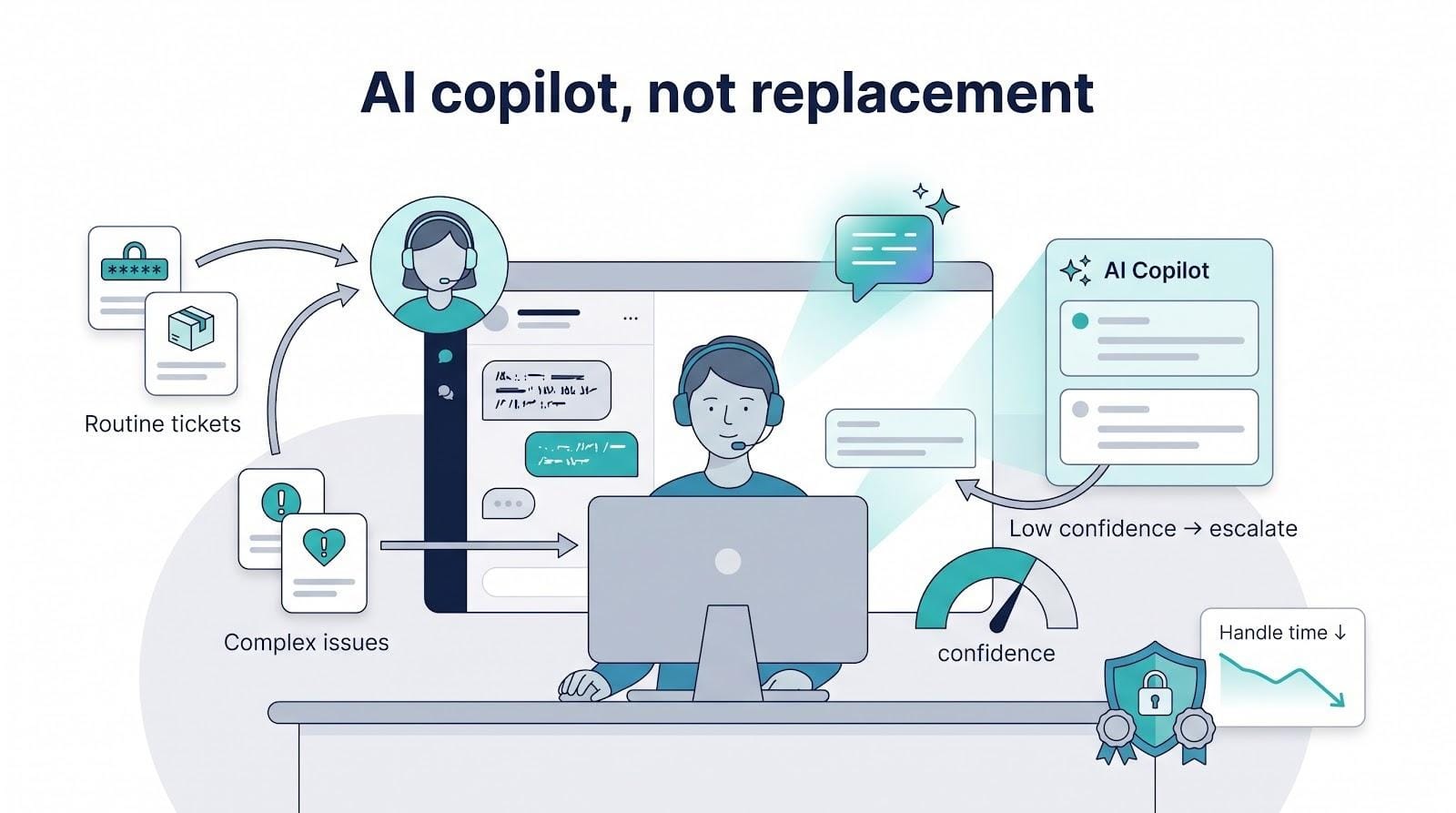
Agent-plus-AI has become the standard operating model. Every human gets a copilot that drafts replies, fills forms, and flags churn risks, lifting productivity without the morale cost of full replacement.
Governance is now center stage. Boards ask for an audit trail. Vendors that show confidence scores, redaction controls, and plain data-use policies (Comm100 stands out) close deals faster.
Outcome-based pricing is gaining speed. Paying per resolved ticket instead of per seat lines up incentives and eases budgeting when volume spikes are hard to predict.
FAQs: straight answers to common AI support questions
Will AI agents replace my human team?
No. Treat the bot as a first-line intern that clears routine work so your experts focus on empathy, upsell, and complex troubleshooting.
How fast can we see ROI?
High-volume teams typically reach payback in one quarter once 60–80 percent of repetitive tickets vanish. Track cost per contact before and after launch; the numbers tell the story.
What if the AI gets it wrong?
Modern platforms assign confidence scores. Below a set threshold, the bot escalates with full context so a human can jump in without a messy hand-off.
Is our customer data safe?
Choose vendors with SOC 2 or HIPAA badges and clear “no data sharing” policies. Comm100’s stance is a gold standard: your data never trains other clients’ models.
How much internal effort is this?
No-code tools go live in days using your existing FAQs. Open-source frameworks demand developer time but trade effort for control. Pick the model that matches your bandwidth.
Buyer’s checklist for choosing the right AI support platform
You have a shortlist and a budget cycle ahead. Use the questions below as your diligence script when vendors enter demo mode. Checking each box keeps bells and whistles from overshadowing real-world fit.
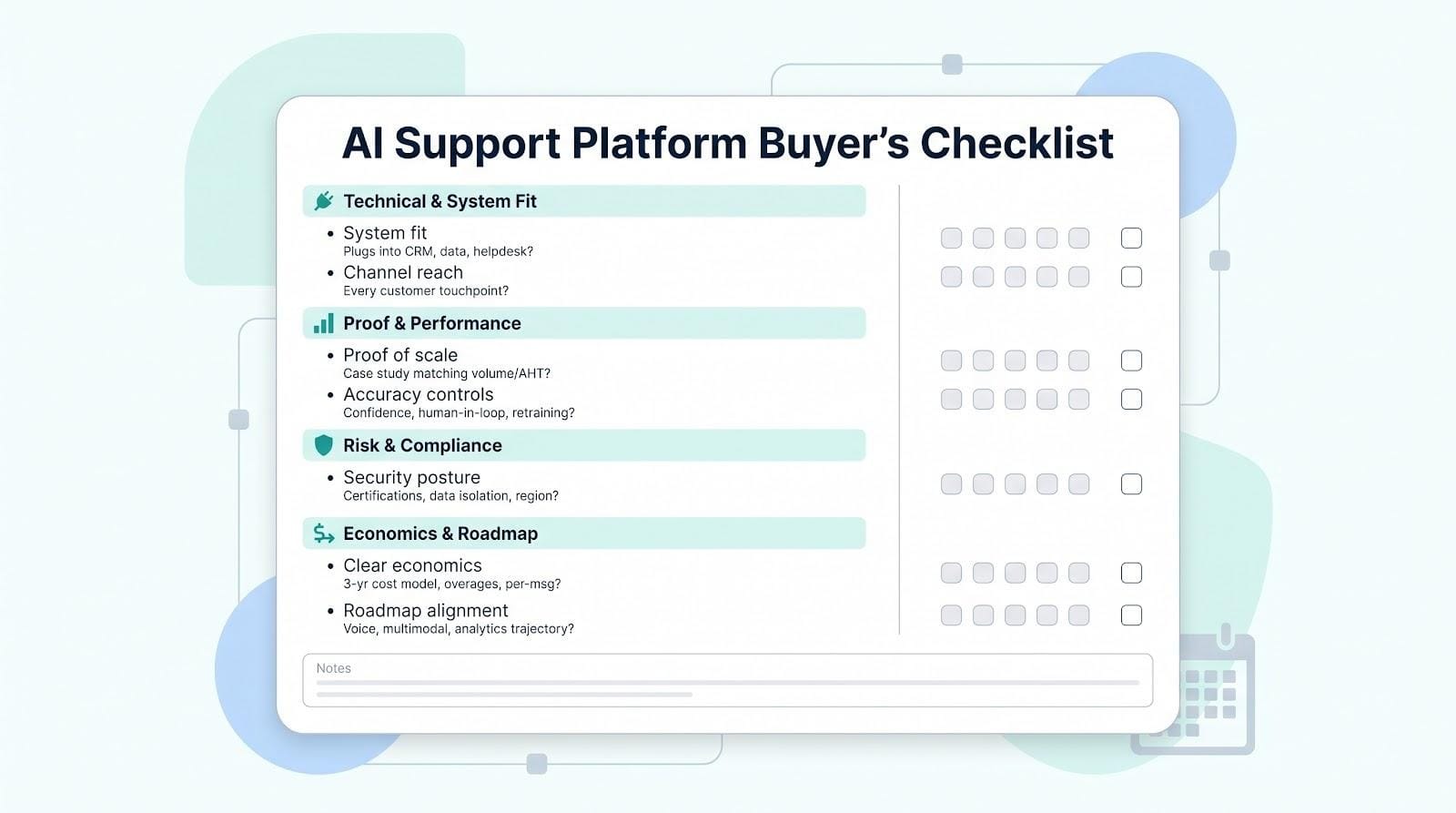
- System fit: Does the platform plug into your helpdesk, CRM, and data sources today, or will IT need months of middleware?
- Channel reach: List every customer touchpoint—web, email, phone, social, app. If a channel is missing, plan the workaround cost.
- Proof of scale: Ask for a case study that mirrors your monthly volume and average handle time, not a hand-picked pilot.
- Accuracy controls: Look for confidence thresholds, human-in-the-loop review, and tools to retrain the model without vendor tickets.
- Security posture: Verify certifications, data-isolation policies, and regional hosting. For healthcare or finance, insist on a signed BAA or equivalent.
- Clear economics: Model pricing three years out. Check overage fees, per-message costs, and expansion tiers to avoid a surprise bill.
- Roadmap alignment: Where is the vendor taking voice, multimodal, and analytics? Their vision should match your growth curve.
Walk through each line, score every solution, and the strongest choice will surface without guesswork.