Cognizant: Interview Preparation For Business Analyst(Pan India) Role - A Complete Guide
Business Analyst(Pan India)

Cognizant is a leading global professional services company that helps organizations modernize technology, reimagine processes, and transform experiences. Founded in 1994 and listed on Nasdaq (CTSH), the company partners with enterprises across banking, financial services, healthcare, life sciences, communications, media, technology, manufacturing, and retail to drive digital transformation at scale. Cognizant’s portfolio spans application modernization, cloud, data and AI, product engineering, intelligent process automation, and industry platforms.
With a client-centric delivery model and deep industry specialization-particularly in healthcare through its TriZetto platforms-Cognizant combines consulting-led engagement with engineering rigor to deliver measurable business outcomes. The company reported approximately $19.4 billion in revenue in 2023, underscoring its scale and relevance among the world’s top IT services providers. Strong alliances with major hyperscalers and enterprise software leaders, along with a global delivery network, make Cognizant a strategic partner for enterprises seeking speed, resilience, and innovation in an increasingly AI-enabled economy.
This comprehensive guide provides essential insights into the Business Analyst - Central Operational Excellence at Cognizant, covering required skills, responsibilities, interview questions, and preparation strategies to help aspiring candidates succeed.
1. Cognizant Overview
About Cognizant
Cognizant Technology Solutions Corporation is a Fortune 500 professional services company that engineers modern businesses. Established in 1994 and headquartered in Teaneck, New Jersey, Cognizant partners with global enterprises to modernize legacy systems, migrate to cloud, harness data and AI, and build digital products and experiences.
The company is known for its consulting-led, engineering-driven approach and deep vertical expertise-especially in healthcare, financial services, and life sciences-supported by strong alliances with major cloud providers and enterprise platforms. Cognizant trades on Nasdaq under the ticker CTSH and reported ~$19.4 billion in 2023 revenue.
| Attribute | Details |
|---|---|
| Founded | 1994; began as an in-house technology unit of The Dun & Bradstreet Corporation; incorporated in Delaware |
| Founders | The Dun & Bradstreet Corporation (founding entity) |
| Industry | Information technology services and consulting |
| Headquarters | Teaneck, New Jersey, United States |
| Key Services | Consulting; application development and modernization; cloud; data and AI; intelligent process automation; digital experience; infrastructure and security; quality engineering; software product engineering; industry platforms (e.g., TriZetto healthcare products) |
Company History
Trace Cognizant's evolution through key periods, highlighting major transformations and growth phases.
Founding and Independence (1994–1998)
- 1994: Founded in Chennai, India, as Dun & Bradstreet Satyam Software (DBSS), serving as an in-house IT unit for Dun & Bradstreet.
- 1996–1997: Began serving external clients, spun off as Cognizant Corporation, and rebranded as Cognizant Technology Solutions.
- 1998: Went public on the Nasdaq under the ticker CTSH.
Growth and Leadership Changes (2000s–2019)
- 2000s: Expanded rapidly beyond software development into consulting and business process outsourcing.
- 2014: Strengthened its healthcare footprint by acquiring TriZetto Corp for $2.7 billion.
- 2019: CEO transition - Francisco D’Souza stepped down, succeeded by Brian Humphries.
Transformation and Industry Shifts (2020–2024)
- 2020–2022: Executed “Fit for Growth” strategy and acquired several firms to enhance digital, cloud, and AI capabilities.
- 2023: Leadership change - Ravi Kumar Singisetti became CEO; acquired Thirdera to expand ServiceNow and AI expertise.
- 2024: Formed a strategic AI partnership with Microsoft and acquired Belcan, reporting $19.7 billion in revenue for the year.
Key Milestones in Cognizant History
Critical achievements that shaped Cognizant's trajectory and market position.
| Year | Milestone |
|---|---|
| 2018 | Entered the Fortune 200 list, marking a major milestone in global scale. |
| 2019 | Brian Humphries appointed as CEO, ushering in a new leadership era. |
| 2021 | Became title sponsor of Aston Martin Formula One, boosting global brand visibility. |
| 2022 | Introduced new brand identity with the tagline “Intuition engineered.” |
| 2023 | Ravi Kumar S. appointed CEO and announced $1B investment in generative AI. |
| 2024 | Acquired Belcan to expand engineering research and development capabilities. |
| 2025 | CEO Ravi Kumar S. named to TIME 100 AI list, reinforcing AI leadership. |
2. Corporate Culture and Values
Vision
Cognizant aims to establish itself as the leading technology services partner for the world's top companies, driving innovation and excellence in every collaboration.
Purpose
Cognizant is dedicated to engineering modern businesses, focusing on solutions that enhance everyday life for individuals and communities alike.
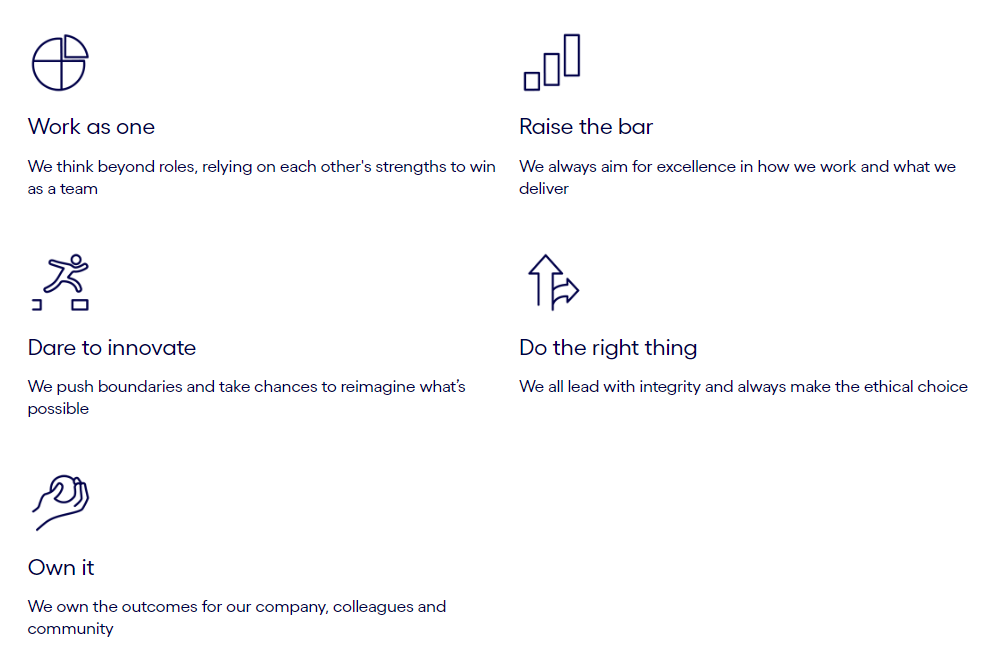
Values
Cognizant's values form the bedrock of their culture and define how they work together to serve their stakeholders.
3. About the Business Analyst (Pan India)– Role
The Business Analyst in Central Operational Excellence drives operational efficiency and performance improvement by defining the right metrics, analyzing trends, and translating insights into action. Positioned at the intersection of corporate functions, business leadership, and IT, the role shapes a coherent metrics landscape, builds models for scenario planning and sensitivity analysis, and presents findings through clear, executive-ready data visualizations. By tracking initiatives and documenting process improvements, the analyst ensures data-backed decision-making and sustained performance gains across the enterprise.
Operating with PAN India flexibility, the role collaborates with application services teams to plan and monitor system rollouts for process reengineering, conducts root cause analysis to identify process gaps, benchmarks performance against peers, and manages stakeholders with regular updates to top management. As a central enabler of process transformation programs, the Business Analyst is instrumental in aligning strategy with execution-turning quantitative insights into measurable business outcomes for Cognizant.
4. Required Skills and Qualifications
Success in this role requires a blend of strong academics, analytical rigor, business acumen, and stakeholder management. Candidates must demonstrate proficiency in quantitative analysis, process mapping, and communication, alongside the discipline to manage enterprise-wide initiatives and present insights effectively to leadership.
Educational Qualifications
- MBA / Executive MBA (Full-time) graduating in 2026 (mandatory).
- A strong academic background with a minimum of 60% aggregate in Class 10, Class 12, and Undergraduate degree (all subjects considered) with no standing arrears.
- Open only to Indian nationals or Overseas Citizens of India (OCIs).
Key Competencies
- Analytical & Problem-Solving Skills: Strong capability for quantitative analysis, root cause analysis, and developing creative solutions through scenario building and sensitivity analysis.
- Strategic Operations & Business Acumen: Deep understanding of IT business operations, financial metrics, and the principles of Operations Excellence to drive process transformation and performance.
- Stakeholder Management & Communication: Excellent interpersonal and communication skills to manage stakeholders, present insights to top management, and steer enterprise-wide initiatives.
- Project & Program Management: Ability to plan, track, and monitor process improvement projects, providing consistent updates on strategy and progress to ensure timely completion.
- Process Optimization Mindset: A proactive approach to identifying optimization opportunities, conducting gap analysis, and benchmarking against peers to enhance business operations.
Technical Skills
- Data Analysis & Visualization: Proficiency in MS Excel and MS PowerPoint for data processing and presentation. Ability to present information using data visualization techniques.
- Process Modeling & Design: Deep understanding and knowledge of Process Mapping, Gap Analysis, and Solution Design.
- Metrics & Performance Management: Skill in conceptualizing and implementing a metrics landscape to drive data-driven insights and monitor performance.
- Systems & Reengineering: Experience liaising with IT teams to design, plan, and track the rollout of corporate systems for process reengineering.
5. Day-to-Day Responsibilities
The role blends analytics, process excellence, and stakeholder coordination. Expect to work on metric frameworks, model-building, performance benchmarking, and governance of enterprise initiatives-while partnering closely with IT for system rollouts and with leadership for decision-making.
- Performance Metrics & Data Analysis: Conceptualize and implement a comprehensive metrics landscape to drive quantitative analysis; utilize data visualization techniques to present insights and support decision-making.
- Process Improvement & Optimization: Proactively identify optimization opportunities, monitor process improvement projects, and conduct benchmarking against peers to enhance business performance and operational excellence.
- Solution Modeling & Scenario Analysis: Apply strong capabilities in solution modeling, scenario building, and sensitivity analysis to evaluate different business approaches and support strategic planning.
- Stakeholder Management & Communication: Manage stakeholders across corporate functions and business leaders; provide consistent project updates to top management regarding strategy, progress, and adjustments.
- Root Cause Analysis & Problem-Solving: Identify gaps in existing processes, conduct root cause analysis, and drive organizational changes to address operational challenges.
- Project Management & Initiative Execution: Steer enterprise-wide initiatives and transformation programs towards timely completion, ensuring alignment with business objectives and operational goals.
- Systems Implementation Support: Liaise with Application Services teams to design, plan, track, and monitor the rollout of corporate systems aimed at process reengineering and operational improvement.
- Business Operations Understanding: Maintain a strong understanding of IT business operations, financial metrics, and operations excellence principles to drive effective process transformations.
6. Key Competencies for Success
Beyond foundational qualifications, standout analysts demonstrate business-oriented thinking, change leadership, and the ability to convert insights into measurable outcomes. The competencies below distinguish high performers in Central Operational Excellence.
- Business Acumen: Understand IT services economics, cost drivers, and value levers to prioritize initiatives with tangible P&L impact.
- Insight Storytelling: Craft compelling narratives from data, aligning recommendations with strategy and stakeholder priorities.
- Change Management: Anticipate adoption risks, build stakeholder buy-in, and sustain momentum through clear communication and governance.
- Benchmarking Mindset: Compare internal performance with industry peers to set realistic targets and uncover improvement opportunities.
- Ownership and Bias for Action: Proactively remove blockers, escalate risks early, and drive closure on actions to deliver results at speed.
7. Common Interview Questions
This section provides a selection of common interview questions to help candidates prepare effectively for their Business Analyst - Central Operational Excellence interview at Cognizant.
Give a concise, role-aligned overview: education, analytics/process excellence experiences, and why Central Operational Excellence excites you.
Connect Cognizant’s scale and transformation agenda with your passion for metrics-driven improvements and enterprise impact.
Explain context, dataset, analysis, insight, stakeholder reaction, and business outcome; quantify impact where possible.
Share a structured approach (impact vs. effort, risk, dependencies), stakeholder alignment, and re-baselining when needed.
Cover problem definition, mapping/gap analysis, solutions, pilot, KPIs, adoption, and measurable results.
Discuss stakeholder mapping, common objectives, trade-offs, data-backed options, and transparent governance.
Explain how you framed the problem, identified hypotheses, validated with data, and iterated quickly.
Focus on business narratives, visuals, scenarios, and clear recommendations with risks and next steps.
Own the gap, show corrective actions, and demonstrate improved outcomes in subsequent projects.
Highlight impact, continuous improvement, cross-functional collaboration, and measurable value creation.
Use the STAR method and quantify results (e.g., cycle time -18%, adoption +35%) to demonstrate impact.
KPIs align to strategic goals and drive action; metrics are broader measurements that monitor activity and health.
Start with objectives, map value streams, define leading/lagging KPIs, set owners, frequencies, and data sources with governance.
Utilization, cycle/lead time, first-time-right/defect rate, SLA adherence, CSAT/NPS, backlog, and productivity.
Model base/optimistic/pessimistic cases and test key drivers (e.g., volume, rate, productivity) to assess risk and impact.
Define standards, validation checks, lineage, reconciliation with source systems, and ownership with issue logs.
Select peer set, normalize definitions, compare trends, identify gaps, and translate into targets and action plans.
5 Whys, Fishbone, Pareto, control charts; validate hypotheses with data and experiments.
Combine trend lines, target bands, segment cuts (client, region), and drill-downs for exceptions.
Revenue, cost drivers, contribution/margin, productivity, and variance vs. plan; link ops metrics to financial outcomes.
Map current vs. future state, define user stories and acceptance criteria, prioritize, and align with IT for rollout.
Ground your answers in a repeatable framework (objectives → metrics → data → insight → action → outcome).
Validate the metric, segment by category, run Pareto/root cause, and prioritize fixes with quick-win experiments.
Identify friction points, refine UX, deliver role-based training, align incentives, and track adoption KPIs.
Map current costs, estimate benefits (time, errors, speed), quantify risks, model scenarios, and define payback.
Reframe around business goals, present trade-offs with data, propose a harmonized metric set with governance.
Check demand variability, skill mix, rework rates, bottlenecks, and handoffs; pilot WIP limits or standard work.
Hold definition integrity, explain risks, propose supplemental views (e.g., seasonality-adjusted) without bias.
Pilot, document SOPs, enable change champions, phase deployment, monitor KPIs, and run feedback loops.
Quantify gap, identify levers, propose recovery plan, align owners/timelines, and communicate transparently.
Use pre/post metrics, control groups, time-to-proficiency, error rates, and adoption dashboards.
Translate into cost avoidance or capacity release, validate assumptions, and align with finance on accounting.
Structure answers: define, diagnose, design, deliver, and document outcomes tied to KPIs.
Detail problem, data, methods, models, and business impact; emphasize decisions enabled by your analysis.
Mention modeling, PivotTables, lookups/INDEX-MATCH, what-if analysis, scenario manager, and error handling.
Lead with insights, use clean visuals, state recommendations, implications, and a clear action roadmap.
Explain how you designed dashboards and chose charts to reveal trends, exceptions, and root causes.
Show how you aligned objectives, handled pushback, and secured decisions through data-driven options.
Discuss mapping, user stories, prioritization, releases, and post-implementation monitoring.
Highlight baseline, interventions, control mechanisms, and how you prevented regression.
Confirm flexibility and share any prior experience working across time zones and distributed teams.
Explain proof of employment and how you maintained accurate records for verification.
Ask about the metrics governance model, roadmap for transformation, tooling, and stakeholder cadence.
Tailor every example to the JD: metrics, modeling, visualization, process change, and stakeholder updates.
8. Common Topics and Areas of Focus for Interview Preparation
To excel in your Business Analyst - Central Operational Excellence role at Cognizant, it’s essential to focus on the following areas. These topics highlight the key responsibilities and expectations, preparing you to discuss your skills and experiences in a way that aligns with Cognizant objectives.
- Metrics Design & Governance: Study how to define KPIs, set targets, assign ownership, and ensure consistent calculations and data lineage across functions.
- Process Mapping & Gap Analysis: Be comfortable with current/future state mapping, bottleneck identification, and translating gaps into prioritized solutions.
- Modeling, Scenarios & Sensitivity: Practice scenario planning and driver-based models that quantify impact on productivity, SLAs, and financial outcomes.
- Data Visualization & Storytelling: Learn to create dashboards and succinct executive narratives that turn analysis into decisions and actions.
- Stakeholder & Change Management: Prepare examples of influencing without authority, handling trade-offs, and driving adoption of new processes/systems.
9. Perks and Benefits of Working at Cognizant
Cognizant offers a comprehensive package of benefits to support the well-being, professional growth, and satisfaction of its employees. Here are some of the key perks you can expect
- Health and Well-Being Programs: Medical coverage and wellness resources, including support services to help employees and their families.
- Paid Time Off and Leave Policies: Structured leave, including provisions for personal and family needs, to support work-life balance.
- Learning and Career Development: Access to learning platforms, structured training, and role-based upskilling to advance your career.
- Flexible Work and Mobility: Roles with PAN India flexibility and opportunities to collaborate across locations and time zones.
- Retirement and Financial Benefits: Market-competitive compensation and statutory benefits as applicable to the location.
10. Recruitment Process at Cognizant
The recruitment process at Cognizant consists of the following five steps:
1. Your Application
Candidates start by applying to an open position on the Cognizant careers site. If a suitable match isn't found, candidates can sign up for the Talent Community.
2. Initial Screening
A recruiter reviews the application to determine alignment with the role. If there's a match, the recruiter will reach out for a short introductory meeting. If both parties agree on the fit, the candidate's profile is shared with the hiring manager for further evaluation.
3. Interview
After the hiring manager reviews the profile, feedback is provided to the recruiter to schedule a business interview. Depending on the role, there may also be technical and/or client interviews.
4. Final Decision and Offer
Once the interviews are completed, candidates are informed whether they have been selected to join the team.
5. Onboarding
If the candidate accepts the offer, the recruiter will explain the onboarding process to welcome them to the team.
This recruitment process may vary depending on the specific role and location of the candidate. For more details, visit Cognizant.
11. Cognizant's Learning and Development Opportunities
Cognizant offers a comprehensive learning and development ecosystem to help associates build incremental skills aligned with their career aspirations and business needs. The key learning opportunities include:
1. Focused Development Plan
- Associates create a focused development plan with their managers to reach their goals.
2. Robust Learning Ecosystem
- Focuses on five skilling areas: Technical, Functional, Industry, Professional Development, and Leadership Development.
- Provides a self-service marketplace where associates can choose their learning path.
- Includes on-demand and live training, gamified experiences, virtual labs, and more.
3. Niche Training in High-Demand Technologies
- Offered through partners such as Adobe, Microsoft, Amazon Web Services, Oracle, SAP, and Udemy.
4. Leader Development Programs
- Provided through world-class vendor partners and universities.
5. Generative AI Training
- Offers GenAI learning paths for associates, tailored to their roles and GenAI journey.
6. Bluebolt Initiative
- Cognizant's innovation engine, fueled by associates' ideas, converts ideas into working prototypes and monetizes them to generate value for clients.
7. Propel Program
- A signature women's leadership development program for mid- and senior-level women leaders around the world, accelerating a diverse leadership pipeline and enabling women leaders to thrive in a digital era.
As of 2023, Cognizant has over 84,000 learning resources, 88,000+ completions of AI and GenAI learnings, and 139,000+ associates trained across digital skills. 90% of the global workforce are active learners.
12. Conclusion
Cognizant’s Central Operational Excellence team sits at the heart of enterprise performance-defining metrics, enabling process transformation, and turning insight into measurable outcomes. To stand out, demonstrate analytical rigor, process orientation, and the ability to communicate clearly with senior stakeholders.
Strengthen your toolkit across metrics design, modeling, visualization, and change management, and be ready with quantified examples of improvements you’ve led. With thorough preparation and a focus on impact, you can show how your skills will help Cognizant scale operational excellence across functions while supporting strategic goals.
Tips for Interview Success:
- Lead with impact: Quantify outcomes (e.g., SLA +7%, cycle time −15%) and tie them to business objectives.
- Show your frameworks: Walk through clear steps for metrics design, root cause analysis, and change adoption.
- Make data executive-ready: Bring sample visuals and practice a 60–90 second narrative per slide.
- Align to the JD: Emphasize Excel modeling, visualization, process reengineering, and stakeholder updates to top management.