
Cognizant: Interview Preparation For Business Analyst - A Complete Guide
Cognizant is a leading global professional services company that helps organizations modernize technology, reimagine processes, and transform experiences. Founded in 1994 and listed on Nasdaq (CTSH), the company partners with enterprises across banking, financial services, healthcare, life sciences, communications, media, technology, manufacturing, and retail to drive digital transformation at scale. Cognizant’s portfolio spans application modernization, cloud, data and AI, product engineering, intelligent process automation, and industry platforms.
With a client-centric delivery model and deep industry specialization-particularly in healthcare through its TriZetto platforms-Cognizant combines consulting-led engagement with engineering rigor to deliver measurable business outcomes. The company reported approximately $19.4 billion in revenue in 2023, underscoring its scale and relevance among the world’s top IT services providers. Strong alliances with major hyperscalers and enterprise software leaders, along with a global delivery network, make Cognizant a strategic partner for enterprises seeking speed, resilience, and innovation in an increasingly AI-enabled economy.
This comprehensive guide provides essential insights into the Business Analyst role PAN India (Kolkata, Chennai, Pune, Hyderabad, Bangalore) at Cognizant, covering required skills, responsibilities, interview questions, and preparation strategies to help aspiring candidates succeed.
1. Cognizant Overview
About Cognizant
Cognizant Technology Solutions Corporation is a Fortune 500 professional services company that engineers modern businesses. Established in 1994 and headquartered in Teaneck, New Jersey, Cognizant partners with global enterprises to modernize legacy systems, migrate to cloud, harness data and AI, and build digital products and experiences.
The company is known for its consulting-led, engineering-driven approach and deep vertical expertise-especially in healthcare, financial services, and life sciences-supported by strong alliances with major cloud providers and enterprise platforms. Cognizant trades on Nasdaq under the ticker CTSH and reported ~$19.4 billion in 2023 revenue.
| Attribute | Details |
|---|---|
| Founded | 1994; began as an in-house technology unit of The Dun & Bradstreet Corporation; incorporated in Delaware |
| Founders | The Dun & Bradstreet Corporation (founding entity) |
| Industry | Information technology services and consulting |
| Headquarters | Teaneck, New Jersey, United States |
| Key Services | Consulting; application development and modernization; cloud; data and AI; intelligent process automation; digital experience; infrastructure and security; quality engineering; software product engineering; industry platforms (e.g., TriZetto healthcare products) |
Company History
Trace Cognizant's evolution through key periods, highlighting major transformations and growth phases.
Founding and Independence (1994–1998)
- 1994: Founded in Chennai, India, as Dun & Bradstreet Satyam Software (DBSS), serving as an in-house IT unit for Dun & Bradstreet.
- 1996–1997: Began serving external clients, spun off as Cognizant Corporation, and rebranded as Cognizant Technology Solutions.
- 1998: Went public on the Nasdaq under the ticker CTSH.
Growth and Leadership Changes (2000s–2019)
- 2000s: Expanded rapidly beyond software development into consulting and business process outsourcing.
- 2014: Strengthened its healthcare footprint by acquiring TriZetto Corp for $2.7 billion.
- 2019: CEO transition - Francisco D’Souza stepped down, succeeded by Brian Humphries.
Transformation and Industry Shifts (2020–2024)
- 2020–2022: Executed “Fit for Growth” strategy and acquired several firms to enhance digital, cloud, and AI capabilities.
- 2023: Leadership change - Ravi Kumar Singisetti became CEO; acquired Thirdera to expand ServiceNow and AI expertise.
- 2024: Formed a strategic AI partnership with Microsoft and acquired Belcan, reporting $19.7 billion in revenue for the year.
Key Milestones in Cognizant History
Critical achievements that shaped Cognizant's trajectory and market position.
| Year | Milestone |
|---|---|
| 2018 | Entered the Fortune 200 list, marking a major milestone in global scale. |
| 2019 | Brian Humphries appointed as CEO, ushering in a new leadership era. |
| 2021 | Became title sponsor of Aston Martin Formula One, boosting global brand visibility. |
| 2022 | Introduced new brand identity with the tagline “Intuition engineered.” |
| 2023 | Ravi Kumar S. appointed CEO and announced $1B investment in generative AI. |
| 2024 | Acquired Belcan to expand engineering research and development capabilities. |
| 2025 | CEO Ravi Kumar S. named to TIME 100 AI list, reinforcing AI leadership. |
2. Corporate Culture and Values
Vision
Cognizant aims to establish itself as the leading technology services partner for the world's top companies, driving innovation and excellence in every collaboration.
Purpose
Cognizant is dedicated to engineering modern businesses, focusing on solutions that enhance everyday life for individuals and communities alike.
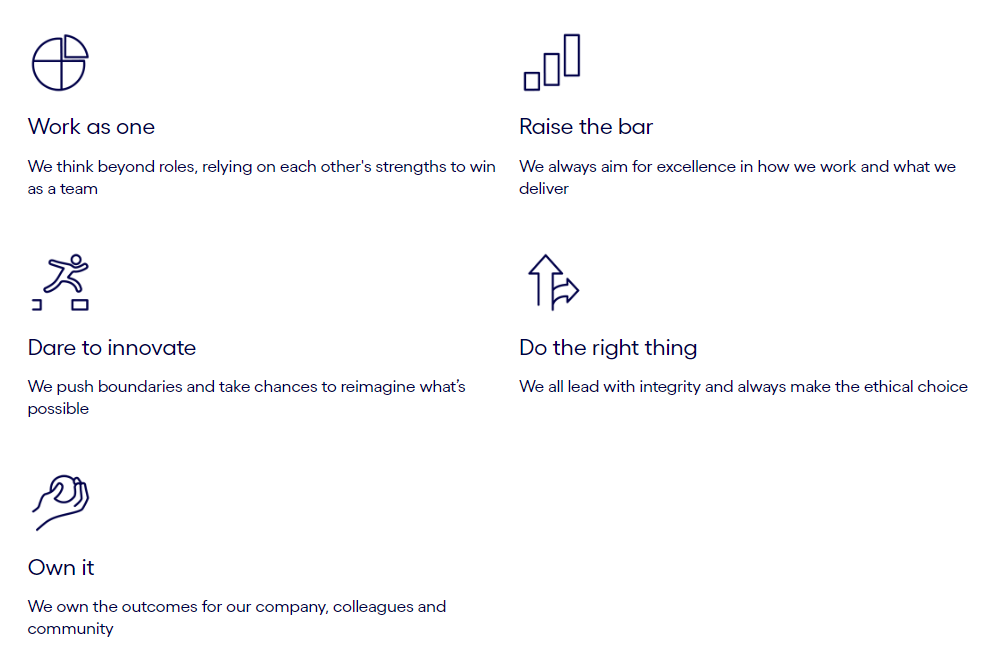
Values
Cognizant's values form the bedrock of their culture and define how they work together to serve their stakeholders.
3. About the Business Analyst Role
As a Business Analyst within Cognizant’s Industry Solutions Group, you act as the bridge between business stakeholders and technology teams. You elicit, document, and prioritize business requirements; analyze current processes; and identify improvement opportunities that drive measurable outcomes. You support the pre-sales phase of solutioning, contribute to business cases and proposals, and prepare clear management-ready reports and presentations. Your work spans requirement workshops, user story creation, backlog refinement, and validation of solutions to ensure they align with business goals and user needs.
Positioned at the core of cross-functional delivery, you collaborate closely with client stakeholders, product owners, architects, engineers, and project managers to plan and monitor execution. You leverage analytical skills to assess performance metrics, generate insights, and inform decision-making. You also conduct market and competitive research that shapes strategic planning and roadmap prioritization. This role is pivotal to Cognizant’s growth and client impact: by translating business intent into implementable solutions and enabling efficient delivery, Business Analysts help accelerate digital transformation initiatives across industries.
4. Required Skills and Qualifications
Candidates need a solid business foundation, proven analytical rigor, and the ability to collaborate across functions. Below are the core educational requirements, competencies, and technical skills for the role.
Educational Qualifications
- MBA / Executive MBA (Full-time) graduating in 2026 from a recognized institution (mandatory).
- A minimum of 60% aggregate in the pursuing degree with no standing arrears.
- Industry domain certifications will be an added advantage.
- Open only to Indian nationals, Overseas Citizens of India (OCIs), or Persons of Indian Origin (PIOs) currently residing in India.
Key Competencies
- Strategic & Analytical Thinking: Ability to analyze business processes, assess performance metrics, and generate insights to drive strategic initiatives and support decision-making.
- Stakeholder Management & Communication: Excellent communication and interpersonal skills to collaborate effectively with cross-functional teams, internal and external stakeholders, and to prepare detailed reports and presentations for management.
- Business Acumen & Solutioning: Strong business acumen to understand client needs, align IT solutions with business objectives, and support the pre-sales phase of solutioning and business development.
- Project Management & Execution: Ability to support project management activities, including planning, execution, and monitoring, with a strong organizational skills and attention to detail.
- Innovation & Problem-Solving: Proficiency in strategic thinking and design thinking to identify opportunities for improvement and contribute to the company's growth and innovation agenda.
Technical Skills
- Data Analysis & Visualization: Proficiency in Microsoft Office Suite (Word, Excel, PowerPoint). Experience with data analysis tools such as SQL, Tableau, or Power BI for market/competitive analysis and reporting.
- Project Management Methodologies: Knowledge of project management methodologies such as Agile and Scrum.
- Business Process Modeling: Familiarity with business process modelling tools.
- IT Systems Understanding: Basic understanding of IT systems and the software development lifecycle (SDLC).
- Pre-Sales & Research: Ability to conduct market research, competitive analysis, and support pre-sales solutioning activities.
5. Day-to-Day Responsibilities
Your daily and weekly cadence blends client collaboration, analysis, documentation, and delivery support.
- Business Requirements Analysis: Collaborate with stakeholders to gather, analyze, and document business requirements, ensuring clear translation into functional specifications for IT solutions.
- Process Improvement & Initiative Management: Analyze existing business processes to identify improvement opportunities and work with cross-functional teams to drive strategic initiatives from conception to implementation.
- Data Analysis & Performance Reporting: Utilize analytical skills and tools (SQL, Tableau, Power BI) to assess performance metrics, generate insights, and create detailed reports and presentations to support management decision-making.
- Pre-Sales Solution Support: Support the pre-sales phase by contributing to solution development, proposal creation, and client engagement activities to help secure new business opportunities.
- Project Management Support: Assist in project planning, execution, and monitoring activities, applying knowledge of project management methodologies (Agile, Scrum) to ensure timely delivery of IT solutions.
- Market & Competitive Intelligence: Conduct market research and competitive analysis to identify trends, opportunities, and threats, providing valuable inputs for strategic planning and business development.
- Stakeholder Engagement & Communication: Work closely with internal and external stakeholders across departments to align IT solutions with business objectives and ensure effective collaboration throughout project lifecycles.
- Strategic Initiative Contribution: Support strategic initiatives that drive growth, innovation, and operational efficiency within the Industry Solutions Group, leveraging business acumen and analytical capabilities.
6. Key Competencies for Success
Beyond baseline skills, standout Business Analysts combine structured thinking with strong stakeholder empathy and delivery discipline. The following competencies consistently differentiate top performers at Cognizant.
- Customer-Centric Mindset: Keeps user goals front and center, ensuring solutions are valuable, usable, and feasible.
- Structured Problem-Solving: Applies frameworks (hypothesis-driven analysis, MECE, prioritization matrices) to focus efforts and deliver impact.
- Data Literacy: Comfortably interrogates data, validates assumptions, and translates findings into actionable recommendations.
- Influencing Without Authority: Aligns diverse stakeholders through clarity, empathy, and evidence-based narratives.
- Learning Agility: Adapts quickly to new domains, tools, and client environments; continuously improves through feedback.
7. Common Interview Questions
This section provides a selection of common interview questions to help candidates prepare effectively for their Business Analyst interview at Cognizant.
Give a concise storyline: education, relevant internships/projects, key BA skills, and why Cognizant’s client-focused work excites you.
Link your MBA, analytical projects, and interest in digital transformation to Cognizant’s consulting-led, technology-enabled engagements.
Pick BA-relevant strengths (analytical rigor, communication) and one growth area with a concrete improvement plan.
Use STAR; show how you aligned expectations with data, negotiation, and clear acceptance criteria.
Mention backlog prioritization, MoSCoW, timeboxing, and proactive risk/issue tracking.
Share metrics, the insight uncovered, and the business impact achieved.
Show ownership, root-cause analysis, and specific changes you implemented afterward.
Emphasize active listening, quick wins, transparent status updates, and credible deliverables.
Explain hypothesis-driven exploration, progressive elaboration, and validating assumptions with quick experiments.
Match your competencies to the JD: requirements, analytics, process improvement, Agile exposure, and mobility across PAN India.
Prepare 3–4 STAR stories covering leadership, conflict resolution, data-driven impact, and learning from mistakes.
Highlight elicitation, requirements management, prioritization, acceptance criteria, UAT, and change control.
Use “As a… I want… so that…” and INVEST; align criteria with testability and business outcomes.
BRD captures business needs and value; FRD details functional specifications for developers and QA.
Explain modeling of as-is/to-be processes to visualize handoffs, exceptions, and improvement areas.
Backlog refinement, sprint planning, daily standups, reviews, and retrospectives-ensure clarity, flow, and feedback.
Tie KPIs to business goals, ensure data quality, define leading/lagging indicators, and set thresholds.
Example: filtering, grouping, and joining to validate requirements or generate ad-hoc insights.
Consider existing ecosystem, collaboration, governance, performance, and licensing constraints.
Performance, security, scalability, availability, and usability constraints that shape solution design.
Client problem statements, capability maps, estimates, case studies, high-level architecture, and value hypotheses.
Know core BA artifacts, Agile terminology, and analytics concepts; be ready with practical examples from projects or coursework.
Probe for outcomes, define success metrics, and validate with a quick experiment or prototype.
Reassess with product owner, re-sequence backlog using business value and effort, and communicate impacts.
Validate data lineage, check transformations, align on definitions, and document remediation actions.
Map RACI, quantify impacts, present options with trade-offs, and gain executive alignment.
Time-and-motion analysis, identify bottlenecks, apply automation rules, and set SLAs with monitoring.
Clarify requirements, assign workstream owners, reuse collateral, craft a crisp value narrative, and manage risks.
Use proxy stakeholders, review existing artifacts, document assumptions, and plan for validation checkpoints.
Analyze effect size, confidence, cost-to-scale, and strategic fit; recommend iterate, pivot, or scale.
Baseline scope, implement change control, quantify impact, and negotiate trade-offs with stakeholders.
Triage severity, communicate status, coordinate hotfix, perform RCA, and add preventive controls.
Practice framing: problem, analysis, options, recommendation, and impact; keep responses structured and time-bound.
Cover goal, your role, tools used (e.g., SQL/Power BI), and quantified outcomes.
Connect coursework (analytics, strategy), case competitions, and internships to BA activities.
Mention structure, stakeholder sign-offs, and how they guided development and testing.
Quantify impact (cycle time, error rate, cost) and explain tools or methods used.
Align interests with Cognizant’s key verticals and cite relevant trends you follow.
Confirm mobility and demonstrate your approach to remote/hybrid collaboration.
Discuss scoping, prioritization, versioning, and stakeholder communication.
Examples: JIRA, Confluence, MS Office, Teams-explain how they improved delivery.
Emphasize storyline, data accuracy, visual clarity, and clear next steps.
Mention cross-functional exposure, client impact, and end-to-end transformation engagements.
Rehearse concise, quantified resume stories; ensure tool proficiency and outcomes are clear and verifiable.
8. Common Topics and Areas of Focus for Interview Preparation
To excel in your Business Analyst role at Cognizant, it’s essential to focus on the following areas. These topics highlight the key responsibilities and expectations, preparing you to discuss your skills and experiences in a way that aligns with Cognizant objectives.
- Requirements Elicitation and Documentation: Practice stakeholder interviews, user story writing, acceptance criteria, and change control to ensure clarity and traceability.
- Agile and Project Execution: Understand Scrum roles, ceremonies, backlog refinement, velocity, and how BAs support planning, reviews, and UAT.
- Process Mapping and Optimization: Learn BPMN basics, value stream mapping, and root-cause analysis to identify improvement opportunities.
- Analytics and Visualization: Strengthen SQL fundamentals and create actionable dashboards in Tableau/Power BI focused on KPIs and business outcomes.
- Market and Competitive Analysis: Study how to size markets, benchmark competitors, and translate insights into product or roadmap recommendations.
9. Perks and Benefits of Working at Cognizant
Cognizant offers a comprehensive package of benefits to support the well-being, professional growth, and satisfaction of its employees. Here are some of the key perks you can expect
- Health and Wellness Programs: Medical coverage options, wellness resources, and employee assistance support.
- Learning and Certifications: Access to learning platforms and support for skill development aligned to career growth.
- Flexible Work and Leave: Policies that support work-life balance, including leave benefits and hybrid collaboration where applicable.
- Recognition and Rewards: Performance-based rewards and recognition programs tied to impact and client outcomes.
- Global Exposure and Mobility: Opportunities to collaborate across diverse teams, industries, and geographies on large-scale initiatives.
10. Recruitment Process at Cognizant
The recruitment process at Cognizant consists of the following five steps:
1. Your Application
Candidates start by applying to an open position on the Cognizant careers site. If a suitable match isn't found, candidates can sign up for the Talent Community.
2. Initial Screening
A recruiter reviews the application to determine alignment with the role. If there's a match, the recruiter will reach out for a short introductory meeting. If both parties agree on the fit, the candidate's profile is shared with the hiring manager for further evaluation.
3. Interview
After the hiring manager reviews the profile, feedback is provided to the recruiter to schedule a business interview. Depending on the role, there may also be technical and/or client interviews.
4. Final Decision and Offer
Once the interviews are completed, candidates are informed whether they have been selected to join the team.
5. Onboarding
If the candidate accepts the offer, the recruiter will explain the onboarding process to welcome them to the team.
This recruitment process may vary depending on the specific role and location of the candidate. For more details, visit Cognizant.
11. Cognizant's Learning and Development Opportunities
Cognizant offers a comprehensive learning and development ecosystem to help associates build incremental skills aligned with their career aspirations and business needs. The key learning opportunities include:
1. Focused Development Plan
- Associates create a focused development plan with their managers to reach their goals.
2. Robust Learning Ecosystem
- Focuses on five skilling areas: Technical, Functional, Industry, Professional Development, and Leadership Development.
- Provides a self-service marketplace where associates can choose their learning path.
- Includes on-demand and live training, gamified experiences, virtual labs, and more.
3. Niche Training in High-Demand Technologies
- Offered through partners such as Adobe, Microsoft, Amazon Web Services, Oracle, SAP, and Udemy.
4. Leader Development Programs
- Provided through world-class vendor partners and universities.
5. Generative AI Training
- Offers GenAI learning paths for associates, tailored to their roles and GenAI journey.
6. Bluebolt Initiative
- Cognizant's innovation engine, fueled by associates' ideas, converts ideas into working prototypes and monetizes them to generate value for clients.
7. Propel Program
- A signature women's leadership development program for mid- and senior-level women leaders around the world, accelerating a diverse leadership pipeline and enabling women leaders to thrive in a digital era.
As of 2023, Cognizant has over 84,000 learning resources, 88,000+ completions of AI and GenAI learnings, and 139,000+ associates trained across digital skills. 90% of the global workforce are active learners.
12. Conclusion
Cognizant’s Business Analyst role places you at the intersection of business and technology-eliciting requirements, analyzing processes and data, and enabling delivery teams to realize measurable outcomes. To stand out, demonstrate structured problem-solving, stakeholder management, and data-driven storytelling backed by hands-on familiarity with Agile, SQL, and visualization tools. Focus your preparation on BA artifacts, process optimization, and pre-sales solutioning to show impact readiness from day one. With strong learning agility and client-centric thinking, you can thrive in Cognizant’s dynamic, cross-functional environment and contribute meaningfully to digital transformation programs across industries.
Tips for Interview Success:
- Lead with outcomes: Quantify improvements (time saved, errors reduced, revenue impact) in your STAR stories.
- Show BA rigor: Bring sample user stories/BRD outlines and explain acceptance criteria and traceability.
- Be data fluent: Prepare simple SQL examples and a brief dashboard walkthrough highlighting KPI choices.
- Align to Cognizant’s model: Emphasize cross-functional teamwork, pre-sales exposure, and flexibility for PAN-India delivery.
