
Cognizant: Interview Preparation For Business Development Analyst - A Complete Guide
Business Development Analyst

Cognizant Cognizant is a leading global professional services company that helps organizations modernize technology, reimagine processes, and transform experiences. Founded in 1994 and listed on Nasdaq (CTSH), the company partners with enterprises across banking, financial services, healthcare, life sciences, communications, media, technology, manufacturing, and retail to drive digital transformation at scale. Cognizant’s portfolio spans application modernization, cloud, data and AI, product engineering, intelligent process automation, and industry platforms.
With a client-centric delivery model and deep industry specialization-particularly in healthcare through its TriZetto platforms-Cognizant combines consulting-led engagement with engineering rigor to deliver measurable business outcomes. The company reported approximately $19.4 billion in revenue in 2023, underscoring its scale and relevance among the world’s top IT services providers. Strong alliances with major hyperscalers and enterprise software leaders, along with a global delivery network, make Cognizant a strategic partner for enterprises seeking speed, resilience, and innovation in an increasingly AI-enabled economy.
This comprehensive guide provides essential insights into the Business Development Analyst at Cognizant, covering required skills, responsibilities, interview questions, and preparation strategies to help aspiring candidates succeed.
1. Cognizant Overview
About Cognizant
Cognizant Technology Solutions Corporation is a Fortune 500 professional services company that engineers modern businesses. Established in 1994 and headquartered in Teaneck, New Jersey, Cognizant partners with global enterprises to modernize legacy systems, migrate to cloud, harness data and AI, and build digital products and experiences.
The company is known for its consulting-led, engineering-driven approach and deep vertical expertise-especially in healthcare, financial services, and life sciences-supported by strong alliances with major cloud providers and enterprise platforms. Cognizant trades on Nasdaq under the ticker CTSH and reported ~$19.4 billion in 2023 revenue.
| Attribute | Details |
|---|---|
| Founded | 1994; began as an in-house technology unit of The Dun & Bradstreet Corporation; incorporated in Delaware |
| Founders | The Dun & Bradstreet Corporation (founding entity) |
| Industry | Information technology services and consulting |
| Headquarters | Teaneck, New Jersey, United States |
| Key Services | Consulting; application development and modernization; cloud; data and AI; intelligent process automation; digital experience; infrastructure and security; quality engineering; software product engineering; industry platforms (e.g., TriZetto healthcare products) |
Company History
Trace Cognizant's evolution through key periods, highlighting major transformations and growth phases.
Founding and Independence (1994–1998)
- 1994: Founded in Chennai, India, as Dun & Bradstreet Satyam Software (DBSS), serving as an in-house IT unit for Dun & Bradstreet.
- 1996–1997: Began serving external clients, spun off as Cognizant Corporation, and rebranded as Cognizant Technology Solutions.
- 1998: Went public on the Nasdaq under the ticker CTSH.
Growth and Leadership Changes (2000s–2019)
- 2000s: Expanded rapidly beyond software development into consulting and business process outsourcing.
- 2014: Strengthened its healthcare footprint by acquiring TriZetto Corp for $2.7 billion.
- 2019: CEO transition - Francisco D’Souza stepped down, succeeded by Brian Humphries.
Transformation and Industry Shifts (2020–2024)
- 2020–2022: Executed “Fit for Growth” strategy and acquired several firms to enhance digital, cloud, and AI capabilities.
- 2023: Leadership change - Ravi Kumar Singisetti became CEO; acquired Thirdera to expand ServiceNow and AI expertise.
- 2024: Formed a strategic AI partnership with Microsoft and acquired Belcan, reporting $19.7 billion in revenue for the year.
Key Milestones in Cognizant History
Critical achievements that shaped Cognizant's trajectory and market position.
| Year | Milestone |
|---|---|
| 2018 | Entered the Fortune 200 list, marking a major milestone in global scale. |
| 2019 | Brian Humphries appointed as CEO, ushering in a new leadership era. |
| 2021 | Became title sponsor of Aston Martin Formula One, boosting global brand visibility. |
| 2022 | Introduced new brand identity with the tagline “Intuition engineered.” |
| 2023 | Ravi Kumar S. appointed CEO and announced $1B investment in generative AI. |
| 2024 | Acquired Belcan to expand engineering research and development capabilities. |
| 2025 | CEO Ravi Kumar S. named to TIME 100 AI list, reinforcing AI leadership. |
2. Corporate Culture and Values
Vision
Cognizant aims to establish itself as the leading technology services partner for the world's top companies, driving innovation and excellence in every collaboration.
Purpose
Cognizant is dedicated to engineering modern businesses, focusing on solutions that enhance everyday life for individuals and communities alike.
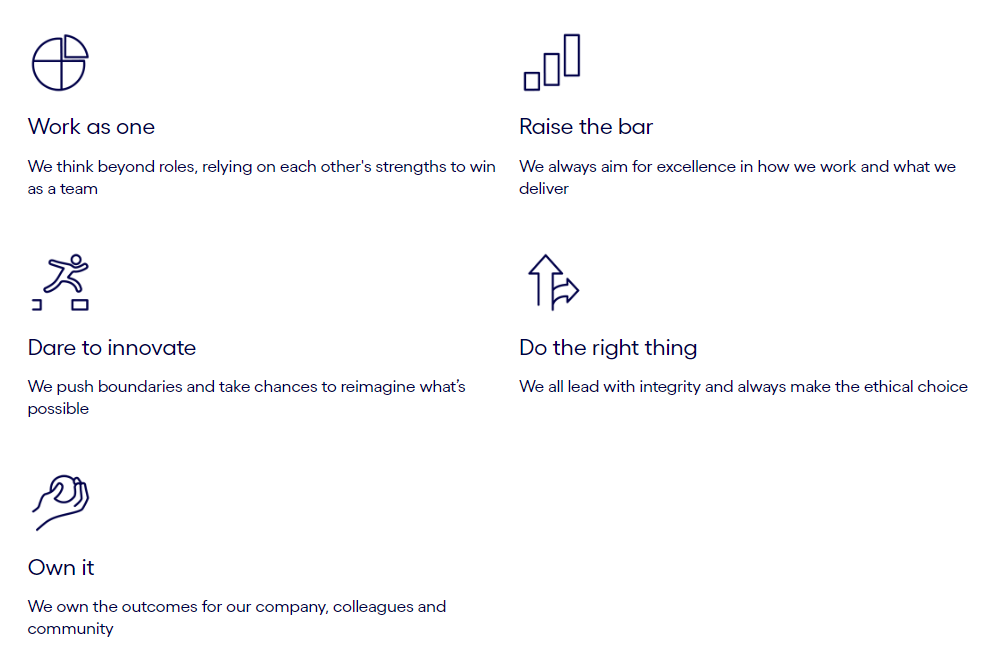
Values
Cognizant's values form the bedrock of their culture and define how they work together to serve their stakeholders.
3. About the Business Development Analyst Role
As a Business Development Analyst, you contribute across the pre-sales lifecycle-shaping responses to RFI/RFPs, enabling lead generation, and supporting go-to-market motions for specific industries and regions. You gather and synthesize customer, competitor, and market intelligence; coordinate inputs from delivery, solutions, pricing, and leadership teams; and help craft compelling narratives, references, and case studies that highlight Cognizant’s unique value propositions. The role blends research, analysis, stakeholder management, and structured communication to help win strategic deals.
Situated at the intersection of sales, solutions, and delivery, the BDA is a connective force in a global IT consulting environment. You manage sections of deal responses (including pricing inputs and estimations in coordination with specialists), support domain capability building, and capture project capabilities that strengthen the firm’s differentiators. By ensuring timely, high-quality proposals and market-informed insights, the role directly impacts pipeline conversion, revenue growth, and client trust-making it a high-visibility launchpad for careers in business development, consulting, and product/solution strategy.
4. Required Skills and Qualifications
Below are the essential qualifications and competencies for success in this role, organized by education, core capabilities, and technical proficiency.
Educational Qualifications
- MBA / Executive MBA (Full-time) graduating in 2026 (mandatory).
- A minimum of 60% aggregate in the pursuing degree with no standing arrears.
- Open only to Indian nationals, Overseas Citizens of India (OCIs), or Persons of Indian Origin (PIOs) currently residing in India.
- Required Work Experience: 0 – 35 Months (suitable for fresh graduates and those with limited experience).
Key Competencies
- Sales & Business Acumen: Strong understanding of the pre-sales cycle, with the ability to contribute to lead generation, go-to-market strategies, and develop compelling solutions.
- Market & Competitive Intelligence: Aptitude for gathering, analyzing, and reporting on industry information, including Know Your Customer (KYC), competitor intelligence, and market trends to inform strategy.
- Stakeholder Coordination & Collaboration: Excellent team and interpersonal skills to effectively coordinate pre-sales activities (RFI, RFP, client visits) between various internal and external stakeholders.
- Analytical & Problem-Solving Skills: Ability to analyze complex information, manage sections of deal responses (pricing, case studies), and contribute to solution development.
- Communication & Presentation Skills: Strong verbal and written communication skills to articulate Cognizant's Unique Selling Propositions (USPs) and create effective collaterals.
- Learning Agility & Adaptability: A positive attitude and drive to quickly learn and contribute across different functional areas like Software Development Lifecycle (SDLC) and various domains.
Technical Skills
- Pre-Sales & Proposal Management: Practical knowledge of handling Request for Information (RFI) and Request for Proposal (RFP) processes.
- Pricing & Estimation: Foundational skills in managing the pricing and estimation sections of deal responses.
- Functional & Domain Expertise: Ability to quickly acquire and apply functional expertise across projects and support domain capability building.
- Software Development Lifecycle (SDLC): A high-level understanding of SDLC to effectively contribute to and communicate about technology solutions.
5. Day-to-Day Responsibilities
The BDA’s routine blends structured research, collaborative proposal development, and stakeholder orchestration to progress opportunities through the pre-sales funnel. Typical activities include the following:
- Pre-Sales Cycle Management: Own and manage key stages of the pre-sales cycle including Request for Information (RFI), lead generation, and Go-to-Market strategies for specific geographies and industry segments.
- Market Intelligence & Analysis: Gather, analyze, and report critical industry information including Know Your Customer (KYC) data, competitor intelligence, and market trends to support business development decisions.
- Stakeholder Coordination & Collaboration: Coordinate between multiple stakeholders on pre-sales activities including RFI/RFP responses, collateral development, and client visits to ensure alignment and effective execution.
- Solution Development & Proposal Support: Contribute to the development of customized solutions for pre-sales; manage specific sections of deal responses including pricing, estimation, references, and case studies.
- Cross-Functional Learning & Contribution: Ability to learn and contribute across different functional areas including Software Development Lifecycle (SDLC) and domain expertise to enhance solution quality.
- Domain Capability Building: Support domain capability building activities and provide functional expertise to projects to strengthen organizational knowledge and competitive positioning.
- Solution Differentiation & Positioning: Capture project capabilities and highlight Unique Selling Propositions (USPs) of Cognizant solutions to effectively differentiate offerings in the marketplace.
6. Key Competencies for Success
Beyond eligibility, standout BDAs apply structured thinking, cross-functional coordination, and client-centric storytelling to influence win outcomes.
- Client-Centric Storytelling: Translates needs into compelling value propositions and outcomes-focused narratives.
- Commercial Awareness: Understands pricing levers, estimation assumptions, and risk/benefit trade-offs that shape competitive proposals.
- Program Management Discipline: Manages timelines, dependencies, reviews, and quality gates to deliver zero-defect submissions.
- Research Depth & Validation: Uses credible sources, triangulates data, and converts insights into clear, defensible recommendations.
- Learning Agility: Quickly absorbs domain, SDLC, and solution knowledge to adapt across industries and offerings.
7. Common Interview Questions
This section provides a selection of common interview questions to help candidates prepare effectively for their Business Development Analyst interview at Cognizant.
Provide a concise narrative linking your education, internships, and interest in pre-sales/business development.
Connect Cognizant’s global consulting presence and ethics/innovation recognition to your aspiration to impact growth via pre-sales.
Use STAR; emphasize planning, prioritization, and stakeholder updates leading to on-time delivery.
Explain alignment techniques: clarifying requirements, impact analysis, and documented decisions.
Show how market or competitor data informed a strategy, proposal, or pitch outcome.
Describe using urgency/impact matrices, deadlines, and transparent communication.
Discuss learning, collaboration, and measurable impact on win rates and revenue.
Highlight relationship-building, data-backed arguments, and aligning to shared goals.
Mention checklists, peer reviews, version control, and compliance to RFP requirements.
Show a growth path within business development/solutioning while contributing to marquee wins.
Prepare 2–3 STAR stories (deadline pressure, stakeholder conflict, research impact) and tailor them to pre-sales outcomes.
Discuss lead qualification, discovery, solutioning, proposal, pricing/estimation, and orals/negotiation.
RFI for capability fit; RFP for detailed solution and commercials-highlight compliance matrices and response strategy.
Cover client business model, priorities, buying centers, tech landscape, initiatives, and vendor history.
Identify competitor offerings, pricing tendencies, win themes, and differentiators to counter-position.
Define ICP, value propositions, solution bundles, content plan, and routes-to-market with metrics.
Scope, assumptions, SLAs, delivery model, risk buffers; collaborate with finance/delivery for validation.
Use a compliance matrix, map requirements to responses, and track mandatory certifications/appendices.
Quantified outcomes, client context, Cognizant’s approach, technologies used, and measurable impact.
Win rate, cycle time, response quality scores, shortlist rate, and pipeline coverage.
Scope creep, estimation variance, dependency risks; note mitigation via assumptions and governance.
Know the vocabulary: RFI/RFP, SOW, SLAs, assumptions, dependencies, and standard governance checkpoints.
Propose clarifying Q&A, list assumptions, and quantify risks/contingencies with an updated timeline.
Rebaseline plan, parallelize tasks, secure SME time, and communicate revised milestones and owners.
Facilitate a decision workshop using evaluation criteria, trade-off analysis, and client priorities.
Elevate to outcome-based proof points, differentiators, and references aligned to the client’s KPIs.
Offer scope options, delivery model alternatives, and phased roadmap to fit budget while preserving value.
Assess impact, update assumptions, secure approvals, and communicate clearly in an addendum.
Triangulate from credible proxies, segment assumptions transparently, and validate with SMEs.
Balance transparency with IP protection; provide high-level approach and reference architectures.
Prioritize by strategic value and feasibility; secure additional capacity and set daily check-ins.
Track shortlist/win outcomes, evaluator feedback, and post-mortems to improve response playbooks.
Use structured frameworks (STAR, decision matrices, assumptions/risks logs) to demonstrate clear, repeatable problem-solving.
Link objectives, your role, research/analysis, stakeholder coordination, and business impact.
Discuss structure, compliance, review cycles, and lessons learned.
Explain spreadsheets, assumptions, benchmarking, and collaboration with finance/delivery.
Show method, sources, synthesis, and resulting value proposition.
Demonstrate actionable insight and how it informs GTM and solution tailoring.
Mention access controls, need-to-know sharing, and secure repositories.
Explain trackers, checklists, and versioning practices that improved quality/on-time delivery.
Bridge outcomes, KPIs, and client priorities using clear, non-technical language.
Outline your learning plan, SME engagement, and how you applied insights.
Confirm flexibility and readiness per role expectations.
Map each resume point to a BDA capability: research, coordination, proposal quality, and commercial awareness.
8. Common Topics and Areas of Focus for Interview Preparation
To excel in your Business Development Analyst role at Cognizant, it’s essential to focus on the following areas. These topics highlight the key responsibilities and expectations, preparing you to discuss your skills and experiences in a way that aligns with Cognizant objectives.
- RFI/RFP Fundamentals: Study response structures, compliance matrices, evaluation criteria, and review workflows to deliver precise, on-time proposals.
- KYC and Market Intelligence: Practice frameworks to analyze client context, competitor moves, and market trends that inform positioning and GTM.
- Pricing & Estimation Basics: Understand scope, assumptions, delivery models, and risk buffers to support credible commercial sections.
- GTM and Value Proposition Design: Learn to articulate ICPs, differentiators, and outcomes that connect Cognizant capabilities to client KPIs.
- Stakeholder Coordination & Governance: Prepare to manage timelines, checkpoints, version control, and quality gates across global teams.
9. Perks and Benefits of Working at Cognizant
Cognizant offers a comprehensive package of benefits to support the well-being, professional growth, and satisfaction of its employees. Here are some of the key perks you can expect
- Learning and Career Growth: Access to structured training, mentorship, and capability building across domains and technologies.
- Global Exposure: Opportunities to collaborate with diverse, cross-functional teams serving clients across industries and geographies.
- Recognition Culture: Performance-driven environment with avenues to showcase impact through proposals, case studies, and client wins.
- Ethics and Inclusion: A workplace recognized for ethical business practices and an inclusive, merit-based culture.
- Flexible Assignments: Ability to work across offerings, industries, and offices based on business needs and role requirements.
10. Recruitment Process at Cognizant
The recruitment process at Cognizant consists of the following five steps:
1. Your Application
Candidates start by applying to an open position on the Cognizant careers site. If a suitable match isn't found, candidates can sign up for the Talent Community.
2. Initial Screening
A recruiter reviews the application to determine alignment with the role. If there's a match, the recruiter will reach out for a short introductory meeting. If both parties agree on the fit, the candidate's profile is shared with the hiring manager for further evaluation.
3. Interview
After the hiring manager reviews the profile, feedback is provided to the recruiter to schedule a business interview. Depending on the role, there may also be technical and/or client interviews.
4. Final Decision and Offer
Once the interviews are completed, candidates are informed whether they have been selected to join the team.
5. Onboarding
If the candidate accepts the offer, the recruiter will explain the onboarding process to welcome them to the team.
This recruitment process may vary depending on the specific role and location of the candidate. For more details, visit Cognizant.
11. Cognizant's Learning and Development Opportunities
Cognizant offers a comprehensive learning and development ecosystem to help associates build incremental skills aligned with their career aspirations and business needs. The key learning opportunities include:
1. Focused Development Plan
- Associates create a focused development plan with their managers to reach their goals.
2. Robust Learning Ecosystem
- Focuses on five skilling areas: Technical, Functional, Industry, Professional Development, and Leadership Development.
- Provides a self-service marketplace where associates can choose their learning path.
- Includes on-demand and live training, gamified experiences, virtual labs, and more.
3. Niche Training in High-Demand Technologies
- Offered through partners such as Adobe, Microsoft, Amazon Web Services, Oracle, SAP, and Udemy.
4. Leader Development Programs
- Provided through world-class vendor partners and universities.
5. Generative AI Training
- Offers GenAI learning paths for associates, tailored to their roles and GenAI journey.
6. Bluebolt Initiative
- Cognizant's innovation engine, fueled by associates' ideas, converts ideas into working prototypes and monetizes them to generate value for clients.
7. Propel Program
- A signature women's leadership development program for mid- and senior-level women leaders around the world, accelerating a diverse leadership pipeline and enabling women leaders to thrive in a digital era.
As of 2023, Cognizant has over 84,000 learning resources, 88,000+ completions of AI and GenAI learnings, and 139,000+ associates trained across digital skills. 90% of the global workforce are active learners.
12. Conclusion
The Business Development Analyst role at Cognizant is a high-impact launchpad for careers in consulting and growth strategy. By mastering pre-sales fundamentals-RFI/RFP processes, KYC research, GTM design, and pricing support-you directly influence win outcomes and client value. Success hinges on structured communication, stakeholder coordination, commercial awareness, and a learning mindset. Cognizant’s global exposure, ethical culture, and opportunities for capability building make it a compelling destination for ambitious graduates. Prepare deeply, tailor your stories to measurable outcomes, and show how you’ll elevate proposal quality and speed to help convert pipeline into revenue.
Tips for Interview Success:
- Anchor to Outcomes: Quantify impacts in your stories (cycle-time saved, win-rate uplift, cost reduction).
- Show Proposal Craftsmanship: Bring a mini compliance matrix or outline to demonstrate structure and attention to detail.
- Demonstrate Commercial Sense: Explain assumptions, risks, and trade-offs behind estimation or pricing scenarios.
- Connect to Cognizant Differentiators: Map your strengths to case studies, references, or solution themes relevant to the target industry.
