

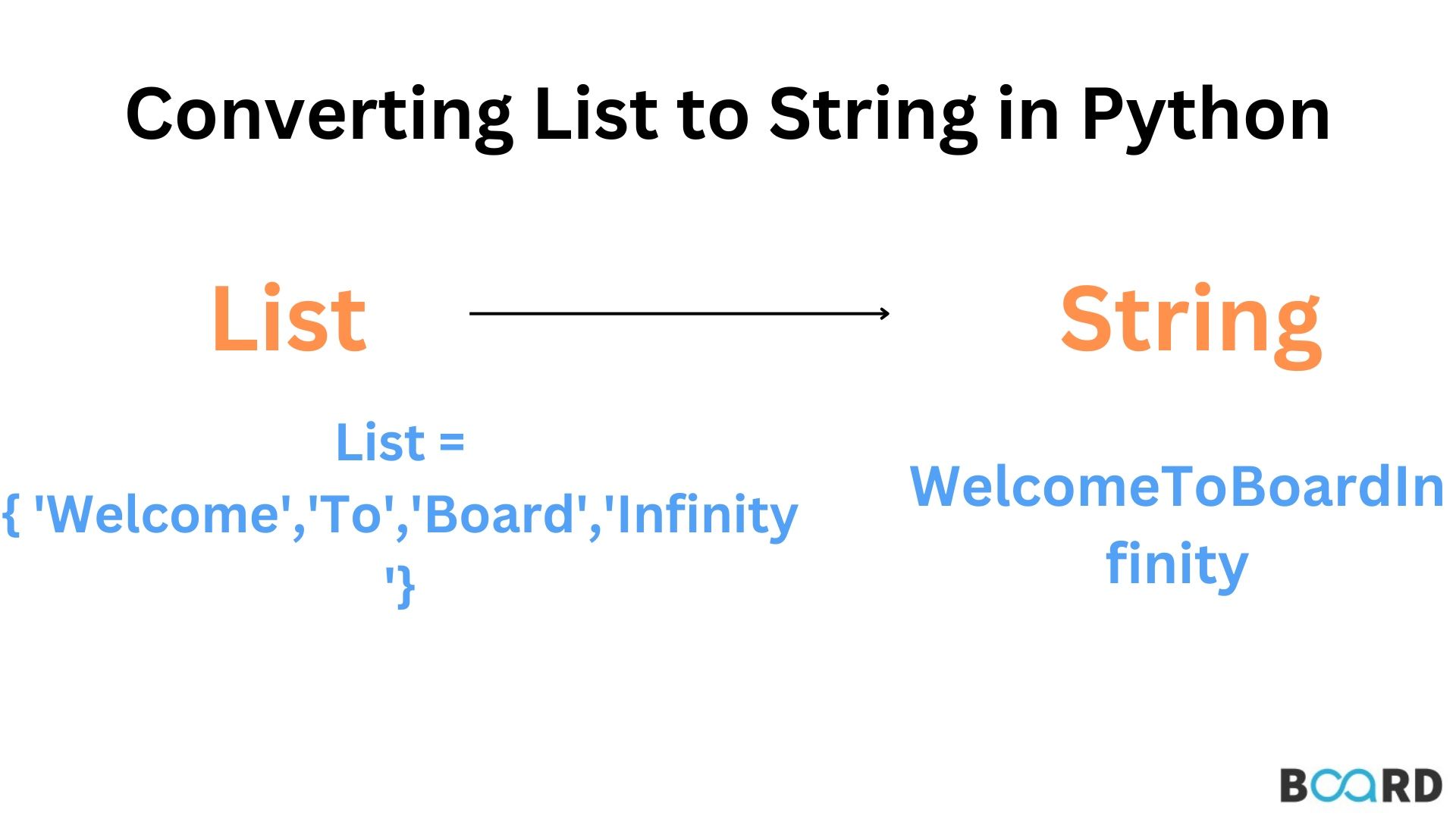
Python is one of the most popular programming languages today, and in this lesson, we will learn how to convert a list to a string in a variety of methods. Aside from that, we will go through Python details such as what is a list in Python, what is a string, and so on. Let us get started.
List in Python
In Python, a list is an ordered sequence that can hold several object types such as integer, character, or float. In various computer languages, a list is equivalent to an array. Square brackets are used to denote it, and a comma (,) is used to divide two things in the list.
A list and an array in other programming languages differ in that an array only stores the same data type, indicating that it is homogenous, whereas a list in Python can store diverse data types at the same time, indicating that it can be either homogeneous or heterogeneous. Here are some Python examples of homogeneous and heterogeneous lists:
Homogeneous List
String in Python
In Python, a string is an ordered sequence of characters. It should be emphasized that a list is an ordered sequence of object types, whereas a string is an ordered sequence of characters. This is the primary distinction between the two.
A sequence is a data type made up of several components of the same type, such as integers, floats, characters, and so on. This means that a string is a subset of the sequence data type, with all items represented as characters.
Output
BoardInfinity
We declare a string by assigning it to a variable. In this case, ‘a’ is a variable associated with the string Board Infinity. A string element can be accessed in the same way that a list element can. The indexing of elements in a string begins at 0.
How to Convert a List to String in Python
Using Join Function
The join function in Python is one of the simplest ways to convert a list to a string. The essential thing to remember when using this method is that the join function can only convert lists that contain just strings as elements into strings.
Output
BoardInfinity
Using Map Function
The map function can be used to convert a list to a string in two ways.
- if the list just contains numbers
- If the list is diverse,
The map() method takes two arguments;
The str() method converts the provided data type to the string data type.
An iterable sequence; the str() function will be called on each element in the sequence. An iterator will be used to return the string values.
Finally, the join() function is used to combine all of the values returned by str().
Output:
I want 4 apples and 18 bananas
List Comprehension
In Python, list comprehension builds a list of elements from an existing list. The for loop is then used to traverse the iterable objects in an element-wise manner.
Use Python List Comprehension with the join() method to convert a list to a string. The list comprehension will iteratively traverse the elements, and the join() method will concatenate the elements of the list into a new string and return it as output.
Output
I want 4 apples and 18 bananas
Conclusion
This brings us to the end of the article. These are the various techniques to convert list to string using python.
