
Data Structure vs Algorithm: Types, Differences & Code Examples
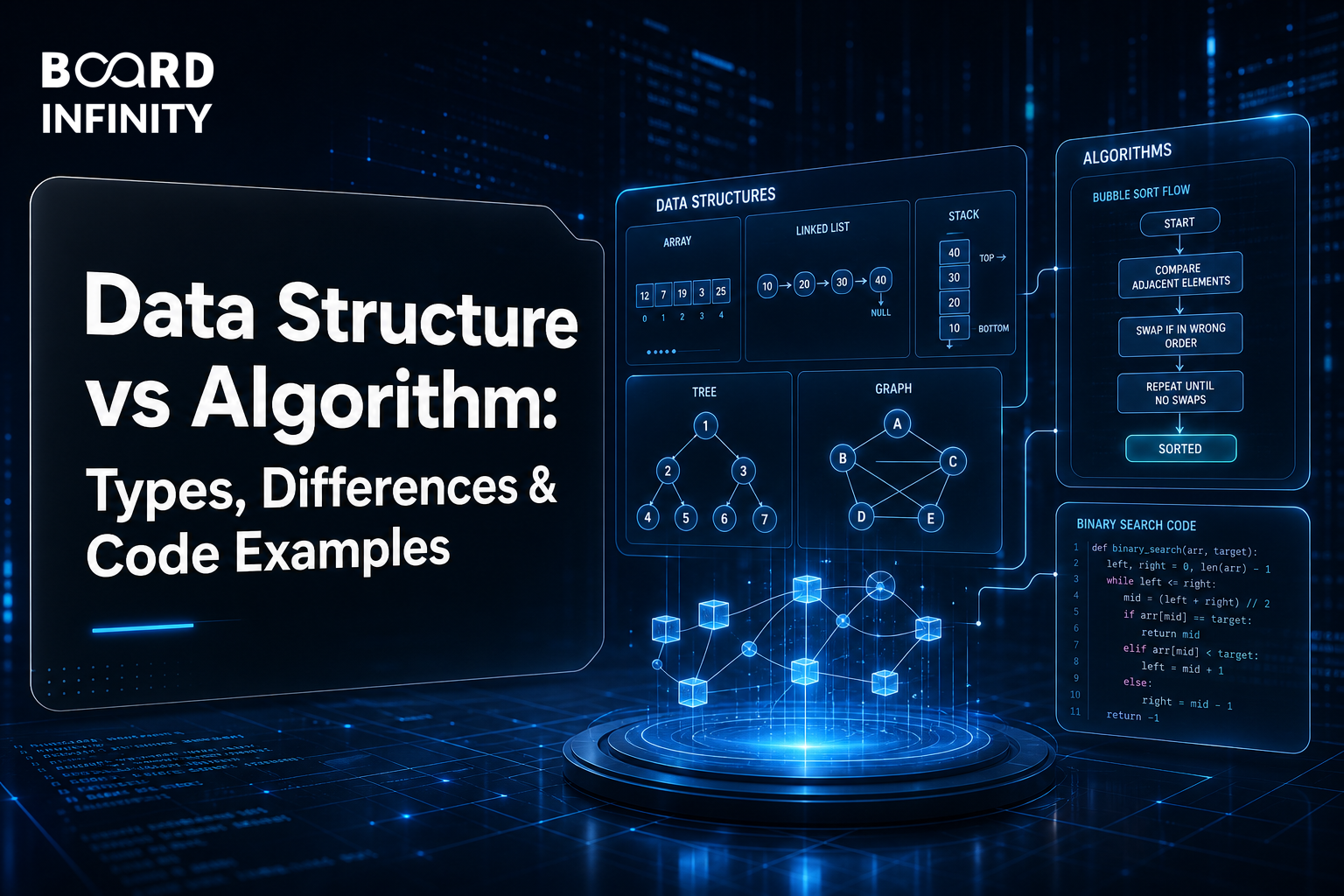
Data structure vs algorithm means the difference between how data is organised in memory and the step-by-step procedure used to process that data. The distinction matters because a fast algorithm can still fail with the wrong structure, such as checking millions of UPI transaction IDs in a list instead of a hash set.
Data structures and algorithms form the core of DSA, system design, database indexing, compilers, search engines, and production APIs. If you already understand basic programming flow, the next useful comparison is how an algorithm differs from its visual representation, covered in Difference Between Algorithm and Flowchart.
After reading, you will be able to explain the difference between ds and algorithm, choose the right structure-algorithm pair, analyse time and space complexity, and answer interview questions with concrete code-backed reasoning.
Core Concepts
The core idea is simple: a data structure stores and organises data; an algorithm consumes, transforms, searches, sorts, validates, or updates that data. They are separate concepts but almost always work together. A queue without an enqueue/dequeue algorithm is just a storage idea; binary search without a sorted array is invalid.
1.Data Structures Explained
A data structure is a storage and organisation strategy. It decides how values are placed, connected, indexed, and accessed in memory or persistent storage. The same Aadhaar numbers can be kept in an unsorted list, sorted array, B-tree index, or hash set; each choice changes lookup speed, insertion cost, memory overhead, and implementation complexity.
Familiar example: a contact list on a phone may use an array-like structure for display order and a hash map for fast search by name or number. Industry-specific example: a banking fraud system may store recent UPI transaction IDs in a hash set to detect duplicates quickly, while keeping transaction history in append-only logs for auditability.
Standard data structure classifications include primitive and non-primitive; linear and non-linear; static and dynamic; homogeneous and heterogeneous; internal memory and external storage structures. Common interview examples are arrays, linked lists, stacks, queues, deques, hash tables, heaps, trees, tries, graphs, and disjoint sets.
Code Example
2.Algorithms In Practice
An algorithm is a finite sequence of unambiguous steps that takes input, performs operations, and produces output. It is not the storage itself; it is the method applied to the storage. For example, binary search is an algorithm, while the sorted array on which it operates is a data structure.
Familiar example: searching a sorted PAN card helpdesk list can use binary search if the list is sorted by PAN number. Industry-specific example: an e-commerce marketplace may use a shortest-path or ranking algorithm to decide which warehouse should fulfil a delivery based on distance, stock, and service-level constraints.
Standard algorithm categories include searching, sorting, traversal, recursion, iteration, divide and conquer, greedy algorithms, dynamic programming, backtracking, graph algorithms, string matching, hashing-based algorithms, randomised algorithms, and approximation algorithms. Each category describes a problem-solving strategy, not a storage container.
Code Example
3.Operations And Complexity
The difference becomes clearer when you compare operations. Data structures support operations such as access, search, insertion, deletion, traversal, update, merge, and sometimes extract-min or extract-max. Algorithms define how those operations are carried out and how many steps they take as input grows.
Familiar example: checking whether a restaurant exists in a Zomato-like app can be O(n) in a list but average O(1) in a hash map keyed by restaurant ID. Industry-specific example: a hospital triage system may use a priority queue so that the most critical patient is extracted before routine cases, using heap operations internally.
Complexity analysis connects both sides. Time complexity measures operation growth, such as O(1), O(log n), O(n), O(n log n), O(n²), and O(2ⁿ). Space complexity measures extra memory used. Interviews also test best case, average case, worst case, and amortised cost, especially for dynamic arrays, hash tables, heaps, and balanced trees.
Code Example
4.Structure Algorithm Pairing
Most real solutions are pairs: one data structure plus one or more algorithms. A stack pairs naturally with depth-first processing, a queue with breadth-first processing, a heap with priority scheduling, a hash map with fast lookup, and a graph with traversal or shortest-path algorithms.
Familiar example: IRCTC booking queues can be modelled using queue-like processing where earlier confirmed actions should be handled predictably, while waitlist priority may need additional rules. Industry-specific example: a SaaS notification system may use a queue for pending emails and a retry algorithm for failed delivery attempts.
Graphs are the clearest example of pairing. The graph is the structure: vertices and edges. BFS, DFS, Dijkstra, Bellman-Ford, Floyd-Warshall, Kruskal, and Prim are algorithms applied on graphs for traversal, shortest path, and minimum spanning tree problems. For a focused graph treatment, see Graphs in Data Structure and Algorithm.
Code Example
5.Choosing The Right Pair
The practical decision is rarely “data structure or algorithm”; it is “which data structure supports the algorithm efficiently for this workload?” Choose based on access pattern, update frequency, ordering needs, duplicate handling, memory limits, concurrency, and worst-case guarantees.
Familiar example: if a food delivery app needs to show the latest orders first, a stack-like or timestamp-sorted list may work for display; if it needs to dispatch nearest riders, graph and priority-queue algorithms become more relevant. Industry-specific example: a banking ledger may prefer append-only logs and indexed lookup to preserve audit history and enable fast reconciliation.
For interviews, explain the trade-off explicitly. A hash map is excellent for average lookup but does not preserve sorted order by default. A balanced tree gives O(log n) search, insert, and delete while maintaining sorted order. A heap gives fast access to the highest or lowest priority element but not fast arbitrary search.
Code Example
Learning Path
Use this path to move from conceptual clarity to interview-level confidence. Practise each phase with small code examples first, then solve mixed problems where the structure and algorithm are not given directly.
Frequently Asked Questions
What is data structure vs algorithm?
Data structure vs algorithm compares data organisation with problem-solving procedure. A data structure stores data efficiently, while an algorithm defines the steps used to process that data for search, sorting, traversal, validation, or optimisation.
What is the difference between ds and algorithm?
The difference between ds and algorithm is that DS focuses on representation and access, while an algorithm focuses on computation and decision-making. For example, a queue is a data structure, but BFS is an algorithm that uses a queue.
Can an algorithm work without data structures?
Only very small algorithms can appear to work without explicit structures, usually by using primitive variables. In real programs, algorithms always operate on some representation of data, even if it is just an array, string, object, file, or database index.
Which should I learn first?
Learn basic data structures and simple algorithms together. Start with arrays, strings, loops, linear search, sorting, stacks, queues, and hash maps, then move to trees, graphs, heaps, recursion, dynamic programming, and greedy methods.
Why does binary search need a sorted array?
Binary search repeatedly discards half of the search space based on ordering. If the array is not sorted, the algorithm has no reliable reason to eliminate either half, so the result can be wrong.
Is Big-O about data structures or algorithms?
Big-O can describe both. It describes algorithm runtime growth, but the result depends strongly on the chosen data structure, such as O(1) average lookup in a hash map versus O(n) lookup in a list.
Are arrays and linked lists algorithms?
No. Arrays and linked lists are data structures because they describe how elements are stored and connected. Algorithms such as traversal, insertion, deletion, sorting, or searching can be performed on them.
What is the most common misconception?
The most common misconception is treating data structures and algorithms as interchangeable terms. They are related but distinct: the structure determines storage and access capabilities, while the algorithm determines the processing steps.
Key Takeaways
Data structures define storage and access patterns; algorithms define processing steps. The same algorithm can perform very differently on different structures, and the same structure can support many algorithms. Correct DSA reasoning always includes the chosen structure, the algorithm, time complexity, space complexity, and constraints.
For GATE and interviews, the most tested points are Big-O comparison, binary search requiring sorted random-access data, stack versus queue behaviour, tree and graph traversal, hash table average O(1) lookup, heap-based priority queues, and the distinction between ADT and implementation.
The natural next step is deeper graph practice through Graphs in Data Structure and Algorithm, because graphs clearly show how one data structure can support multiple algorithms such as BFS, DFS, shortest path, and spanning tree methods.
