
Business/Financial Analytics DPA Interview Guide
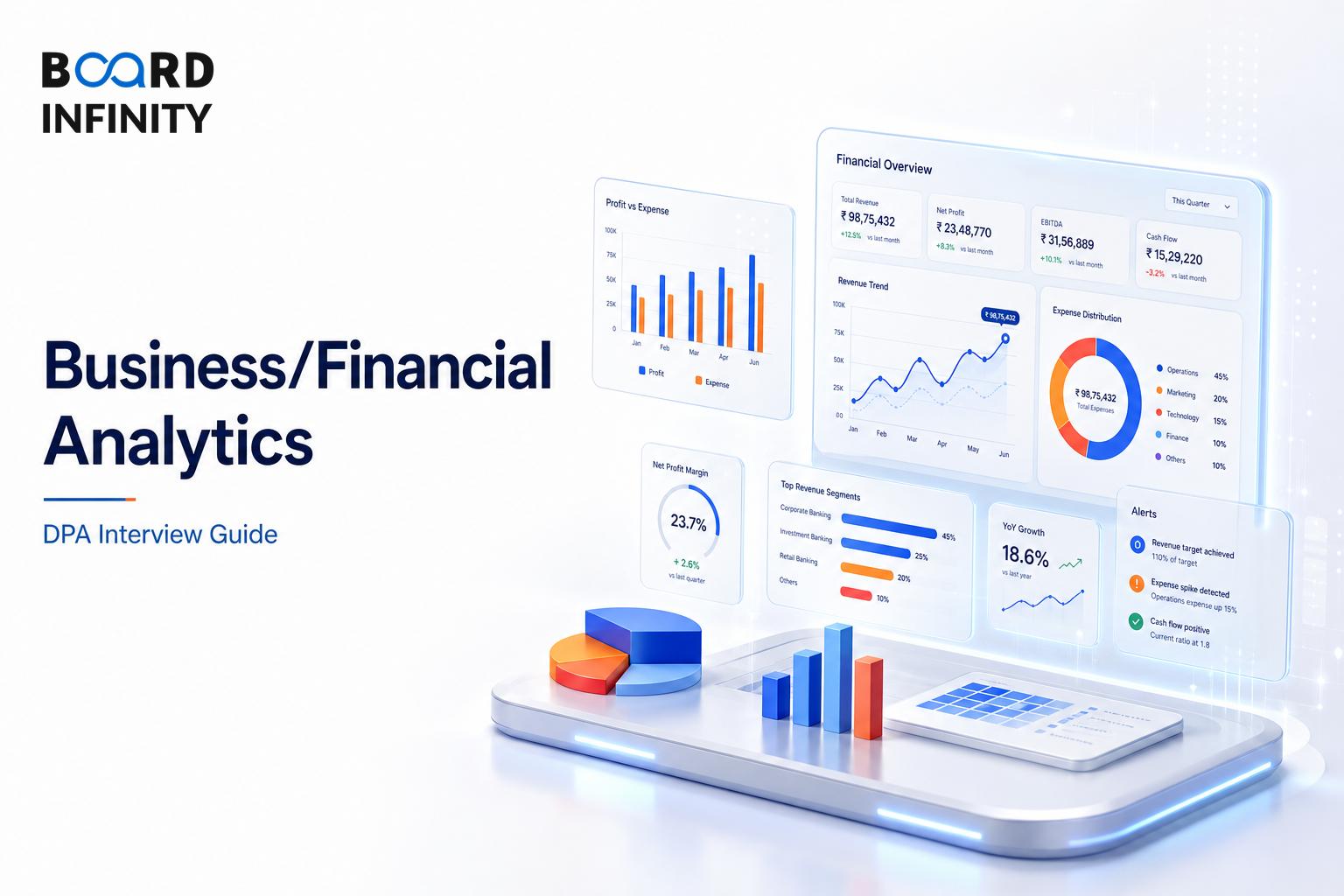
Business/Financial Analytics interns at Decimal Point Analytics Private Limited (DPA) turn raw financial and business data into usable research, reports, dashboards and decision support. The work matters because analysts help teams interpret markets, portfolios, risk indicators and forecasting signals before those insights reach internal or client-facing stakeholders.
This guide is built for MBA candidates preparing for the Business/Financial Analytics Management Trainee internship interview at DPA. It covers the role, required skills, responsibilities, interview process, role-specific questions, preparation topics, a 4-week plan and likely growth path.
1. About the Business/Financial Analytics (Management Trainee) Role
This role sits at the intersection of finance, analytics and business problem-solving. You may clean datasets, analyse securities or business metrics, prepare dashboards, automate repetitive reporting steps and convert findings into slides or reports that senior team members can use in client or internal discussions.
DPA works in financial research analytics for global financial-market clients and combines finance domain knowledge with technology capabilities such as Artificial Intelligence (AI), Machine Learning (ML) and automation on its official site, Decimal Point Analytics. Day-to-day, interns work with senior analysts, project leads and stakeholders who need clear, accurate and timely analysis.
2. Required Skills and Qualifications
Educational Qualifications
Skills Overview
3. Day-to-Day Responsibilities
A typical week can move between financial research, data preparation, analytics builds, report writing and review discussions. The internship is project-led, so your output must be accurate enough for senior team members to rely on while building client-ready insights.
Solve Analytics Problems
You may receive a business question linked to portfolio management, risk analysis, supply chain management or demand forecasting. Your task is to define the variables, inspect the data, identify patterns and create a structured output that helps the team decide what the numbers imply rather than only reporting what they are.
Research and Reports
You support financial research by collecting data, checking it for consistency, analysing patterns and turning findings into reports. This can include preparing recurring research outputs, updating calculations, documenting assumptions and improving parts of the reporting workflow so repeated tasks become faster and less error-prone.
Support Asset Projects
Projects may involve equities, bonds, derivatives or broader business analytics. In practice, this means understanding the product or business context, preparing the dataset, building comparison tables, checking calculations and summarising what the output says about performance, exposure, trend or risk.
Prepare Model Data
You learn and perform AI or ML based preprocessing before analysis can begin. This includes cleaning messy fields, standardising formats, structuring data models and creating basic visualisations in tools such as Excel, Python, Power BI, Tableau or Qlik, depending on what the project uses.
Automate and Dashboard
You may build simple automation or dashboard components using the available tools. Examples include reducing manual spreadsheet steps, refreshing a visual report, creating a tracker for business metrics or helping convert a one-time analysis into a repeatable reporting view.
Discuss Business Insights
You collaborate with senior team members to understand what the analysis means for business strategy or financial decision-making. This involves asking clarifying questions, validating assumptions, revising outputs after review and connecting the numbers to a practical recommendation or next step.
Create Stakeholder Outputs
You prepare presentations and reports for internal or external stakeholders. The work requires clean charts, concise commentary, traceable numbers and clear conclusions so the reader can understand the business issue, the method used and the key takeaway without reworking the analysis.
Flexible Project Support
You may be assigned relevant project work outside a narrow task list during the internship. Strong interns handle this by first clarifying the expected output, deadline, data source and review process, then delivering a clean first version that senior members can improve quickly.
4. Key Competencies for Success
High performers in this role do more than run tools. They protect data quality, connect analysis to the business question, communicate uncertainty clearly and improve after review without losing speed.
5. Interview Process at Decimal Point Analytics Private Limited (DPA)
For this internship, expect a campus-led process that checks finance basics, analytical reasoning, comfort with data tools and communication quality. Prepare for both conceptual questions and task-style discussions where you explain how you would clean data, analyse a financial product or present findings.
Campus Shortlist
The placement process usually begins with eligibility screening for MBA candidates. Your resume is checked for finance coursework, analytics exposure, projects, internships, tool familiarity and evidence that you can handle a short, output-driven internship.
Aptitude or Analytics Check
This round may test numerical reasoning, business interpretation, basic statistics, spreadsheet logic or finance concepts. Focus on accuracy, clear working and speed rather than trying to use complex methods when a simple calculation is enough.
Technical Finance Discussion
A senior analyst or manager may ask about accounting, valuation, financial markets, derivatives, mutual funds, data preprocessing or dashboarding. They are likely to probe how you reason, how you validate data and how you explain assumptions.
Case or Project Round
You may receive a portfolio, risk, forecasting or business analytics scenario. The interviewer looks for problem framing, data requirements, metric selection, analysis method, likely limitations and a clear recommendation that a stakeholder can act on.
HR and Fit Discussion
This discussion checks motivation, adaptability, teamwork, feedback orientation and interest in finance analytics. Be ready with crisp examples from MBA projects, internships or competitions where you handled data, worked with others and improved an output after review.
6. Interview Questions
Use STAR for behavioural answers, a step-by-step calculation approach for finance questions and a MECE structure for case answers. DPA interviewers will prioritise accuracy, analytical clarity, tool awareness and whether you can translate data work into useful business insight.
Behavioral and Company-Fit Questions
Technical and Financial Questions
Case-Based and Analytical Questions
7. Topics and Areas of Focus
Preparation should mirror the work: finance concepts, data cleaning, basic statistics, tool fluency and business communication. Aim to explain every concept with a small example, because this role rewards applied clarity over memorised definitions.
8. Preparation Plan
Finance Base
Revise accounting, markets and valuation with one-page summaries.
Data Practice
Clean, standardise and visualise datasets using Excel and Python.
Cases and Stories
Practise portfolio, risk, forecasting and automation scenarios.
Mock Review
Run timed mocks and fix weak explanations.
Pre-Interview Checklist
9. Career Growth & Next Roles
The internship offers a completion certificate, mentorship, hands-on exposure to business problems and a pre-placement interview or offer route for high performers. Progression depends on analytical accuracy, speed of learning, review quality, communication and the ability to own increasingly complex finance analytics work.
Business/Financial Analytics Intern
At this stage, you prove that you can learn quickly, clean data carefully, support research, build simple analysis and communicate findings. The key expectation is reliable execution under guidance, with clear assumptions, clean files and willingness to improve after review.
Business Scientist
High-performing interns may be considered for a full-time Business Scientist role. The focus shifts from assisting tasks to owning defined workstreams, improving automation, handling larger datasets and presenting analysis with enough clarity for project teams to use directly.
Senior Analyst Track
With experience, the role can expand into reviewing outputs, designing analysis logic, mentoring juniors and working on more complex finance or business analytics assignments. Promotion depends on quality control, domain depth, tool maturity and the ability to explain recommendations confidently.
Specialist or Lead Path
Beyond senior analyst responsibilities, growth can move toward a deep specialist path in financial analytics, automation or data modelling, or toward project leadership. To move up, you must prove client-ready judgement, repeatable delivery systems and the ability to guide others through ambiguous analytics problems.
10. Conclusion
The most important preparation step is to connect finance concepts with data execution. DPA is not only testing whether you know definitions or tools, but whether you can clean data, analyse it logically and explain what the output means for a business or financial decision.
Before the interview, build one strong story around a finance or analytics project and one practical walkthrough of data cleaning or dashboarding. Then practise role-specific cases on portfolio performance, risk analysis, demand forecasting and automation so your answers sound structured, specific and job-ready.
