
DSA for Beginners: DSA Basics, Roadmap, Code Examples & Interview Prep
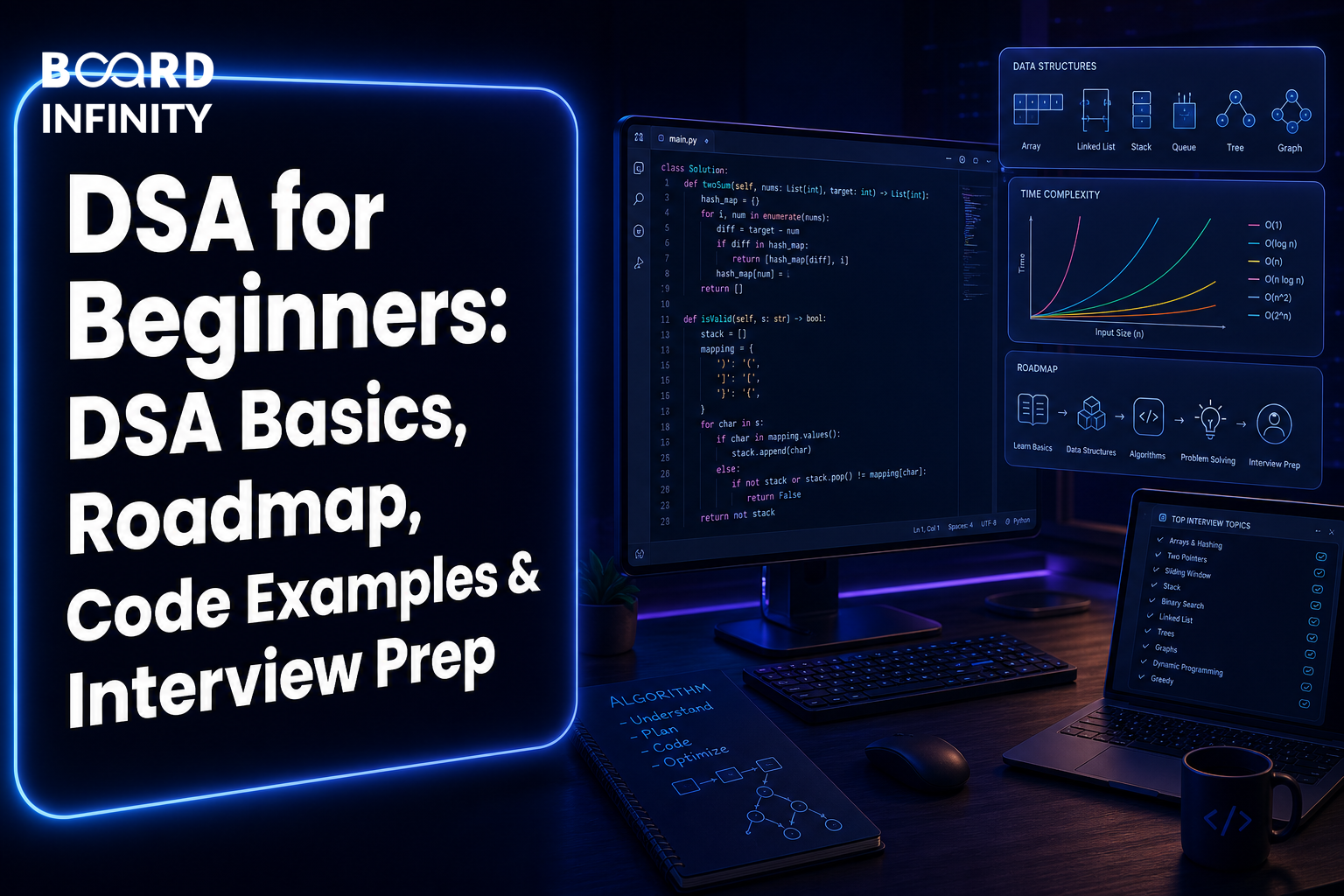
DSA for beginners means learning data structures and algorithms in a planned order so you can store data efficiently, process it correctly, and solve coding problems with predictable performance. It matters in practice because a UPI app, delivery platform, or hospital system must handle requests quickly, safely, and at scale.
DSA sits between programming syntax and real problem solving. Intermediate learners use it to move from writing working code to writing efficient code, while advanced learners use it to reason about trade-offs, edge cases, and system behaviour under load.
After reading, you will be able to learn DSA from scratch, choose the right data structure, analyse time complexity, implement core patterns in Python, and prepare focused answers for interviews and GATE-style questions.
Core Concepts
DSA has two connected parts: data structures, which decide how information is stored, and algorithms, which decide how work is performed on that information. The standard beginner-to-advanced path covers complexity analysis, arrays, strings, linked lists, stacks, queues, hashing, trees, heaps, tries, graphs, recursion, sorting, searching, greedy methods, divide and conquer, backtracking, dynamic programming, and range-query structures.
1.Complexity Analysis
Complexity analysis tells you how an algorithm behaves as input size grows. A solution that works for 100 entries may fail for 10 lakh entries if it repeats unnecessary work. Big O notation focuses on growth: O(1) is constant, O(log n) grows slowly, O(n) scans once, O(n log n) is common in efficient sorting, and O(n²) often comes from nested comparisons.
A familiar example is searching a contact in a sorted phone list: binary search checks the middle and discards half the list each time. An industry-specific example is a banking fraud system scanning transaction history; an O(n²) pairwise comparison across millions of payments can be too slow, while hashing or sorting may make the same check feasible.
Code Example
2.Arrays and Strings
Arrays store elements in order and support fast index-based access. Strings are sequence structures too, but usually immutable in languages like Python, which means repeated concatenation can be costly. Arrays and strings are the first serious step in dsa for beginners because many interview problems reduce to scanning, counting, reversing, grouping, or finding ranges.
A familiar example is checking whether a PAN number has the expected character pattern before sending it to a backend service. An industry-specific example is an e-commerce cart where item prices are scanned to compute discounts, taxes, and delivery thresholds. The main patterns are two pointers, prefix sums, sliding window, frequency arrays, and in-place updates where allowed.
Code Example
3.Linked Lists
A linked list stores data in nodes, where each node points to the next node. Unlike arrays, nodes do not need contiguous memory. This makes insertion and deletion efficient when you already have the relevant node reference, but random access is slow because reaching the kth item requires traversal from the head.
A familiar example is a music playlist where adding the next song after the current one does not require shifting all songs. An industry-specific example is a memory allocator maintaining free blocks as linked nodes. Standard variants include singly linked lists, doubly linked lists, circular linked lists, and linked lists with sentinel nodes.
Code Example
4.Stacks
A stack follows last-in, first-out order: the last item added is the first item removed. Stacks appear whenever the most recent unfinished task must be handled first. They are central to function calls, expression evaluation, browser history, undo operations, and monotonic stack problems.
A familiar example is undo in a notes app: the latest edit is reversed first. An industry-specific example is validating nested JSON payloads in a SaaS API gateway before the request reaches business logic. Interviewers often use balanced brackets, next greater element, and min-stack design to test stack understanding.
Code Example
5.Queues and Deques
A queue follows first-in, first-out order: the earliest item added is served first. A deque, or double-ended queue, supports insertion and removal from both ends. Queues model waiting lines and breadth-first processing, while deques are useful for sliding windows and bidirectional operations.
A familiar example is an IRCTC booking request queue during peak traffic, where earlier requests should be processed before later ones. An industry-specific example is a hospital triage stream where patients enter a processing queue and critical cases may be handled through priority rules layered over queueing. In Python, collections.deque is preferred over list for queue operations.
Code Example
6.Hash Tables
A hash table stores key-value pairs and supports average O(1) lookup, insertion, and deletion. It works by converting a key into an index using a hash function. Collisions can occur when different keys map to the same location, so implementations use strategies such as chaining or open addressing.
A familiar example is checking duplicate mobile numbers during account signup. An industry-specific example is a payments reconciliation service mapping transaction IDs to settlement records. Hashing is also used in caching, frequency counting, grouping, two-sum problems, and deduplication pipelines.
Code Example
7.Trees and BSTs
A tree is a hierarchical structure with nodes connected by parent-child relationships. Important variants include general trees, binary trees, binary search trees, balanced trees, expression trees, heaps, tries, and segment trees. A binary search tree keeps smaller values on the left and larger values on the right, enabling efficient search when the tree remains balanced.
A familiar example is a folder structure on a laptop, where folders contain files and subfolders. An industry-specific example is a SaaS permission hierarchy where organisation, workspace, project, and user roles form a tree. Tree problems frequently involve traversal: preorder, inorder, postorder, and level order.
Code Example
8.Heaps and Priority Queues
A heap is a specialised tree-based structure where the smallest or largest item is kept at the top, depending on min-heap or max-heap design. Python’s heapq implements a min-heap. Heaps are ideal when you repeatedly need the next highest-priority item without fully sorting the entire dataset.
A familiar example is selecting the top three exam scores from a large list. An industry-specific example is a logistics platform assigning urgent deliveries before regular deliveries. Heaps also support Dijkstra’s algorithm, event simulation, task scheduling, and top-K analytics.
Code Example
9.Tries
A trie, also called a prefix tree, stores strings character by character. It is useful when many strings share prefixes and prefix-based queries must be fast. Unlike hashing, a trie naturally supports prefix search, autocomplete, lexicographic traversal, and word existence checks.
A familiar example is autocomplete in a phone keyboard after typing the first few letters of a contact name. An industry-specific example is a healthcare search system suggesting medicine names as a doctor types. Tries can use more memory than hash sets, so they are chosen when prefix behaviour is central to the problem.
Code Example
10.Graphs
A graph contains vertices connected by edges. Graphs may be directed or undirected, weighted or unweighted, cyclic or acyclic, connected or disconnected, sparse or dense. Standard representations are adjacency lists, adjacency matrices, and edge lists. The right representation depends on memory limits and operation needs.
A familiar example is metro stations connected by routes. An industry-specific example is a food delivery platform connecting restaurants, riders, customer locations, and route segments. BFS is used for shortest path in unweighted graphs, DFS is used for traversal and cycle detection, and Dijkstra’s algorithm handles non-negative weighted shortest paths.
Code Example
11.Recursion and Backtracking
Recursion solves a problem by calling the same function on smaller input. Every recursive solution needs a base case and progress toward that base case. Backtracking extends recursion by exploring choices, rejecting invalid paths, and undoing choices before trying the next option.
A familiar example is generating all possible PIN patterns under specific rules. An industry-specific example is an ed-tech assessment engine generating valid question combinations based on topic, difficulty, and time limits. Backtracking is common in permutations, combinations, subsets, N-Queens, Sudoku, and constraint satisfaction problems.
Code Example
12.Sorting and Searching
Sorting arranges data in a defined order, while searching finds whether or where a target exists. Standard sorting algorithms include bubble sort, selection sort, insertion sort, merge sort, quicksort, heap sort, counting sort, radix sort, and bucket sort. Searching includes linear search, binary search, lower bound, upper bound, and search on answer.
A familiar example is sorting movie tickets by price before choosing the cheapest option. An industry-specific example is an analytics dashboard sorting sellers by revenue and using binary search on sorted timestamps to find events in a date range. Sorting often enables simpler and faster logic for duplicate detection, interval merging, and two-pointer problems.
Code Example
13.Greedy Algorithms
A greedy algorithm makes the best local choice at each step. It is attractive because greedy solutions are often simple and fast, but they work only when the problem has a valid greedy-choice property and optimal substructure. Without proof, greedy can produce wrong answers.
A familiar example is choosing the fewest Indian currency notes for amounts where denominations support the greedy approach. An industry-specific example is selecting the maximum number of non-overlapping ad slots in a media platform by always choosing the earliest finishing slot. Greedy is common in interval scheduling, activity selection, Huffman coding, minimum platforms, and some graph algorithms such as Kruskal and Prim.
Code Example
14.Divide and Conquer
Divide and conquer splits a problem into smaller parts, solves those parts, and combines their answers. The pattern is powerful when subproblems are independent or nearly independent. Merge sort, quicksort, binary search, closest pair of points, and fast exponentiation are classic examples.
A familiar example is searching a dictionary by repeatedly opening near the middle instead of reading every page. An industry-specific example is processing a large sales report by splitting it across time ranges, summarising each range, and merging results. Divide and conquer is also the mental foundation for many recursive optimisations.
Code Example
15.Dynamic Programming
Dynamic programming stores answers to overlapping subproblems so they are not recomputed. It is used when a problem has optimal substructure and repeated states. DP can be written as top-down memoisation or bottom-up tabulation. The hardest part is defining the state correctly.
A familiar example is counting the number of ways to climb stairs when you can take one or two steps. An industry-specific example is a subscription pricing engine selecting the best bundle combination under budget and feature constraints. Standard DP families include one-dimensional DP, two-dimensional DP, grid DP, interval DP, tree DP, bitmask DP, digit DP, and knapsack DP.
Code Example
16.Range Queries
Range-query structures answer questions over intervals, such as sum from index L to R or minimum value in a range. Prefix sums handle static range sums. Fenwick trees support point updates and prefix queries. Segment trees support broader range queries and updates. Sparse tables answer static idempotent queries such as range minimum efficiently after preprocessing.
A familiar example is calculating total mobile data usage between two dates. An industry-specific example is a retail inventory dashboard that repeatedly asks for total stock across warehouse ranges while individual warehouses receive updates. Range-query structures are essential when repeated queries make direct scanning too slow.
Code Example
Learning Path
A good roadmap prevents random practice. Move from implementation fluency to pattern recognition, then to timed problem solving and explanation. If your aim is competitive programming, the natural practice extension is learning contest discipline through How to become a 5 Star Coder at CodeChef in 7 Easy Steps?.
Practice Strategy
Start each topic with implementation, then solve easy pattern problems, then solve mixed problems where the topic is not revealed. This builds recognition rather than dependency on labels. Track failed attempts by reason: wrong data structure, missed edge case, incorrect complexity, or weak proof.
Frequently Asked Questions
What is DSA for beginners?
DSA for beginners is a structured way to learn data structures, algorithms, complexity analysis, and problem-solving patterns. It helps you move from basic programming to writing efficient solutions for interviews, contests, and production systems.
How should I learn DSA from scratch?
Start with Big O, arrays, strings, hashing, recursion, and sorting. Then move to linked lists, stacks, queues, trees, graphs, greedy algorithms, backtracking, and dynamic programming. Practise each topic with implementation plus problem-solving patterns.
What are the most important dsa basics?
The most important dsa basics are time complexity, space complexity, arrays, strings, hash maps, recursion, sorting, searching, stacks, queues, trees, and graphs. These concepts appear repeatedly in advanced topics such as DP, shortest paths, and range queries.
Which language is best for DSA?
Python is beginner-friendly and fast to write, while C++ is common in competitive programming because of speed and the STL. Java is also strong for placements and backend roles. Choose one language and learn its collections deeply.
When should I use arrays vs linked lists?
Use arrays when you need fast indexing, compact memory layout, and frequent scanning. Use linked lists when insertions or deletions are frequent and you already have node references. For most interview problems, arrays are more common than linked lists.
When should I use BFS vs DFS?
Use BFS for shortest path in unweighted graphs and level-order traversal. Use DFS for exploring connected components, cycle detection, topological sorting, and recursive tree-style exploration. Both are O(V + E) with adjacency lists.
Why is dynamic programming difficult?
Dynamic programming is difficult because the main challenge is not coding but defining the right state and transition. Start with one-dimensional DP, then grid DP, then knapsack-style problems before moving to interval, tree, bitmask, and digit DP.
What is the biggest beginner mistake in DSA?
The biggest mistake is memorising solutions without understanding the invariant, state, or proof. A better approach is to ask why a data structure fits, what operation is being optimised, and which edge cases can break the solution.
Key Takeaways
DSA becomes manageable when learned in order: complexity first, then linear structures, hashing, trees, heaps, tries, graphs, recursion, sorting, greedy, divide and conquer, dynamic programming, and range queries. Each topic should be practised through implementation, pattern problems, edge cases, and complexity explanation.
For GATE and interviews, the most tested points are Big O analysis, binary search conditions, stack and queue operations, tree traversals, BFS vs DFS, hashing trade-offs, greedy proof, and DP state-transition-base-case design.
The natural next step is regular timed practice, mock explanations, and topic-wise revision. Keep a mistake log and revisit failed problems until you can explain the invariant, not just reproduce the code.
