
DSA Mistakes to Avoid: Learning Traps, Code Examples & Interview Fixes
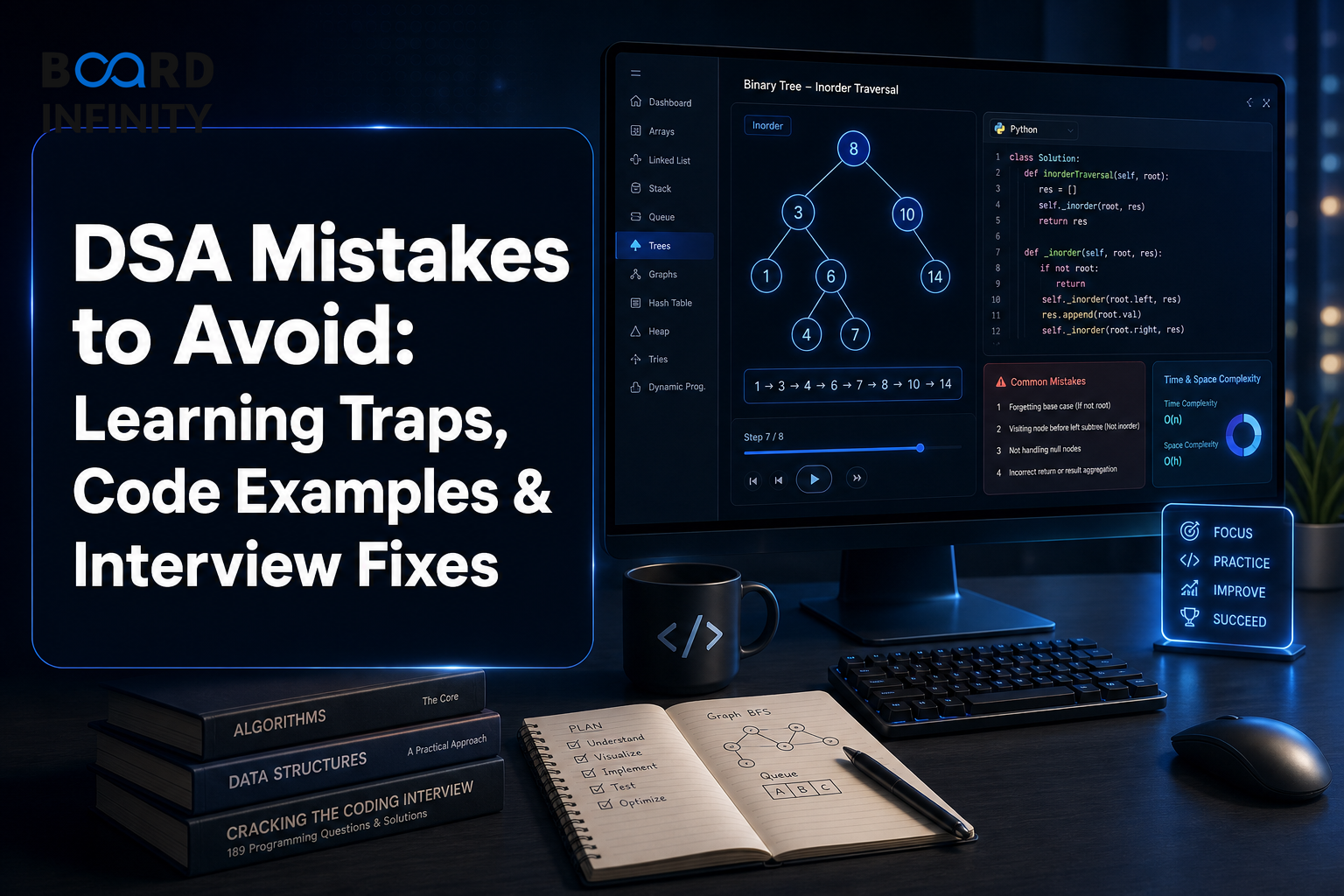
DSA mistakes to avoid are repeated learning habits that slow down algorithmic thinking, such as memorising solutions, skipping complexity analysis, and ignoring edge cases. They matter because a correct-looking solution can still fail on large UPI transaction logs or timed interview tests. After reading, you can diagnose your weak spots and practise DSA more deliberately.
DSA sits between programming fundamentals and production problem-solving: arrays, maps, heaps, trees, graphs, recursion, and dynamic programming become the tools used to reason about performance. Intermediate learners often know syntax already, but lose marks or interview rounds because they choose the wrong structure, cannot justify Big O, or cannot explain trade-offs.
You will learn the major DSA learning tips that separate random practice from measurable progress: how to build foundations, test edge cases, dry-run logic, review mistakes, and communicate solutions clearly in GATE-style and placement interviews.
Core Concepts
The core concepts here are the actual mistake patterns that damage DSA progress. Each one has a technical symptom, a practical consequence, and a correction habit. Treat this as a diagnostic checklist rather than a motivational list: the goal is to find exactly where your learning process breaks.
1.Weak Foundations
Weak foundations are the most expensive DSA mistake because every advanced topic depends on simple operations. If you do not know what push, pop, peek, enqueue, dequeue, lookup, traversal, and recursion stack mean internally, you may still memorise answers but struggle to adapt them.
A familiar example is checking whether brackets are balanced in an Aadhaar form validation rule: a stack naturally stores the most recent opening symbol. An industry-specific example is healthcare workflow validation, where nested approval steps must close in the correct order before a patient discharge record is finalised.
The fix is not to reread definitions endlessly. Implement each structure in small problems, then explain why that structure fits better than alternatives. For example, a stack fits balanced parentheses because the last opened bracket must close first; a queue fits IRCTC-style waiting order because the earliest request should be processed first.
Code Example
2.Ignoring Complexity
Ignoring time and space complexity is one of the most common dsa mistakes to avoid because it hides until input size grows. A solution that checks every item linearly may pass five sample cases, then fail when the constraint says n = 10^5.
A familiar example is checking whether a PAN number exists in a small list versus a large national-scale record set. A banking-specific example is fraud detection, where checking every blocked account in a list for every transaction can become too slow; a hash set gives average-case constant-time membership lookup.
The correction habit is simple: before coding, write the expected input size, target complexity, and most expensive operation. After coding, re-check loops, nested loops, sorting, recursion depth, and extra data structures. This habit improves both interview answers and real-world performance decisions.
Code Example
3.Memorising Patterns
Pattern memorisation becomes harmful when you remember the shape of a solution but not the reason it works. DSA patterns are useful only when you understand the invariant: what remains true at each step. Without that, a small change in constraints can break your approach.
A familiar example is splitting a UPI dinner bill and finding two payments that add to a target amount. An e-commerce example is matching two discount adjustments that together equal a refund target. Both look like Two Sum, but the real idea is storing what you have seen so you can find the required complement quickly.
The better habit is to ask four questions: What is the state? What decision happens at each step? What must be remembered? What answer is returned? This turns patterns into reasoning tools instead of fragile templates.
Code Example
4.Skipping Dry Runs
Skipping dry runs causes subtle bugs in loops, windows, recursion, and binary search. A dry run is not just checking sample input mentally; it is tracing variable values step by step until you can prove why the algorithm moves forward correctly.
A familiar example is calculating the maximum spending over any three consecutive UPI payments in a personal finance app. A SaaS example is finding the maximum number of API errors in any five-minute window from monitoring data. In both cases, a sliding window works only if you add the incoming item and remove the outgoing item exactly once.
Use a table with index, current value, window sum, best answer, and movement rule. This is especially useful when constraints require O(n), because recomputing every window from scratch may turn a simple problem into an avoidable performance failure.
Code Example
5.Missing Edge Cases
Missing edge cases means your algorithm works only for the neat version of the problem. Real test cases include empty arrays, one-element arrays, duplicates, negative values, already sorted data, reverse sorted data, overflow-prone sums, disconnected graphs, and impossible states.
A familiar example is IRCTC booking logic when zero seats are available or only one seat remains. A banking example is handling a failed transaction where the amount is valid but the transaction ID is duplicated. In DSA, these cases usually expose wrong boundary conditions.
Binary search is the classic edge-case trap. Many learners know the idea but write loops that skip the answer, run forever, or fail when the target should be inserted at the beginning or end. A robust version makes the search interval and return value explicit.
Code Example
6.Poor Debugging Habits
Poor debugging habits turn learning into guesswork. Beginners often change multiple lines at once, rerun hidden tests, and hope for acceptance. Intermediate learners improve faster by identifying the exact failed assumption: wrong input handling, wrong loop invariant, wrong data structure, or wrong base case.
A familiar example is a food delivery cart where removing one item accidentally removes all items with the same name. A healthcare example is a triage queue where a discharged patient remains in the queue because state was mutated in the wrong place. Both are easier to catch with small focused tests.
Use assertions for known outcomes, print only the variables connected to the suspected bug, and create the smallest failing input. Debugging is also an interview skill: explaining how you would verify correctness shows maturity beyond simply writing code.
Code Example
7.Jumping Too Advanced
Jumping too advanced feels productive but often creates shallow understanding. Segment trees, tries, graph shortest paths, advanced DP, and bitmasking become easier only after arrays, hashing, sorting, recursion, stacks, queues, BFS, DFS, and basic DP are stable.
A familiar example is trying to optimise a delivery route before understanding simple grid traversal. An ed-tech example is building a recommendation graph before knowing how BFS discovers nearest connections. BFS is a foundational graph idea: visit nodes level by level, which naturally gives the shortest path in an unweighted graph.
The correction is layered practice. When stuck on an advanced problem, identify the prerequisite you are missing rather than collecting more templates. Many “advanced” interview problems are combinations of basics under stricter constraints.
Code Example
8.No Review System
No review system makes progress look larger than it is. Solving 100 problems once is less valuable than understanding why 25 of them failed and revisiting those mistakes until the pattern becomes automatic.
A familiar example is repeatedly making off-by-one errors in date-range problems for travel bookings. A SaaS example is repeatedly mishandling pagination boundaries in API results. Both mistakes disappear faster when recorded with the cause, corrected approach, and next review date.
A good error log contains the problem name, topic, failed assumption, correct invariant, complexity, and retest date. This is one of the highest-impact dsa learning tips for intermediate learners because it converts failure into a searchable personal syllabus.
Code Example
Learning Path
A structured path prevents random topic hopping. Use this sequence if you already know at least one programming language and want interview-ready DSA skills without wasting time on repeated beginner traps.
Frequently Asked Questions
What are the most common mistakes beginners make while learning DSA?
The most common mistakes are weak fundamentals, memorising patterns, ignoring time complexity, skipping dry runs, missing edge cases, poor debugging, jumping to advanced topics too early, and not reviewing failed problems. These mistakes matter because DSA tests reasoning under constraints, not just code that works on sample input.
Is memorising DSA patterns bad?
Memorising patterns is useful only after you understand why they work. For example, Two Sum is not just a hashmap template; it is a complement lookup invariant. If you cannot explain the invariant, the pattern will fail when constraints change.
How do I stop making edge-case mistakes in DSA?
Use a fixed checklist before submission: empty input, one element, duplicates, negative values, sorted input, reverse sorted input, target absent, and maximum constraints. For graphs, also check disconnected components and cycles. For recursion, check base cases and recursion depth.
Should I learn advanced DSA before mastering basics?
No, advanced topics become much easier when the basics are automatic. Segment trees, DP, tries, and graph algorithms often combine arrays, recursion, hashing, binary search, BFS, or DFS. If those foundations are weak, advanced solutions feel like memorised formulas.
How many DSA problems should I solve for interviews?
There is no verified universal number because interview difficulty varies by company and role. A better target is coverage: solve enough problems in each major topic until you can identify the pattern, explain the invariant, code correctly, and analyse complexity without hints.
What is the best way to review DSA mistakes?
Maintain an error log with topic, failed assumption, correct idea, complexity, and retest date. Review by mistake category, such as off-by-one errors or wrong graph visited logic. This turns repeated failure into targeted revision.
How do I improve DSA problem-solving speed?
Speed improves when recognition and implementation both become reliable. Practise common patterns, but also time your dry run, coding, testing, and explanation. Avoid rushing directly to code because debugging a wrong approach usually takes longer than planning.
Key Takeaways
The most damaging DSA mistakes to avoid are weak fundamentals, skipping complexity analysis, memorising without invariants, ignoring edge cases, and failing to review errors. Strong learners build a loop: understand the structure, choose the right operation, dry-run carefully, test boundary cases, and record the mistake for revision.
For GATE and interviews, the most tested points are Big O analysis, recursion behaviour, stack and queue applications, binary search boundaries, graph traversal correctness, DP state design, and data structure selection. Your answer should always include approach, correctness, complexity, and edge cases.
