
Effective Supervision for First-Time Managers: A Practical Guide
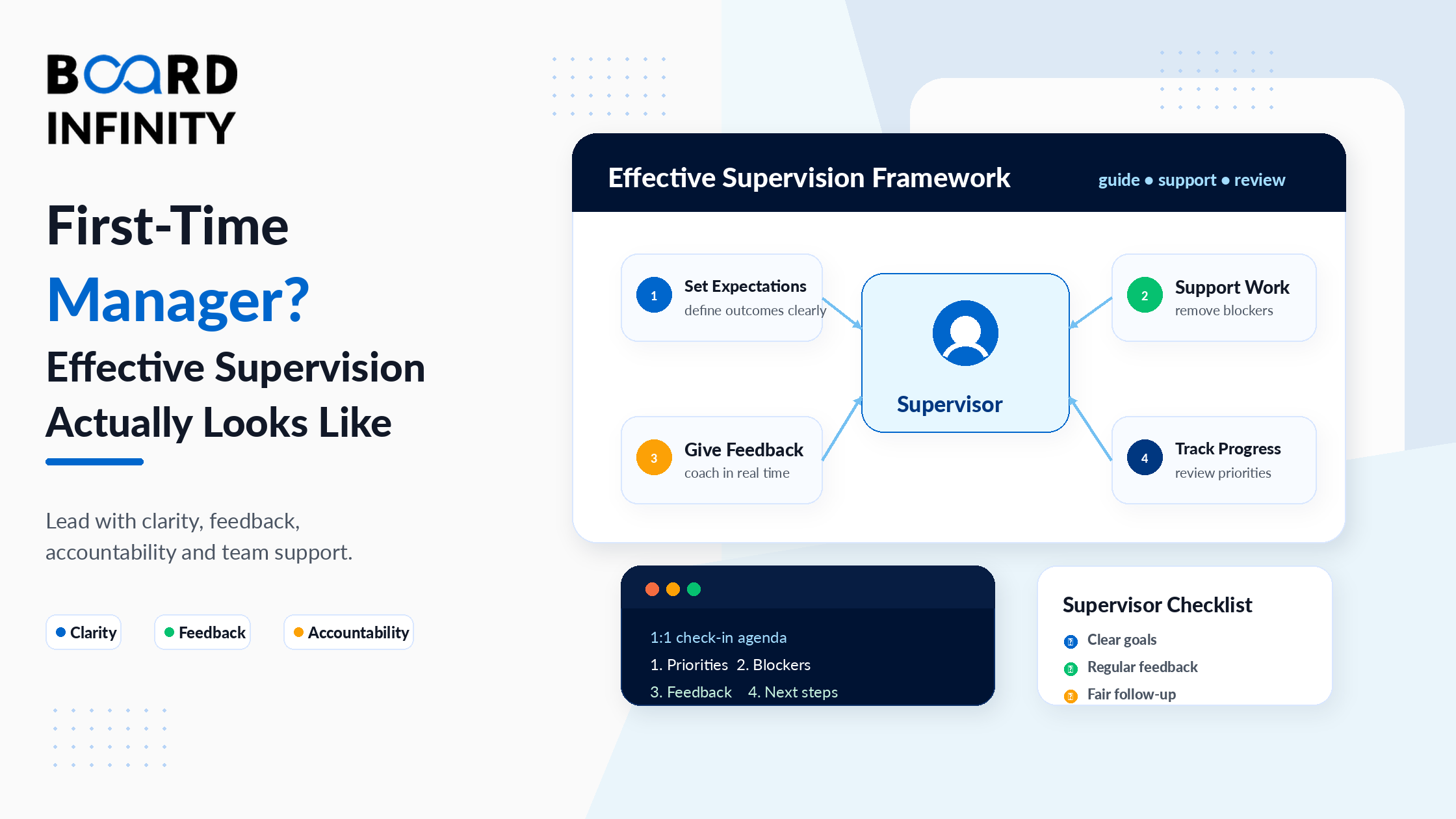
The promotion felt like recognition. And it was. But a few weeks in, most new supervisors hit the same wall: nobody explained what the job actually requires. You were promoted because you were excellent as an individual contributor. But supervision is a different job entirely - one that requires skills you've never been formally taught and instincts that take deliberate practice to develop.
The most common experience among new supervisors is feeling like an impostor. You're managing people who were your peers days ago. You're expected to have answers you don't have. You're trying to be liked while also holding people accountable. And nobody gave you a manual. The result is often one of two extremes: either you micromanage because you can't let go of the control that made you successful as an individual, or you under-manage because you're afraid of damaging relationships by pushing too hard.
This guide is the manual you weren't given. It covers what supervision actually means, what your core responsibilities are, how to build authority without becoming authoritarian, how to communicate expectations clearly, and how to give feedback that genuinely changes behavior. If you've just stepped into a supervisory role - or are about to - everything in this guide applies on day one.
Who This Guide Is For
This guide is for you if you:
- Were recently promoted from individual contributor to supervisor or team lead
- Are managing a team for the first time and feel underprepared
- Have been supervising for a while but feel like you're winging it
- Want a practical framework for the day-to-day realities of people management
1. What Supervision Actually Is - And What It Isn't
Most new managers walk into the role with a fundamental misconception: they think supervision is about telling people what to do and making sure it gets done. That's task management. Supervision is something broader and more demanding.
Supervision is the ongoing process of creating the conditions in which your team can do their best work. That includes setting direction, allocating resources, removing obstacles, building capability, holding people accountable, and maintaining the team's psychological safety - simultaneously, every day.
The critical insight that changes everything for new supervisors: your success is now measured entirely through your team's output - not your own. The skills that got you promoted (individual technical excellence, personal productivity, expert problem-solving) are no longer the primary measure of your performance. What matters now is your team's results. This shift in mindset - from "what did I accomplish today?" to "what conditions did I create for my team?" - is the first and most important transition you need to make.
| Individual Contributor Mindset | Supervisor Mindset |
|---|---|
| "How much did I get done today?" | "Did my team have what they needed to do their best work today?" |
| "I'll just do this myself - it's faster" | "How do I develop someone on my team to own this?" |
| "My expertise is my value" | "My team's growth and output is my value" |
| "I need to know the answer" | "I need to know who knows the answer, or how to find it" |
| "I succeed when I perform well" | "I succeed when my team performs well" |
2. Core Supervisory Responsibilities: Planning, Organizing, Directing
Supervision has four classic functions that haven't changed despite every evolution in management theory. New supervisors who understand these four functions have a framework for every challenging situation they'll face.
Planning - setting goals, defining what success looks like, and mapping the path to get there. At the team level, this means translating your organization's priorities into specific, measurable objectives your team is working toward at any given time.
Organizing - allocating people, time, tools, and resources so the plan can actually be executed. This includes role clarity (who owns what), task delegation, and removing bureaucratic obstacles that slow your team down.
Directing - providing guidance, making decisions, setting priorities, and communicating clearly what needs to happen and why. Directing is not micromanaging. Micromanaging is directing in the absence of trust. Effective directing builds the trust that eventually makes direction unnecessary.
Controlling (in the classical management sense) - monitoring progress, identifying gaps between plan and reality, and course-correcting. Modern supervisors do this through regular check-ins, shared metrics, and transparent conversations - not surveillance.
Most new supervisors feel pressure to assert authority quickly by making changes. Resist this. Your first 30 days should be spent understanding: how the team actually works (not just how it's supposed to work), what frustrates them, what they're proud of, and where the real bottlenecks are. Changes made before this understanding are often the wrong changes, delivered without the trust needed to make them land.
3. Building Trust and Authority With Your Team
Trust is the foundation of effective supervision. Without it, your team follows your instructions mechanically at best and undermines them at worst. With it, they bring you problems early, take ownership of outcomes, and extend you the benefit of the doubt when you make mistakes.
Trust is not given with a title. It's earned through consistent, observable behavior over time. New supervisors often confuse authority (the organizational right to direct others) with trust (the personal willingness to follow direction). Authority gets compliance. Trust gets commitment. You want commitment.
The Four Behaviors That Build Trust Fastest
Consistency - do what you say you will do. Every time. If you say you'll have feedback to someone by Thursday, have it by Thursday. Your team watches how your commitments and your actions align.
Transparency - tell your team what's happening, even when you don't have complete information. "I don't know the full picture yet, but here's what I do know" builds more trust than polished answers that feel incomplete.
Fairness - apply the same standards to everyone. Nothing destroys team trust faster than visible favoritism. This is especially hard when managing former peers - there will be pressure (conscious and unconscious) to be easier on your friends.
Psychological safety - make it safe to disagree, raise problems, and admit mistakes. Teams with psychological safety surface issues early when they're small. Teams without it hide issues until they're crises. Google's Project Aristotle found that psychological safety was the #1 predictor of effective teams - above talent, experience, or any other factor.
The most common mistake new supervisors make is trying to preserve every friendship exactly as it was before the promotion. The relationship has changed - not ended, but changed. You now have different responsibilities and different authority. Have an honest, private conversation with each close former peer early: acknowledge the change, confirm your respect for them, and explain that your job now requires you to hold everyone - including them - to the same standards. This conversation feels awkward. Not having it feels worse, for months.
4. Communication Skills Every Supervisor Must Develop
Communication is the primary tool of supervision. Every expectation you set, every piece of feedback you give, every problem you solve, every relationship you build - all of it happens through communication. New supervisors who develop these three specific communication skills outperform those who don't, regardless of their domain expertise.
Clarity: Structuring Messages to Remove Ambiguity
The most common source of team performance problems is not unwillingness - it's unclear expectations. When you give an instruction, the test of clarity is whether your team member can describe back to you exactly what success looks like, by when, and how you'll know it's done. If they can't, the instruction wasn't clear enough.
Practice the following structure for any task delegation: What (the specific outcome, not the activity), Why (the context that makes it important), When (the deadline and any interim milestones), and How (the boundaries of authority - what decisions they can make independently).
Active Listening: More Than Waiting to Speak
Active listening means demonstrating to the other person that you genuinely heard what they said - not just the words, but the meaning behind them. In supervision, this matters because team members who feel heard are more likely to bring you real information (including bad news you need early).
The three components of active listening are paraphrasing (restating what you heard in your own words), clarifying (asking questions to fill in gaps), and confirming (checking that your understanding is correct before responding).
Adapting Your Communication Style
Different team members need different communication approaches. Some need detail; others need the bottom line. Some want to be consulted before decisions; others prefer clear direction. Neither is right or wrong - effective supervisors read the room and adapt accordingly.
End every task delegation or expectation-setting conversation with: "Can you tell me back what you're taking away from this?" Not as a test - frame it as wanting to make sure you communicated clearly. This single habit catches miscommunication before it becomes a missed deadline, prevents the "but I thought you meant..." conversation, and builds your team's habit of confirming understanding. It takes 30 extra seconds and saves hours of rework.
5. Setting Expectations and Accountability Without Micromanaging
The line between accountability and micromanagement is clearer than most new supervisors think: micromanagement is about process control; accountability is about outcome ownership.
A micromanager specifies how every step should be done, checks in constantly, and corrects deviations from their preferred method. An accountable supervisor specifies what the outcome needs to be, why it matters, and by when - then trusts the team member to determine the how, with agreed checkpoints along the way.
Setting expectations effectively means being specific about three things before any significant task or project begins: the standard (what does good look like?), the timeline (when is it due, and are there interim milestones?), and the support available (what can they ask for, and from whom?).
The Weekly Check-In Structure
Regular check-ins are the mechanism through which accountability is maintained without becoming surveillance. A well-run weekly or bi-weekly 1:1 should cover: progress against current priorities (what's going well, what's blocked), upcoming priorities and any changes, anything the team member needs from you, and one item of specific feedback.
The check-in should feel like a coaching conversation - not a reporting session. Your team members should leave feeling clearer, more supported, and more capable - not monitored.
Most new supervisors only have accountability conversations after something goes wrong. Effective accountability is proactive: you establish the expectation clearly, agree on how you'll track progress, and check in before a deadline is missed. When you catch a deviation early and address it as a coaching conversation - "I noticed X, help me understand what's happening" - you prevent a performance issue. When you only address it after failure, you're managing consequences instead of preventing them.
6. How to Give Feedback That Actually Changes Behavior
Most feedback given in workplaces is ineffective - not because the feedback is wrong, but because it's delivered in a way that triggers defensiveness rather than reflection. New supervisors often avoid giving negative feedback entirely (to preserve relationships) or deliver it in ways that feel like personal attacks (which damages the relationship anyway). Neither approach helps.
The SBI Framework: Situation, Behavior, Impact
The most reliable structure for effective feedback is SBI: describe the Situation (when and where it happened - specific, not generalized), the observable Behavior (what you saw or heard - not your interpretation of it), and the Impact it had (on the team, the work, the client, or you).
The reason SBI works is that it separates the behavior from the person. You're not saying "you're irresponsible." You're saying "In yesterday's team meeting (situation), you interrupted Alex three times before they finished their point (behavior), and I noticed Alex stopped contributing for the rest of the meeting (impact)." One is a character judgment. The other is a factual observation that opens a conversation.
The Three-Part Feedback Conversation
Effective feedback is a conversation, not a monologue. After delivering the SBI observation, ask: "What was your experience of that situation?" Listen genuinely to the answer - sometimes there's context you don't have. Then, together, agree on what different behavior would look like going forward and what support the person needs to get there.
| Ineffective Feedback | Effective Feedback (SBI Format) |
|---|---|
| "You're always late with your reports." | "The last three Monday reports came in after 2pm (situation), when the deadline is 10am (behavior). This means I can't share the summary with the director before the afternoon meeting (impact)." |
| "You have a bad attitude in meetings." | "In this morning's planning session (situation), you responded to two proposals with 'that won't work' without explaining why (behavior). I noticed the team stopped sharing ideas after that (impact)." |
| "You need to communicate better." | "On Tuesday (situation), you made a decision to change the project timeline without informing the client or me (behavior). The client called me surprised, which put us in a difficult position (impact)." |
7. Mistakes New Supervisors Make (and How to Avoid Them)
These are the seven most common mistakes new supervisors make in their first year - and the specific mindset shift that fixes each one.
Doing instead of developing. When a task comes in, the instinct is to handle it yourself because you know you can do it well. Every time you do this, you deprive your team member of a development opportunity and signal that you don't trust them. The fix: ask yourself "who on my team could do this?" before defaulting to doing it yourself.
Avoiding difficult conversations. Every avoided accountability conversation creates a larger problem later and signals to the team that you'll tolerate underperformance. The fix: address issues early, when they're small, as coaching conversations rather than waiting until they're formal performance issues.
Being a friend first, a supervisor second. You can be warm, human, and genuinely invested in your team's wellbeing AND still hold them accountable, give hard feedback, and make decisions they disagree with. The fix: understand that the most respectful thing you can do for someone is to be honest with them.
Setting goals without following up. Goals set in January and never revisited are decorations. The fix: build accountability into your regular check-in rhythm from day one.
Protecting your team from organizational reality. New supervisors often try to shield their team from organizational uncertainty, budget constraints, or strategic changes. This backfires because the team senses something is being hidden, which creates anxiety worse than the actual information. The fix: share what you know, acknowledge what you don't, and be honest about uncertainty.
Taking over when things go wrong. The instinct when a project is struggling is to step in and take control. This solves the immediate problem but teaches your team that struggling is how they get the supervisor to do the work. The fix: coach through problems, don't solve them for the team.
Neglecting your own development. Supervision is a skill set. It requires deliberate practice, feedback, and learning - just like any professional skill. The fix: treat your own development as a manager with the same seriousness you'd apply to developing any other capability.
Days 1-30: Listen and observe. Conduct individual conversations with each team member to understand their work, their frustrations, and what they need from you. Don't make structural changes yet. Days 31-60: Establish your rhythms. Introduce regular 1:1 check-ins, clarify team goals and expectations, and identify two or three things to improve based on what you heard. Days 61-90: Begin coaching. Start giving specific, timely feedback, delegate a meaningful challenge to each team member, and hold your first structured accountability conversation if needed.
Conclusion
Effective supervision is not a natural extension of individual excellence. It's a distinct professional discipline with its own skills, mindsets, and practices - and it takes deliberate effort to develop. The transition from individual contributor to supervisor is arguably the most significant career shift most people make, and most people make it without adequate preparation.
The seven concepts in this guide - understanding what supervision really means, mastering your core responsibilities, building trust, developing communication skills, setting expectations without micromanaging, giving feedback that actually works, and avoiding the classic new-manager traps - form the foundation of effective supervisory practice. They don't require perfection. They require consistency, honesty, and a genuine commitment to your team's success over your own comfort.
The best supervisors are not those who never make mistakes. They're the ones who create environments where mistakes surface early, get addressed honestly, and make the team stronger. That kind of supervision is a craft, and like any craft, it improves with practice, feedback, and the right development resources.
Lead with Confidence: Foundations of Effective Supervision
This Coursera course by Board Infinity is built specifically for first-time supervisors and team leads. It takes every concept in this blog - role transition, trust, communication, expectations, feedback, and accountability - and develops them into practical, job-ready supervisory skills through real scenarios, AI practice dialogues, and structured exercises.
✓ Practical exercises · ✓ AI practice dialogues · ✓ Real-world scenarios · ✓ Certificate available
