
ELGI: Company Overview, Careers and Interview Guide
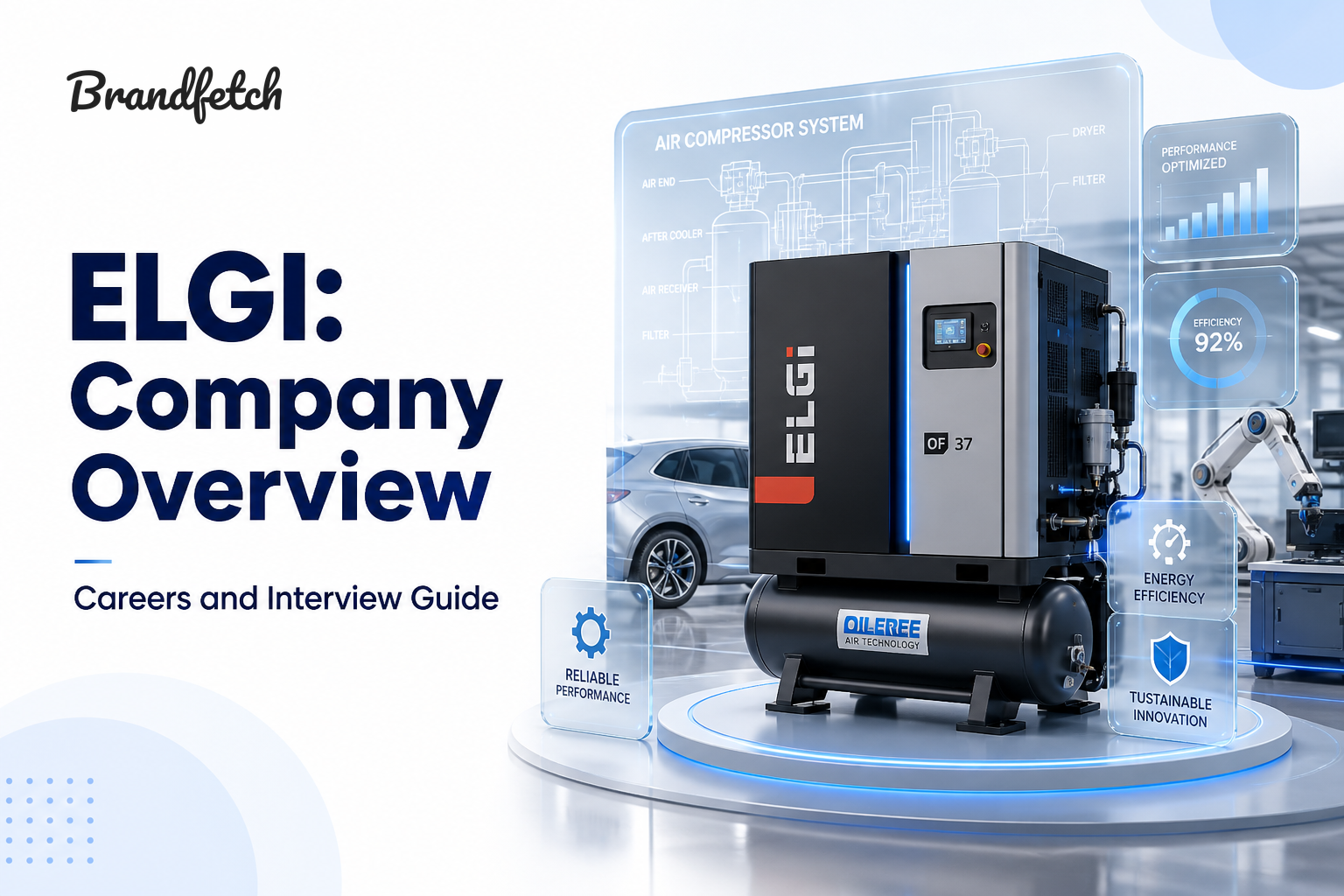
ELGI is an Indian industrial engineering company best known for designing, manufacturing and servicing air compressors and compressed-air systems. Its work sits inside the broader capital goods, industrial equipment and manufacturing services space, where reliability, energy efficiency, maintenance support and channel execution matter as much as product design. For a candidate, ELGI is useful to study because it combines factory-led engineering with customer-facing sales, service, supply chain, quality, aftermarket and international business. The company’s products are used by manufacturers, workshops, infrastructure contractors and process industries that need dependable compressed air for daily operations. That makes interview preparation more concrete: candidates can connect their answers to uptime, lifecycle cost, distributor management, field service discipline and continuous improvement rather than speaking only in generic corporate terms. ELGI also matters because it is a home-grown engineering business that has built a global-facing industrial brand from Coimbatore.
This guide covers where ELGI came from, who runs the business today, and the companies it competes with.
1. Company Overview
About ELGI
ELGI, formally ELGi Equipments Limited, manufactures air compressors, compressed-air accessories and related service solutions for industrial users. The company describes itself as a compressed-air systems manufacturer with origins in Coimbatore, and its official profile traces the business to L. G. Varadaraj’s founding of ELGi Equipments in 1960 (ELGi About Us).
That makes ELGI a useful case study for engineering, operations, quality, sales, service, procurement and product-management roles. Interviewers can test whether a candidate understands how a technical product becomes a customer outcome: stable pressure, lower downtime, lower energy use, safe installation, quick service response and long-term lifecycle support.
Company History
ELGI’s history is useful in interviews because it shows a shift from a regional engineering manufacturer to a global-facing compressed-air systems company. The themes to notice are founder-led manufacturing roots, product expansion, public-market discipline, overseas acquisitions and a continuing push toward reliability, energy efficiency and lifecycle support.
The timeline below follows the major phases presented in ELGi’s own company profile and public company information (ELGi About Us; BSE company page).
L. G. Varadaraj founded ELGi Equipments in Coimbatore, giving the company its manufacturing base in one of India’s established engineering clusters.
The business widened from its early engineering roots into a fuller compressed-air and garage-equipment manufacturing model, building relevance with industrial and automotive customers.
ELGI strengthened its compressor portfolio and service-led operating model, which is important for candidates because industrial equipment success depends on both product performance and post-sale support.
The company increased its focus on broader markets, channel execution and integrated compressed-air solutions rather than treating compressors as standalone machines.
ELGI’s international expansion phase included acquisitions such as Rotair in Italy and Pattons in the United States, strengthening its access to portable-compressor capability and overseas distribution.
The company deepened its presence in Australia through compressed-air distribution and service businesses, a move that highlights the importance of aftermarket networks in this industry.
ELGI added further distribution and service depth in the United States through Michigan Air Solutions, reinforcing its route-to-market focus beyond manufacturing alone.
The current phase is centred on energy-efficient compressed-air systems, oil-free applications, lifecycle service and a stronger global brand promise around being “Always Better.”
2. Mission, Vision & Values
Mission
"Always Better."
This is ELGi’s official brand promise used across its public identity (ELGi official website), so use it in interviews as a practical improvement theme: better uptime, better efficiency, better service response and better lifecycle value.
Vision
ELGI frames its long-term direction through the “Always Better” promise and its compressed-air systems positioning on official company pages. For interview answers, connect that direction to customer choice, product reliability, energy performance and global execution rather than memorising a separate slogan.
Core Values
ELGI’s most candidate-useful public value language is tied to its product promise: compressors and compressed-air systems that deliver reliability, energy efficiency and low lifecycle cost. These are drawn from how the company describes its offering on its official pages, not from a separate culture-values poster.
Prepare interview stories against this exact list: one example each for reliability under pressure, energy or cost improvement, and long-term customer ownership value.
3. Products and Services
ELGI’s offering is centred on compressed air: machines that generate it, accessories that clean and manage it, and service support that keeps the system running. This makes the company relevant for candidates in mechanical design, production, quality, field service, industrial sales, supply chain, product management and aftermarket operations.
The most useful way to understand the portfolio is by application: factory utilities, process industries, workshops, construction sites, railway and transport needs, and customers that require clean or oil-free compressed air.
- Oil-lubricated screw air compressors serve general industrial compressed-air needs in factories, fabrication shops and process plants where continuous operation, pressure stability and energy use are key buying considerations.
- Oil-free air compressors support applications where air quality is critical, such as food processing, pharmaceuticals, electronics manufacturing and other environments where oil contamination can damage the product or process.
- Reciprocating air compressors cover smaller and medium-duty requirements such as workshops, garages, maintenance bays and intermittent-use industrial applications where robustness and simpler maintenance are important.
- Portable air compressors are used in mobile and outdoor work such as construction, mining support, road projects and site-based pneumatic tools where the compressor must move with the job.
- Compressed-air accessories include air dryers, filters, drains, receivers and downstream equipment that help remove moisture, protect tools and improve the reliability of the full air system.
- Aftermarket service and spares cover installation support, preventive maintenance, repairs, genuine parts and service planning, which are central to customer retention because industrial users buy uptime, not just equipment.
- Automotive service equipment is represented through the ELGi group’s garage-equipment ecosystem, covering workshop needs such as vehicle servicing, repair infrastructure and related equipment for automotive customers.
4. Key Competitors of ELGI
ELGI competes in the compressed-air equipment market, where buyers compare screw compressors, oil-free compressors, portable compressors, dryers, filters and lifecycle service capability. Competition usually runs on energy efficiency, uptime, service reach, air purity requirements, lifecycle cost and the ability to support factories across multiple locations.
Atlas Copco
Competes on: premium compressor technology, energy-efficient systems, oil-free air, connected monitoring and service-led lifecycle contracts.
Position: Strong in large industrial accounts where reliability, engineering depth and global service standards matter more than upfront equipment price.
Ingersoll Rand
Competes on: industrial compressor breadth, aftermarket support, packaged solutions and installed-base relationships with manufacturing customers.
Position: A familiar multinational name for plants that prefer established brands, predictable spares access and broad industrial equipment coverage.
Kaeser Compressors
Competes on: engineering quality, compressed-air system design, energy optimisation and low total cost of ownership.
Position: Strong where the buyer is technically mature and evaluates the whole air system, not only the compressor unit.
Kirloskar Pneumatic
Competes on: domestic manufacturing familiarity, Indian industrial relationships, application engineering and service support for local customers.
Position: Relevant in India-led bids where procurement teams value local presence, industrial references and long-term service accessibility.
In a competitive-analysis answer, compare ELGI against peers on product range, service network, energy efficiency, lifecycle cost, air-quality use cases and customer segment fit; company size alone is not a strong answer.
5. Corporate Social Responsibility (CSR)
For a compressed-air equipment manufacturer like ELGi, credible CSR themes sit close to industrial capability: skills, safety, energy efficiency, environment and communities around operations. In an interview, discuss CSR as responsible manufacturing and long-term stakeholder trust, and verify ELGi’s latest annual report or company communication before naming any specific programme.
Technical Education
A business built on compressors, motors, service and precision manufacturing can support employability through practical technical learning.
Skill Development
CSR discussions can connect naturally to shop-floor skills, field-service readiness and safer industrial work practices.
Energy Awareness
Compressed air is energy-intensive in many factories, so awareness around efficient usage is a relevant social and industrial theme.
Safety & Wellbeing
Industrial businesses can make a real difference by promoting safe equipment handling, workplace discipline and community health awareness.
Local Community Support
Manufacturing and service networks are rooted in local ecosystems, so community support can include education, infrastructure or wellbeing initiatives.
Responsible Operations
Candidates can link CSR thinking to waste reduction, resource discipline and cleaner operating habits across factories and service teams.
6. Interview Process & Selection Rounds
ELGi hiring should be approached as a function-led process: engineering, manufacturing, sales, service and corporate roles will test different evidence even when the overall flow looks similar. Freshers may see more aptitude, fundamentals and learning-potential checks, while experienced candidates should expect deeper discussion on ownership, customer impact, process discipline and prior results. Location and plant or office requirement can also change whether rounds happen virtually, on-site or as a practical discussion with the hiring team.
Application Screening
Recruiters or hiring teams check whether your education, experience and location fit the opening. Engineering resumes are screened for project and domain depth, sales resumes for territory or account exposure, and manufacturing resumes for shop-floor, quality or process experience.
Recruiter or HR Conversation
This round checks motivation, communication, notice period, compensation expectations and basic company fit. For campus or fresher roles, the emphasis is on clarity and learning attitude; for experienced roles, it also tests career logic and stability.
Functional or Technical Interview
The hiring manager tests the work you will actually do. Engineering candidates may discuss design logic or compressor fundamentals, manufacturing candidates may discuss production, quality and safety, sales candidates may discuss customer discovery, and service candidates may discuss troubleshooting discipline.
Case, Task or Practical Discussion
Some roles may include a problem-solving task, presentation, field scenario or practical discussion. The format differs sharply by function: sales may get a customer situation, service may get a fault scenario, operations may get a quality or throughput issue, and corporate roles may get an analysis or stakeholder-management case.
Final Discussion and Offer Fit
The final stage usually checks team fit, joining feasibility, role expectations and long-term alignment. Senior candidates should be ready to discuss leadership style and measurable impact, while early-career candidates should show coachability, reliability and interest in industrial products.
7. Common Interview Questions Across Roles
These are questions any ELGi candidate can face across functions; role-specific technical questions should be prepared from the exact role guide or job description.
General & Company-Fit Questions
8. Required Skills & Tools
Required skills at ELGi are route-specific rather than one universal checklist, so this table maps preparation to the same career routes used in the Career Opportunities section.
9. Career Opportunities at ELGI
Careers at ELGI are best understood by functional route: candidates usually enter through engineering, manufacturing, sales, service, supply chain, digital, or business-support tracks rather than a single generic ladder. Each route has its own interview focus, day-to-day ownership, and promotion signal, so preparation should match the kind of work the role actually does.
Engineering & R&D
This route suits candidates targeting roles such as Design Engineer, Product Engineer, Application Engineer, Project Engineer, or R&D Engineer, where compressor fundamentals, CAD, thermodynamics, product validation, and problem-solving matter; the growth signal is the ability to convert technical analysis into reliable, manufacturable product improvements.
Manufacturing & Operations
This route includes job titles such as Production Engineer, Manufacturing Engineer, Assembly Engineer, Maintenance Engineer, and Operations Supervisor, with interview emphasis on shop-floor discipline, safety, productivity, process control, and continuous improvement; the growth signal is consistent delivery of quality output with lower rework, downtime, and escalation.
Quality, Testing & Reliability
This route covers roles such as Quality Engineer, Supplier Quality Engineer, Testing Engineer, Reliability Engineer, and Quality Assurance Executive, where root-cause analysis, inspection systems, calibration, documentation, and corrective action skills are central; the growth signal is preventing repeat failures instead of only detecting defects after they occur.
Sales, Application & Business Development
This route is relevant for job titles such as Sales Engineer, Area Sales Manager, Key Account Manager, Business Development Executive, and Application Sales Engineer, where candidates must connect customer requirements with compressor selection, lifecycle cost, and commercial negotiation; the growth signal is building repeatable customer wins without depending only on price discounts.
Service, Aftermarket & Customer Support
This route includes Service Engineer, Field Service Engineer, Service Coordinator, Aftermarket Sales Engineer, and Customer Support Engineer roles, with interviews often testing troubleshooting, customer handling, preventive maintenance, spares planning, and field reporting; the growth signal is resolving issues safely and quickly while improving customer uptime and service predictability.
Supply Chain, Procurement & Planning
This route fits candidates aiming for Purchase Engineer, Procurement Executive, Supply Chain Executive, Materials Planner, Vendor Development Engineer, or Logistics Coordinator roles, where supplier follow-up, cost control, inventory discipline, and production planning are key; the growth signal is protecting delivery timelines while improving cost, quality, and supplier reliability.
Digital, IT & Business Support
This route covers titles such as IT Executive, Data Analyst, ERP Support Executive, Finance Executive, HR Executive, and Business Analyst, where process understanding, reporting accuracy, stakeholder coordination, and system adoption matter; the growth signal is making teams faster and more reliable through better data, controls, and cross-functional execution.
10. Future Outlook and Strategic Plan
ELGI’s future positioning is best read through the same arc as its timeline: an Indian engineering company that built credibility in compressed air, expanded beyond its home base, and kept the Always Better promise visible in product and service conversations. The strategic themes a candidate should understand are operating priorities: reliability, efficiency, service depth, application knowledge and disciplined global competition.
Energy-Efficient Compressed Air
Be ready to discuss why compressed air cost is about lifecycle performance, not only machine price. Strong answers should cover load patterns, leakage, motor efficiency, heat, maintenance discipline and examples such as a textile unit in Tiruppur or a packaging line in Ahmedabad.
Reliability and Uptime
Prepare to explain how compressor reliability affects production continuity. A good interview answer links product design, preventive service, spares planning and fault diagnosis to real operating environments such as an automotive components plant in Pune or a pharma utility room in Hyderabad.
Service-Led Customer Trust
Candidates should show that aftersales is central to industrial equipment relationships. Talk about installation quality, response time, technician coordination, warranty discipline, customer training and how a service issue can become either a trust builder or a renewal risk.
Application-Based Selling
Be prepared to move beyond product names into use-case diagnosis. Interviewers may value answers that connect air demand, duty cycle, operating pressure, site conditions and maintenance access before recommending a solution for sectors such as food processing, fabrication or electronics manufacturing.
Disciplined Global Competition
Have a balanced view of how ELGI competes with established compressor companies such as Atlas Copco, Ingersoll Rand and Kaeser. Strong candidates compare service reach, product fit, total cost of ownership and execution quality without dismissing competitor strengths.
11. Conclusion
ELGI sits in the industrial compressed-air market as an engineering-led compressor specialist rather than a broad consumer brand. Its direction depends on how well it keeps product reliability, energy efficiency, service responsiveness and the Always Better mindset aligned while competing with global compressor companies. For someone joining, the role is likely to reward practical problem-solving: understanding plant utilities, explaining total cost of ownership, supporting dealers and service teams, and turning technical detail into trust for customers in sectors such as textiles, automotive components, pharmaceuticals and packaging.
