
Junior Business Analyst EPAM India Interview Guide
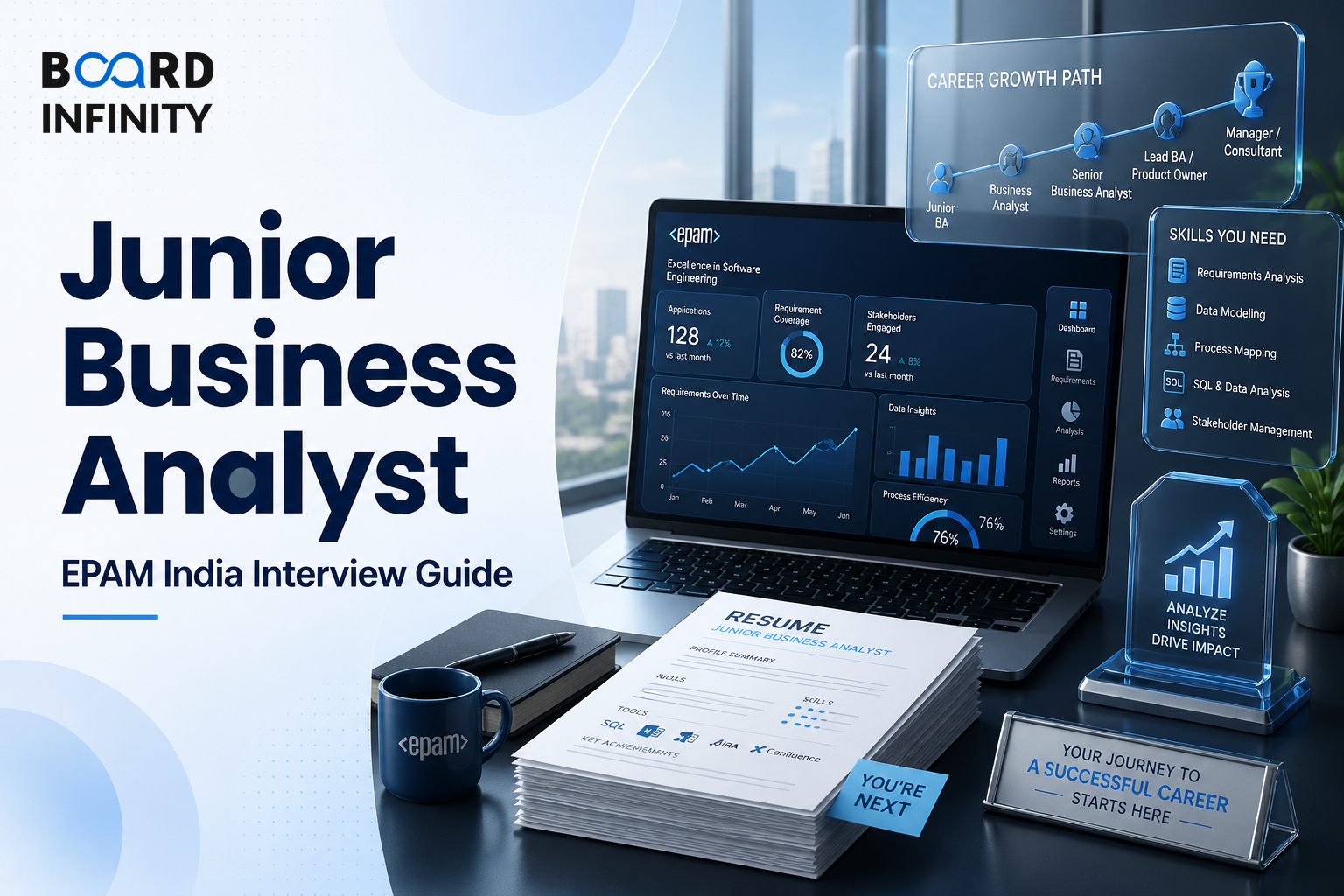
A Junior Business Analyst at EPAM India helps turn business needs into clear product work for software delivery teams. The role matters because unclear requirements slow engineering, confuse stakeholders and reduce delivery quality. Your job is to bring structure to conversations, documents, priorities and project decisions.
This guide is built for 2027 MBA and PGDM candidates preparing for EPAM India campus interviews. It covers the role, required skills, nice to have skills, responsibilities, interview rounds, practice questions, focus areas and a 4-week preparation plan. Candidates comparing analyst roles can also review Board Infinity's junior analyst interview preparation guide.
1. About the Junior Business Analyst Role
This role sits between business stakeholders and software engineering teams. You will help capture what users or clients need, convert those needs into product documents and support senior business analysts during requirements discussions. The impact is simple: better clarity before development starts means fewer rework cycles later.
Day to day, you will work with senior business analysts, project teams, software engineers and internal or client-side stakeholders. Expect your interview to test whether you can listen carefully, organise information, ask practical questions and communicate in a structured way without overcomplicating the problem.
2. Required Skills and Qualifications
Educational Qualifications
Skills Overview
3. Nice to have Skills
These skills are not the same as the core requirements. They help you stand out because they show you understand the environment in which a business analyst works at a technology services company.
4. Day-to-Day Responsibilities
A typical week involves joining requirement discussions, organising information, updating product documents and coordinating with software delivery teams. The role is execution focused, but your ability to think clearly and communicate precisely will be tested from the first interview.
Follow Project Processes
You will work within defined software development and business analysis processes rather than handling requirements casually. In practice, this means using agreed templates, tracking approvals, documenting changes and following review steps before information reaches development teams. Interviewers may test whether you respect process while still staying practical.
Build Stakeholder Trust
You will interact with people who influence project outcomes, including internal teams and external stakeholders. Trust is built by being prepared, capturing decisions accurately and following up when information is missing. For example, if a product owner changes a requirement, you should confirm the impact before passing it to engineering.
Map Stakeholder Needs
Stakeholder analysis means identifying who has information, who approves decisions and who is affected by the product change. You may use a template to capture each stakeholder group, their role, their concerns and the communication needed. This helps the project team avoid missing key voices during requirements gathering.
Communicate With Structure
Clear communication is not just good English. It means separating facts from assumptions, summarising decisions and explaining open questions in a way others can act on. You may need to convert a long discussion into a crisp email, meeting note, product update or requirement clarification.
Plan BA Activities
You are expected to understand how business analysis work is planned, even at a junior level. This can include scheduling requirement sessions, preparing questionnaires, tracking pending clarifications and aligning document reviews. The interviewer may check whether you can think ahead instead of reacting only after a deadline is missed.
Support Engineering Teams
You will collaborate with software development teams so they understand what needs to be built. This can involve clarifying requirement intent, checking whether a feature description is complete and helping resolve ambiguity before development begins. You do not need to code, but you should understand how engineers consume requirements.
Create Product Artifacts
Product artifacts can include requirement notes, process flows, feature descriptions, acceptance points or analysis sheets. Your role is to help analyse inputs and convert them into usable working documents. Strong candidates show that they can organise information so another team member can understand it without repeated explanation.
Join Requirement Sessions
Requirement elicitation involves helping the team discover what stakeholders need. You may listen in client discussions, ask follow-up questions, capture open points and validate whether the stated need is clear enough. Interviewers often test this through situations where the user request is vague or incomplete.
Maintain Product Documents
Under guidance from senior business analysts, you will update documents as requirements change. This includes keeping versions clean, noting decisions, removing outdated assumptions and making sure the latest information is easy to find. Poor documentation creates confusion, so accuracy matters more than decorative formatting.
Understand Prioritisation Basics
You should be aware that every requirement cannot be treated as equally urgent. Prioritisation and estimation techniques help teams decide what should be built first and how much effort may be involved. At junior level, you are expected to understand the logic and support senior analysts with clean inputs.
Follow Quality Standards
Quality in this role means following organisational guidelines, using the right templates and checking whether deliverables are complete before sharing them. You may be asked how you avoid mistakes in Excel, presentations or requirement notes. A good answer shows review discipline and ownership.
Learn Domain Context
Each project may have its own business domain, such as finance, retail, operations or human resources. You will need to read domain material, understand common terms and connect requirements to business context. Candidates who show curiosity about domains usually perform better than candidates who treat requirements as isolated text.
5. Key Competencies for Success
Top candidates combine structured thinking with humility. EPAM India evaluates whether you can learn fast, work with engineering teams and represent stakeholder needs accurately without pretending to know everything on day one.
6. Interview Process at EPAM India
For a campus Junior Business Analyst role in a technology services environment, expect evaluation across communication, analytical thinking, business analysis awareness and team fit. Prepare for a process that checks both how you think and how clearly you explain your thinking.
Eligibility and Profile Screening
The first filter checks academic eligibility, graduation background and whether your resume shows analytical, communication or project exposure. MBA or PGDM candidates should make relevant coursework, Excel work, presentations and project documentation visible.
Aptitude or Analytical Assessment
This stage may assess logical reasoning, data interpretation, basic problem solving and written clarity. For this role, the goal is not advanced mathematics. The goal is to see whether you can reason through information without losing accuracy.
Business Analysis Discussion
A panel may ask about requirements, stakeholders, Excel, documentation and your understanding of software delivery teams. You should be ready to explain how you would clarify vague needs, prepare artifacts and support senior analysts.
Case or Scenario Round
You may receive a situation involving unclear requirements, stakeholder conflict or a product improvement idea. The interviewer will look for questions you ask, assumptions you state and how you convert messy information into a workable approach.
HR and Fit Discussion
The final discussion checks motivation, adaptability, communication confidence and willingness to work from Hyderabad during training and later from project-based EPAM India locations. Prepare clear answers for mobility, learning mindset and why business analysis interests you.
7. Interview Questions
Use Situation, Task, Action, Result for behavioral answers and a structured problem-solving approach for case questions. EPAM India interviewers will likely prioritise clarity, learning ability, teamwork and whether you understand how a business analyst supports software delivery.
Behavioral and Company-Fit Questions
Role-Specific Business Analysis Questions
Case, Product Sense and Metrics Questions
8. Topics and Areas of Focus
Master the areas that directly map to the role: requirements, stakeholders, documentation, Excel, communication and software delivery awareness. Do not spend preparation time on coding or deep system design for this interview.
9. Preparation Plan
Role Foundation
Understand business analysis work, EPAM India context and software team roles.
Core Skills
Practise Excel tracking, requirement writing and stakeholder mapping.
Interview Answers
Build STAR stories and rehearse BA scenarios aloud.
Mock Rounds
Run timed mock interviews and refine weak areas.
Pre-Interview Checklist
10. Career Growth & Next Roles
Growth from this role depends on how quickly you move from supporting documentation to owning requirement conversations with confidence. Promotions are usually driven by delivery reliability, domain learning, stakeholder communication and the ability to reduce ambiguity for engineering teams.
Junior Business Analyst
At this stage, you support senior analysts, prepare trackers, document requirements and participate in meetings. To move ahead, prove that you can capture information accurately, ask useful clarification questions and understand how product artifacts help development teams.
Business Analyst
Around the next stage, you begin owning smaller requirement areas, running discussions and managing stakeholder follow-ups with less supervision. You must show stronger domain understanding, better prioritisation awareness and the ability to produce documents that teams can act on directly.
Senior Business Analyst
At senior level, you handle more complex requirement areas, guide junior analysts and work more directly with project stakeholders. Progress requires stronger facilitation, sharper trade-off thinking and the ability to manage ambiguity before it reaches engineering teams.
Specialist or Lead Path
Beyond senior BA roles, growth can move toward people leadership, product ownership support, domain specialization or consulting-style analysis. The direction depends on whether you prefer guiding teams, going deeper into domains or shaping larger business solutions.
11. Conclusion
The strongest preparation strategy is to practise translating vague business needs into clear, testable requirements. EPAM India will value candidates who can think in a structured way, listen carefully and communicate with software delivery teams without adding confusion.
Before the interview, prepare one sample requirement tracker and one stakeholder analysis example from a familiar Indian product flow. Then rehearse answers that show analytical thinking, collaboration and adaptability through real academic or internship experiences.
