
Gustora Foods: Quality and Production Interview Guide
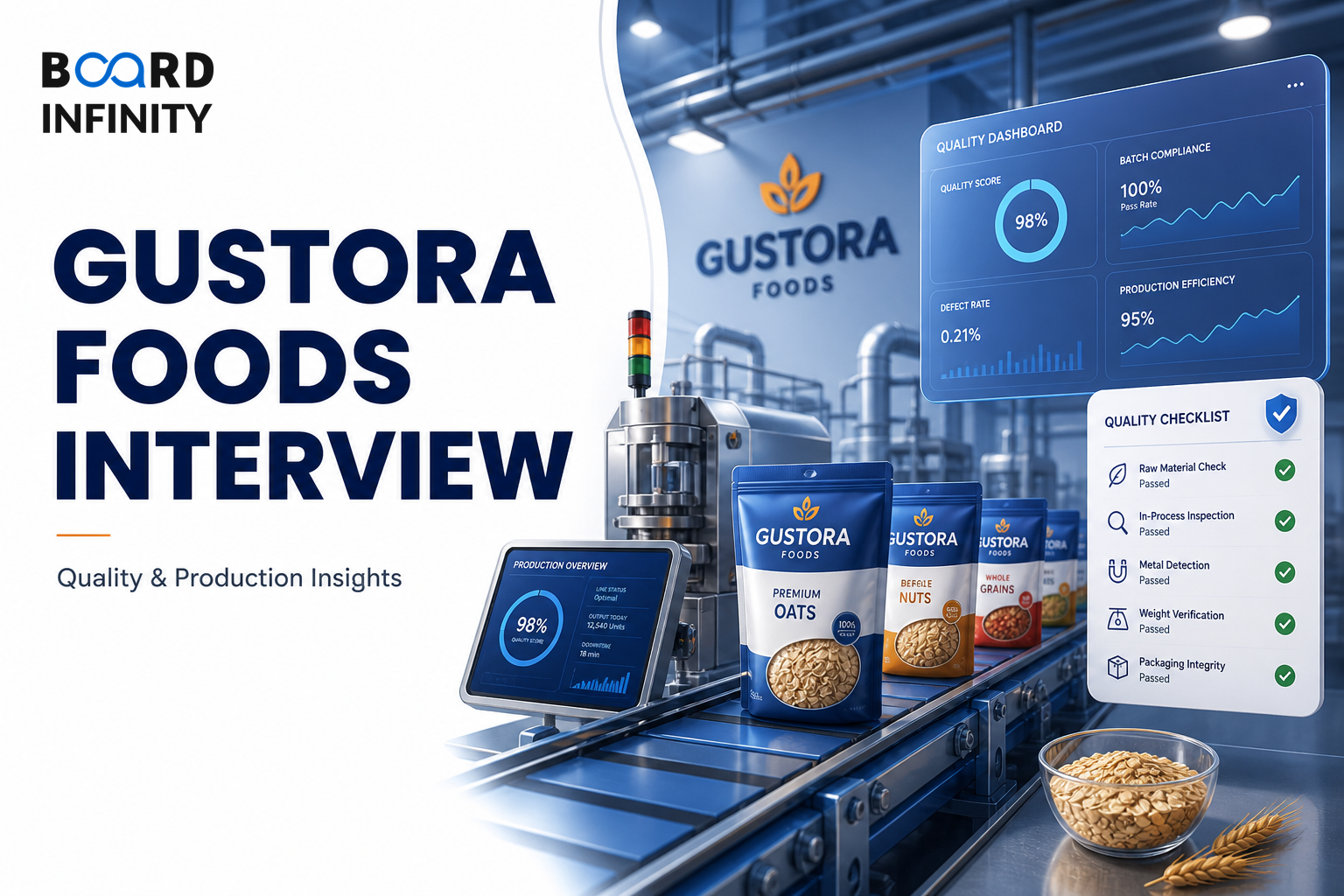
Quality and Production at Gustora Foods sits close to the factory floor, product trials, quality checks, and process improvement work that protects the pasta experience customers finally taste. The role matters because Gustora positions itself around high quality pasta, durum wheat semolina, Italian machinery, bronze dies, and a long drying process.
This guide is for MBA, PGDM, food technology, biotechnology, and operations candidates preparing for the Gustora Foods Quality and Production interview. It covers what the role involves, the skills to show, likely interview rounds, company-specific questions, preparation priorities, and the growth path a strong candidate can build from this internship.
1. About the Quality and Production Role
This role supports product development, shopfloor quality control, trial execution, and production process improvement. You may help test raw materials, observe pasta processing conditions, record deviations, compare trial batches, and convert observations into reports that help the team make better product and process decisions.
Day to day, the role connects quality, production, research, operations, marketing, and sales inputs. For example, if the market asks for a new pasta format or packaging improvement, the Quality and Production intern helps test feasibility before the idea reaches a customer-facing campaign.
2. Required Skills and Qualifications
Educational Qualifications
Skills Overview
3. Day-to-Day Responsibilities
A typical week mixes factory observation, lab-style documentation, product trial support, and coordination with teams that need production inputs. You should expect practical work where accuracy, hygiene awareness, and structured reporting matter more than flashy presentation.
Product Trial Support
You may help prepare trial plans for new pasta formats, ingredient variations, or process changes. The work includes noting the objective, batch details, ingredient ratios, process conditions, observations, and final product behavior. A strong intern records what changed, what stayed constant, and what the result suggests for the next trial.
Quality Check Assistance
You support the quality team in checking raw materials, intermediate products and finished goods. In practice, this means observing tests, recording values, comparing results with internal standards, and flagging abnormalities. The interviewer will value candidates who understand that quality control is about prevention, traceability and consistency, not only final inspection.
Process Improvement Notes
You observe production stages and look for repeated delays, variation, rework, material loss or documentation gaps. The expectation is not to redesign the line alone, but to gather reliable observations and suggest practical fixes. Examples include improving batch record completeness, reducing waiting time between checks, or making deviation escalation faster.
Food Safety Records
You help maintain records connected with food safety standards, audits and certifications such as Hazard Analysis and Critical Control Points (HACCP) or International Organization for Standardization (ISO) documentation. In practice, this can include collecting supporting documents, checking formats, organizing test reports and ensuring records are easy to retrieve during reviews.
Research Compilation
You may gather inputs on packaging, preservation, sustainability, ingredient behavior and food technology trends. The useful output is a concise report that connects research to Gustora product realities. For example, a packaging idea should be judged on shelf life, product breakage, cost, handling and customer perception.
Team Coordination
You attend meetings where production feasibility, market needs and quality constraints meet. A good intern can explain a technical observation in simple business language. For example, if a pasta shape looks appealing but breaks too often during packing, you should be able to explain the quality risk and suggest the next controlled trial.
4. Key Competencies for Success
Top candidates combine careful observation with respect for food quality, process discipline and Gustora Foods values of quality, integrity, commitment, multicultural collaboration and sharing pasta culture. Interviewers will prefer students who can connect factory details to customer experience and business outcomes.
5. Interview Process at Gustora Foods
For a Quality and Production internship in a food manufacturing setting, expect a practical evaluation of food safety basics, product curiosity, discipline, and fit with a hands-on factory environment. The process usually checks whether you can learn quickly, document carefully, and work with production realities rather than only discuss theory.
Application Screening
The first screen checks education, internship relevance, food or biotechnology exposure, documentation comfort, and interest in manufacturing. Your resume should show lab work, operations projects, quality courses, research assignments, or process improvement examples. Recruiters also look for candidates who can work in Jaipur and are comfortable with factory-based learning.
HR and Motivation Round
This round checks why you want a food production role, how you handle routine work, and whether you understand Gustora position around Italian-style pasta production. Expect questions on relocation comfort, learning goals, teamwork, and past examples of discipline. Strong answers connect personal interest with food quality, operations and customer trust.
Technical Discussion
The technical round usually tests quality control basics, food safety awareness, documentation, trial design and production observation. You may be asked how you would test a raw material, respond to a deviation, structure a product trial or prepare certification documentation. The interviewer may be from quality, production or operations.
Case or Scenario Round
You may receive a practical situation such as high breakage in packed pasta, inconsistent drying, raw material variation, or a new product trial that failed. The panel assesses how you structure the problem, define checks, identify likely causes, protect food safety, and recommend next steps without jumping to conclusions.
Final Fit Discussion
The final conversation checks attitude, availability, communication, ownership and ability to learn in a cross-functional environment. You should be ready with concise answers on why Gustora, why quality and production, and what you hope to contribute in the internship. Keep the tone practical and factory-ready.
6. Interview Questions
Use Situation, Task, Action, Result (STAR) for behavioral answers, and use a structured problem-solving flow for technical and case questions. Gustora Foods interviewers are likely to value clarity, quality discipline, food safety awareness, and the ability to connect product decisions with customer experience.
Behavioral and Company-Fit Questions
Technical Quality and Production Questions
Case-Based and Analytical Questions
7. Topics and Areas of Focus
Preparation should focus on the overlap between food quality, production observation, trial design, documentation and business communication. The goal is to sound practical enough for a factory environment while showing the structured thinking expected from a management student.
8. Preparation Plan
Role and Brand
Understand Gustora pasta positioning and the daily work of quality and production.
Core Technicals
Revise food safety, quality records, trials, process observation and packaging basics.
Answer Practice
Build STAR stories and practise technical scenarios with structured reasoning.
Mock and Refine
Run mock interviews, fix weak areas and prepare crisp company-fit answers.
Pre-Interview Checklist
9. Career Growth and Next Roles
A Quality and Production internship can lead toward food quality, production operations, product development, process improvement or supply chain roles. Progression depends on technical credibility, audit discipline, ability to reduce recurring issues, and comfort working with shopfloor teams as well as commercial functions.
Quality and Production Intern
At the internship stage, you support testing, product trials, documentation, process observations and cross-functional updates. The goal is to prove reliability, curiosity and respect for food safety. To move forward, you must show that you can observe accurately, report clearly and learn the technical language of food manufacturing without needing constant reminders.
Quality or Production Executive
After roughly 2-3 years, the next step is usually an executive role in quality assurance, quality control, production planning or process improvement. You own routine checks, records, basic deviation handling and improvement projects. To grow, you need stronger audit readiness, manufacturing problem-solving and communication with operators, supervisors and business teams.
Senior Quality or Operations Lead
At roughly 4-6 years, the role can expand into leading audits, owning improvement projects, managing cross-functional trials and reducing recurring defects. You must prove that you can turn data into action, train juniors, and align production realities with customer-facing commitments. This stage rewards people who combine technical depth with commercial judgment.
Manager or Specialist Track
Beyond this point, growth can split into people management or specialist depth. The management route may cover plant quality, production operations or operations excellence. The specialist route may move toward food safety systems, product development, packaging, research and process technology. The best path depends on whether you enjoy leading teams, solving deep technical problems or bridging both.
10. Conclusion
The strongest way to prepare for the Gustora Foods Quality and Production interview is to connect every answer to quality, process discipline and the final pasta experience. Show that you understand why raw materials, production controls, documentation and trial learning matter for a brand built around high quality pasta.
Before the interview, practise two product trial scenarios and two defect investigation scenarios. Also prepare a clear explanation of Gustora Foods differentiation using simple language, because interviewers will expect you to translate production details into customer value without sounding vague or memorized.
