
Hindustan Unilever Limited: Sales Leadership Trainee Guide
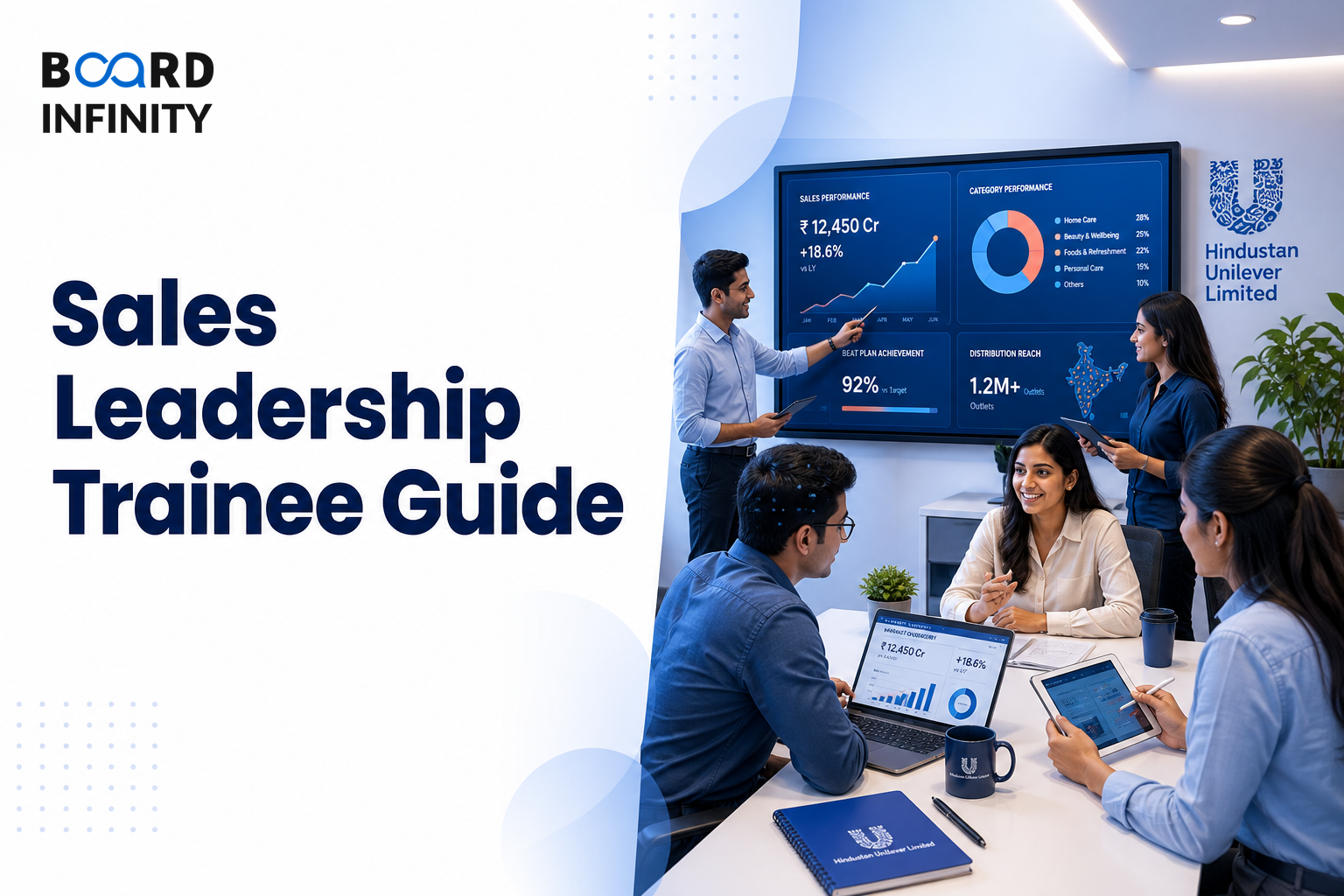
The Sales Leadership Trainee function at Hindustan Unilever Limited sits close to the market, where brand plans become actual sales through distributors, retailers, modern trade partners and digital commerce channels. The role matters because a trainee learns how availability, visibility, pricing, assortment and frontline execution affect business outcomes.
This guide is for MBA candidates preparing for the Sales Leadership Trainee interview at HUL. It covers role expectations, skills, responsibilities, interview rounds, role-specific questions, sales cases, a four-week preparation plan and growth paths. For wider Unilever context, use Board Infinity's Unilever global sustainable consumer goods overview.
1. About the Sales Leadership Trainee Role
A Sales Leadership Trainee at HUL learns how large FMCG sales systems work across General Trade, category growth, digital channels and brand building. The role is not only about selling more units. It is about diagnosing market problems, improving execution quality and making trade decisions that support long-term brand growth.
The trainee works with sales managers, distributors, retailers, category teams, brand teams, e-commerce teams and field sales teams. HUL describes its business through well-known consumer brands across categories on its official brands page, so candidates should understand how these categories reach different shopper segments.
2. Required Skills and Qualifications
Educational Qualifications
Skills Overview
3. Day-to-Day Responsibilities
A typical week combines market visits, data reviews, distributor discussions, project work and cross-functional check-ins. The trainee is expected to learn fast, act independently and convert field observations into measurable business improvements.
Market Execution
The trainee spends time in retail markets to understand how products move from distributor stock to store shelves. This includes checking outlet coverage, visibility, stock availability, pricing hygiene, competitor presence and whether sales representatives are following the beat plan properly.
Distributor Reviews
The trainee learns how distributor operations affect business results. Practical work may include reviewing stock days, pending orders, claims, sales representative productivity, service gaps and route discipline, then aligning with the manager on corrective actions that can be tracked weekly.
Category Projects
During category exposure, the trainee studies how shoppers behave across channels and product segments. The work can include identifying a pack-size opportunity, improving assortment for a store type, comparing category growth drivers and building a simple activation plan for a target shopper group.
Digital Channel Learning
The future-facing stint builds comfort with quick commerce, e-commerce and sales technology. The trainee may study assortment, search visibility, stock fill rates, platform campaigns, pricing consistency and how digital dashboards can help sales teams act faster.
Brand Translation
The brand stint helps the trainee understand how consumer insight becomes positioning, communication and market activation. The sales lens is important here: a strong brand plan must still translate into availability, persuasive trade communication and practical execution at the point of sale.
Independent Ownership
In the sub-charge phase, the trainee handles an end-to-end sales responsibility. This tests whether the person can own targets, manage daily priorities, solve field issues, communicate upward with clarity and lead execution without constant supervision.
4. Key Competencies for Success
High performers in this role show commercial sharpness, humility in the field and speed in execution. HUL looks for people who can learn from retailers and frontline teams, but still think like future business leaders.
5. Interview Process at Hindustan Unilever Limited
For an HUL Sales Leadership Trainee selection process, prepare for a campus-style assessment sequence that tests leadership potential, commercial thinking, sales orientation and cultural fit. Expect evaluators to probe both market logic and personal ownership, not just polished answers.
Application and Profile Screening
The first filter usually reviews academic record, MBA specialisation, leadership evidence, extra-curricular depth and consistency. A strong profile connects achievements to ownership, measurable outcomes and people leadership rather than listing positions held.
Aptitude or Business Screening
This stage may test numerical comfort, business reasoning and decision-making under time pressure. For sales roles, practise interpreting growth, market share, outlet productivity, promotion cost and simple profit impact without overcomplicating the calculation.
Group Discussion or Case Discussion
The discussion evaluates structure, commercial sense, listening and influence. Good candidates bring the group back to the problem, use numbers carefully and build on others points instead of dominating the room.
Sales and Business Interview
This is the heaviest round for the role. Interviewers may ask about General Trade, distributor challenges, category activation, quick commerce, market sizing, channel conflict, rural sales or how a brand plan should be executed in stores.
Leadership and Fit Interview
The final selection conversation checks long-term motivation for field sales, comfort with mobility, resilience and values. Prepare for deep follow-ups on ownership, failure, conflict, ethics and why HUL sales is the right starting point for your career.
6. Interview Questions
Use Situation, Task, Action, Result (STAR) for behavioural answers, and use a clear issue tree for sales cases. HUL interviewers usually reward practical judgment: define the problem, ask for missing data, make assumptions explicit and close with an action plan.
Behavioral and Company-Fit Questions
Role-Specific Sales, Channel and Execution Questions
Product, Market and Case Questions
7. Topics and Areas of Focus
Preparation should focus on how FMCG sales actually works in India: distribution, channels, shopper behavior, category growth and execution metrics. The strongest answers combine simple business logic with practical field actions.
8. Preparation Plan
Company and Role
Understand HUL categories, channels and the trainee rotation structure.
Sales Fundamentals
Build comfort with distributor, retailer, category and digital sales concepts.
Cases and Stories
Practise sales cases and build evidence-backed leadership stories.
Mock Readiness
Run timed mocks, tighten answers and revise weak areas.
Pre-Interview Checklist
9. Career Growth & Next Roles
The Sales Leadership Trainee path is designed to build readiness for independent sales responsibility after rotational exposure and sub-charge ownership. Progression depends on field performance, people leadership, commercial judgment and the ability to deliver results across different markets and channels.
Sales Leadership Trainee
This stage builds the operating base across General Trade, category work, digital channels, brand exposure and sub-charge ownership. To move forward, the trainee must show field discipline, fast learning, business maturity and the ability to act with ownership under guidance.
Area Sales or Customer Development Role
The next stage usually involves owning a defined market, distributor network, sales team rhythm and target delivery. The proof point is consistent execution: improving outlet productivity, solving market issues, coaching teams and communicating business risks early.
Regional or Channel Responsibility
At this stage, the manager handles a wider business problem across multiple markets, categories or channel partners. Growth depends on sharper commercial planning, capability building, negotiation, cross-functional coordination and the ability to scale successful pilots.
People Leadership or Channel Specialist
Beyond early sales roles, careers can deepen into larger people leadership, customer development strategy, category sales, modern trade, e-commerce or route-to-market roles. The differentiator becomes strategic thinking backed by credible field experience and measurable business delivery.
10. Conclusion
The most important preparation step is to think like a sales leader in the field. Every answer should show how you would understand the market, identify the real bottleneck, act quickly, measure progress and learn from retailers, distributors and frontline teams.
Prepare two HUL categories deeply and practise converting brand or shopper insight into store-level and digital-channel action. Build a clear sub-charge plan before the interview, because it proves you understand that this role is about ownership, not observation.
