
How AI Tools Are Reshaping Education and Career Development in 2026
We’ve officially passed the point where AI is just a novelty in education. Today, having an AI tutor available at midnight or rewriting a resume in under a minute is standard practice. For job seekers, the shift has been just as dramatic: interview prep, skill-gap analysis, and career pathing that used to require an expensive coach are now available through a browser tab.
Today's real challenge is option overload. Dozens of AI tools now claim to help with learning or career growth, many built on the same handful of underlying language models with different branding on top. Knowing which ones are actually worth your time, and which are thin repackaging of a general-purpose chatbot, has become its own skill. Before settling on a single assistant for everything, it's worth taking the time to explore ChatGPT alternatives and see how they compare on the specific tasks that matter for learning and career development, rather than assuming one general-purpose tool covers every use case equally well.
Here is a quick breakdown of how general-purpose assistants stack up against purpose-built tools:
General-Purpose AI vs. Purpose-Built AI
Why AI in Education and Career Development Is a Different Problem
Using AI to draft a marketing email and using AI to genuinely learn a new skill are not the same kind of task, even though both might involve typing a prompt into a chat window. Education has a specific requirement that most other AI use cases don't: the process of struggling with a problem, getting it partially wrong, and correcting course is often where the actual learning happens. A tool that simply hands over the correct answer can shortcut that process in a way that feels productive in the moment but leaves a weaker understanding behind.
Career development presents a similar challenge. An AI tool can polish a resume or generate confident-sounding interview answers, but if a candidate can't actually speak to their own experience with the same confidence in a live interview, the tool has created a mismatch between how they present on paper and how they perform in person. The most effective tools in this space are increasingly designed with this tension in mind built to support the learning or preparation process rather than simply produce a finished output that skips it.
Key AI Use Cases for Students and Job Seekers in 2026
Personalized Tutoring and Study Support
AI tutoring tools have moved well past generic Q&A. The stronger platforms now adapt to a student's specific gaps noticing, for example, that someone consistently struggles with a particular type of algebra problem and generating additional practice targeted at that specific weakness rather than repeating the same generic lesson everyone else gets. Some tools also adjust explanation style based on how a student is responding, offering a more visual explanation after a purely verbal one didn't land.
Summarization and study-aid tools represent a related but distinct use case: turning long readings, lecture recordings, or dense textbook chapters into structured notes, flashcards, or practice questions. Used well, this saves significant time on the mechanical work of note-taking, freeing up more time for the actual studying and practice that builds retention.
Resume and Application Materials
AI-assisted resume tools have become sophisticated enough to tailor a resume's language and emphasis to a specific job posting, highlighting the experience most relevant to that particular role rather than presenting a single generic version to every employer. The better tools also flag common resume mistakes vague accomplishment statements without measurable impact, formatting inconsistent with applicant tracking systems, or skills sections padded with buzzwords that don't reflect actual experience.
Cover letters remain a trickier use case. Generic AI-generated cover letters are easy for hiring managers to spot, and using one without meaningful personal editing often does more harm than good. The tools that add real value here are the ones that prompt the user for specific details a particular project, a genuine reason for interest in the company rather than generating generic enthusiasm from a job title alone.
Interview Preparation and Mock Interviews

This has become one of the fastest-growing categories in career-focused AI tools. Platforms now offer realistic mock interview simulations, complete with follow-up questions based on how a candidate answers, and feedback on pacing, filler words, and how directly a response addresses the actual question asked. For behavioral interview questions in particular, practicing out loud with immediate feedback has proven far more effective than simply reading example answers, and AI tools have made that kind of practice accessible without needing to schedule time with a career coach.
Skill Gap Analysis and Career Pathing
A newer but rapidly growing category involves tools that compare a person's current skills and experience against the requirements of a target role or industry, then generate a specific learning plan to close the gap. Rather than a generic "learn to code" recommendation, these tools can identify that a candidate is missing a specific certification or technical skill that's showing up repeatedly in job postings for their target role, and suggest a focused way to close that exact gap.
Language Learning and Communication Skills
For students and professionals working in a second language, AI conversation practice tools have become genuinely useful for building fluency and confidence offering low-stakes practice with real-time correction that doesn't carry the social pressure of practicing with another person. This has proven particularly valuable for professionals preparing for interviews or presentations in a non-native language.
What to Evaluate Before Relying on an AI Learning or Career Tool
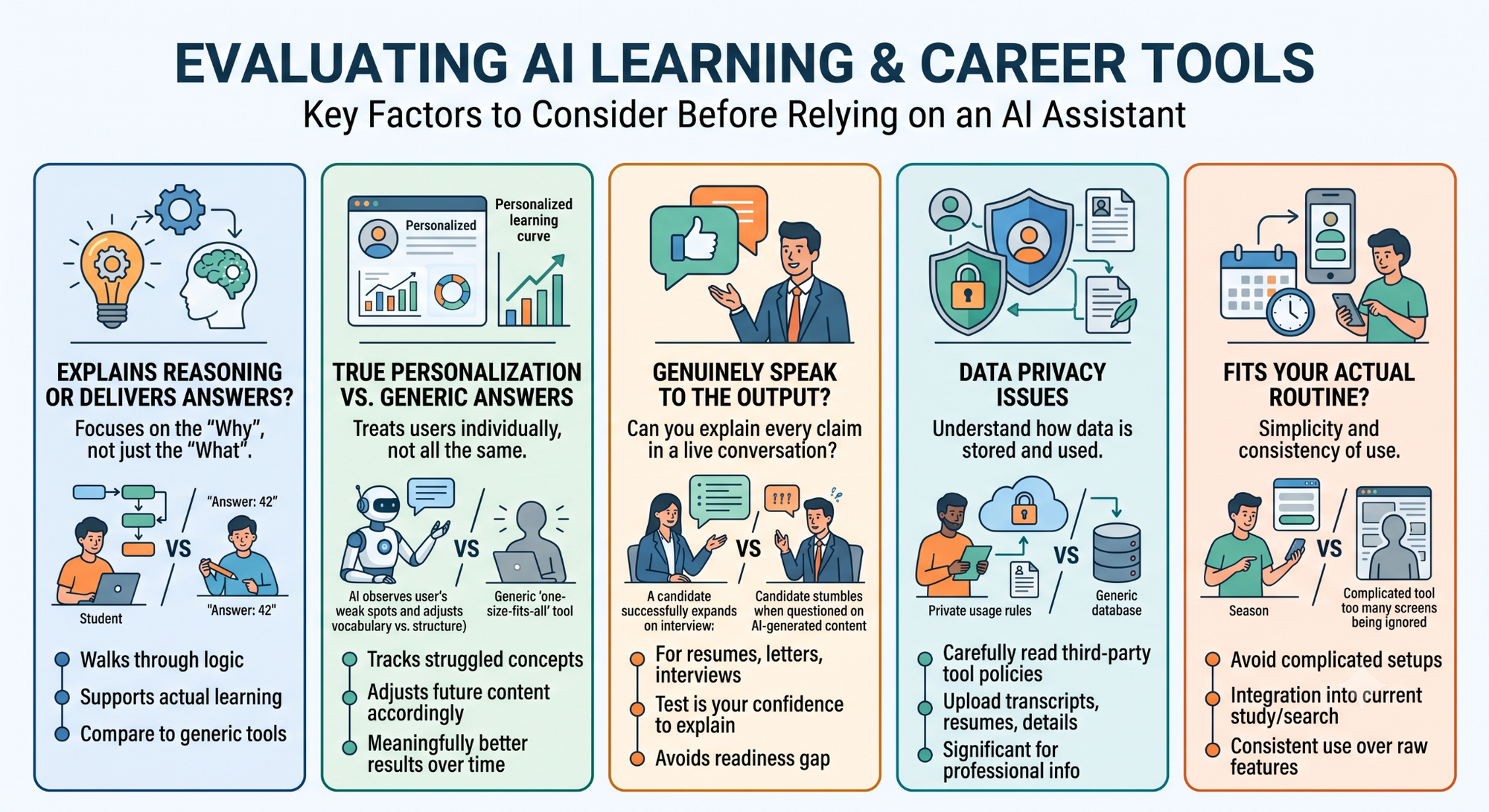
Does it explain reasoning, or just deliver answers? For education specifically, a tool that shows its work walking through why an answer is correct, not just stating it supports actual learning far better than one that simply solves the problem and moves on.
True personalization vs. generic answers. Generic tools treat every user the same. Tools that track what you've struggled with and adjust future content accordingly deliver meaningfully better results over time, even if the initial experience feels similar.
Is the output something you can genuinely speak to? For resumes, cover letters, and interview answers, the test isn't whether the AI-generated content sounds impressive it's whether you could confidently explain and expand on every claim in a live conversation. If you can't, the tool has created a gap between your paper presentation and your actual readiness.
Data privacy issues. Uploading transcripts, resumes, or personal career details to a third-party tool means understanding how that data is stored and used. This matters more for career tools than most people initially assume, given how much personal and professional information tends to get shared.
Does it fit your actual routine? A powerful tool that requires a complicated setup or doesn't fit into how you already study or job search will get abandoned within a few weeks, regardless of how capable it is in theory. Simplicity and consistency of use often matter more than raw feature count.
Common Mistakes Students and Job Seekers Make With AI Tools
Submitting AI-generated work without genuine review. Whether it's a homework assignment or a cover letter, submitting AI output without meaningfully reviewing, editing, and internalizing it tends to create problems downstream either academically, if the gap in understanding surfaces later in an exam, or professionally, if an interviewer asks a follow-up question the candidate can't actually answer.
Using one general-purpose tool for every task. A general-purpose chatbot can technically attempt tutoring, resume writing, and interview practice all at once, but purpose-built tools designed specifically for each of those tasks consistently outperform a one-size-fits-all approach, particularly for structured practice like mock interviews.
Treating AI feedback as infallible. AI tools can be confidently wrong, particularly on nuanced or highly specific technical topics. Cross-checking important academic or career guidance against a human mentor, teacher, or advisor remains a sensible habit rather than an unnecessary extra step.
Skipping the practice that builds real confidence. Reading a well-written AI-generated interview answer is not the same as practicing saying it out loud under mild pressure. The tools that build genuine preparedness are the ones used actively practicing, revising, repeating not the ones used passively to generate a document and move on.
Building a Personal AI Toolkit Without Overspending
Most students and early-career professionals don't need five separate paid subscriptions to build an effective AI-assisted routine. A practical approach is to identify the one or two tasks where AI genuinely saves the most time or improves outcomes the most for many people, that's either structured study support or interview practice and invest in a strong, purpose-built tool for that specific need first.
Free tiers are worth taking seriously rather than dismissing as inferior. Many platforms offer genuinely useful free access, sufficient for regular use by an individual student or job seeker, with paid tiers primarily aimed at heavier or more specialized use cases like tutoring centers or career coaching businesses working with many clients at once. Testing the free tier of two or three tools against a real task the same practice interview question, the same study topic before paying for anything gives a much clearer picture than comparing marketing pages.
Where AI in Education and Career Development Is Headed Next
Adaptive learning is becoming the default, not a premium feature. Tools that adjust content difficulty and explanation style based on individual performance, rather than delivering the same static curriculum to every user, are increasingly standard rather than a differentiator reserved for expensive platforms.
Career tools are shifting from generic advice to role-specific guidance. Instead of broad career advice, more tools are narrowing their focus to specific industries or job functions, offering guidance calibrated to the actual hiring patterns and skill requirements of a particular field rather than generic best practices that apply loosely everywhere.
Voice-based practice is expanding beyond language learning. The same real-time conversational feedback that's proven effective for language practice is increasingly being applied to interview preparation and presentation skills, allowing for more natural, spoken practice rather than typed exchanges.
Institutions are building AI literacy directly into curricula. Rather than treating AI tools as something students figure out informally, more schools and universities are formally teaching how to use them responsibly and effectively a recognition that avoiding the technology entirely is no longer a realistic strategy for preparing students for the workplace they're entering.
Frequently Asked Questions
Will using AI tools for studying or job applications hurt my chances if it's discovered? It depends heavily on context. For coursework, using AI to shortcut an assignment you're meant to complete independently carries real academic risk if discovered, and more importantly, leaves you with a genuine knowledge gap that tends to surface later. For job applications, using AI to draft and then meaningfully personalize a resume or cover letter is now common practice and generally not viewed negatively the risk comes from submitting generic, unedited output that reads as impersonal to a hiring manager.
How do I know if an AI tutoring tool is actually helping me learn versus just giving me answers? A simple test: after a session, try explaining the concept back in your own words without looking at the tool's output. If you can do that confidently, the tool supported real understanding. If you can't, it likely just handed you an answer without building the underlying comprehension.
Are free AI tools good enough for serious interview preparation? Often, yes, particularly for early practice sessions where the goal is building general comfort with the format. As preparation gets more targeted practicing for a specific role or company a more specialized paid tool may offer more relevant feedback, but starting with a free option to build baseline comfort is a reasonable and cost-effective approach.
Should I disclose that I used AI tools when applying for jobs? Most employers don't expect disclosure for reasonable use, like using AI to help polish a resume or brainstorm interview answers you then personalize and practice. The expectation is that the final application and your interview performance genuinely reflect your own experience and understanding, not that AI assistance was avoided entirely at every step of the process.
A Realistic Example: Preparing for a Career Switch
To make this more concrete, consider someone transitioning from a marketing role into data analytics a common career pivot that involves both learning new technical skills and repositioning an existing resume for a different type of role.
Rather than starting with a generic "learn data analytics" search, they use a skill-gap tool to compare their current resume against job postings for entry-level data analyst roles. The tool flags a specific, recurring gap: most postings expect familiarity with SQL and a basic data visualization tool, neither of which appears anywhere in their current experience. Instead of enrolling in a broad, months-long bootcamp covering dozens of tools they may never use, they focus study time specifically on the two skills the gap analysis identified as most consistently requested.
While building those skills, they use an AI tutor for structured practice problems, checking their own explanations against the tool's feedback rather than passively reading solutions. Once ready to apply, they use a resume tool to reframe existing marketing experience in analytics-relevant terms highlighting the campaign performance data they already analyzed in their previous role, just described in language that speaks directly to a data analyst hiring manager. Finally, they run several mock interviews focused specifically on questions about their career transition, practicing until they can explain their reasoning for the switch confidently and specifically rather than in vague, rehearsed-sounding terms.
The result isn't a resume padded with buzzwords or interview answers that fall apart under a follow-up question it's a genuinely stronger, more targeted application built on real skill development, informed by AI tools used to focus effort rather than to shortcut it.
Measuring Whether AI Tools Are Actually Helping
It's easy to feel like a tool is helping simply because using it feels efficient. A more reliable way to check is to track something concrete over time rather than relying on a general impression.
For studying, this might mean comparing quiz or practice test scores before and after consistently using a particular tutoring tool over a few weeks, rather than assuming improvement based on how confident the sessions felt. For interview preparation, recording a few mock interview sessions a few weeks apart and comparing pacing, filler words, and how directly answers address the question asked provides a much clearer signal of actual progress than a subjective sense of "getting better."
For job applications, tracking response rates before and after meaningfully revising a resume with AI assistance not just generating a new version, but genuinely improving how experience is framed gives a concrete signal of whether the tool is helping or simply producing different-looking output without changing outcomes. If response rates don't shift after several weeks of a new approach, that's useful information suggesting the issue may lie elsewhere, such as the roles being targeted rather than the resume itself.
The Role of Teachers and Career Advisors Alongside AI Tools

None of the tools covered in this guide are meant to replace a good teacher, mentor, or career advisor and treating them that way tends to backfire. Human mentors bring context an AI tool simply doesn't have: knowledge of a specific institution's grading expectations, insight into an industry's unwritten hiring norms, or the ability to notice when a student's confusion points to a deeper conceptual gap rather than just a single wrong answer.
The more effective pattern emerging in 2026 is a division of labor rather than substitution: AI tools handle the repetitive, on-demand parts of learning and preparation - practice problems available at any hour, a first-draft resume revision, a low-stakes mock interview - while human mentors focus on the higher-judgment guidance that's harder to standardize, like whether a particular career pivot makes sense given someone's specific circumstances, or how to navigate a genuinely difficult interview follow-up question. Students and job seekers who treat AI tools as a supplement to human guidance, rather than a replacement for it, consistently report better outcomes than those relying on either resource exclusively.
The Golden Rule of AI in 2026
AI tools have genuinely changed what's possible for students and job seekers in 2026, but the value depends entirely on how they're used. The people getting the most out of this technology aren't using it to skip the work of learning or preparing they're using it to make that work faster, more targeted, and more consistent. Choosing the right tool for a specific task, testing it against something real before committing, and staying honest about whether it's building genuine understanding or just producing a finished document will matter far more than which particular platform ends up in your toolkit.