
How to Build a Pre-MBA Career Roadmap for Better Post-MBA Outcomes
A strong MBA outcome rarely begins on orientation day. It usually starts months earlier with sharper career goals, better evidence of leadership, stronger communication, relevant technical skills, and a network that can support recruiting. Employers still prize problem-solving, strategic thinking, communication, adaptability, and leadership, while AI-tool fluency and data interpretation are rising fast. In a market where skill requirements are shifting quickly, the smartest move is to build your pre-MBA roadmap before the MBA begins.
The MBA starts before day one
Too many candidates treat the MBA as a reset button. A better approach is to treat it like an accelerator. An accelerator works best when you already know what you want to speed up. That means defining the role, industry, geography, and capabilities you want the degree to unlock before you submit applications, not after you arrive on campus. GMAC’s 2025 prospective student research shows that consulting, financial services, and technology remain among the top preferred post-graduation industries, while AACSB guidance emphasizes choosing programs that align with career goals, work opportunities, and the kind of environment you need.
If you are still refining your target role, talking to experienced mba admissions consultants can help you pressure-test whether your short-term goal, long-term direction, and school mix actually fit your profile. The point is not to create a perfect script. It is to build a realistic plan that connects your current experience to the roles you want after business school.
A good way to begin is to reverse-engineer the outcome. Look at how MBA outcomes are commonly reported: offers by graduation, offers within three months, compensation, industry, function, and source of accepted offer. Those are not just school metrics. They are planning clues. If you want a strong outcome later, you need to prepare for those variables now.
Start with outcome-first career mapping
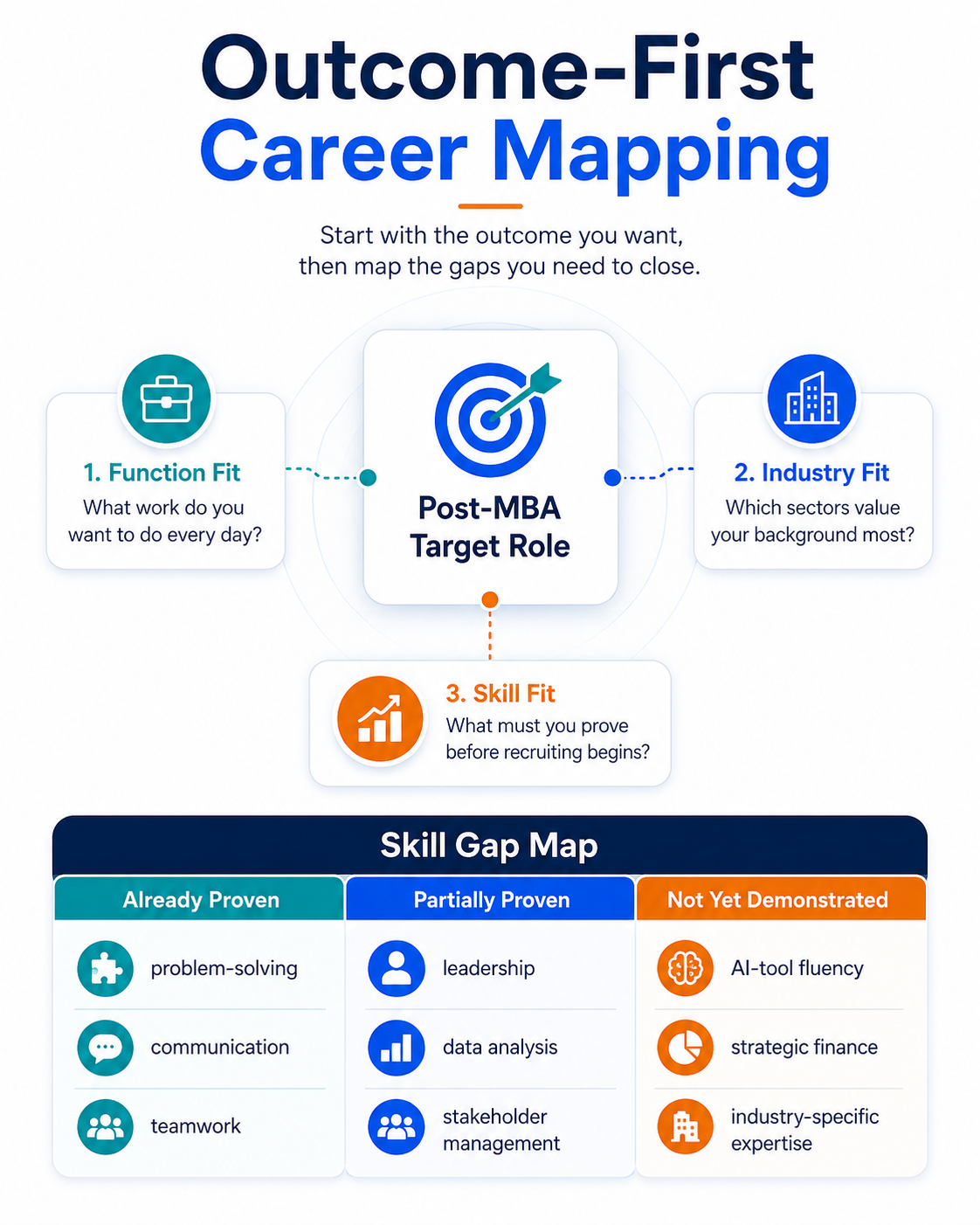
Write down one primary post-MBA target and one adjacent backup target. Then map both against three filters:
· Function fit: What day-to-day work do you want to do?
· Industry fit: Which sectors genuinely value your background?
· Skill fit: What must you prove before recruiting begins?
This is where many candidates get stuck. They pick a prestigious title but ignore whether their pre-MBA profile supports it. A more practical method is to compare your current experience with employer priorities. Recruiters continue to value problem-solving, strategic thinking, communication, adaptability, and leadership, while future demand is moving even more toward AI tools, technology skills, and data analysis. NACE’s framework adds teamwork, professionalism, technology, and career self-development to that picture. In other words, your roadmap should combine human judgment with technical fluency.
Once you know the gap, build a pre-MBA skills map with three columns: already proven, partially proven, and not yet demonstrated. If you need inspiration for how career planning frameworks are structured, Board Infinity already has useful reads on career planning and building a roadmap for career goals. If you are deciding between an MBA path and a more specialized quantitative route, this guide to top universities for a data science degree in 2026 is also a useful contrast in how program choice shapes outcomes.
Build proof, not just potential
Post-MBA recruiting is easier when your pre-MBA story already contains evidence. That evidence usually comes from four places:
· a high-impact project with measurable results
· leadership without formal authority
· analytical or financial problem-solving
· clear communication across teams or stakeholders
Employers do not only want ambition. They want proof that you can deliver in ambiguous situations. That is why ongoing learning, ownership, and self-management matter before business school. Board Infinity’s articles on career-ready skills through self-paced learning and long-term career growth through training fit this logic well: build evidence steadily, not all at once.
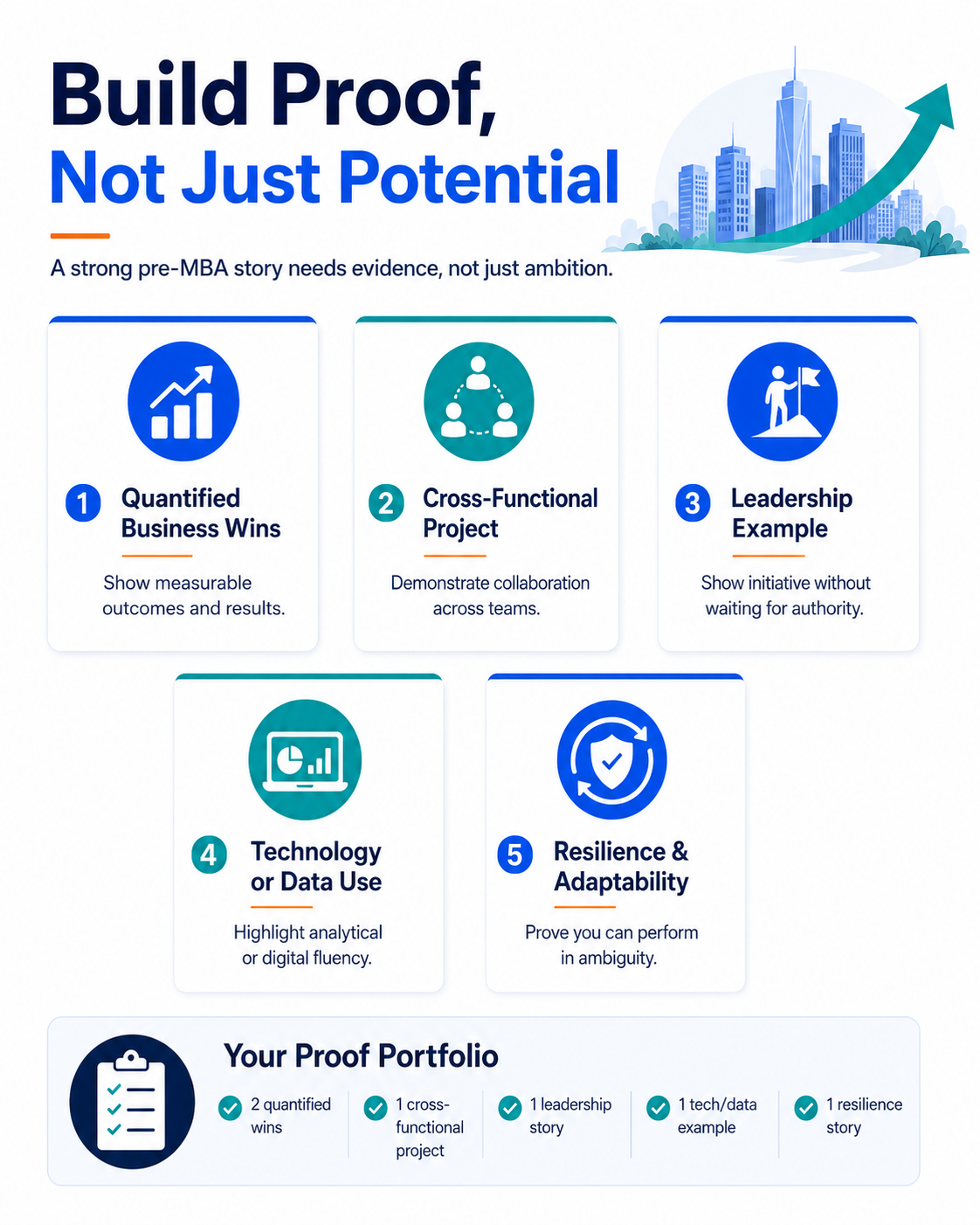
Your proof portfolio can be simple. Aim to collect:
- two quantified business wins
- one cross-functional project
- one leadership example
- one example of technology or data use
- one story showing resilience or adaptability
That mix aligns well with what employers say they value now and in the future. It also gives you better raw material for applications, networking conversations, internship recruiting, and interviews.
Use networking as a career laboratory
Networking works best before the MBA when it is used for learning, not only for asking favors. Speak with alumni, current students, managers in your target function, and peers who recently changed industries. Ask what skills mattered most, what surprised them in recruiting, and which parts of their pre-MBA profile helped the most.
This matters because official employment reports still show that accepted offers come from a mix of school-facilitated channels, internships, alumni, referrals, events, and personal networks. Your pre-MBA months are the best time to test assumptions and sharpen your story. They are also the right time to improve the communication and relationship-building skills that employers continue to rank highly.
A simple networking target is enough: two meaningful career conversations per month, one follow-up note after each conversation, and one insight captured in a tracker. Over time, patterns appear. You will start hearing which skills recur, which roles fit your background, and which stories land best.
A practical six-to-twenty-four-month roadmap
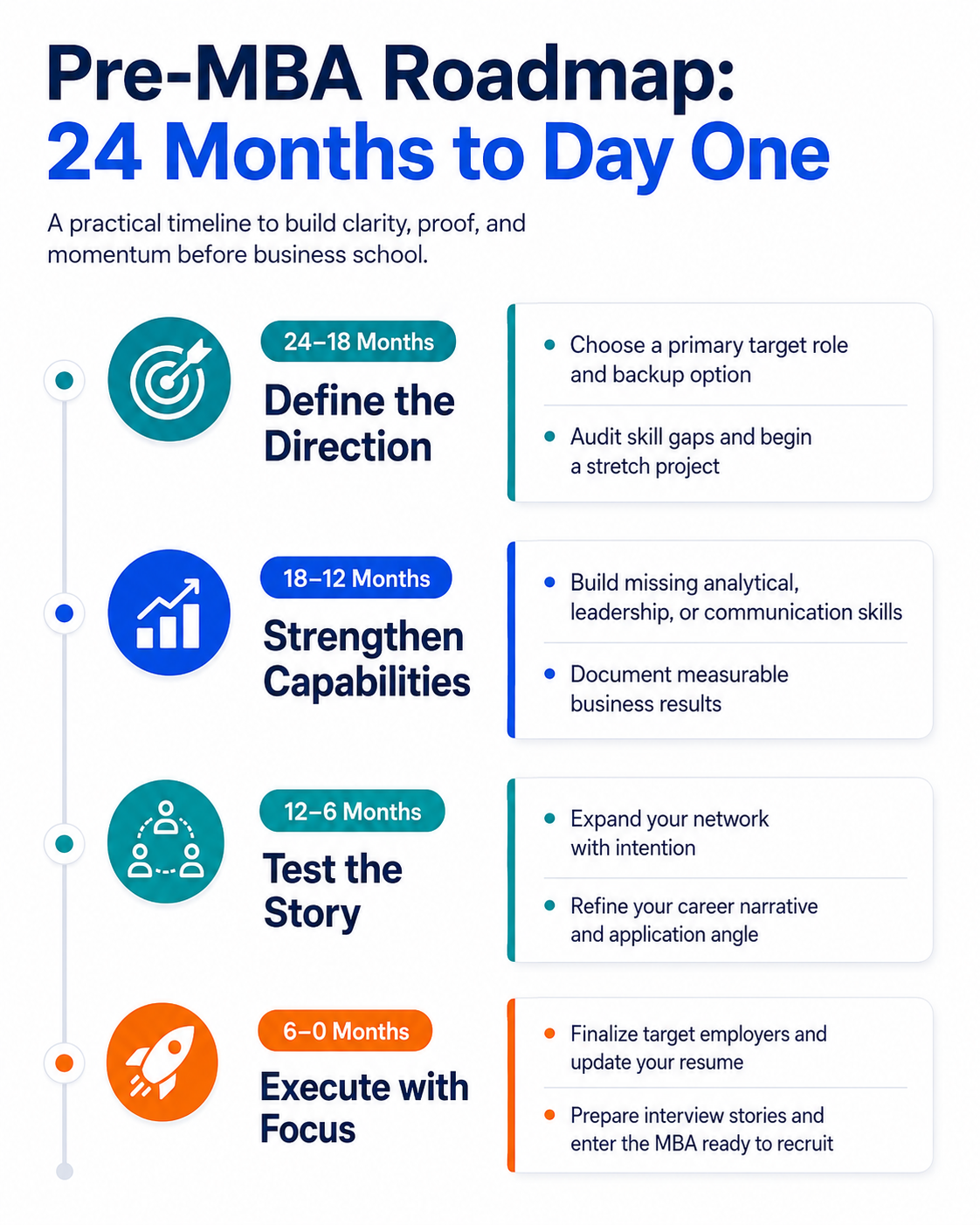
Here is a sample pre-MBA timeline you can adapt.
- 24 to 18 months before enrollment:Define your target function and backup option. Audit your skill gaps. Start one stretch project that can produce measurable business impact. Begin tracking outcomes the way employment reports do: role fit, industry fit, compensation range, and likely recruiting channel.
- Eighteen to twelve months before enrollment:Strengthen the missing capabilities. For some candidates, that means analytics or financial fluency. For others, it means managing a team, presenting senior-level recommendations, or owning a client-facing initiative. Document results in numbers wherever possible.
- Twelve to six months before enrollment:Expand your network with intent. Test your career story in real conversations. Refine your application narrative so it clearly links past experience, MBA need, and post-MBA goal. Make sure your examples demonstrate leadership, adaptability, and decision-making, not just hard work.
- Six months before enrollment to matriculation:Turn from exploration to execution. Finalize your target employer list, update your resume around quantified impact, organize interview stories, and enter the MBA with a focused but flexible plan. The best candidates arrive ready to learn, but also ready to recruit.
Common pitfalls and the metrics that matter
The biggest mistake is vagueness. “I want to grow into leadership” is not a roadmap. “I want to move from operations into strategy in healthcare, and I need stronger data storytelling plus cross-functional leadership proof” is a roadmap.
Other common pitfalls include chasing titles without checking fit, delaying networking until applications are done, and overestimating what the MBA alone will fix. In a labor market where nearly 40% of key skills are expected to change by 2030 and skill gaps are a major business barrier, waiting is expensive.
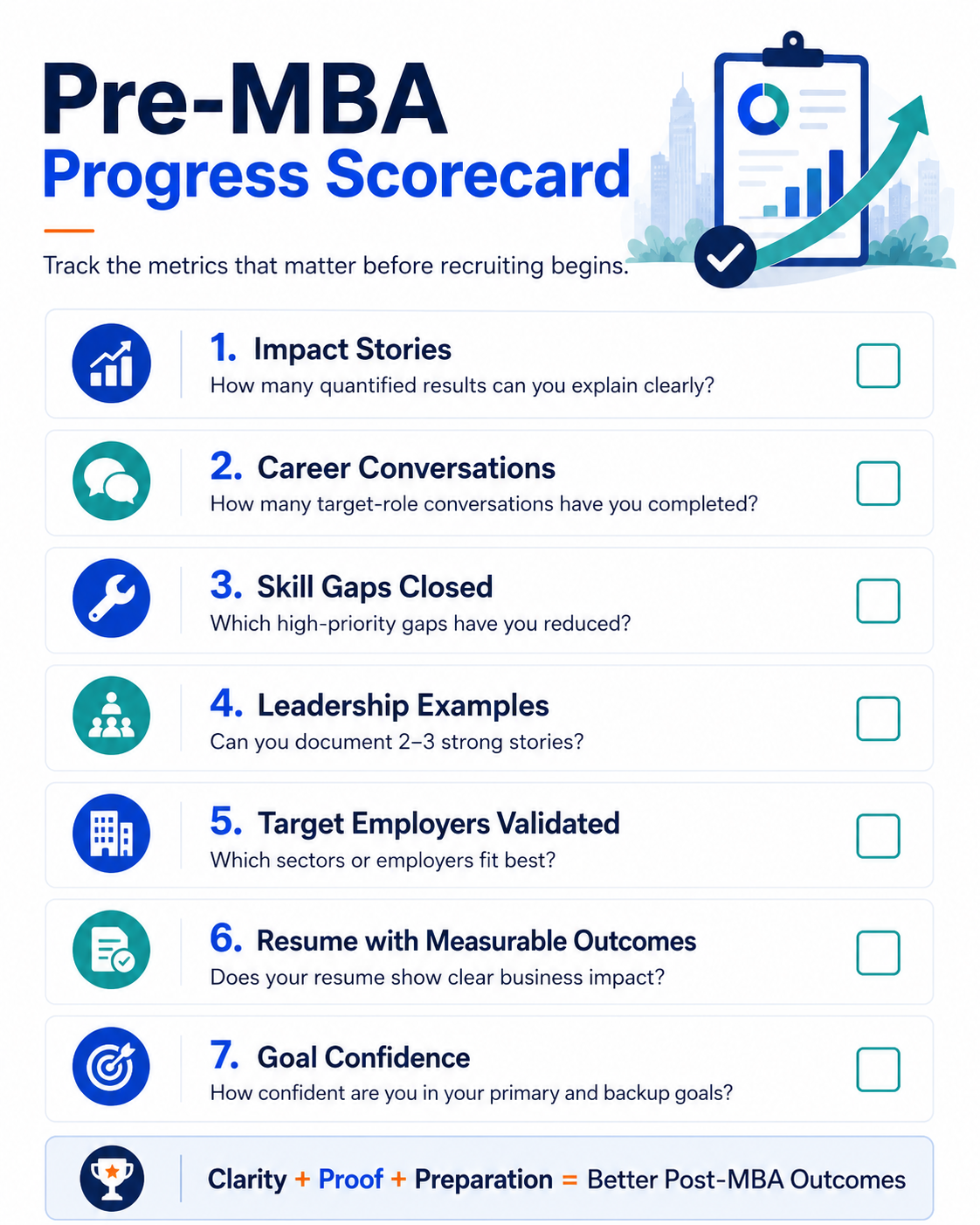
Track your pre-MBA progress with a short scorecard:
- number of quantified impact stories
- number of target-role conversations completed
- key skill gaps closed
- leadership examples documented
- target employers or sectors validated
- resume bullets with measurable outcomes
- confidence level in primary and backup post-MBA goals
Conclusion
A strong pre-MBA roadmap does not make your career rigid. It makes your next steps clearer. The goal is not to predict every outcome. It is to enter business school with enough direction, proof, and momentum that recruiting becomes easier and post-MBA choices become better. In a market that increasingly rewards both human skills and technical fluency, the candidates who prepare early give themselves the best chance of turning an MBA into a genuine career multiplier.