
HPCL: Sales Officer Direct Sales Interview Guide
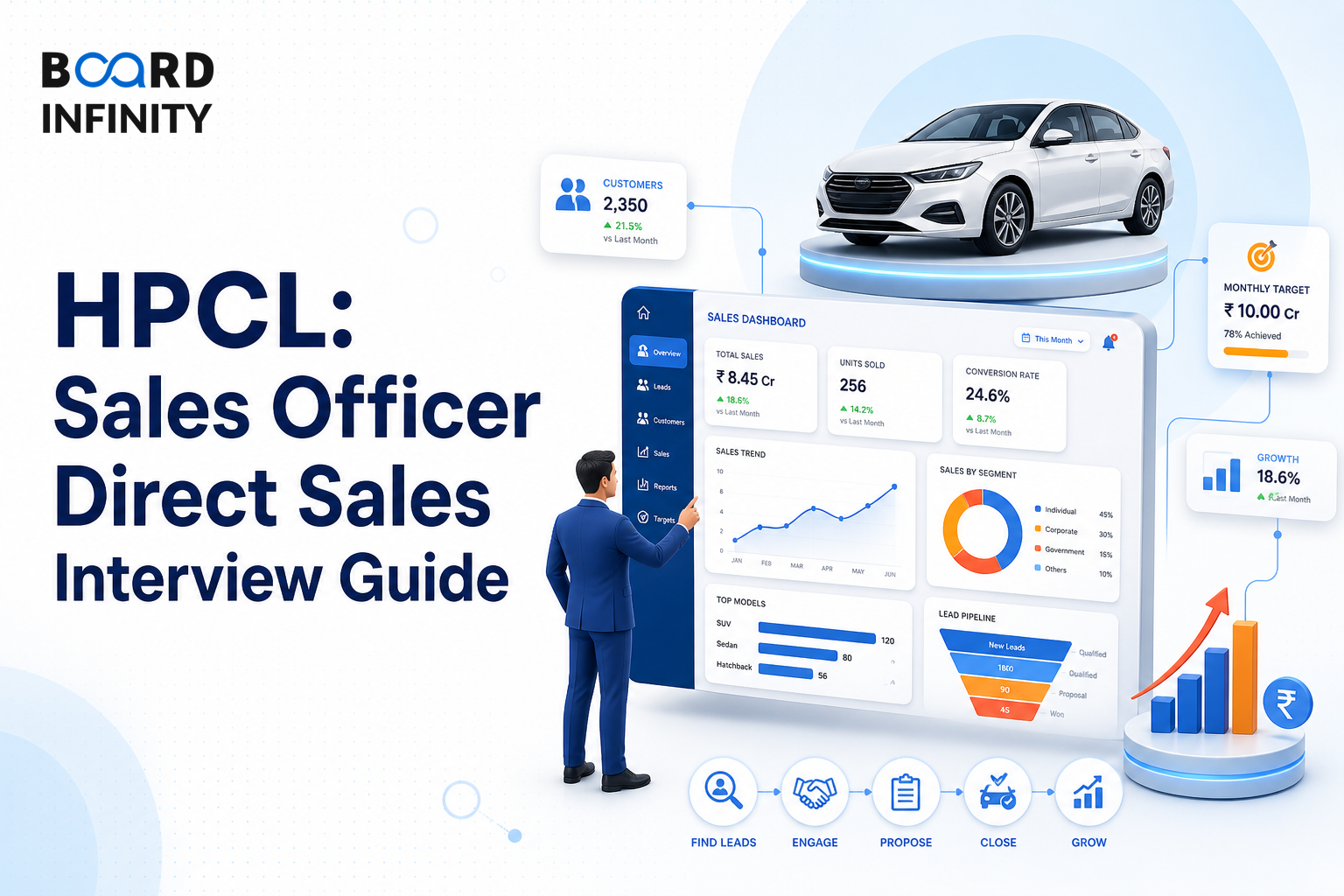
The Sales Officer in HPCL Direct Sales owns business from industrial and government customers, where every order affects volume, margin, supply reliability and account quality. The role is commercial, field-heavy and analytical, with decisions around customer acquisition, pricing, supply coordination, market intelligence and receivables.
This guide is built for campus and early-career candidates preparing for HPCL Sales Officer Direct Sales interviews. It covers the role, skills, responsibilities, interview process, role-specific questions, case areas and a four-week preparation plan.
1. About the Sales Officer - Direct Sales Role
This role is responsible for growing HPCL product sales in an assigned Industrial and Commercial portfolio. In practical terms, the officer identifies target accounts, visits customer sites, discusses supply needs, checks commercial viability, tracks competitor pricing and works to protect profitable volume.
The role works closely with industrial buyers, government departments, supply locations, regional office teams and internal commercial teams. If you want to compare how direct sales differs from product-led lubricant selling, the HPCL Lube Sales Officer interview guide is a relevant adjacent read.
2. Required Skills and Qualifications
Skills Overview
3. Day-to-Day Responsibilities
A typical week combines field visits, account reviews, pricing work, supply coordination and market tracking. The officer must balance volume growth with profitable transactions and timely collection.
Grow sales volume
The officer builds sales of HPCL petroleum products among industrial and government buyers. This means identifying buying centres, estimating product requirement, planning conversion actions and tracking whether assigned sales volume, market share and profitability targets are being achieved in the territory.
Develop new markets
The role requires scanning geographies and customer clusters where HPCL has scope to increase presence. In practice, this means mapping potential industrial accounts, understanding local demand, comparing competitor reach and preparing focused actions for entry or expansion.
Manage customer accounts
The officer acquires new customers and strengthens existing accounts through planned visits, engagement calendars and account-specific sales actions. The work includes meeting key customer personnel, understanding product usage, resolving service concerns and building enough trust to protect repeat business.
Run sales tours
Field touring is not random travel. The officer follows planned touring circuits, schedules meaningful customer meetings, combines prospecting with service follow-up and captures observations that can later support pricing, supply planning and market share actions.
Control commercial terms
Every transaction must make commercial sense. The officer checks pricing, terms and profitability before finalising business, prepares Management-Approved Exceptions when discounts or preferential terms are needed and monitors whether transactions meet Regional Office profitability expectations.
Coordinate supply readiness
The officer coordinates with supply locations so committed customers receive products reliably and on time. The role also includes identifying infrastructure needs at customer premises, helping facilitate improvements for new and existing customers and carrying out fixed asset verification when required.
Build market intelligence
The officer creates market profiles, performs ABC analysis by product and customer, tracks competitor infrastructure and compares landing costs for major products. This intelligence is then converted into practical actions to improve HPCL sales performance and profitability.
Track performance risks
The officer follows up receivables, monitors performance against the Annual Operating Plan and helps manage customer account risks. The same role also explores product trials, identifies energy-transition fuel opportunities, trains new officers and contributes to committees, task forces and manager-assigned work.
4. Key Competencies for Success
Top candidates show that they can sell without ignoring margin, collect without damaging relationships and use market data to decide where to spend field time. HPCL will value answers that connect customer action with commercial discipline.
5. Interview Process at HPCL
HPCL hiring for officer roles is typically structured through formal shortlisting and assessment stages communicated via the HPCL Careers portal. For a Sales Officer Direct Sales role, prepare for screening on eligibility, business judgement, customer handling, commercial understanding and fit with a field-sales environment.
Application and eligibility screening
Recruitment teams verify the application, academic and eligibility details, and basic role fit. Keep your resume aligned to sales, customer handling, commercial analysis, field projects, internships and any measurable business outcomes.
Aptitude or business screening
Expect checks on quantitative comfort, reasoning, communication and basic commercial awareness. For this role, practise percentage change, margin, discount, receivable aging and territory prioritisation questions.
Group task or business discussion
The panel may assess how you structure a market problem, listen to others and defend a practical recommendation. Sales cases may involve winning an industrial account, responding to competitor pricing or improving collections.
Personal interview
The interview focuses on motivation for HPCL, sales temperament, customer handling, commercial judgement, market analysis and willingness to travel. Prepare examples that show persistence, ethical conduct, numerical thinking and comfort with field execution.
6. Interview Questions
Use STAR for behavioural answers, MECE for market and case answers, and clear arithmetic for pricing or profitability questions. HPCL interviewers will look for practical field judgement, ethical selling, comfort with numbers and the ability to coordinate across customers and internal teams.
Behavioral and Company-Fit Questions
Role-Specific Sales and Commercial Questions
Product, Market and Case Questions
7. Topics and Areas of Focus
Preparation should focus on field sales execution, commercial maths, industrial account behaviour and territory analysis. The strongest candidates can explain how a field visit becomes a profitable and collectible sale.
8. Preparation Plan
Role basics
Understand HPCL Direct Sales work, customers and territory logic.
Commercial depth
Practise pricing, margin, landing cost and receivable scenarios.
Interview stories
Build STAR stories and practise sales case answers.
Mock review
Run mocks, fix weak answers and revise calculations.
Pre-Interview Checklist
9. Career Growth and Next Roles
Growth in this path depends on consistent target delivery, clean account management, strong commercial judgement and the ability to handle larger territories or more complex customer portfolios. Think of the path as increasing ownership, from managing assigned accounts to shaping wider regional sales outcomes.
Officer - Sales, Direct Sales
At this stage, you own assigned customers, territory visits, account follow-up, pricing inputs, supply coordination and receivable discipline. To grow, you must prove that you can deliver targets while protecting profitability and maintaining accurate market intelligence.
Larger territory ownership
After building field credibility, the next capability stage is handling a larger customer base or more complex territory. You need sharper prioritisation, stronger negotiation discipline and the ability to anticipate supply, pricing and collection issues before escalation.
Regional commercial contributor
With experience, strong officers contribute more to regional planning, market analysis, customer strategy and capability building. The proof point becomes quality of recommendations, not just personal effort in the field.
People or specialist track
Beyond the early stages, growth can lean toward people-management responsibilities or deeper commercial specialisation in pricing, market development, logistics coordination and strategic accounts. The strongest foundation is a record of ethical, profitable and well-documented account ownership.
10. Conclusion
The best preparation for an HPCL Sales Officer Direct Sales interview is to think like a territory owner. Every answer should show how you will win customers, protect profitability, coordinate supply, collect receivables and use market intelligence to improve performance.
Before the interview, prepare one territory plan and one commercial case calculation. If you want another HPCL sales role comparison, the HPCL LPG Sales Officer interview guide can help you compare customer context and field responsibilities.
