
Infosys: Associate and Senior Associate Consultant Guide
The Associate Consultant or Senior Associate Consultant in Infosys Data and Analytics Consulting helps clients turn scattered data problems into practical roadmaps, process designs and analytics solutions. The role matters because the work influences how business teams govern data, measure performance, build reports and adopt newer data platforms.
This guide is built for students and early career professionals preparing for the Infosys Data and Analytics Consulting interview. It covers the role, skills, responsibilities, interview process, role-specific questions, preparation topics, a 4-week plan and realistic next roles.
1. About the Associate Consultant/ Senior Associate Consultant Role
This role supports consulting projects where the client may have unclear reporting, weak data ownership, duplicated dashboards or incomplete governance rules. You help frame the problem, collect evidence, compare solution options, document the target process and support proof of concept work before the solution is deployed.
You work with senior consultants, data architects, business users, delivery teams and client-side data owners. If you want to compare this track with another Infosys consulting role, the Infosys Senior Associate Consultant Oracle Practice guide is useful for understanding how consulting expectations change by domain.
2. Required Skills and Qualifications
Skills Overview
3. Day-to-Day Responsibilities
A typical week combines research, client discussion notes, current-state analysis, requirements writing and solution comparison. The work is not only about tools; it is about explaining which data problem should be solved first and why.
Research the Problem
You collect background information on data governance, data management, security, compliance, business intelligence and industry use cases. In practice, this means reading internal knowledge assets, public vendor material and industry examples, then converting them into concise notes that help senior consultants define the client problem more clearly.
Support Proposals
You help build inputs for proposals by finding comparable project examples, effort drivers, typical deliverables and assumptions. For example, a data governance assessment may need effort split by interviews, document review, dashboard review, gap analysis and final recommendations. Your inputs help the team avoid vague estimation.
Assess Current State
You review current reports, processes, data flows and assessment notes to identify gaps. This may include finding inconsistent metric definitions, unclear data ownership, manual spreadsheet reconciliations or missing quality checks. On smaller assignments, you may directly contribute sections to the current-state assessment report.
Compare Solutions
You compare possible options using research, client context, feasibility and expected value. For example, you may compare a centralised dashboard model with a self-service reporting approach, or assess whether a proof of concept should focus first on data quality, metadata or dashboard standardisation.
Write Requirements
You convert business needs into requirement specifications and process design documents. This means defining users, input data, output reports, approval flows, exceptions, controls and expected business outcomes. The documents must be clear enough for both business reviewers and technical teams to act on.
Maintain Knowledge Assets
You help keep project templates, case examples, reusable research, vendor comparison notes and data strategy references updated in the knowledge repository. This matters because consulting teams reuse proven material across proposals and projects, but only when the content is current, reliable and easy to find.
4. Key Competencies for Success
High performers in this role do not stop at knowing data concepts. They show structured thinking, client-ready writing, comfort with ambiguity and the ability to connect analytics work to a business decision.
5. Interview Process at Infosys
For this consulting and analytics role, prepare for a mix of resume discussion, data fundamentals, consulting cases and behavioural evaluation. Infosys applications and role searches are handled through the official Infosys Careers portal, while campus processes may also involve college placement coordination.
Application and Shortlisting
The first filter reviews role fit through education, internships, projects, analytics exposure, consulting interest and communication clarity. For campus candidates, the placement cell may collect resumes and coordinate the shortlist. For lateral applicants, profile alignment with data governance, business intelligence or consulting work becomes more important.
Analytical or Technical Screen
This round may test SQL basics, data modelling, reporting logic, interpretation of a small dataset, data quality thinking and business intelligence concepts. The interviewer looks for clear reasoning, not tool memorisation. Be ready to explain joins, facts and dimensions, dashboard metrics and how data moves from source systems to reports.
Consulting Case Discussion
Expect a situation such as poor dashboard adoption, inconsistent sales numbers, delayed reporting or weak data ownership. You may need to ask clarifying questions, structure the issue, identify root causes, suggest analysis and recommend a practical path. The round tests how you think under ambiguity.
Managerial Interview
A consulting manager or senior team member may probe your resume, project ownership, communication style, teamwork and client-readiness. Prepare examples where you handled unclear requirements, improved a process, analysed data or worked with multiple contributors to produce a result.
HR and Fit Discussion
The final discussion checks motivation, flexibility, communication, learning mindset and alignment with consulting work. Be ready for questions on why Infosys, why data and analytics consulting, how you handle feedback, and how you respond when a client asks for something outside scope.
6. Interview Questions
Use STAR for behavioural answers, MECE thinking for case questions and step-by-step logic for technical answers. Infosys interviewers are likely to value clarity, humility, client-readiness and the ability to connect data work with business outcomes.
Behavioral and Company-Fit Questions
Technical Questions: Data, BI, SQL and Governance
Case, Product Sense and Metrics Questions
7. Topics and Areas of Focus
Preparation should cover data fundamentals, consulting structure and business communication. The strongest candidates can explain concepts simply, apply them to client situations and document their thinking clearly.
8. Preparation Plan
Role Basics
Understand Infosys, consulting flow and data analytics responsibilities.
Core Skills
Build depth in SQL, data governance, data modelling and dashboards.
Case Practice
Practise data consulting cases and write STAR stories.
Mock Review
Run mocks, fix weak answers and polish communication.
Pre-Interview Checklist
9. Career Growth & Next Roles
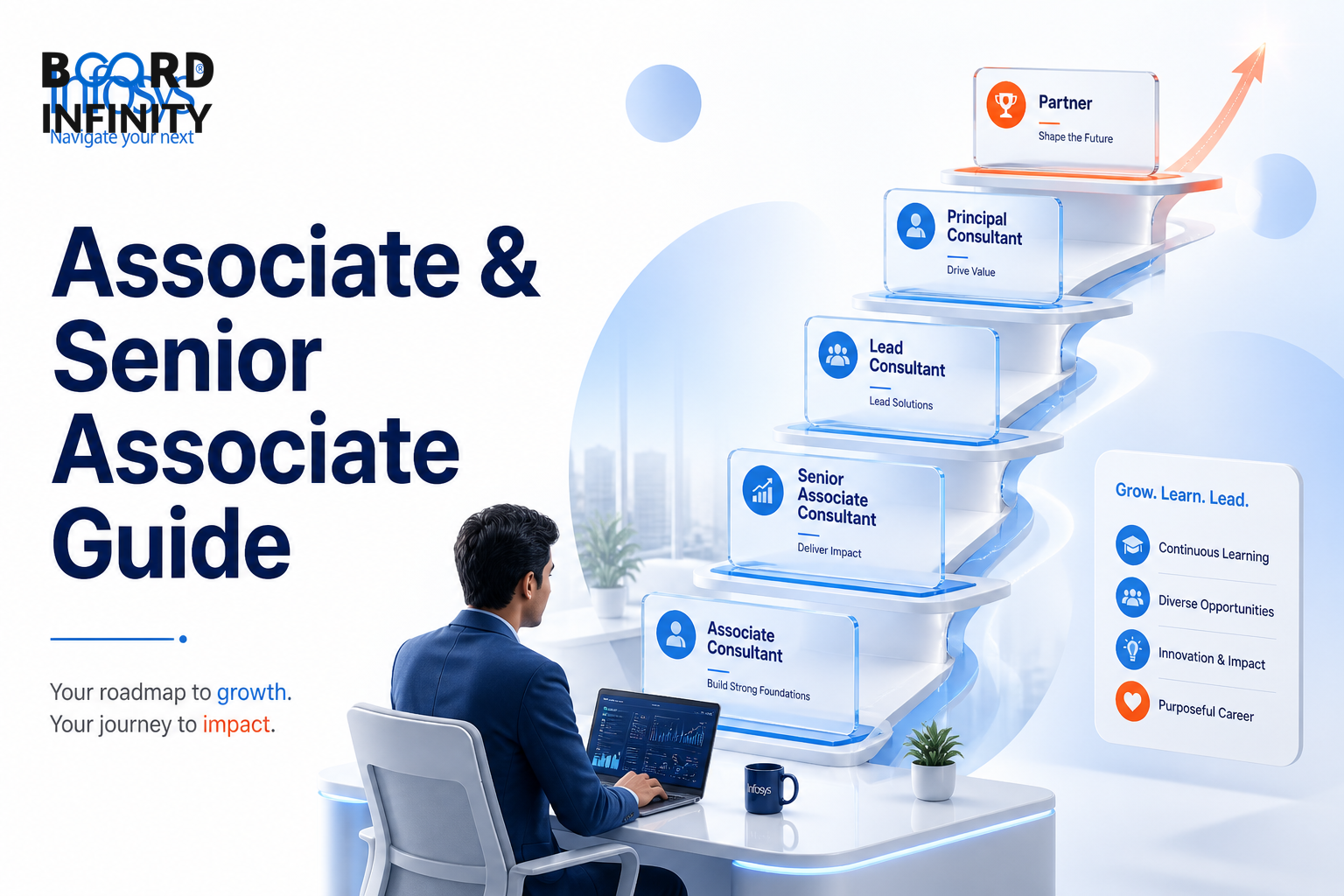
Progression in this track depends on your ability to move from task support to independent workstream ownership. Candidates who build strong documentation, client communication, data strategy thinking and delivery awareness can grow into broader consulting roles over time.
Associate Consultant/ Senior Associate Consultant
At this stage, you support research, assessments, requirements, solution comparisons and knowledge assets. To move up, prove that you can produce client-ready work with limited rework, ask strong discovery questions and explain data concepts clearly to both business and technical audiences.
Consultant
A consultant is expected to own defined workstreams such as current-state assessment, dashboard requirements, data governance design or proof of concept coordination. You must show better client handling, stronger problem decomposition and the ability to guide analysts or junior consultants on deliverables.
Senior Consultant
A senior consultant shapes recommendations, manages client discussions and aligns data initiatives with business outcomes. To reach this level, build domain fluency, executive presentation skills, estimation judgement and the ability to identify risks before they affect timelines or client confidence.
Manager or Specialist Track
Beyond senior consultant, growth can move toward people management or deep specialisation. The management route needs account coordination, team leadership and commercial understanding. The specialist route needs depth in data governance, data strategy, business intelligence architecture, metadata, quality or emerging analytics capabilities.
10. Conclusion
The strongest preparation strategy is to think like a consultant, not only like a data student. For every answer, start with the business problem, define the data needed, explain the checks and then recommend a practical path that a client team can understand.
Before the interview, prepare one data governance case, one dashboard requirement document and one SQL-based data quality example. Candidates exploring adjacent Infosys tracks can also review the Infosys Senior Associate Consultant interview guide to compare question patterns across consulting roles.
