
Key Finance Formulas & Benchmarks
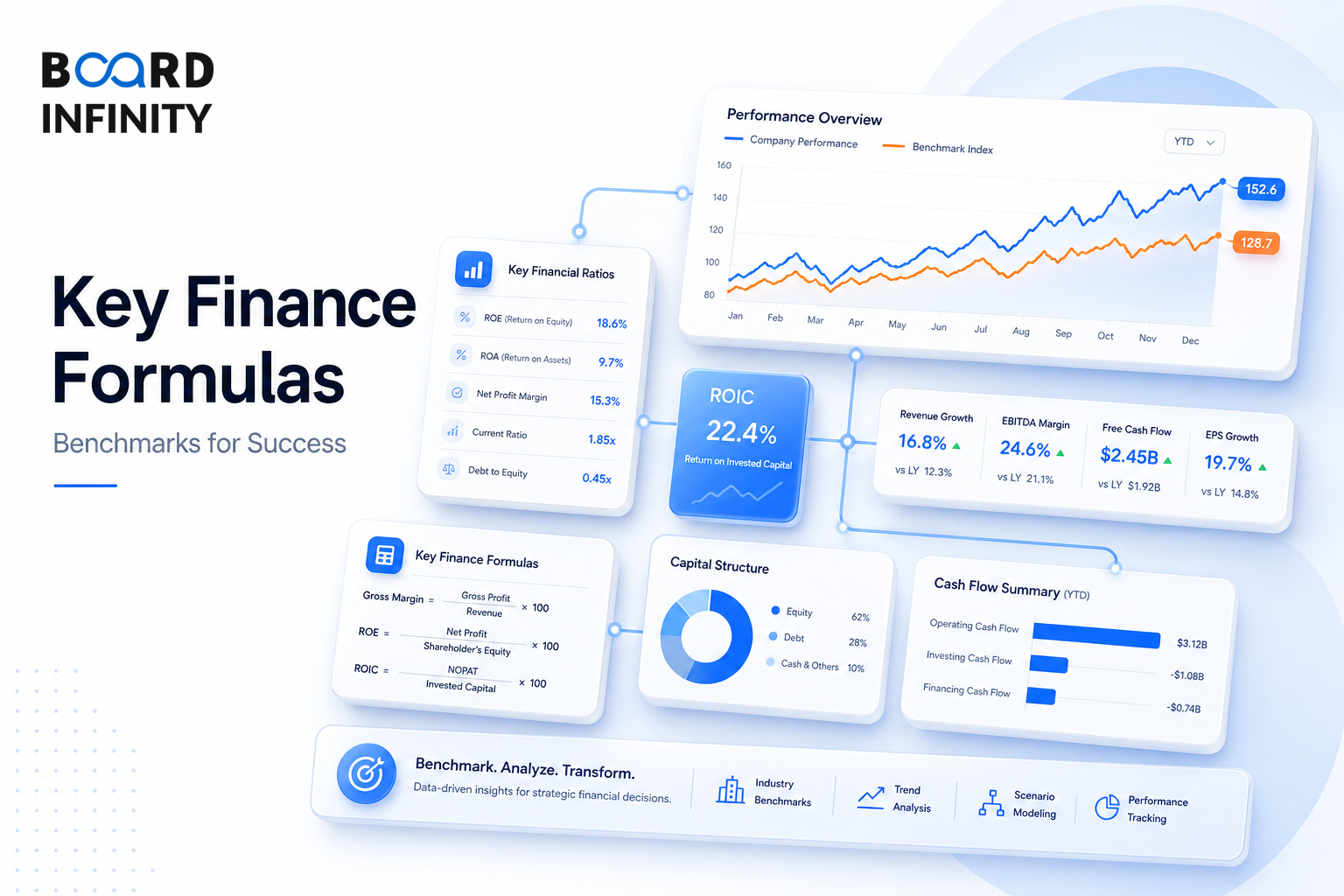
After the Finance Day 0 Cheat Sheet, the next placement problem is instant recall: formulas, live Indian macro numbers, banking benchmarks, and golden rules you must know cold before walking into any finance placement interview. This reference keeps the focus on what interviewers test under uncertainty - structure, Indian context, and intellectual honesty.
- Present Value (PV) = FV ÷ (1 + r)^n, and Future Value (FV) = PV × (1 + r)^n.
- Weighted Average Cost of Capital (WACC) = Ke·E/(D+E) + Kd(1−t)·D/(D+E), where Ke = cost of equity, Kd = pre-tax debt cost, and t = tax rate.
- Discounted Cash Flow (DCF) intrinsic value = Σ FCF_t/(1+WACC)^t + TV/(1+WACC)^n, with Terminal Value using Gordon Growth or Exit Multiple.
- India macro numbers to know cold include Repo Rate 6.50%, 10-Year G-Sec Yield ≈ 6.8 - 7.2%, and Total MF AUM ₹ 63-65 lakh Cr+.
- Banking benchmarks include CASA Ratio - Pvt Banks 40 - 55%, Net Interest Margin 3.0 - 4.5%, and Gross NPA Ratio ≈ 2.8 - 3.5%.
- Always quote a range, not a single number - it signals you understand that metrics vary by bank type, size, and credit cycle.
- Finance interviews test how you think under uncertainty - not whether you can recite formulas.
Big Picture: The Instant-Recall Finance Map
This is an instant-recall reference for finance interviews. It condenses the formulas, live Indian macro numbers, and golden rules you must know cold before walking into any finance placement interview.
The recall map has five parts: core finance formulas, advanced formula cards, India macro numbers, banking quick numbers, and 10 golden rules for finance interviews.
Core Finance Formulas
These are the first-layer formulas that come up across valuation, financial statement analysis, corporate finance, and interview case discussions.
Advanced Formula Cards
These formulas are especially useful when the discussion moves into valuation, M&A, free cash flow, portfolio risk, beta re-levering, and distress analysis.
India Macro Numbers
All figures are sourced from RBI, SEBI, AMFI, NSE/BSE published reports as of FY2024-25. Macro numbers change - verify the latest before your interview.
Banking Quick Numbers in India
Banking metrics vary by bank type, size, and credit cycle. Use these benchmarks as quick anchors for Indian banking discussions.
Always quote a range, not a single number - it signals you understand that metrics vary by bank type (PSU vs private), size, and credit cycle. Anchoring to HDFC Bank and SBI as reference points is always well-received.
10 Golden Rules for Finance Interviews
These golden rules are about mindset, not memorisation. They help you frame answers when numbers are incomplete, assumptions matter, and the interviewer is testing judgement.
The Interviewer's Perspective: These golden rules are about mindset, not memorisation. Finance interviews test how you think under uncertainty - not whether you can recite formulas. Structure + Indian context + intellectual honesty = interview success.
Conclusion
The core takeaway is simple: know the formulas, quote Indian benchmarks as ranges, and use structure before calculation. In finance interviews, structure + Indian context + intellectual honesty = interview success.
The most frequent error is quoting a formula, ratio, or macro number without a benchmark or context. A P/E of 25× means nothing without sector, historical average, and peer comps, and a single banking number without a range ignores bank type, size, and credit cycle.
