
Operations & Supply Chain Intern Laxmi Organics Interview Guide
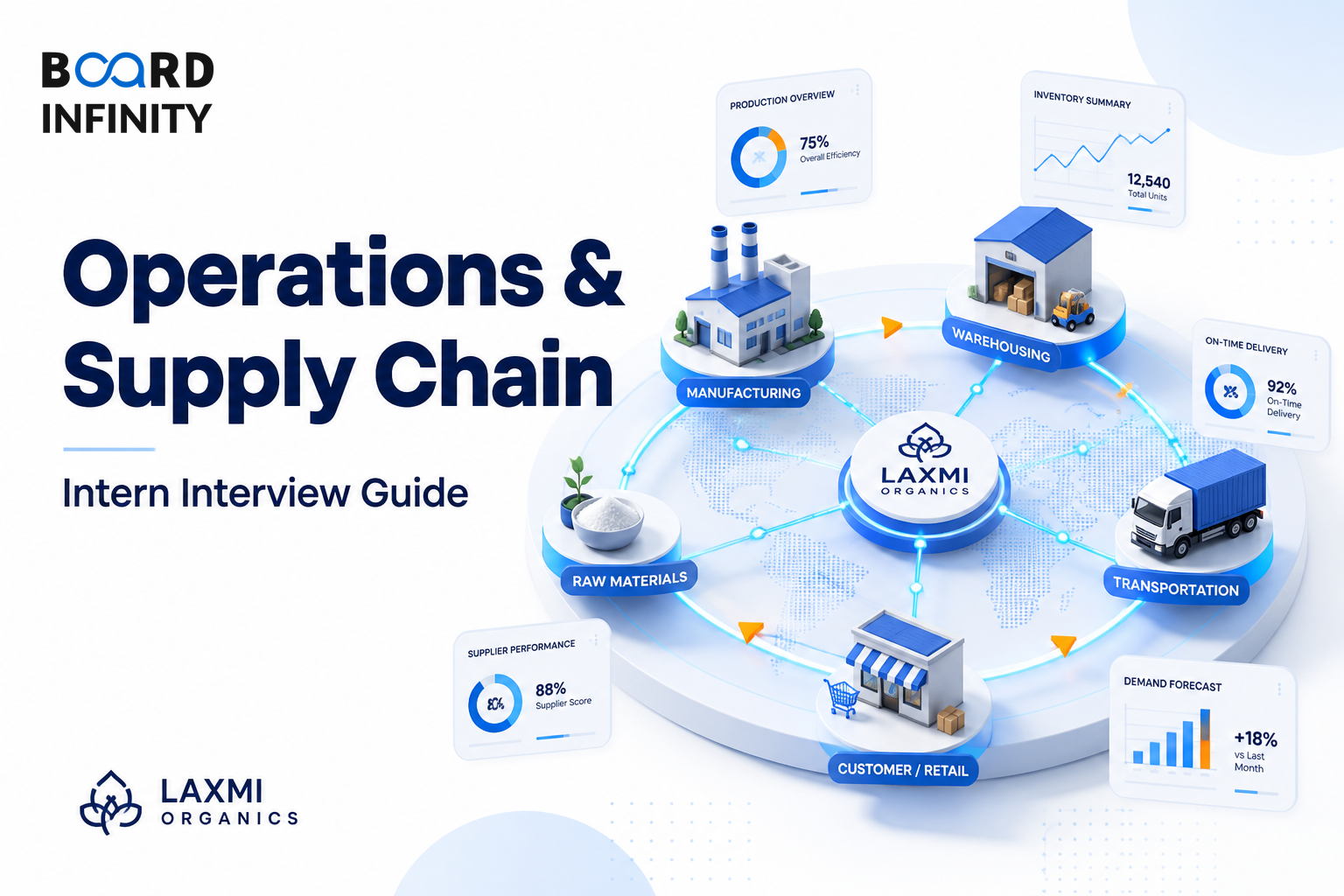
Laxmi Organics Industries Ltd: Operations & Supply Chain Intern Interview Guide
The Operations & Supply Chain Intern role supports the plant-facing work that keeps chemical manufacturing moving from raw material availability to finished goods dispatch. At Laxmi Organics, this means understanding production flows, tracking operational data, coordinating with multiple plant teams and converting observations into practical improvement recommendations.
This guide is built for MBA and postgraduate management students preparing for campus interviews. It covers the role, skills, day-to-day responsibilities, interview process, role-specific questions, preparation topics and a four-week plan. For extra practice, use these supply chain management and operations interview questions alongside this guide.
1. About the Operations & Supply Chain Intern Role
Laxmi Organic Industries Limited describes its business around acetyl intermediates and specialty intermediates on its official website. In this role, your work sits close to manufacturing execution, where small delays in material movement, inventory visibility or production planning can affect cost, output and service reliability.
You are expected to learn from plant managers, functional heads and operating teams rather than work only from a classroom framework. The closest related preparation path is the Laxmi Organic Management Trainee Supply Chain and Operations guide, especially if you want a broader view of operations roles in the same company context.
What You Should Expect to Learn
2. Required Skills and Qualifications
Educational Qualifications
Skills Overview
Preferred Candidate Profile
3. Day-to-Day Responsibilities
A typical week involves observing how materials move through production, checking trackers, speaking to team members and helping managers convert plant-level data into usable summaries. The work is practical, so interviewers look for candidates who can learn systems quickly and ask structured questions.
Map Plant Flows
You may be asked to understand how a material enters the plant, moves into processing, becomes work-in-progress and finally reaches finished goods storage. The practical task is to observe the flow, ask where delays usually occur and document the handoffs between production, warehousing and dispatch without disturbing routine work.
Track Production Plans
You help compare planned output with actual progress using production sheets, Excel trackers or manager inputs. The work can include checking whether a production plan is on schedule, identifying process data that needs attention and summarising deviations in a way that helps the plant team decide what to follow up on.
Monitor Inventory Status
You support inventory tracking across raw materials, work-in-progress and finished goods. This may involve reconciling quantities in trackers, understanding where material is physically located and identifying mismatches that can affect production readiness, warehousing space or dispatch commitments.
Support Material Planning
You gain exposure to procurement, vendor coordination, material planning and logistics by seeing how purchase timing and inbound movement affect production. The intern role is not vendor ownership, but you may help prepare status views that show what material is expected, what is pending and where follow-up is needed.
Analyse Process Gaps
You review operational data to identify gaps, bottlenecks and improvement opportunities. For example, you may compare cycle times across shifts, look at recurring delays in material issue or identify repeated reasons for plan variance, then prepare a short explanation of what the data suggests.
Prepare Operating Reports
You support reports, dashboards and performance summaries that help managers review operations. A strong intern does not only beautify Excel sheets, but also checks whether the numbers are consistent, whether the labels are clear and whether a manager can identify the action point within a few minutes.
Coordinate Team Inputs
You learn how production, quality, procurement, warehousing and dispatch teams depend on each other. In practice, this means understanding which team owns each data point, why a delay in one team affects another and how to communicate follow-ups without blaming people.
Improve Productivity Levers
You may participate in projects related to productivity improvement, resource utilisation, process optimisation or cost efficiency. The intern contribution is usually to collect data, compare current and desired performance, calculate the size of the issue and suggest practical improvements that the plant team can evaluate.
Present Manager Assignments
Plant managers or functional heads may assign focused problems, such as analysing a tracker, reviewing a process delay or preparing a performance summary. You are expected to present findings in a structured way, separate facts from assumptions and recommend actions that are realistic for a manufacturing environment.
4. Key Competencies for Success
Top candidates show that they can move from classroom concepts to plant-level problem solving. The strongest answers combine Excel comfort, operational logic, clear communication and respect for the realities of chemical manufacturing workflows.
5. Interview Process at Laxmi Organics Industries Ltd
For an operations and supply chain internship in a chemical manufacturing company, prepare for a process that tests motivation, Excel comfort, operations fundamentals, plant-readiness and ability to explain analysis. Expect the functional round to carry the most weight because the role is close to manufacturing execution.
Application or Campus Shortlist
The first filter usually checks programme fit, interest in operations, internship availability and resume alignment. Your resume should show analytical work, Excel use, operations projects, manufacturing exposure or supply chain coursework where applicable.
Human Resources Screening
This round checks communication, willingness for plant exposure, internship seriousness and basic fit with a manufacturing environment. Prepare clear answers for why operations and supply chain, why chemical manufacturing and why Laxmi Organics.
Functional Operations Round
A manager or functional interviewer may test production planning, inventory logic, material movement, bottleneck analysis, Excel thinking and report interpretation. You may get a small operational scenario and be asked to diagnose the issue.
Plant or Manager Discussion
This discussion checks whether you can work with plant teams, understand instructions and present findings clearly. Expect questions on how you would collect data, whom you would speak to and how you would avoid jumping to conclusions.
Final Fit Conversation
The final conversation usually confirms availability, location flexibility if needed, project interest and expectations. Keep your answers crisp and connect your learning goals with the work of production planning, inventory control and process improvement.
6. Interview Questions
Use STAR for behavioural answers, MECE for diagnosis questions and a step-by-step calculation approach for operations cases. Laxmi Organics interviewers will value candidates who can connect Excel, inventory logic, production planning and cross-functional communication to practical plant situations.
Behavioral & Company-Fit Questions
Technical & Operations Fundamentals
Case-Based & Analytical Questions
7. Topics and Areas of Focus
Prepare topics that map directly to the internship: production planning, inventory tracking, procurement coordination, logistics, dashboards and plant-level process improvement. The goal is to show that you can learn quickly and apply concepts without overcomplicating them.
8. Preparation Plan
Company and Role
Understand Laxmi Organics, chemical manufacturing context and the internship scope.
Operations Core
Practise production planning, inventory tracking, procurement flow and Excel reporting.
Questions and Cases
Write STAR stories and solve plant-style analytical cases.
Mock and Revise
Run mocks, refine weak answers and practise clear recommendation summaries.
Pre-Interview Checklist
9. Career Growth & Next Roles
This internship can build a foundation for operations, supply chain, manufacturing planning or process improvement roles. Progression depends on how well you learn plant systems, use data responsibly, communicate across teams and turn analysis into practical recommendations.
Operations & Supply Chain Intern
At this stage, you learn plant workflows, support trackers, analyse operating data and present small recommendations. To stand out, prove that you can work carefully with raw material, work-in-progress and finished goods data while communicating respectfully with multiple teams.
Operations or Supply Chain Executive
In the early full-time stage, you may handle trackers, follow-ups, planning support or coordination tasks with more ownership. To move ahead, build reliability in data accuracy, daily reporting, stakeholder follow-up and root cause thinking.
Planning or Process Improvement Lead
At this stage, the role becomes more analytical and improvement-led. You may own planning reviews, inventory improvement projects, productivity analysis or cost-efficiency initiatives, and you must show stronger problem definition, stakeholder alignment and measurable outcomes.
Manager or Specialist Track
Longer-term growth can move toward people management in operations and supply chain or a deeper specialist track in planning, inventory, logistics or process excellence. The differentiator is the ability to combine plant understanding, data-backed decisions and cross-functional execution.
10. Conclusion
The strongest preparation is to understand the plant as a connected system, not as separate departments. Your interview answers should show how raw materials, production planning, work-in-progress, quality, warehousing and dispatch influence each other in day-to-day manufacturing.
Before the interview, practise Excel-based trackers and prepare stories where you used data, clarified ambiguity and worked with multiple people. Also rehearse how you would present one operational issue to a plant manager with facts, causes, recommendation and expected benefit.
