
Polycab: Company Overview & Careers Guide
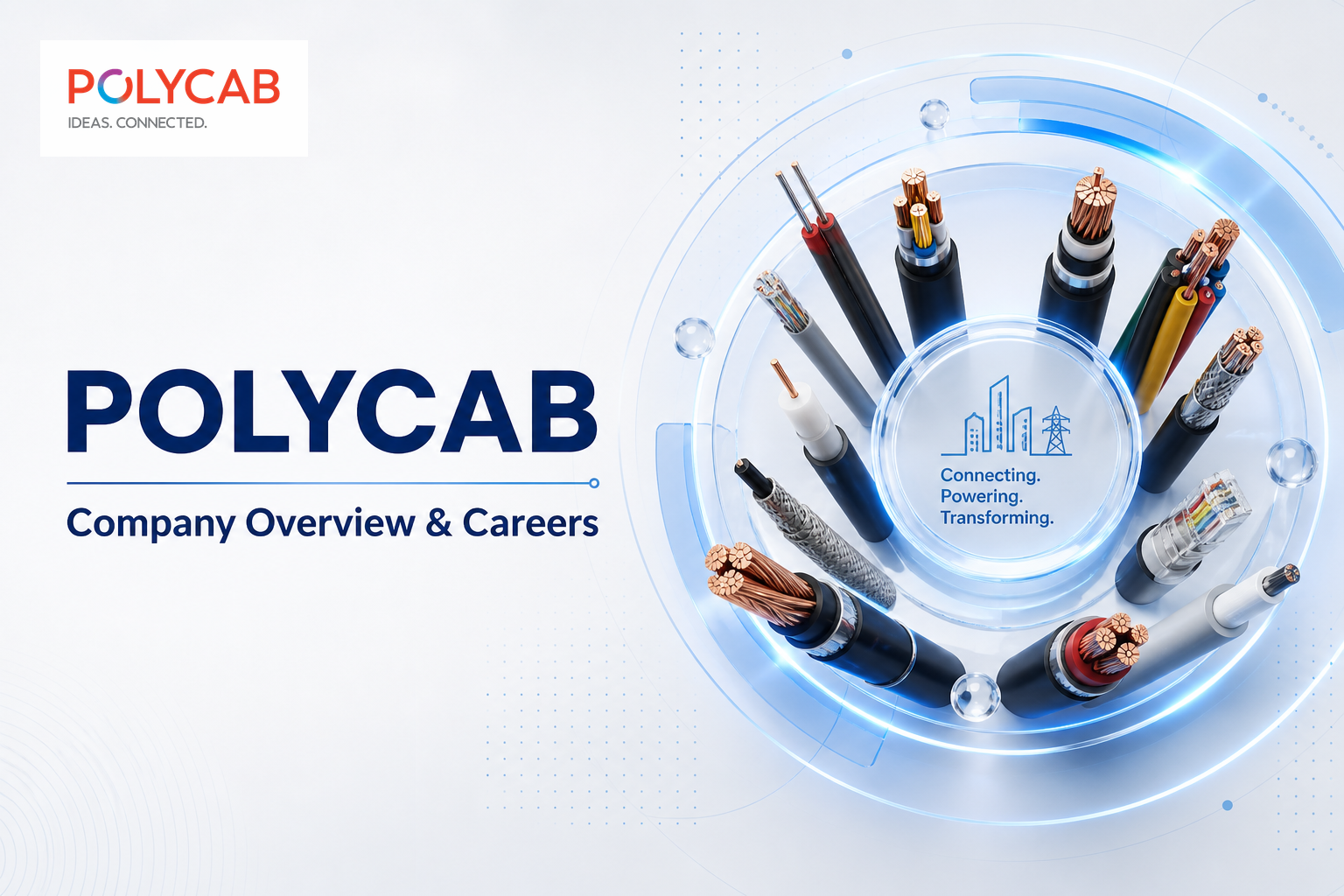
Polycab India Limited is an Indian electricals company best known for wires and cables, with a wider portfolio that also includes consumer electrical products and electrical infrastructure solutions. It sits in the electrical equipment and fast-moving electrical goods space, serving homes, commercial buildings, industries, utilities, infrastructure projects and trade channels.
For candidates, Polycab matters because it combines manufacturing discipline with brand-led distribution, contractor relationships, product quality, safety compliance and channel execution. A role here can require understanding factories, supply chains, dealers, electricians, project customers, after-sales service, product launches and regulatory expectations. The company is useful to study because its business touches both B2B and B2C markets: a cable sold to an infrastructure contractor needs technical credibility, while a fan, switch or light sold through retail needs availability, pricing, service and brand trust. Interviewers can therefore test both operational thinking and customer-market awareness.
This guide covers where Polycab came from, who runs it today, and the product categories and competitors a candidate should understand.
1. Company Overview
About Polycab
Polycab manufactures and markets electrical products, with wires and cables at the core of the business and a wider consumer electricals portfolio around it. Its own product catalogue covers categories such as cables, wires, fans, lighting, switches, switchgear, solar products and conduits (Polycab Products), making it a useful case study for sales, supply chain, manufacturing, quality, product management, finance and channel roles.
| Attribute | Details |
|---|---|
| Founders | Inder T. Jaisinghani, Ajay T. Jaisinghani, Ramesh T. Jaisinghani, and Girdhari T. Jaisinghani |
| Founded | 1983 (as Polycab Industries) |
| Industry | Electrical Equipment / Wires & Cables, FMEG (Fast Moving Electrical Goods) |
| Headquarters | Mumbai, Maharashtra, India |
Company History
For interview preparation, Polycab’s history is best read as a shift from a family-led electrical trading base into a manufacturing-led, publicly listed electricals company. The milestones below are drawn from Polycab’s official investor information and its 2019 red herring prospectus filed with SEBI (SEBI RHP, 2019), so focus on the operating changes: manufacturing scale-up, institutionalisation, diversification and listing.
Thakurdas Jaisinghani’s electrical goods trading activity laid the base for the business that later became associated with the Polycab brand.
Polycab Wires Private Limited was incorporated, giving the business a corporate structure around wires and cables manufacturing.
The company expanded its manufacturing orientation, moving beyond trading roots toward a stronger wires and cables production model.
International Finance Corporation became an investor, marking a phase where governance, reporting and institutional capital became more relevant to the company’s growth story.
Polycab expanded into fast-moving electrical goods, which made brand building, retail distribution and after-sales execution more central to its operating model.
The company name changed from Polycab Wires Limited to Polycab India Limited, reflecting a broader electricals identity beyond wires alone.
Polycab completed its public issue and became a listed company, making public-market governance and investor communication part of its external profile.
2. Mission, Vision & Values
Vision
Vision Statement: To look beyond the present and shape a brighter future through innovative ideas and products that simplify lives and create meaningful connections.
3. Products and Services
Polycab’s offering spans core electrical infrastructure products and consumer-facing electrical goods, so candidates should understand both technical product performance and channel execution. The official product catalogue groups the business across wires, cables, fans, lighting, switches, switchgear, solar and conduit categories (Polycab Products), which makes the company relevant for manufacturing, sales, distribution, product, procurement, quality and service roles.
- Wires covers house wires, flexible wires and application-specific wiring used in homes, commercial premises and electrical installations where safety, insulation quality and electrician preference matter.
- Cables includes power cables, control cables, instrumentation cables and specialty cables used by industries, utilities, buildings and infrastructure projects where product specification, testing and project delivery are critical.
- Fans covers consumer and commercial fan products where candidates should think about design, energy efficiency, retail placement, warranty experience and after-sales service.
- Lighting and luminaires includes lighting products for homes, offices, retail spaces, outdoor areas and project applications, connecting product choice with energy saving, illumination design and channel availability.
- Switches and switchgear covers user-facing switches as well as electrical protection and control products, so the category sits between consumer aesthetics and technical safety performance.
- Conduits, pipes and fittings support electrical wiring protection in buildings and projects, making the category relevant for construction-site coordination, contractor adoption and installation reliability.
- Solar and electrical infrastructure solutions include solar-related electrical products and project-facing solutions, where candidates should connect product knowledge with installation quality, regulatory compliance and long-term system reliability.
4. Key Competitors of Polycab
Polycab competes across electrical infrastructure and consumer electrical categories, so the competitive set changes by product line. In interviews, compare rivals on product breadth, dealer and electrician influence, project approvals, retail brand recall, pricing discipline, quality perception and after-sales reach rather than treating size as the only differentiator.
Havells India
Competes on: wires, cables, switchgear, lighting, fans, appliances, brand pull and retail distribution.
Position: strong consumer-facing rival with a broad electrical portfolio and high recall in home electrical categories.
KEI Industries
Competes on: power cables, house wires, institutional sales, industrial demand and project-led supply.
Position: especially relevant in B2B and project-oriented cable comparisons, with retail wires adding overlap in the consumer channel.
RR Kabel
Competes on: residential wires, cables, switches, fans, lighting, electrician preference and retail counter visibility.
Position: a direct wire-and-cable competitor where safety perception, brand trust and dealer recommendation matter.
Finolex Cables
Competes on: electrical wires, communication cables, retail replacement demand, quality trust and long-standing dealer relationships.
Position: important for legacy wire-and-cable benchmarking, especially where customer confidence and channel familiarity influence purchase.
V-Guard Industries
Competes on: wires, pumps, fans, kitchen appliances, voltage stabilizers and household electrical retail.
Position: useful when assessing Polycab’s consumer electrical expansion beyond core cables.
Crompton Greaves Consumer Electricals
Competes on: fans, lighting, pumps, appliances, retail visibility and household brand preference.
Position: stronger comparison for FMEG categories than for cables, helping candidates separate consumer pull from project-led cable strength.
A strong competitive-analysis answer should compare Polycab against each rival by category, customer segment and go-to-market channel; “who is bigger” is only one lens, not the full answer.
5. Corporate Social Responsibility (CSR)
For a cables, wires and electricals business, CSR is closely connected to safety, employability, education, health and resource conservation in communities around its operations. Polycab candidates should read the latest official CSR page and recent company communication before naming a specific programme in an interview, because programme names and focus areas can change over time.
Electrical Safety Awareness
In this business, community impact can include safer use of electrical products, wiring awareness and risk prevention around homes, shops and workplaces.
Education & Employability
A manufacturing-led company can support learning outcomes, vocational exposure and practical skills that help young people enter technical and service careers.
Health & Wellbeing
CSR around industrial locations often includes preventive health, access to basic medical support and awareness for workers’ families and nearby communities.
Environment & Resource Care
For an electricals manufacturer, relevant themes include responsible resource use, cleaner surroundings and awareness about energy and water conservation.
Community Infrastructure
Practical community work can involve facilities that improve everyday access, safety and convenience in areas connected to company operations.
Employee Volunteering
Candidates can frame volunteering as a culture signal: employees contributing time, field knowledge and local problem-solving beyond their formal roles.
6. Interview Process & Selection Rounds
Hiring at Polycab usually follows a practical sequence: profile screening, recruiter discussion, functional evaluation, business interview and final alignment. The exact depth varies by function, seniority and location: sales roles may emphasise territory execution and channel relationships, plant roles may test process discipline and safety, while corporate roles usually go deeper into analytics, stakeholder management and judgement.
Application & Resume Screening
Recruiters look for role fit, relevant industry exposure, stability, education and practical achievements. Sales resumes are checked for territory, dealer and collection experience, manufacturing resumes for plant, quality and safety exposure, and corporate resumes for functional ownership and measurable business impact.
Recruiter or HR Discussion
This round checks communication, career motivation, notice period, location fit and salary alignment. Freshers should explain learning agility and basic company awareness, while experienced candidates should be ready with movement reasons, team size, reporting line and the scale of responsibilities handled.
Functional or Technical Evaluation
The assessment focuses on job-specific capability rather than a common test for all candidates. Sales candidates may discuss distributor expansion, secondary sales and market visits, plant candidates may face questions on production, maintenance, quality and safety, and finance, procurement, marketing or IT candidates may be assessed through cases, Excel work, process scenarios or past projects.
Hiring Manager Interview
The manager checks whether the candidate can solve real problems in the team’s context. Expect deeper probing on execution style: sales roles may be tested on market prioritisation, operations roles on downtime and quality control, and corporate roles on cross-functional influence, governance and decision quality.
Final Alignment & Offer Discussion
The last stage usually confirms role scope, compensation, joining timeline, location, references and long-term fit. Senior candidates may also meet leadership for business judgement and cultural fit, while campus or junior candidates may have a shorter closing round focused on clarity, attitude and readiness to relocate or work in the assigned function.
7. Common Interview Questions Across Roles
These are company-fit and general-awareness questions any Polycab candidate can face; role-specific technical questions belong in the guide for that particular role.
General Company-Fit Questions
8. Required Skills & Tools
Required skills at Polycab are not one universal list; they change by career route, and the table below maps to the same routes used in Career Opportunities.
9. Career Opportunities at Polycab
Careers at Polycab are best prepared by route because each route tests a different mix of product knowledge, execution discipline and stakeholder handling. A candidate should map their experience to one primary route, then show the promotion signal that proves readiness for the next level.
Sales & Distribution
This route includes Sales Officer, Territory Sales Incharge, Area Sales Manager and Regional Sales Manager roles across dealer, distributor, retailer and project channels; promotion comes from consistent target achievement, strong channel relationships and clean secondary-sales execution.
Manufacturing & Operations
This route covers Production Engineer, Shift Incharge, Maintenance Engineer, Production Manager and Plant Operations roles in factory environments; promotion comes from improving output, reducing downtime, enforcing safety discipline and handling larger lines or shifts independently.
Quality, R&D & Product
This route includes Quality Engineer, QA/QC Engineer, R&D Engineer, Product Development Engineer and Product Manager roles; promotion comes from preventing defects, resolving field failures, improving product reliability and converting market feedback into manufacturable product improvements.
Supply Chain, Procurement & Logistics
This route covers Purchase Executive, Procurement Manager, Logistics Executive, Warehouse Executive and Supply Chain Manager roles; promotion comes from better vendor coordination, inventory control, dispatch reliability and cost discipline without disrupting service levels.
Finance, Accounts & Commercial
This route includes Accounts Executive, Finance Executive, Commercial Executive, Internal Audit Manager and Finance Manager roles; promotion comes from accurate reporting, strong controls, faster closing cycles, compliance discipline and useful business partnering with sales or plant teams.
IT, Digital & SAP
This route covers IT Executive, SAP Consultant, SAP FICO Consultant, SAP ABAP Consultant, Business Analyst and Digital Transformation roles; promotion comes from stable systems, faster issue resolution, successful process automation and measurable adoption by business users.
HR, Administration & Support Functions
This route includes HR Executive, Talent Acquisition Executive, HR Business Partner, Admin Executive and Employee Relations roles; promotion comes from faster hiring closure, smoother onboarding, reliable employee support and the ability to handle multi-location stakeholders with maturity.
10. Future Outlook and Strategic Plan
Polycab positions itself as an electricals company built on deep wires and cables roots, organised manufacturing capability, and the discipline expected from a listed business. Its future direction is best understood through themes such as core-category strength, product adjacencies, distribution execution, quality systems, and brand trust.
Core wires and cables strength
A candidate should be ready to explain why product reliability, safety standards, supply consistency, contractor confidence, and dealer relationships matter so much in this category.
FMEG and adjacent electrical products
Be prepared to discuss how a wires-and-cables-led company can use brand familiarity, channel access, and service expectations when operating in consumer-facing electrical categories.
Distribution and channel execution
Interview answers should show practical understanding of dealers, distributors, electricians, project buyers, retail visibility, credit discipline, and how field execution converts brand recall into sales.
Manufacturing, quality and compliance
Candidates in operations, procurement, quality, sales or service should connect their examples to defect prevention, testing discipline, traceability, safety, statutory compliance, and dependable delivery.
Brand trust and listed-company discipline
A strong answer should recognise that Polycab is not only selling electrical products; it is also expected to protect trust with customers, trade partners, employees, regulators, and investors.
11. Conclusion
Polycab sits in a market where reliability, availability and brand trust carry real weight for households, electricians, contractors, developers and industrial buyers. Its direction depends on protecting the wires and cables core while executing carefully across adjacent electrical categories, channels and manufacturing systems. For someone joining, that means the interview is not only about role skills; it is also about showing commercial judgement, quality awareness, discipline in execution and respect for the company’s long operating journey.
