
PwC AC India: Careers, Services and Interview Guide
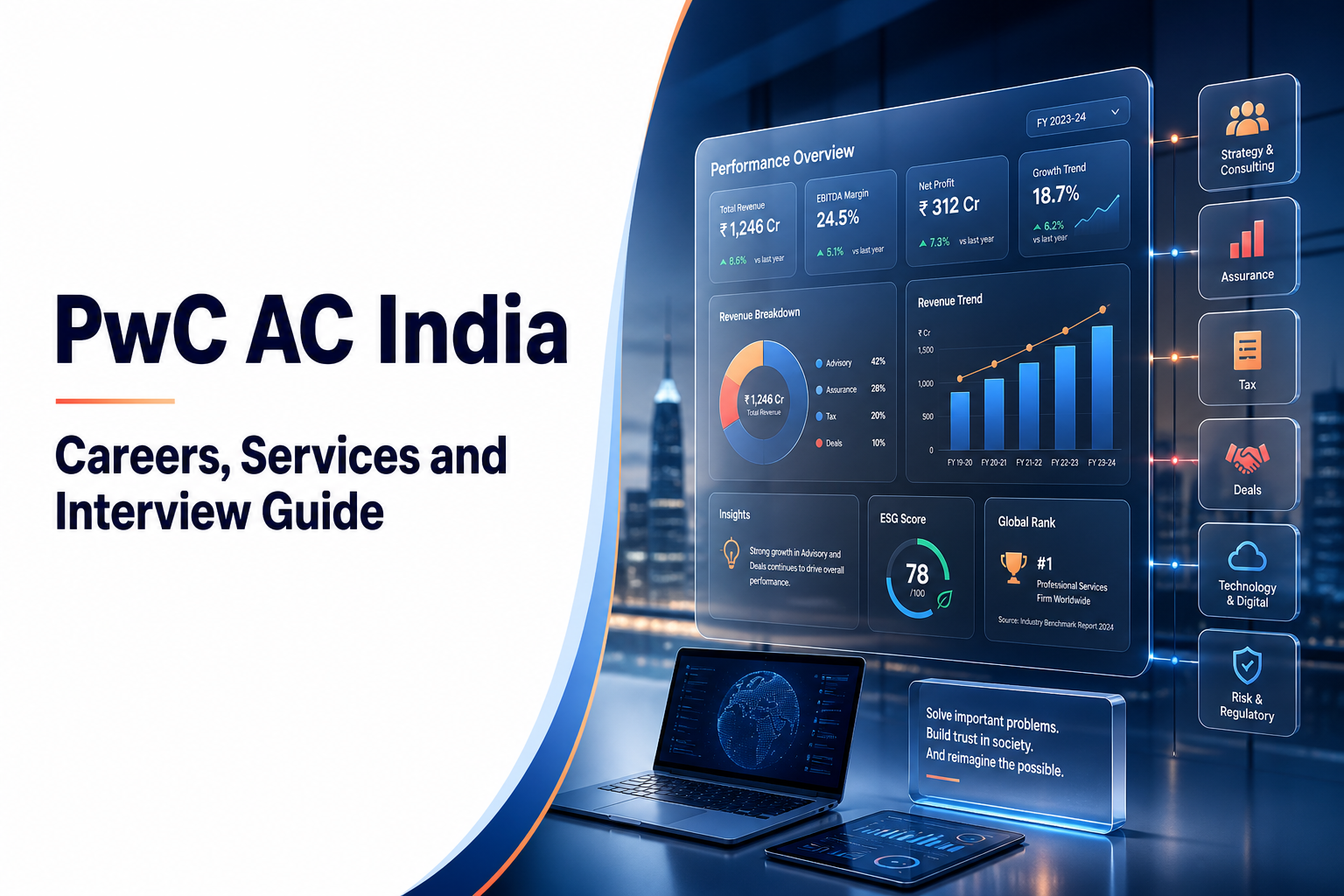
PwC AC India is the India-based Acceleration Center capability within the PwC network. It supports PwC member firms by delivering work across assurance, tax, consulting, risk, technology, operations and managed services. For candidates, this matters because the work is not a typical single-client back-office role. Teams often support global engagements, follow PwC methodologies, use shared delivery platforms and collaborate with client-facing teams in other markets. The environment sits at the intersection of professional services, global capability centres and digital business operations.
A candidate may be assessed on technical fundamentals, communication, documentation quality, stakeholder handling and the ability to work across time zones. Understanding PwC AC India helps you answer interview questions with context: what the centre does, how it fits inside PwC’s network model, and why quality, confidentiality and consistency matter in every role.
This guide covers where PwC AC India came from, who controls the PwC network today, and which service lines it operates across.
1. Company Overview
About PwC AC India
PwC AC India operates as a delivery and capability centre for the PwC network, supporting member-firm teams in areas such as assurance, tax, consulting, risk, analytics, finance operations and technology. PwC explains that its Acceleration Centers bring together specialist skills to support work across the network (PwC Acceleration Centers).
For a candidate, this makes the company a useful case study because many roles combine domain knowledge with process discipline, documentation, collaboration and client-service standards. For broader PwC context beyond the Acceleration Center model, use the PwC corporate profile as a companion read.
PwC is structured as a network rather than a single worldwide partnership: PwC states that member firms are separate legal entities and members of PricewaterhouseCoopers International Limited (PwC network structure). That distinction is useful in interviews because AC India supports the network’s delivery model while legal ownership and client contracting sit with relevant PwC entities.
| Attribute | Details |
|---|---|
| Founded (India) | 1880 (Price Waterhouse & Co. opened its first office in Kolkata) |
| Founder (Global) | Samuel Lowell Price, William Cooper, and Edwin Waterhouse |
| Industry | Professional Services (Assurance, Advisory, Tax) |
| Headquarters | Kolkata, India (initial office) |
Company History
The history candidates should understand is the shift from traditional accounting partnerships to a global professional-services network with specialised delivery centres. In interviews, this context helps you explain why PwC AC India emphasises quality control, documentation, global collaboration, technology-enabled delivery and consistent methodology across member firms.
PwC’s official history records the predecessor-firm milestones and the 1998 merger that created the PricewaterhouseCoopers brand (PwC history). PwC later built Acceleration Centers as part of its delivery model for network firms and clients.
Samuel Lowell Price establishes an accounting practice in London, creating one of PwC’s predecessor lines.
William Cooper starts an accounting practice that later becomes part of Coopers & Lybrand, the other major predecessor firm.
Edwin Waterhouse joins Price’s practice, helping form the Price Waterhouse name associated with the firm’s audit and accounting heritage.
Price Waterhouse and Coopers & Lybrand merge to create PricewaterhouseCoopers, the brand now known as PwC.
PwC’s India service delivery centre capability begins, creating a dedicated India-based delivery model for work supporting PwC member firms.
The India delivery model expands from process support into more specialised assurance, tax, advisory, technology and analytics workstreams.
PwC positions Acceleration Centers as capability hubs that combine domain delivery, technology, data, managed services and cross-border collaboration.
2. Mission, Vision & Values
Mission
"Our purpose is to build trust in society and solve important problems."
This is PwC’s official purpose statement, published on its purpose and values page. Use it in interviews to connect your role to trust, quality and problem-solving, rather than treating it as a generic mission line.
Core Values
PwC publishes the following values in its own words on the same official purpose and values page.
Prepare interview stories against this exact list: one example for quality and integrity, one for teamwork, and one for improving a process or solving a difficult problem.
3. Products and Services
PwC AC India’s offering is capability and delivery support for PwC member-firm engagements, not a separate consumer product business. This makes it relevant for candidates in audit support, taxation, consulting, risk, analytics, finance operations, cloud, data engineering and managed services roles.
Expect interview questions to test both the service line and the operating model: how you document work, manage quality, collaborate with global stakeholders and protect confidential information. Candidates targeting tax roles can pair this section with the PwC AC India Associate Apprentice Tax interview guide for role-specific preparation.
- Assurance and audit support covers workpaper preparation, evidence review, audit documentation, control testing support and financial statement tie-outs, such as checking revenue samples for a retail client or reconciling fixed-asset schedules for a manufacturing client.
- Tax services support includes direct tax, indirect tax, transfer pricing, compliance research and return-preparation assistance, such as preparing GST working papers for an India-facing scenario or supporting transfer-pricing documentation for a cross-border services arrangement.
- Consulting and advisory delivery supports business transformation, process improvement, operating-model design and implementation work, such as mapping a procurement process for a conglomerate or documenting a customer-service workflow for a digital platform.
- Risk and regulatory services covers internal controls, governance, compliance testing, financial-crime support and regulatory documentation, such as testing access controls in an ERP system or reviewing KYC process evidence for a financial-services engagement.
- Deals and transaction support helps PwC teams with financial due diligence, data book preparation, market research, valuation inputs and integration planning, such as analysing working-capital trends for an acquisition or preparing carve-out data schedules for a divestment.
- Technology, data and analytics includes automation, reporting, data engineering, cloud support, visual dashboards and analytics workflows, such as building a Power BI dashboard for finance metrics or validating data pipelines for a large transaction dataset.
- Managed services and business operations supports recurring delivery processes for finance, compliance, reporting and operations, such as running month-end reconciliations for a shared-services process or tracking issue-resolution metrics for an enterprise transformation programme.
4. Key Competitors of PwC AC India
PwC AC India operates in the professional-services global delivery market, where competition is less about “who is bigger” and more about who can deliver specialist work reliably across audit support, tax, risk, consulting, technology and managed-services engagements. Clients compare firms on domain depth, delivery quality, regulatory confidence, technology capability, speed, cost efficiency and access to trained talent.
Deloitte
Competes on: audit and assurance support, consulting, risk advisory, tax, enterprise technology and managed-services delivery.
Position: A close like-for-like rival for Big Four client work, especially where delivery quality, controls, documentation discipline and global engagement support matter.
EY
Competes on: assurance, tax, consulting, strategy support, data analytics, risk transformation and cross-border delivery teams.
Position: Strong comparison point for candidates because EY’s global delivery model overlaps closely with PwC AC India’s project-support and specialist delivery environment.
KPMG
Competes on: audit support, tax compliance and advisory, risk consulting, regulatory work, financial services projects and technology-enabled transformation.
Position: Particularly relevant where clients value Big Four brand assurance, sector knowledge, governance-heavy delivery and comfort with regulated industries.
Accenture
Competes on: digital transformation, cloud, data, cybersecurity, business process services, enterprise platforms and large-scale implementation work.
Position: A stronger rival in technology-led consulting and operations than in audit or tax, making it useful for comparing PwC AC India’s advisory and transformation capabilities.
In an interview, structure your competitive-analysis answer by comparing PwC AC India against these firms on service overlap, delivery model, sector expertise, technology capability, quality controls and client problem fit; for parent-firm context, use Board Infinity’s PwC corporate profile before reducing the discussion to size alone.
5. Corporate Social Responsibility (CSR)
For PwC AC India, CSR connects closely with the nature of the business: skilled professionals, digital delivery, risk-aware decision-making and large-scale collaboration across teams. A strong interview answer should link social impact to professional strengths such as mentoring, digital literacy, ethical conduct and sustainability awareness. Before naming a specific programme in an interview, verify the latest PwC India corporate responsibility or careers communication on the official PwC India corporate responsibility page.
Education and employability
Professionals can contribute through mentoring, career awareness, financial literacy and workplace-readiness support for students and early-career talent.
Digital inclusion
A technology-enabled delivery centre can support communities by improving access to basic digital skills, safe online practices and employability tools.
Environmental sustainability
Candidates can connect sustainability to practical office behaviours such as responsible consumption, waste reduction and data-led environmental awareness.
Skills-based volunteering
The most relevant volunteering angle is using professional strengths such as analytics, documentation, communication and project discipline for community benefit.
Ethics and responsible business
CSR-aligned behaviour also means handling data responsibly, escalating concerns, respecting confidentiality and choosing quality over shortcuts.
Community resilience
In interviews, this can be framed as supporting teams and communities during disruption through preparedness, responsiveness and dependable execution.
6. Interview Process & Selection Rounds
Hiring at PwC AC India typically follows a structured but role-dependent path: application screening, an assessment or functional screen, one or more technical or business interviews, and an HR discussion. The depth changes by function, seniority and location, so a Tax fresher may face accounting and compliance basics, while a Consulting, Risk, Technology or Analytics candidate may face case prompts, stakeholder scenarios, tools, data interpretation or domain-led questions.
Application and profile screening
Recruiters check whether your education, experience, notice period, location preference and role alignment match the opening. For freshers, projects, internships and communication clarity matter; for experienced candidates, relevant client delivery, domain exposure and evidence of ownership carry more weight.
Online assessment or functional screen
This round may assess aptitude, business communication, Excel comfort, data interpretation, accounting basics, coding logic or domain judgment depending on the route. Technology and analytics roles usually test problem-solving more directly, while Assurance, Tax and Risk roles often focus on accuracy, concepts and structured reasoning.
Technical or domain interview
Interviewers test whether you can apply concepts in realistic delivery situations, not just define them. Tax candidates should practise compliance, documentation and deadline scenarios through a focused PwC AC India Tax interview guide, while Risk and Regulatory candidates can deepen preparation with a Risk & Regulatory interview preparation guide.
Managerial and behavioural interview
This round checks stakeholder handling, collaboration, ownership, learning agility, deadline discipline and alignment with PwC’s values. For senior candidates, expect more probing on conflict resolution, process improvement, people coaching and how you manage ambiguity across global teams.
HR discussion and offer closure
The final discussion usually confirms motivation, communication, career goals, work arrangement, location, joining timeline and documentation readiness. Be prepared to explain why PwC AC India, why this route, and how your working style fits a professional-services environment with deadlines, confidentiality and global collaboration.
7. Common Interview Questions Across Roles
These are company-fit, values, business-awareness and behavioural questions any PwC AC India candidate can face; role-specific technical questions belong in that role’s own guide.
General & Behavioral Questions
8. Required Skills & Tools
Required skills at PwC AC India are not one universal checklist; each career route needs a different mix of domain knowledge, delivery discipline, communication and tools.
9. Career Opportunities at PwC AC India
Careers at PwC AC India are usually organised by service route, so the work you build expertise in matters as much as your formal level. Candidates typically enter through Associate, Associate 2 or Senior Associate roles, then grow by taking ownership of workpapers, client-ready analysis, review quality, stakeholder communication and team delivery.
Assurance
This route includes titles such as Assurance Associate, Audit Associate, Associate 2, Senior Associate and Manager, with work around audit support, testing, documentation, controls evidence and review-ready files; the promotion signal is consistent accuracy, clean documentation and the ability to handle larger audit areas with limited rework.
Tax
This route includes titles such as Associate Apprentice - Tax, Tax Associate, Associate 2, Senior Associate and Tax Manager, with work around compliance support, return preparation, tax research, reconciliations and client deliverables; candidates preparing for entry-level tax hiring can use the PwC AC India Associate Apprentice - Tax interview guide, and the promotion signal is dependable technical preparation combined with deadline discipline.
Consulting & Advisory
This route includes titles such as Consulting Associate, Advisory Associate, Associate One Consulting Advisory, Senior Associate, Consultant and Manager, with work around business analysis, process improvement, market research, operating-model support and client presentations; the promotion signal is structured problem solving, clear slides and the ability to convert ambiguous inputs into usable recommendations.
Risk & Regulatory
This route includes titles such as Risk Associate, Risk & Regulatory Associate, Associate 2, Senior Associate and Manager, with work around controls testing, regulatory analysis, risk documentation, financial-services support and issue tracking; candidates targeting this path can deepen role-specific preparation through the Associate 2 Risk & Regulatory interview guide, and the promotion signal is sound risk judgement plus crisp evidence-based documentation.
Global Fund Finance
This route includes titles such as Fund Finance Associate, Associate 2 - Global Fund Finance, Senior Associate, Assistant Manager and Manager, with work around fund accounting support, capital activity, investor reporting, reconciliations and financial statements; the promotion signal is strong financial accuracy, ownership of reporting cycles and confidence in explaining variances.
Technology, Data & Automation
This route includes titles such as Technology Associate, Data Analyst, Automation Associate, Senior Associate, Business Analyst and Manager, with work around dashboards, workflow automation, data checks, system testing and process digitisation; the promotion signal is building reusable solutions that reduce manual effort while remaining reliable, documented and easy for delivery teams to adopt.
10. Future Outlook and Strategic Plan
PwC AC India positions itself as a global delivery and capability centre shaped by the same milestones that moved it from its early delivery-centre roots into the wider Acceleration Centers model. The direction is centred on multidisciplinary client work, technology-supported execution, quality discipline and stronger integration with PwC network teams.
Global delivery fluency
Be ready to explain how you work across time zones, documentation standards, review cycles and stakeholder expectations when supporting PwC network teams.
Service-line depth
Prepare examples that show depth in your chosen track, such as audit support, tax compliance, advisory analysis, assurance operations, finance processes or technology delivery.
Technology-enabled execution
Have a clear story on using tools, analytics, automation or structured workflows to reduce manual effort while preserving accuracy, traceability and professional judgement.
Quality, risk and independence mindset
Expect to discuss how you handle confidential data, escalation, quality checks, review comments and situations where speed must not weaken compliance or independence.
Collaboration and learning agility
Bring examples of learning a new domain quickly, asking precise questions, incorporating reviewer feedback and working with peers from different functions or geographies.
11. Conclusion
PwC AC India sits in the professional-services delivery market as a specialist capability centre for PwC network work rather than a standalone consulting brand. Its direction depends on how well teams combine domain depth, quality discipline, technology adoption and cross-border collaboration while staying aligned with PwC’s published values. For someone joining, strong preparation means service-line knowledge plus proof that you can deliver reliably with distributed teams, client confidentiality and review-heavy work habits. For tax roles, pair this company view with the PwC AC India Associate Apprentice Tax interview guide.
