
SEO in 2026: The Interview-Ready Framework for Search and AI Visibility
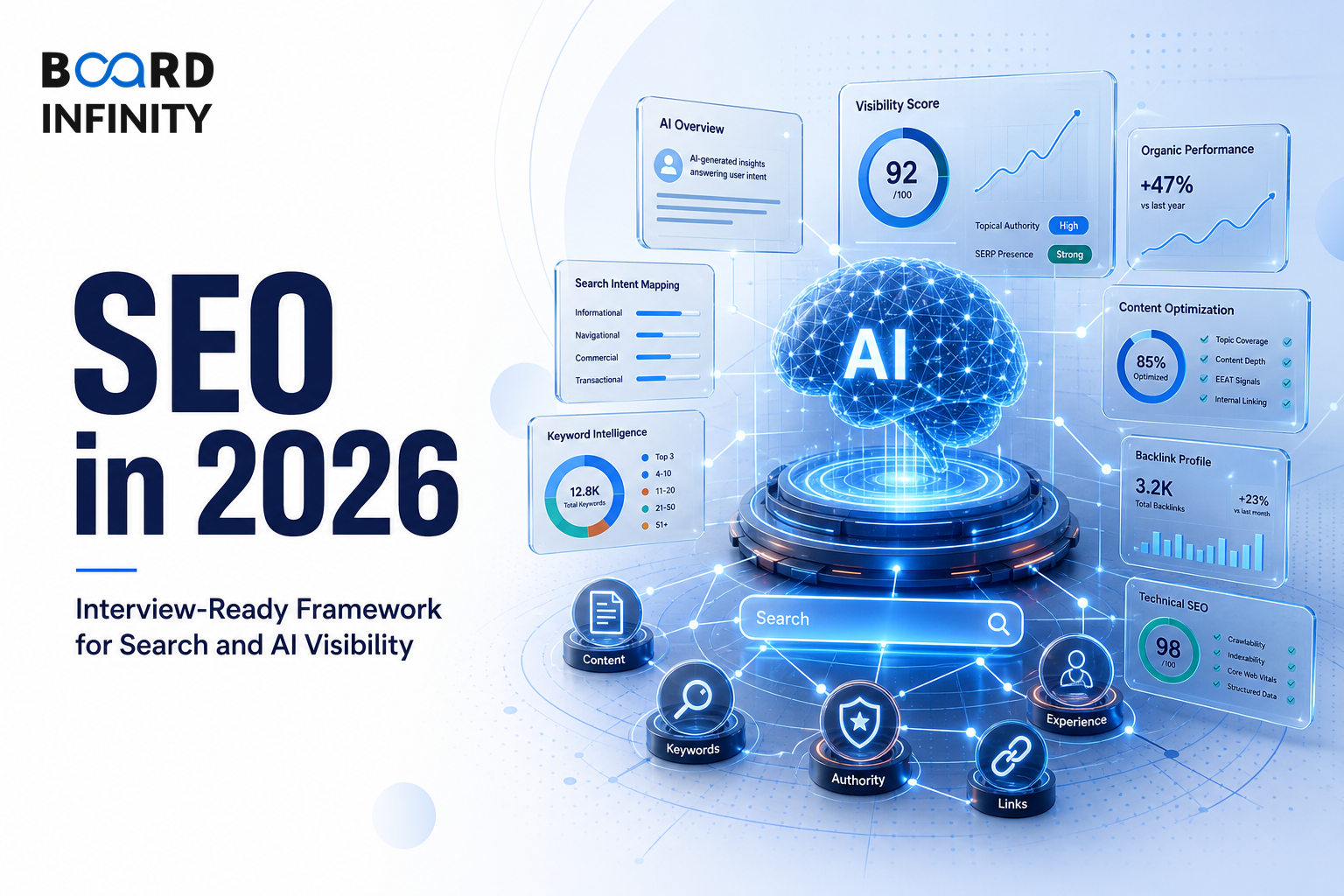
If an interviewer asks “What changes in SEO in 2026?”, they are not looking for a keyword checklist. They want to see whether you understand the shift from ranking pages to becoming the trusted source that search engines and AI answer engines cite.
- SEO is the practice of improving a website and its content so it is discoverable and ranks highly in search engines and AI answer engines.
- The 2026 shift is from “ten blue links” to AI-synthesized answers through Google AI Overviews, ChatGPT, Perplexity and Gemini.
- The three SEO pillars are technical SEO, on-page/content SEO and off-page authority.
- Search intent beats search volume: informational, navigational, commercial and transactional queries need different pages.
- E-E-A-T from Google’s Search Quality Rater Guidelines means Experience, Expertise, Authoritativeness and Trustworthiness. Trust is the most important.
- Modern SEO builds topical authority through pillar pages, topic clusters, entity coverage, internal links and genuinely helpful content.
- Measure SEO through organic traffic, impressions, clicks, rankings, conversions and increasingly AI citation visibility.
The Big Picture
Think of SEO in 2026 as a credibility system. A page must be technically accessible, clearly answer the right intent, prove authority and trust, and be easy for both Google and AI engines to understand, summarize and cite.
Core Explanation: What SEO Means in 2026
Search Engine Optimization is the practice of improving a website and its content so it is discoverable and ranks highly in search engines and in AI answer engines.
The old version of SEO was often reduced to “rank for keywords.” The modern version is broader: create the most useful, credible and technically understandable answer for a real user need. That answer may appear as a traditional organic result, a featured snippet, a Google AI Overview citation, a Perplexity source, or a ChatGPT browsing result.
The Three Pillars of SEO
A strong interview answer should organize SEO into three pillars. If you only talk about keywords, your answer sounds junior. If you cover technical health, content quality and authority, you sound like a growth marketer.
1. Technical SEO
Technical SEO ensures search engines can crawl, index, render and understand your site. It includes crawlability, indexing, site speed, Core Web Vitals, mobile-friendliness, HTTPS, structured data or schema markup, and clean site architecture.
In interviews, use technical SEO as the hygiene layer. A brilliant article hidden behind poor architecture, slow performance or indexing errors will not reliably rank.
2. On-page and Content SEO
On-page SEO improves individual pages so they match search intent and are understandable to users and search engines. It includes keyword and entity coverage, headings, meta titles, meta descriptions, internal linking, content depth and helpfulness.
The big 2026 upgrade is semantic relevance. You are not simply repeating exact-match keywords. You are covering the topic properly: related entities, sub-questions, examples, comparisons, use cases and next-step links.
3. Off-page SEO and Authority
Off-page SEO builds credibility outside your own website. It includes backlinks from reputable sites, brand mentions, digital PR, expert citations and signals that others trust your domain.
Backlinks still matter, but the smarter framing is authority. If multiple credible sources mention, cite or link to your brand, search engines and AI systems have stronger reasons to treat you as a reliable source.
Search Intent: The Question Behind the Keyword
Search intent is the user’s underlying goal behind a query. Matching intent is more important than chasing raw keyword volume because two keywords with similar wording can require completely different page types.
Keywords, Entities and Topic Clusters
Head terms are broad, high-volume and highly competitive keywords such as “running shoes” or “CRM.” Long-tail keywords are more specific phrases such as “best running shoes for flat feet” or “CRM for small real estate teams.” Long-tail queries usually have clearer intent.
Modern SEO does not stop at a keyword list. It builds topical authority: a site proves it understands a topic by creating a strong pillar page and supporting cluster pages linked together logically.
Definitions You Should Say Precisely
SEO: SEO is the practice of improving a website and its content so it is discoverable and ranks highly in search engines and in AI answer engines.
E-E-A-T: In Google’s Search Quality Rater Guidelines, E-E-A-T stands for Experience, Expertise, Authoritativeness and Trustworthiness. Google states that trust is the most important member of the E-E-A-T family.
Helpful content: Google’s helpful content guidance emphasizes creating people-first content rather than content made primarily to attract search engine visits.
GEO or AEO: Generative Engine Optimization or Answer Engine Optimization means improving content so AI answer engines can understand, trust, summarize and cite it as a source.
GEO and AEO: Why AI Changes the SEO Game
Google AI Overviews and answer engines such as ChatGPT, Perplexity and Gemini synthesize answers directly. That creates more zero-click searches, where the user may get the answer without clicking a traditional blue link.
The strategic goal changes from only “rank number one” to “be the trusted source the answer engine cites.” That requires clear structure, original insight, first-hand evidence, schema, reputable mentions and content that answers the query better than a generic rewrite.
Perplexity presents answers with cited sources, which makes the source layer visible to the user. For marketers, the lesson is simple: content must be clear enough to summarize and credible enough to cite. The strategic “so what” is that SEO teams now optimize not just for a click, but for inclusion in the answer itself.
Measurement: What to Track Beyond Rankings
Rankings are useful, but they are not the whole scorecard. A serious SEO answer connects visibility to business outcomes.
Case Study: Canva’s Product-Led SEO Moat
Canva is a strong SEO case because it shows how search strategy, product pages and user intent can work together. Instead of relying only on blog content, Canva built discoverable pages around real design jobs users were searching for.

The takeaway: Canva demonstrates the 2026 SEO mindset. Win the query by understanding the job behind it, building the right page type, and connecting search demand to a useful product experience.
Interview Relevance
Question: “You are leading SEO for a new D2C skincare brand in 2026. What would your SEO strategy be?”
In an interview, say “I would not start with keywords. I would start with intent, page type and trust.” That one sentence immediately signals senior thinking.
Common Mistake
The biggest mistake is treating SEO as keyword stuffing. Candidates say “use more keywords, write more blogs, get backlinks” but ignore intent, E-E-A-T, technical health and AI answer visibility. That answer sounds outdated because 2026 SEO rewards being the most helpful and trusted source, not the page that repeats the phrase most often!
