
Smart Food Safe: Product Manager Interview Guide
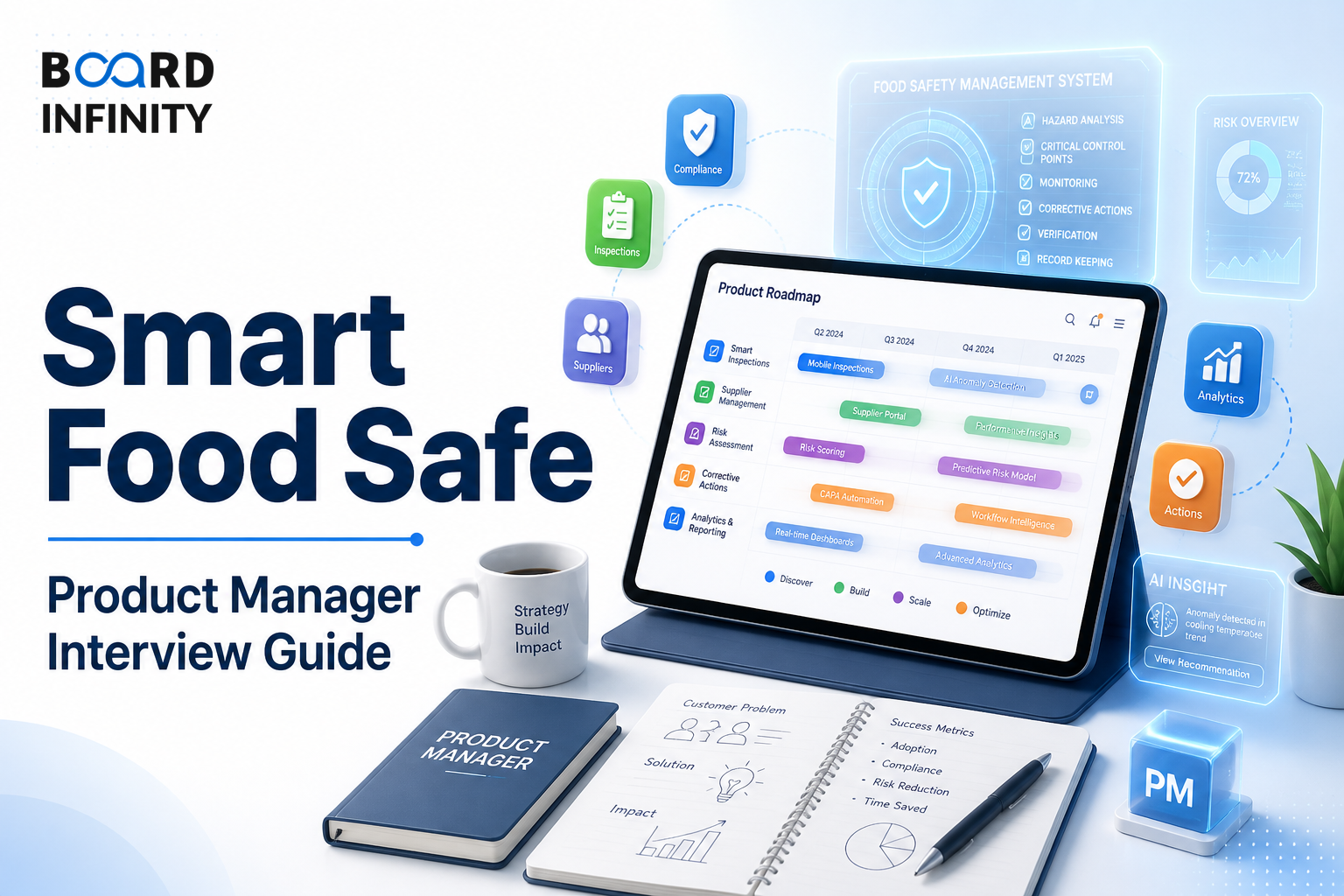
A Product Manager at Smart Food Safe owns the direction of a Business-to-business Software as a Service (B2B SaaS) platform used for food safety, quality, regulatory and traceability workflows. The role matters because product decisions affect compliance visibility, customer adoption, release quality and how fast teams can turn operational food safety needs into usable software.
This guide is built for IIM, IIT and other campus candidates preparing for the Smart Food Safe Product Manager interview. It covers the role, skills, daily work, likely interview rounds, role-specific questions, focus topics, a four-week preparation plan and realistic growth paths.
1. About the Product Manager Role
This role is responsible for deciding what the product should solve, why it matters to customers and how it should be built. Instead of only tracking features, the Product Manager connects customer problems such as audit readiness, supplier visibility and workflow approvals with clear product requirements, delivery priorities and business outcomes.
Day-to-day work sits between product discovery and product delivery. The role works with engineering, design, Quality Assurance (QA), marketing, sales and functional consultants to convert customer conversations into specifications, sprint priorities, release plans and go-to-market inputs.
2. Required Skills and Qualifications
Educational Qualifications
Skills Overview
3. Day-to-Day Responsibilities
A typical week combines customer conversations, product documentation, backlog decisions and delivery follow-ups. The strongest candidates show that they can protect product clarity while still moving fast in a startup-style SaaS environment.
Shape Product Direction
Translate business goals into a product roadmap that balances customer urgency, technical effort and commercial value. For Smart Food Safe, this may mean prioritising features that improve compliance visibility, traceability workflows, quality checks or customer onboarding instead of reacting to every sales request as a separate feature.
Study Customer Workflows
Speak with customers, functional consultants and internal teams to understand how users manage audits, quality checks, document approvals, complaints or traceability events. The goal is to identify the real workflow constraint, not just capture the first solution a customer suggests during a call.
Write Clear Requirements
Create Product Requirements Documents, Business Requirements Documents, Functional Requirements Documents, user stories and acceptance criteria that engineering and QA can execute without repeated clarification. Strong documentation explains the user, the problem, the workflow, edge cases, expected behaviour and success metrics in plain language.
Prioritise the Backlog
Maintain Jira or similar boards so the technical team always knows what should be built next and why. This includes splitting large requirements, clarifying dependencies, ranking bugs and features, preparing sprint scope and making trade-offs when timelines, customer asks and engineering capacity collide.
Validate Releases
Work with design, engineering and QA before release to check whether the shipped workflow matches the user problem. This means reviewing screens, testing key paths, checking acceptance criteria, watching for usability gaps and deciding whether the release is ready for customer demos or phased rollout.
Support Market Launch
Help sales and marketing explain new capabilities in customer language. For a food safety SaaS product, this includes preparing release notes, demo talking points, use-case narratives and proof points that show how a feature reduces manual work, improves visibility or supports compliance workflows.
4. Key Competencies for Success
Top performers in this role combine structured product thinking with the patience to understand domain-heavy customer workflows. They do not only propose features, they show how a product decision helps customers operate better and helps the company deliver scalable SaaS value.
5. Interview Process at Smart Food Safe
For a B2B SaaS Product Manager role, prepare for a process that checks product judgement, technical comfort, communication and ownership. Expect interviewers to move between your past projects, a SaaS product case, requirements writing, stakeholder situations and your ability to work on-site with cross-functional teams in Bangalore.
Recruiter or Initial Screening
This round checks role fit, location readiness, communication and whether your product background matches B2B SaaS ownership. Freshers should be ready to explain why product management, why food safety SaaS and why they can learn a domain-heavy product quickly.
Product Experience Discussion
A product leader or hiring manager may probe your ownership depth, not just participation. Expect questions on discovery, prioritisation, requirements, trade-offs, metrics, sprint execution and how you handled conflicts between customer asks and engineering effort.
Product Case or Assignment
You may be asked to design a feature, prioritise a roadmap, improve adoption or write requirements for a food safety workflow. The expected answer should cover user segments, problem framing, scope, edge cases, metrics and launch considerations.
Technical and Collaboration Round
Engineering, QA or design stakeholders may test how clearly you define user stories, Application Programming Interface dependencies, integration behaviour, acceptance criteria and release risks. The focus is practical technical communication, not deep coding.
Leadership or Final Fit Round
This round usually checks ownership mindset, startup readiness, customer orientation and clarity on why Smart Food Safe is a fit. Prepare crisp stories that show independent decision-making, learning agility and comfort working with multiple functions in an on-site setup.
6. Interview Questions
Use the Situation, Task, Action, Result (STAR) method for behavioural answers, and use structured product frameworks for cases. Smart Food Safe interviewers are likely to value clarity, domain curiosity, practical SaaS execution and the ability to turn ambiguous food safety workflows into buildable product decisions.
Behavioral and Company-Fit Questions
Product Management and SaaS Execution Questions
Product Case, Metrics and Go-to-Market Questions
7. Topics and Areas of Focus
Preparation should focus on practical product work: understanding users, writing requirements, making roadmap trade-offs, communicating with engineering and measuring product impact. If you need an Indian food business context example for supply chain and quality discussions, the Board Infinity overview of Mother Dairy and nationwide food products can help you think through real operating complexity.
8. Preparation Plan
Role and Domain
Understand Smart Food Safe, food safety workflows and the PM role expectations.
Core Product Skills
Practise discovery, requirements, backlog splitting and technical fluency.
Cases and Stories
Build product cases, metrics answers and STAR stories for ownership.
Mocks and Revision
Run timed mocks, refine weak areas and prepare crisp final answers.
Pre-Interview Checklist
9. Career Growth & Next Roles
Progression from this role depends on moving from feature-level execution to module ownership, then to product line strategy. Promotion is usually earned by proving customer understanding, reliable delivery, measurable product outcomes and the ability to guide cross-functional teams without constant supervision.
Product Manager
At this stage, you own discovery support, requirements, backlog clarity, sprint collaboration and launch readiness for defined product areas. To move up, prove that your features solve real customer problems, reduce delivery confusion and create measurable usage or efficiency improvements.
Senior Product Manager
Over roughly 2-3 years, the next step is owning larger modules, making roadmap trade-offs and mentoring junior product contributors. You must show that you can convert repeated customer patterns into scalable capabilities and influence engineering, sales and marketing around one product direction.
Lead Product Manager
Over roughly 4-6 years, the role can expand into product line strategy, portfolio planning, product metrics ownership and stronger commercial influence. You are expected to identify market opportunities, guide discovery across teams and make decisions that balance customer value, platform scalability and revenue impact.
Product Leadership or Specialist Track
Beyond that, growth can split into people management or deep product specialisation. The leadership route focuses on team direction, portfolio strategy and stakeholder alignment, while the specialist route can go deeper into platform, integrations, artificial intelligence workflows or regulatory SaaS product strategy.
10. Conclusion
The most important preparation step is to think like a SaaS product owner, not a feature coordinator. For every answer, connect customer pain, product decision, technical feasibility, delivery plan and measurable outcome in a clear sequence.
Prepare one detailed product case around audits, complaints, traceability or supplier quality, and practise explaining it to product, engineering and sales audiences. Also build crisp STAR stories that prove ownership, learning agility and structured decision-making in ambiguous situations.
