
STP: Segmentation, Targeting & Positioning - The Framework Every Marketing Case Starts With
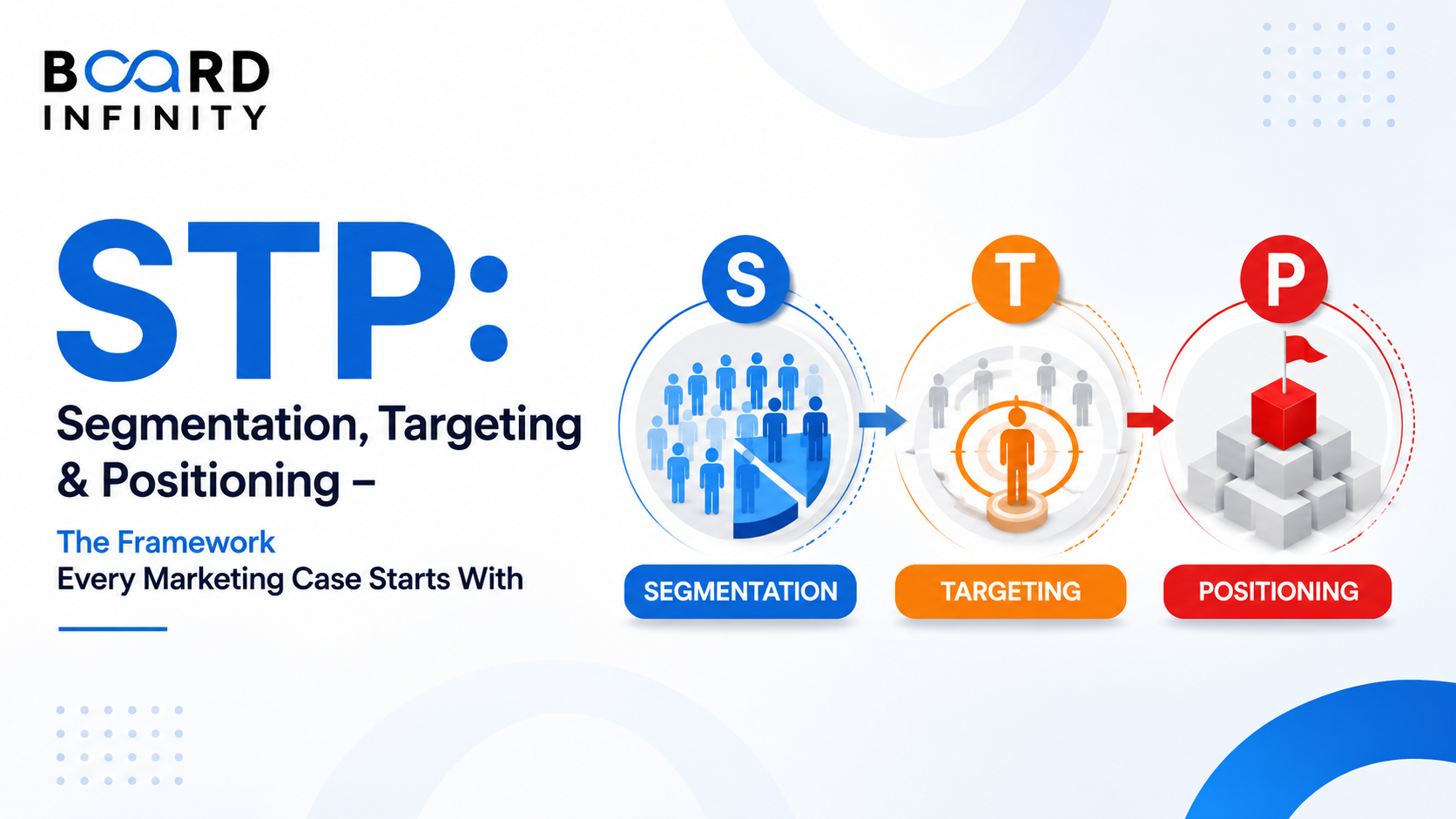
Before a brand decides what to sell, at what price, or through which channel, it has to answer three questions: who is the customer, which customers are worth chasing, and why should they choose us? That is exactly what STP answers - and it is the framework interviewers expect you to reach for first, before you touch the 4Ps.
TL;DR
- STP runs in order: Segmentation (divide the market) → Targeting (choose whom to serve) → Positioning (own a space in the customer's mind). Every marketing strategy starts here.
- There are five ways to segment a market: Geographic, Demographic, Psychographic, Behavioral, and Firmographic (for B2B).
- A segment is only worth serving if it passes five tests: Measurable, Accessible, Substantial, Differentiable, and Actionable.
- Four targeting strategies trade reach for focus: Undifferentiated (mass), Differentiated (multi-segment), Concentrated (niche), and Micromarketing (customized).
- Positioning rests on Points of Parity (must-haves to compete) and Points of Difference (why you win) - a POD must be desirable, deliverable, and differentiating.
- Use the positioning-statement template: "For [target] who [need], [brand] is the [category] that [point of difference] because [reason to believe]."
- In interviews, always run STP before the 4Ps - segment first, then target, then position, and justify each choice out loud.
What STP Is, and Why It Comes First
STP is the foundational strategic framework in marketing. It helps a brand identify the right customers, focus limited resources on them, and craft a value proposition those customers actually care about. The three steps are sequential for a reason - you cannot position a product until you know who you are positioning it for, and you cannot choose whom to serve until you have divided the market into groups worth choosing between.
This is why STP sits upstream of every tactical decision. Segmentation, Targeting, and Positioning define the who and the why; the 4Ps that follow are simply the how.
The Big Picture: STP in Three Moves
| Stage | The question it answers | What you walk away with |
|---|---|---|
| Segmentation | Who is in this market, and how do the buyers differ? | Distinct customer groups with shared needs |
| Targeting | Which of those groups should we actually serve? | Chosen segment(s) plus a targeting strategy |
| Positioning | Why should the target pick us over everyone else? | A clear, defensible place in the customer's mind |
Get the order wrong and the whole strategy wobbles - positioning built on a segment you never defined is just a slogan.
1. Segmentation: Dividing the Market
Market segmentation splits a broad market into distinct subgroups of consumers who share needs, characteristics, or behaviors. There are five common bases for doing it.
| Type | Based on | Key variables | Example |
|---|---|---|---|
| Geographic | Location | Region, climate, city tier, urban/rural, density | Zara targets Tier-1 metros; Amul focuses on Tier 2-3 towns |
| Demographic | Population traits | Age, gender, income, education, occupation, family size | Tanishq targets women aged 25-45 with mid-to-high income |
| Psychographic | Psychological traits | Lifestyle, values, personality, attitudes, interests | Apple targets innovation-seekers who value design & simplicity |
| Behavioral | Consumer actions | Usage rate, loyalty, purchase occasion, benefits sought | Spotify splits free vs premium users; Amazon Prime vs regular |
| Firmographic (B2B) | Company traits | Industry, size, revenue, location, technology stack | Salesforce targets enterprises with 500+ employees |
The same product category can be sliced very differently depending on the base. Amul and Zara both sell to India, but Amul segments geographically toward smaller towns while Zara concentrates on Tier-1 metros - two opposite calls, each defensible once you know which customer each brand is built to serve.
2. Targeting: Choosing Whom to Serve
Once the segments exist, the firm evaluates them and decides how many, and how precisely, to serve. Four strategies sit on a spectrum from "everyone" to "one customer at a time."
| Strategy | What it means | When to use it | Example |
|---|---|---|---|
| Undifferentiated (Mass) | One offering for the entire market | Large market, commodity products | Coca-Cola's universal "Open Happiness" campaigns |
| Differentiated (Multi-Segment) | Different offerings for different segments | You have the resources to serve several segments | Toyota: Yaris (budget), Camry (mid), Lexus (luxury) |
| Concentrated (Niche) | Focus on one specific segment | Limited resources, deep expertise | Rolls-Royce targeting ultra-high-net-worth individuals |
| Micromarketing (Customized) | Tailored to individual customers | High-value customers; technology enables it | Dell's custom PC configurations; Netflix recommendations |
A segment is only worth targeting if it clears five attractiveness tests:
3. Positioning: Owning a Space in the Customer's Mind
Positioning is the deliberate choice of what you want the target customer to think and feel about your brand relative to competitors. It is built on two ideas.
| Concept | What it is | The test it must pass |
|---|---|---|
| Points of Parity (POP) | Associations you need just to be considered a legitimate player in the category | Present - without the must-haves, customers won't even consider you (a smartphone needs a camera, touchscreen, and app store) |
| Points of Difference (POD) | Unique attributes that set the brand apart from rivals | Desirable to customers, Deliverable by the company, and Differentiating from competitors (Volvo = safety; Apple = design + simplicity) |
A perceptual map - plotting competing brands on two dimensions such as price vs quality - is the tool marketers use to spot positioning gaps worth owning. Once the gap is chosen, the position gets written down in a single sentence:
"For [target market] who [need or want], [brand] is the [category] that [point of difference] because [reason to believe]."
"For health-conscious millennials who want convenient nutrition, Epigamia is the Greek yogurt brand that offers high-protein, low-sugar options because it uses authentic straining techniques with natural ingredients." Notice how the statement names the target, the need, the category, the point of difference, and the reason to believe - all in one line.
Structuring an STP Interview Answer
"How would you approach a go-to-market plan for a new product?"
Interviewers are grading the sequence as much as the content - run STP first, in order, and only then reach for tactics.
- Segment - divide the market and state your basis (geographic, demographic, psychographic, or behavioral), and say why you chose it.
- Target - pick the segment(s) and name the strategy (niche, differentiated, mass), justified against the five attractiveness criteria.
- Position - define your Points of Parity and Point of Difference, then state a one-line positioning statement.
- Then, and only then, the 4Ps - translate that positioning into Product, Price, Place, and Promotion decisions.
Pro Tip: Always justify your segmentation basis and targeting choice out loud. Interviewers are listening for the reasoning behind the labels, not the labels themselves.
