
The 4Ps and 7Ps Marketing Mix: Translating Positioning Into Tactical Decisions
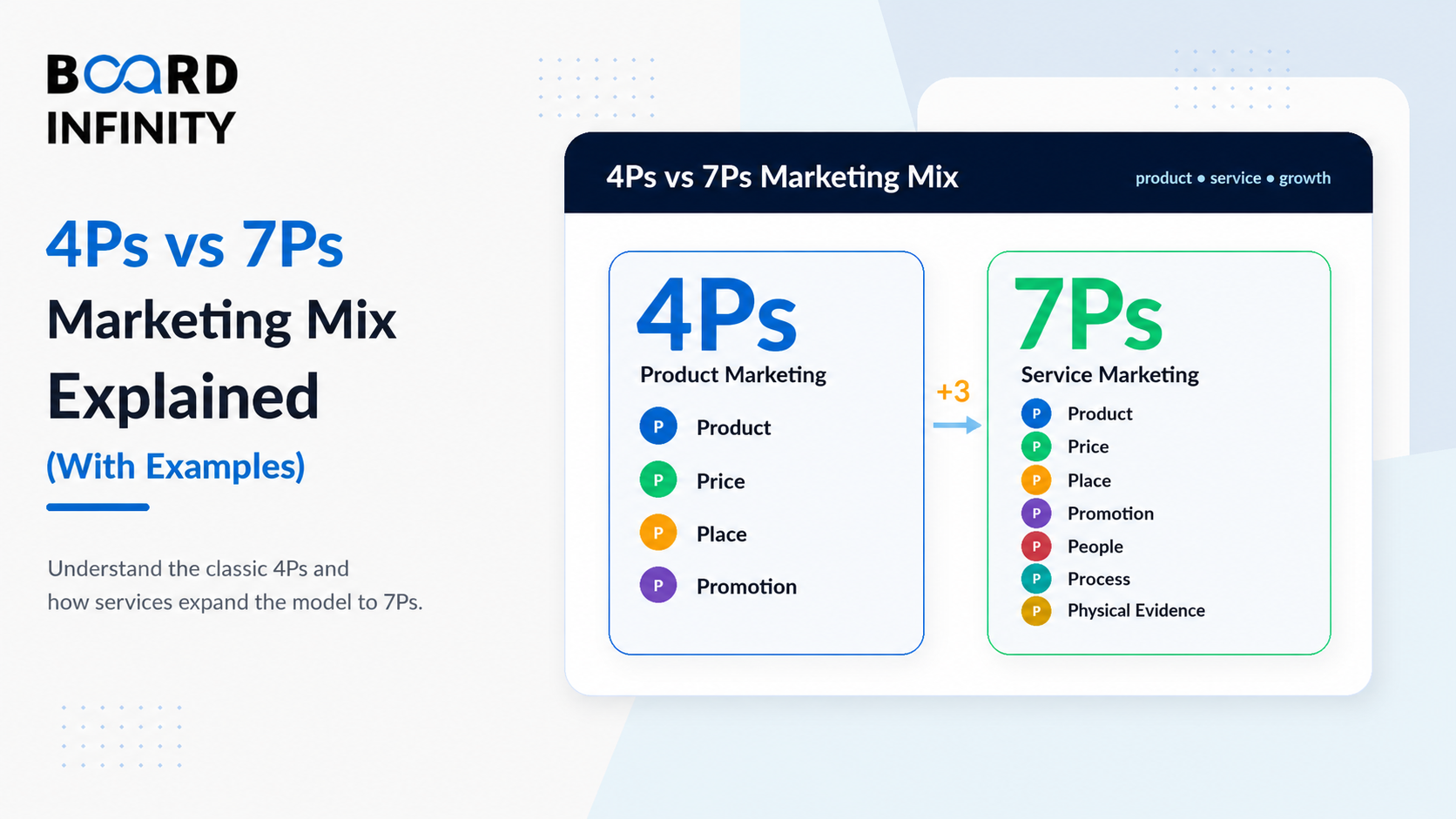
Segmentation, Targeting, and Positioning (STP) tells a marketer who to target and why that customer should care. The next question is how to actually win them - and that's exactly what the Marketing Mix answers.
Originally proposed by E. Jerome McCarthy in 1960 as four decision variables - Product, Price, Place, and Promotion- together known as the 4Ps, the framework was extended in 1981 by Bernard Booms and Mary Bitner into the 7Ps. The extra three - People, Process, and Physical Evidence - exist because most real businesses today are part product, part service, and the original four alone don't capture that.
This is one of the most-tested frameworks in any marketing case interview, and one most candidates explain too shallowly.
The Big Picture: 4Ps Versus 7Ps
The 7Ps exist because services can't be touched or inspected before purchase. A customer judges an airline not by a tangible "product," but by the cabin crew, the check-in experience, and the aircraft's condition.
1. Product: Kotler's Five Levels of Value
A "product" is never just one thing. Philip Kotler's model breaks any offering into five layers, each adding more value than the one beneath it.
1. Core Product
Fundamental need or benefit being met
Car: Transportation | Smartphone: Communication & connectivity
2. Generic Product
Basic functional version of the offering
Car: Engine, wheels, seats | Smartphone: Calls, texts, basic apps
3. Expected Product
Attributes buyers automatically assume
Car: AC, music, power steering | Smartphone: Camera, touchscreen, Wi-Fi
4. Augmented Product
Extras that go beyond what customers expect
Car: Free servicing, roadside assist | Smartphone: AppleCare, iCloud, ecosystem
5. Potential Product
What the offering could become in the future
Car: Self-driving, OTA updates | Smartphone: AR integration, AI assistant
Most companies compete and win at Level 3 - the Expected Product - just by matching category norms. Real competitive advantage gets built at Level 4 and 5.
1. Example - Product
Apple's iPhone matches every competitor at the Core, Generic, and Expected levels - connectivity, touchscreen, decent camera. Its real moat is the Augmented level: AppleCare, iCloud, and AirDrop lock customers into an ecosystem long after the phone itself is sold.
2. Price: The Only Lever That Generates Revenue
One line worth memorizing: Price is the only one of the seven Ps that generates revenue. The other six are all costs incurred to justify that price.
2. Example - Price
Tata Starbucks prices a regular cappuccino well above what the coffee itself costs to make. That price isn't justified by ingredients - it's justified by the "third place" experience Starbucks is positioned to sell. A pricing decision is almost always a positioning decision in disguise.
A full breakdown of pricing strategy - skimming, penetration, value-based, dynamic, freemium - gets its own post later in this series.
3. Place: How the Offering Reaches the Customer
Distribution isn't just logistics - it's a trade-off between reach and control.
3. Example - Place
Louis Vuitton sells only through its own flagship stores - never through multi-brand retailers or marketplaces. That's a deliberate exclusive distribution choice: limiting availability protects scarcity and reinforces the premium price. If Louis Vuitton suddenly sold through every department store the way Coca-Cola sells through every kirana store, the brand's positioning would collapse within a few quarters.
Channel Levels: How Many Hands Touch the Product
More intermediaries mean more reach, but thinner margins and less control.
4. Promotion: The Communication Mix
Promotion covers advertising, sales promotion, personal selling, PR, and digital marketing - broad enough for its own dedicated post later in this series. For now: Promotion is how a brand talks; Product, Price, and Place decide what it's actually offering.
4. Example - Promotion
Cadbury's long-running "Kuch Khaas Hai" campaign in India never promoted taste or ingredients. It promoted an emotional moment - turning a children's snack into an adult gifting occasion. The message was built around positioning, not product features.
5. People: The Humans Delivering the Service
Services are inseparable from the people delivering them. A haircut is only as good as the person holding the scissors, and a flight is only as good as the crew running the cabin.
5. Example - People
Ritz-Carlton lets any employee spend up to $2,000 resolving a guest issue, with no manager approval needed. That's not a customer-service footnote - it's a People decision treating staff as empowered brand custodians.
6. Process: The System Behind the Delivery
Process is the set of steps, systems, and flows that get an offering from order to delivery. It's invisible when it works well and very visible the moment it breaks.
6. Example - Process
Amazon's one-click ordering and hassle-free returns aren't Product decisions. The product is often identical to a competitor's. The friction-free process around buying it is the actual moat.
7. Physical Evidence: The Tangible Cues That Build Trust
Physical Evidence covers everything a customer can see, touch, or sense that signals quality before they've actually experienced the core service.
7. Example - Physical Evidence
A Starbucks store's lighting, aroma, cup design, and free Wi-Fi are all tangible cues that let a customer judge an intangible service before they've bought anything.
Mental model: if a customer can't unbox it, it's probably one of the extra three Ps - People, Process, or Physical Evidence.
All Seven Ps in One Business: The Blinkit Case
The cleanest way to lock in this framework is to map all seven Ps onto one real company. Blinkit works well because it's simultaneously a product business - it owns its inventory - and a service business, since speed and reliability are what it's actually selling.
Blinkit: All Seven Ps in One Business
Decision Variable → Application in the Real Business
Product
First-party-owned grocery and daily-essentials inventory, curated specifically for fast turnover rather than the full assortment of a regular supermarket.
Price
A distance- and demand-based delivery fee on top of item price, positioned around reliability and speed rather than discounting.
Place
A dense network of dark stores, roughly 1,000-2,000 sq. ft. each, within a 2-3 km radius of dense neighborhoods - the single piece of infrastructure the entire delivery promise depends on.
Promotion
Cross-selling to Zomato's existing food-delivery user base, meme-driven social content aimed at younger audiences, and in-app merchandising over heavy discounting.
People
A large gig-economy rider network plus in-store packers. Recent investment in rider insurance signals People as a retention lever, not just a cost line.
Process
AI-driven demand forecasting stocks each dark store in advance; orders are picked and packed in 2-3 minutes, engineered specifically to keep total delivery under ten minutes.
Physical Evidence
Live order-tracking, the countdown delivery timer, and branded packaging - tangible cues that build trust in an otherwise invisible fulfilment process before the order even arrives.
A candidate who only covers the original 4Ps would describe what Blinkit sells and at what price. Covering all 7Ps explains why the ten-minute promise is operationally possible at all.
Structuring a 4Ps/7Ps Interview Answer
"Walk me through the marketing mix for a new product launch."
Structure the answer in this sequence - interviewers are evaluating the sequence as much as the content:
- Product - what exactly is being offered, and at which of Kotler's five levels is the business competing?
- Price - how does it connect back to the positioning established through Segmentation, Targeting, and Positioning (STP)?
- Place - how will the offering physically or digitally reach the customer?
- Promotion - how will the target segment become aware of it?
- If the business is a service - layer in People, Process, and Physical Evidence before concluding
Pro Tip: The most common error is opening with Promotion because it's the most visible of the seven variables. Interviewers are specifically listening for whether the sequence runs Product, then Price, then Place, then Promotion - in a logical order, not free-associating.
Test Your Understanding
A mix of foundational and case-based questions to apply the framework yourself.
Includes case-based questions. Read each stem carefully before selecting an answer.
Summary
- 4Ps (Product, Price, Place, Promotion) were built for goods; 7Ps add People, Process, and Physical Evidence for services.
- Product has 5 value layers (Kotler) - real loyalty is won at the Augmented and Potential levels, not the Expected baseline.
- Price is the only P that's a revenue line, not a cost line.
- Place is a trade-off: Intensive, Selective, or Exclusive distribution.
- For any service business, the extra 3Ps often matter more than the original 4.
- In an interview, sequence it after STP: Product → Price → Place → Promotion.
