
Timble AI Careers and Interview Guide
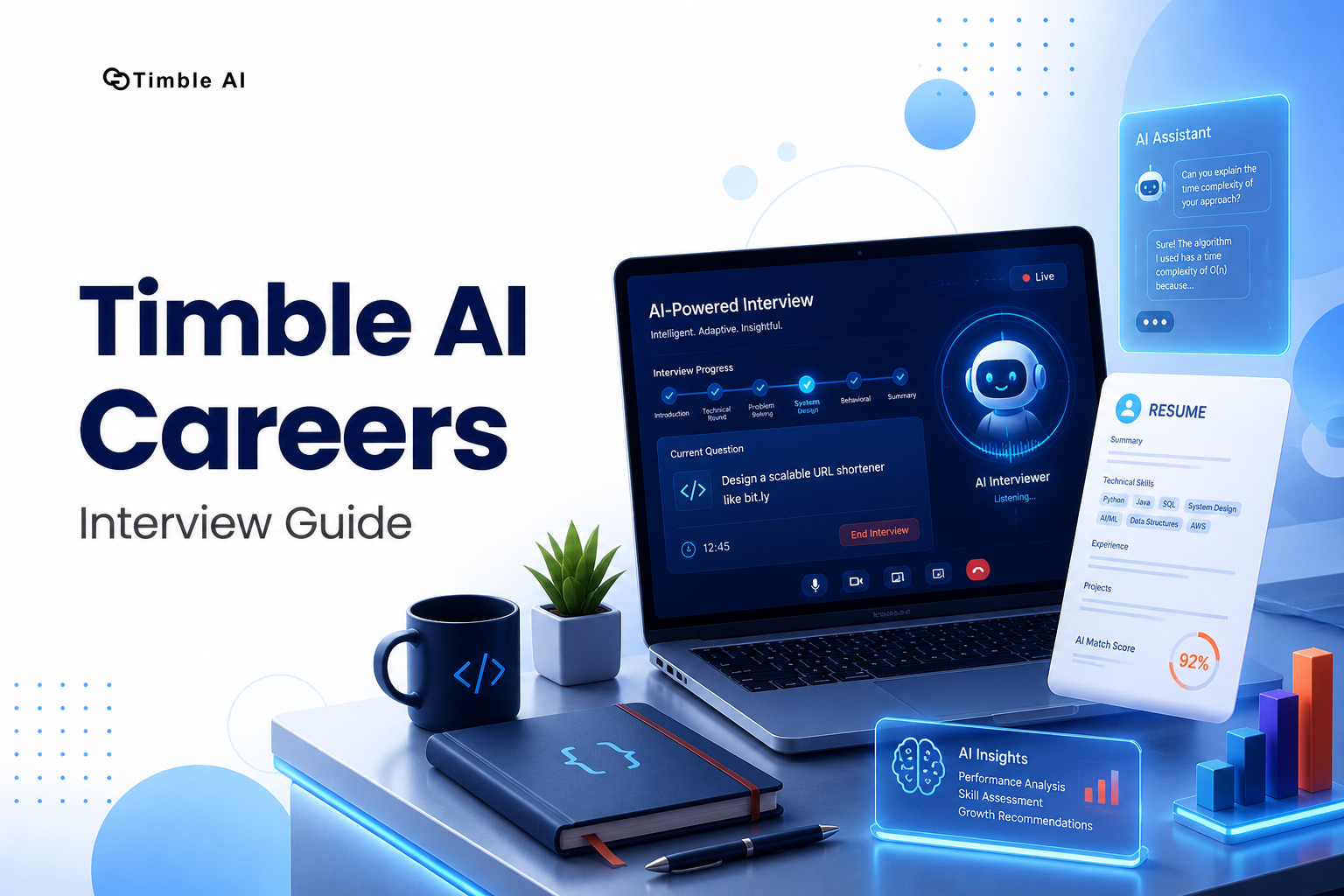
Timble AI is an artificial-intelligence company positioned around AI-led software, automation and business workflow improvement. For a candidate, the company matters because roles at an AI-focused organisation usually test more than tool familiarity: interviewers may look for product thinking, data awareness, problem definition, ethical judgement and the ability to explain technical choices in business language.
The company sits in the broader AI software and services industry, where teams translate fast-changing model capabilities into practical products for customers. That makes preparation different from a conventional software interview. Candidates should be ready to discuss how AI features are scoped, validated, monitored and improved after deployment. Timble AI is also a useful case study for cross-functional roles because AI delivery typically involves engineering, product, sales, customer success and operations working closely together rather than in isolated lanes.
This guide covers Timble AI’s background, available leadership and ownership context, and the competitor landscape a candidate should understand.
1. Company Overview
About Timble AI
Timble AI operates in the artificial-intelligence software and services space, where the central work is turning AI capability into usable business outcomes. For candidates, that makes the company a useful interview case study because it connects technical delivery with customer discovery, workflow design, model reliability, user adoption and measurable business value.
| Attribute | Details |
|---|---|
| Founded | 2016 |
| Founders | Dhananjay Goel (CEO) and Anmol Gupta (CTO) |
| Industry | AI-powered Financial Document Automation / Fintech |
| Headquarters | India (based in Delhi) |
Company History
Timble AI’s public company history is sparse, so candidates should avoid making unsupported claims about founding dates, ownership changes or funding milestones in interviews. A safer approach is to discuss the operating model implied by an AI-services company: identifying customer problems, building AI-enabled solutions, and proving that those solutions work reliably in real workflows.
The founding date and original founding team should be verified from an official company profile before being used in an interview answer.
The available positioning places Timble AI in applied AI, where the business model depends on converting customer workflow problems into deployable AI-led solutions.
Candidates should frame growth in qualitative terms only, focusing on capability areas such as automation, AI product delivery and customer problem-solving.
The most relevant interview angle is how Timble AI can turn modern AI capability into dependable software, repeatable services and customer-ready automation.
2. Mission
Mission
To democratize access to enterprise-grade compliance solutions, making them accessible and affordable for organizations of all sizes.
3. Products and Services
Timble AI’s offering is best understood as applied AI work rather than a single mass-market consumer product. That makes it relevant for candidates in software engineering, product management, data, AI operations, sales, customer success and business analysis because each function has to connect model capability with practical user value.
- AI-led software solutions cover the design and delivery of software features that use artificial intelligence to reduce manual work, improve decision support or make existing workflows easier to operate.
- Workflow automation focuses on replacing repetitive steps with rule-based or AI-supported flows, such as routing requests, summarising inputs, generating first drafts or triggering follow-up actions.
- Generative AI use-case development involves identifying where language models, retrieval systems or AI assistants can help users produce, search, summarise or transform information more efficiently.
- AI integration with business systems connects AI features with the tools a customer already uses, such as CRMs, support platforms, internal dashboards, document repositories or communication channels.
- Data preparation and knowledge structuring supports AI use cases by organising documents, process knowledge and business data so that AI outputs are grounded, searchable and easier to validate.
- Prototype and proof-of-concept delivery helps customers test whether an AI idea is useful before expanding it into a more complete product or operational workflow.
- AI adoption support includes explaining how a solution should be used, where human review is needed, and how teams should monitor quality after deployment.
4. Key Competitors of Timble AI
Timble AI competes in the AI voice-agent and conversational automation market, where buyers compare platforms on call quality, latency, integrations, analytics, safety controls and speed of deployment. The real competition is not just “who has bigger AI,” but who can reliably automate customer conversations without hurting customer experience or operational control.
1. Jumio
Jumio is an AI-powered identity verification company that helps businesses verify customer identities and prevent digital fraud.
Overview: Jumio serves organizations across financial services, fintech, online marketplaces, and other regulated industries with digital identity verification solutions.
Services: Identity verification, electronic KYC (eKYC), biometric authentication, document verification, fraud detection, risk assessment.
Market Position: Competes through AI-driven identity verification, biometric technology, and fraud prevention capabilities for digital onboarding.
2. IDnow
IDnow is a digital identity verification provider offering solutions that help businesses verify users and meet regulatory compliance requirements.
Overview: Headquartered in Germany, IDnow serves businesses across financial services, telecommunications, mobility, and other industries requiring secure digital identification.
Services: Identity verification, video identification, electronic identity verification, digital onboarding, document authentication, fraud prevention.
Market Position: Competes through its range of digital identity verification methods and solutions designed for regulated customer onboarding.
3. M2P Fintech
M2P Fintech is a financial technology infrastructure provider that enables businesses to build and deliver digital financial products.
Overview: Based in India, M2P Fintech works with banks, fintech companies, and enterprises to support digital payments and embedded financial services.
Services: Banking-as-a-Service, payment infrastructure, card issuing, lending technology, API-based financial services, digital banking solutions.
Market Position: Competes in fintech infrastructure through API-driven technology that helps businesses integrate financial products into their platforms.
4. Aitechex Quantum Innovative Solutions Pvt. Ltd.
Aitechex Quantum Innovative Solutions Pvt. Ltd. is a technology solutions provider associated with the digital technology and verification services space.
Overview: The company is positioned within the technology services market, where businesses seek software-based solutions for identity-related and operational requirements.
Services: Technology solutions, software development, digital verification support, business process technology, customized IT services.
Market Position: May compete with identity verification and technology service providers in overlapping areas; its precise service portfolio and competitive scope should be verified against official company information.
5. Aytis Cloud Solutions Private Limited
Aytis Cloud Solutions Private Limited is a technology services company focused on cloud-based and software solutions for business needs.
Overview: The company operates in the broader IT services sector, supporting organizations with technology implementation and digital business requirements.
Services: Cloud solutions, software development, IT consulting, application services, digital transformation support, enterprise technology solutions.
Market Position: Competes in adjacent technology services markets through cloud and software capabilities. Direct competition in identity verification or eKYC would depend on its specific product offerings.
5. Corporate Social Responsibility (CSR)
For an AI business like Timble AI, CSR is best understood through responsible technology use, access to digital skills and care in how automation affects customers, employees and communities. Before naming any specific programme in an interview, verify Timble AI’s latest website, careers page and official social communication so you speak from current company material rather than assumption.
Responsible AI Awareness
A credible CSR-adjacent theme is helping students, small teams and early-career professionals understand safe, fair and practical AI use.
Digital Skill Building
An AI company can contribute by supporting employability skills such as data literacy, prompt writing, product thinking and basic automation fluency.
Data Privacy Education
Because AI workflows often involve sensitive information, privacy-first awareness around customer data, consent and secure handling is a natural fit.
Inclusive Tech Access
A practical community theme is making AI tools and digital knowledge easier to access for learners, founders and small organisations with limited resources.
6. Interview Process & Selection Rounds
Timble AI hiring should be approached as a staged evaluation: first fit and communication, then role depth, then practical problem-solving and stakeholder alignment. Engineering and AI roles usually lean on coding, model reasoning or system design; product, growth, sales and customer roles lean on discovery, prioritisation, metrics and client judgement. Senior rounds go deeper into ownership, ambiguity and cross-functional influence, while early-career rounds focus more on fundamentals, learning speed and clarity of thinking.
Application and Profile Screen
The team checks whether your background matches the route you applied for. Technical profiles are screened for projects, code quality and AI or data exposure, while business profiles are screened for customer understanding, communication and evidence of ownership.
Recruiter or Hiring Manager Conversation
This round tests motivation, communication and basic company fit. For engineering and AI roles, expect questions on your strongest projects; for sales, customer success and marketing roles, expect questions on customer handling, targets, campaigns and why Timble AI’s market interests you.
Role-Specific Assessment
This round checks whether you can do the work, not just describe it. AI and engineering candidates may face coding, data, API or system-design tasks; product candidates may solve prioritisation cases; sales and customer roles may handle discovery, demo or objection scenarios.
Functional or Cross-Functional Panel
The panel evaluates collaboration, judgement and how you work with people outside your own function. Technical candidates should show how they explain trade-offs to product or business teams, while business candidates should show how they use data, feedback and product constraints to make decisions.
Final Alignment and Offer Discussion
The final stage checks role expectations, availability, compensation fit and long-term alignment. For senior candidates, this may include discussion on ownership, mentoring and strategy; for freshers, it usually focuses on learning attitude, reliability and readiness to work in a fast-moving AI environment.
7. Common Interview Questions Across Roles
These are questions any Timble AI candidate can face across functions; role-specific technical questions belong in that role’s own guide.
General & Company-Fit Questions
8. Required Skills & Tools
Required skills at Timble AI are not one flat checklist; they change by career route, and this table maps to the same routes used in Career Opportunities below.
9. Career Opportunities at Timble AI
Careers at Timble AI are best understood by route rather than by a single generic ladder: each route rewards a different mix of technical depth, product judgement, customer empathy and execution ownership. Match your preparation to the route that fits your Section 8 skills profile, then build interview stories around the job titles, responsibilities and promotion signal for that path.
AI / ML Engineering
This route suits candidates targeting Machine Learning Engineer, AI Engineer, Applied Scientist, NLP Engineer or MLOps Engineer roles, where the work centres on model quality, deployment reliability and measurable product impact. Promotion signal: you improve model performance or reliability in production while making the system easier for others to use and maintain.
Data Engineering & Analytics
This route fits Data Engineer, Analytics Engineer, Data Analyst, Business Intelligence Analyst and Data Scientist titles, with emphasis on clean pipelines, trustworthy metrics and decision-ready analysis. Promotion signal: you turn messy product or customer data into reliable datasets, dashboards or insights that directly change a business or product decision.
Full-Stack Product Engineering
This route is for Software Engineer, Backend Engineer, Frontend Engineer, Full-Stack Developer and DevOps Engineer roles that build user-facing features, APIs, integrations and scalable internal systems. Promotion signal: you ship dependable features end to end, reduce technical debt and help the team move faster without compromising quality.
Product Management & UX
This route covers Product Manager, Associate Product Manager, UX Designer, Product Designer and UX Researcher titles, where success depends on customer discovery, prioritisation, usability and feature adoption. Promotion signal: you translate user problems into clear product decisions that improve activation, retention, task completion or customer satisfaction.
GTM, Sales & Customer Success
This route includes Business Development Executive, Sales Development Representative, Account Executive, Customer Success Manager and Solutions Consultant roles, with work across pipeline building, demos, onboarding and account growth. Promotion signal: you connect customer pain to product value and consistently improve conversion, retention, expansion or implementation outcomes.
Business Operations & Strategy
This route suits Operations Associate, Business Analyst, Strategy Associate, Founder’s Office Associate and Program Manager titles, where the work involves cross-functional execution, reporting discipline and problem solving across teams. Promotion signal: you take ambiguous business problems, structure them clearly and deliver repeatable processes that reduce delays or improve decision quality.
10. Future Outlook and Strategic Plan
Timble AI’s direction is best understood through the milestones covered earlier: the company has moved from an early AI-led idea into a sharper product and customer problem-solving narrative. For candidates, the signal is clear: interview answers should connect AI capability with practical business outcomes, not treat AI as a buzzword.
Practical AI adoption
Be ready to explain how AI features should reduce manual effort, improve decision quality, or make workflows faster for real users, rather than only describing models or automation in abstract terms.
Trust, privacy, and responsible use
Prepare examples showing how you would handle user data carefully, reduce hallucination risk, build review loops, and communicate AI outputs transparently to customers or internal teams.
Product-market clarity
Candidates should be able to discuss who the user is, what pain point Timble AI is solving, and how a product team can validate whether a feature is genuinely useful after launch.
Speed with quality
Strong answers should balance startup-style execution with disciplined testing, documentation, customer feedback, and measurable iteration, especially for roles touching product, engineering, operations, or sales.
Differentiation in a crowded AI market
Be prepared to compare Timble AI’s positioning with adjacent AI-first competitors in terms of customer workflow depth, usability, reliability, and the strength of business outcomes delivered.
11. Conclusion
Timble AI sits in a competitive AI software market where differentiation depends on solving specific customer problems better than broader, less focused tools. Its direction depends on product credibility, trustworthy AI execution, and the ability to convert early milestones into repeatable customer value. Someone joining Timble AI should be ready for ambiguity, fast learning, and ownership across functions. The strongest candidates will show that they understand both the promise of AI and the operational discipline needed to make it useful.
