
What is DSA: Data Structures, Algorithms & Beginner Guide
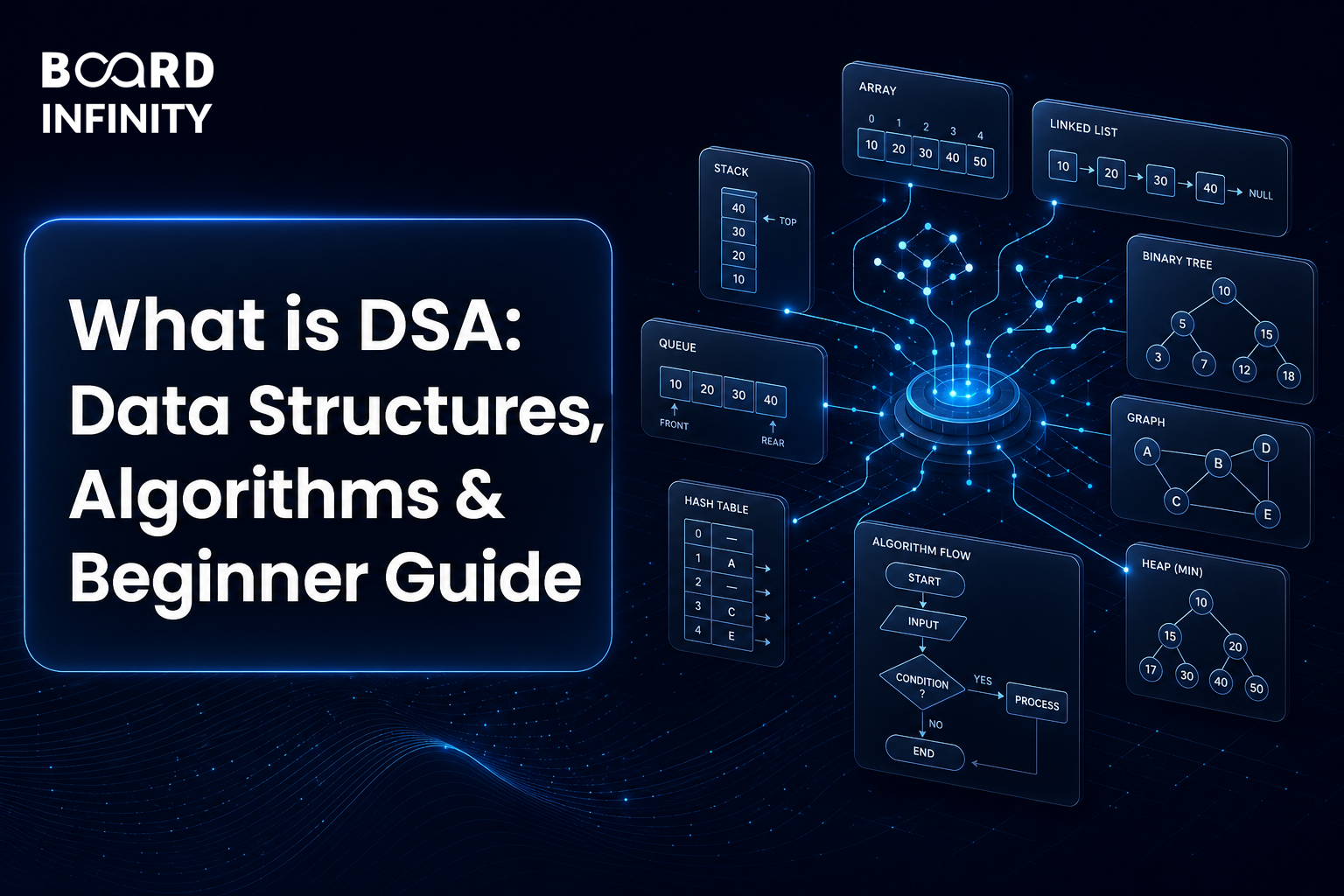
Data Structures and Algorithms, commonly called DSA, is the study of organising data efficiently and solving computational problems step by step. It matters because a slow search, poor queue design, or wrong graph model can break real systems like UPI payments, delivery routing, or hospital appointment booking.
DSA full form is Data Structures and Algorithms: data structures store and arrange information, while algorithms process that information to produce correct results. Intermediate learners use DSA to move from “code that works” to “code that scales” across backend systems, mobile apps, databases, machine learning pipelines, and interview problem solving.
After reading, you will be able to explain what is DSA, choose suitable structures, analyse time and space complexity, implement core patterns in Python, and prepare for common GATE, placement, and software engineering interview questions.
Core Concepts
DSA has two connected halves. Data structures answer “How should data be stored?”, while algorithms answer “What steps should process that data?” A strong learner can compare trade-offs: array indexing is fast, linked list insertion is flexible, hash lookup is usually constant time, trees maintain hierarchy, and graphs represent networks.
The complete beginner-to-advanced map includes complexity analysis, linear data structures, non-linear data structures, hashing, recursion, searching, sorting, divide and conquer, greedy algorithms, dynamic programming, backtracking, graph algorithms, string algorithms, and randomized techniques. These topics appear repeatedly in GATE, product-company interviews, and production engineering.
1.Arrays and Strings
Arrays store elements in index order, usually in contiguous memory in lower-level languages. Strings are character sequences with many array-like operations, although they are immutable in languages such as Python and Java. Arrays matter because they are the base for prefix sums, two pointers, sliding windows, binary search, sorting, and matrix problems.
A familiar example is storing daily expenses in a list and calculating weekly totals. An industry-specific example is an e-commerce analytics service storing hourly page views in an array so dashboards can calculate moving averages quickly. Strings appear in OTP validation, invoice parsing, search boxes, and customer-support ticket classification.
Code Example
2.Complexity Analysis
Complexity analysis measures how an algorithm behaves as input size grows. Time complexity estimates operations; space complexity estimates extra memory. Big O gives an upper bound, Big Omega gives a lower bound, and Big Theta gives a tight bound when upper and lower growth match.
A familiar example is searching for an Aadhaar enrolment token in an unsorted list: linear search may scan every entry, so it is O(n). An industry-specific example is a banking fraud engine checking whether a transaction ID already exists in a hash set; average lookup is O(1), which is essential when millions of events arrive daily.
Common complexities from fastest to slowest are O(1), O(log n), O(n), O(n log n), O(n²), O(2ⁿ), and O(n!). Interviews often ask candidates to justify why an approach is too slow before asking for an optimised version.
Code Example
3.Linked Lists
A linked list stores data in nodes, where each node points to the next node. Singly linked lists point forward, doubly linked lists point forward and backward, circular linked lists connect the last node back to the first, and skip lists add extra forward links for faster search.
A familiar example is a music playlist where adding the next song does not require shifting all songs. An industry-specific example is an operating system scheduler maintaining process queues where tasks may be inserted or removed frequently. Linked lists are less cache-friendly than arrays, but they are useful when pointer manipulation is the core requirement.
Code Example
4.Stacks and Queues
A stack follows LIFO: the last item inserted is removed first. A queue follows FIFO: the first item inserted is removed first. A deque supports insertion and deletion at both ends, while a priority queue removes the highest-priority or lowest-priority item first depending on design.
A familiar stack example is undo in a notes app. A familiar queue example is people waiting at a metro ticket counter. An industry-specific queue example is IRCTC booking requests being processed in controlled order during high traffic. A priority queue example is hospital triage, where critical patients must be served before routine appointments.
Code Example
5.Hashing Structures
Hash tables store key-value pairs using a hash function that maps keys to buckets. Sets store unique values; maps or dictionaries store key-value associations. Collisions can happen when two keys map to the same bucket, and common handling methods include chaining and open addressing.
A familiar example is checking whether a phone contact already exists before saving it. An industry-specific example is a UPI transaction system storing processed transaction IDs to prevent duplicate settlement. Hashing is also central to caches, frequency counters, session stores, deduplication, and indexing.
Code Example
6.Trees, Heaps, Tries
Trees represent hierarchy. Common variants include binary trees, binary search trees, balanced trees such as AVL and red-black trees, B-trees and B+ trees for databases, segment trees and Fenwick trees for range queries, heaps for priority, and tries for prefix search.
A familiar example is a family tree where each person has parent-child relationships. An industry-specific example is a database index using a B+ tree to support efficient range queries. A heap can power an ed-tech leaderboard showing top scorers, while a trie can power autocomplete in a medicine search app.
Code Example
7.Graphs
A graph contains vertices and edges. Graphs may be directed or undirected, weighted or unweighted, cyclic or acyclic, connected or disconnected, sparse or dense. They are usually represented using an adjacency list, adjacency matrix, or edge list.
A familiar example is a map where cities are vertices and roads are edges. An industry-specific example is Zomato order logistics, where restaurants, delivery partners, customer locations, and road segments form a weighted network. For a deeper treatment of graph terminology and traversal, the natural follow-up is Graphs in Data Structure and Algorithm.
Core graph algorithms include BFS, DFS, topological sort, Dijkstra, Bellman-Ford, Floyd-Warshall, Kruskal, Prim, and strongly connected component algorithms. These are heavily tested because they combine modelling skill with implementation discipline.
Code Example
8.Searching and Sorting
Searching finds a required item, position, state, or answer. Linear search works on unsorted data; binary search requires a sorted monotonic space. Sorting arranges items and includes comparison sorts such as bubble, selection, insertion, merge, quick, and heap sort, plus non-comparison sorts such as counting, radix, and bucket sort.
A familiar example is sorting monthly electricity bills by amount before reviewing high usage. An industry-specific example is a SaaS audit log sorted by timestamp so incident investigators can reconstruct event order. Sorting is often a preprocessing step for two pointers, interval merging, binary search, greedy algorithms, and duplicate detection.
Code Example
9.Recursion and Backtracking
Recursion solves a problem by calling the same function on smaller inputs. Every recursive solution needs a base case, progress toward that base case, and a way to combine or return results. Backtracking extends recursion by trying a choice, exploring it, and undoing it when it fails or after collecting a result.
A familiar example is generating all possible lock PIN combinations from available digits. An industry-specific example is a scheduling engine assigning nurses to shifts while respecting availability, workload, and legal constraints. Backtracking is not always fast, but pruning invalid choices early can make difficult search problems practical.
Code Example
10.Divide and Conquer
Divide and conquer splits a problem into smaller independent parts, solves each part, and combines the results. Binary search divides the search range; merge sort divides the array and merges sorted halves; quicksort partitions around a pivot.
A familiar example is finding a word in a sorted dictionary by repeatedly opening near the middle. An industry-specific example is processing large reporting files by dividing them into chunks, aggregating each chunk, and combining partial summaries. The technique works best when subproblems are independent and the combine step is efficient.
Code Example
11.Greedy Algorithms
A greedy algorithm makes the best-looking valid choice at each step and never revisits earlier choices. Greedy works only when the problem has a greedy-choice property and optimal substructure. It fails when a locally best decision blocks a better global result.
A familiar example is giving change using standard coin systems where the largest possible coin often works. An industry-specific example is assigning delivery slots by earliest finishing time to maximise completed deliveries. Greedy ideas also power activity selection, interval scheduling, Huffman coding, Kruskal, and Prim.
Code Example
12.Dynamic Programming
Dynamic programming, or DP, solves problems with overlapping subproblems and optimal substructure. Memoization stores results from recursive calls, while tabulation builds answers bottom-up. DP is widely used for sequence, grid, partition, knapsack, and state-transition problems.
A familiar example is counting the number of ways to climb stairs when each move can be one or two steps. An industry-specific example is optimising cloud resource allocation under budget and capacity constraints. DP is difficult because the challenge is not syntax; the challenge is defining the state and transition correctly.
Code Example
13.String Algorithms
String algorithms process text efficiently. Naive matching checks every possible position; KMP avoids repeated comparisons using the longest prefix-suffix table; Z algorithm computes prefix matches; rolling hash supports fast substring comparison; tries support prefix queries.
A familiar example is searching a saved SMS message for a keyword. An industry-specific example is a customer-support platform detecting repeated complaint phrases across lakhs of tickets. String algorithms are also used in search engines, plagiarism detection, genomics, log analysis, and autocomplete.
Code Example
14.Randomized Techniques
Randomized algorithms use random choices to improve expected performance or simplify logic. The result may be always correct with random running time, as in randomized quicksort, or probably correct with bounded error in specialised algorithms. Most beginner DSA courses introduce randomized pivot selection and hashing.
A familiar example is shuffling quiz questions so every learner gets a different order. An industry-specific example is load balancing API traffic across servers using randomized selection when exact global state is expensive. Randomization is useful, but correctness and probability guarantees must be stated clearly.
Code Example
Learning Path
A good DSA learning path moves from correctness to efficiency, then from isolated topics to mixed problem solving. Do not memorise 200 solutions before understanding why each pattern works.
Frequently Asked Questions
What is DSA?
DSA stands for Data Structures and Algorithms. It is the study of how data is stored and how problems are solved efficiently using step-by-step procedures.
What is the DSA full form?
The DSA full form is Data Structures and Algorithms. Data structures include arrays, linked lists, stacks, queues, trees, graphs, heaps, and hash tables, while algorithms include searching, sorting, recursion, greedy, dynamic programming, and graph algorithms.
What is the difference between data structures and algorithms?
A data structure is a way to organise and store data. An algorithm is a sequence of steps that processes data to solve a problem. For example, a queue can store support tickets, and a scheduling algorithm can decide which ticket is handled next.
Is DSA required for software engineering interviews?
Yes, DSA is widely used in software engineering interviews because it tests problem solving, code clarity, complexity analysis, and edge-case handling. Product companies often ask arrays, strings, hashing, trees, graphs, recursion, dynamic programming, and sorting questions.
Which programming language is best for DSA?
Python is beginner-friendly and concise, C++ is popular for competitive programming, Java is common in enterprise interviews, and JavaScript is useful for frontend-heavy roles. The best language is one you can use confidently to write correct code under time pressure.
How much time does it take to learn DSA?
For an intermediate programmer, 10 to 16 focused weeks is realistic for core DSA if you practise consistently. Advanced mastery takes longer because you need repeated exposure to mixed patterns, proof techniques, and difficult edge cases.
When should I use arrays instead of linked lists?
Use arrays when you need fast index access, compact memory layout, sorting, binary search, or cache-friendly traversal. Use linked lists when frequent insertion or deletion through known node references matters more than random access.
What is the most common mistake beginners make in DSA?
The most common mistake is jumping to code without understanding constraints. A solution that works for 100 items may fail for 100000 items if it uses O(n²) logic where O(n log n) or O(n) is required.
Key Takeaways
DSA means Data Structures and Algorithms: structures organise data, and algorithms process it. Arrays, linked lists, stacks, queues, hash tables, trees, heaps, tries, and graphs solve different storage problems. Searching, sorting, recursion, backtracking, divide and conquer, greedy algorithms, dynamic programming, graph algorithms, string algorithms, and randomized techniques solve different computation problems.
For GATE and interviews, the most tested points are Big O, Big Theta, and Big Omega; array versus linked list trade-offs; stack and queue applications; hash table average-case behaviour; tree traversals; BFS versus DFS; shortest path rules; sorting complexities; greedy correctness; and DP state-transition design.
The natural next step is deeper graph practice, because graphs combine representation, traversal, and optimisation in one topic. If you want to extend DSA into algorithmic decision-making, explore the further reading below.
Further Reading
- Complete Guide To Decision Tree Algorithms for Beginners /w Examples, A useful next read for learners connecting algorithmic thinking with machine learning decision models.
