
The 2-2-1 Hybrid Work Model: A Consultant's Week
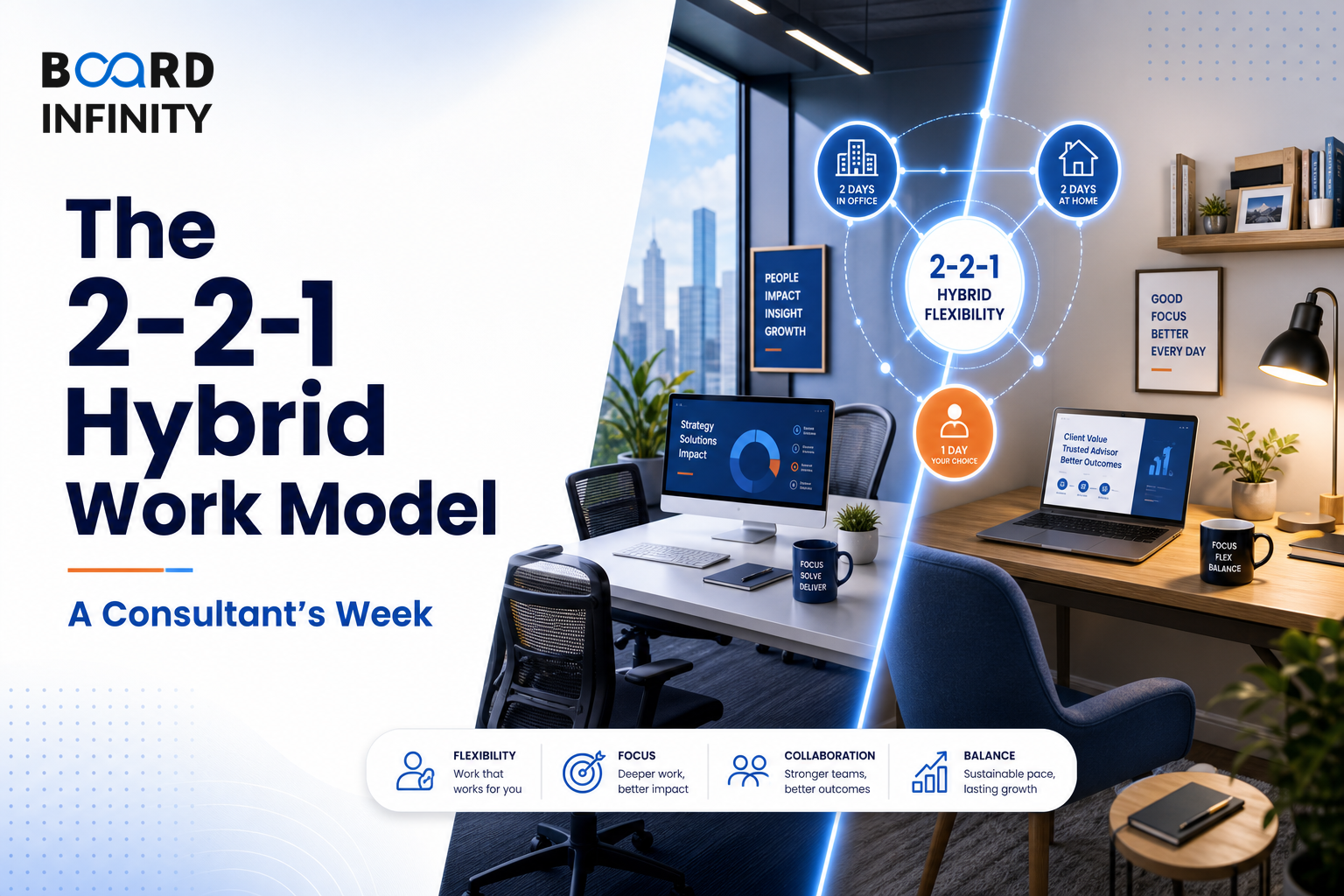
After understanding Consulting Compensation Benchmarks in India, the next practical question is what the workweek actually looks like. Post-pandemic, most consulting firms have settled on the 2-2-1 model as the standard working pattern, and candidates are often expected to understand how client, office, and home days differ. In interviews, this matters because it shows whether you understand consulting readiness beyond titles and compensation.
- Post-pandemic, most consulting firms have settled on the 2-2-1 model as the standard working pattern.
- The model represents a significant shift from the pre-COVID 4-day client-site norm.
- Monday-Tuesday is typically Client Site (Travel): stakeholder meetings, workshops, data collection, relationship building.
- Wednesday-Thursday is typically Office / Co-Working: analysis, modelling, slide decks, team collaboration, EM reviews.
- Friday is typically Home (Remote): independent work, admin, training modules, internal firm initiatives.
- Typical hours: 55-65 hrs/week, down from 60-70 pre-2020.
- Key daily skills: PowerPoint storytelling, Excel modelling, structured problem-solving, hypothesis-driven thinking.
The Big Picture of the 2-2-1 Model
The 2-2-1 Hybrid Work Model is the consulting workweek pattern where Monday-Tuesday is client-site travel, Wednesday-Thursday is office or co-working time, and Friday is home-based remote work. It combines relationship-building at the client site, analytical production in the office, and independent work at home.
The 2-2-1 hybrid model in consulting means Mon-Tue client site, Wed-Thu office, Fri home.
Why the Model Matters
Post-pandemic, most consulting firms have settled on the 2-2-1 model as the standard working pattern. This represents a significant shift from the pre-COVID 4-day client-site norm.
The model matters because consulting work is not one continuous work mode. Client days focus on stakeholder meetings, workshops, data collection, and relationship building. Office days focus on analysis, modelling, slide decks, team collaboration, and EM reviews. Home days focus on independent work, admin, training modules, and internal firm initiatives.
Client Days: Monday and Tuesday
CLIENT DAY (Mon/Tue) is built around client presence and relationship building. The day starts with arrival at the client site and a team stand-up covering progress and blockers.
- 8:00 AM - Arrive at client site; team stand-up (progress, blockers)
- 9:00-12:00 - Client workshops, stakeholder interviews, data collection
- 12:00-1:00 - Lunch with client team (relationship building)
- 1:00-5:00 PM - Presentations, feedback sessions, working sessions with client counterparts
- 5:00-7:00 PM - Debrief, email catch-up, next-day prep
Office Days: Wednesday and Thursday
OFFICE DAY (Wed/Thu) is where the consulting team converts client inputs into analysis and output. The typical schedule is 9:00 AM-7:00 PM, with deep analysis, financial modelling, slide development, EM/Director reviews, and team collaboration.
EM refers to Engagement Manager. In this work pattern, EM/Director reviews are part of the office-day rhythm because teams need feedback on analysis, modelling, and slide decks before the next client interaction.
Home Day: Friday
HOME DAY (Fri) is the remote work anchor of the week. The typical schedule is 9:00 AM-5:00 PM, focused on independent work, admin, internal firm calls, and upskilling.
Friday is also where training modules and internal firm initiatives fit into the consulting week. It is still a working day, but the activities shift away from client-site workshops and office collaboration.
Travel Intensity and Project Nuance
Travel intensity varies by firm and project. Strategy engagements (MBB) still skew towards more client time; implementation projects (Big 4) may require 3-4 days on-site during peak phases.
MBB refers to McKinsey / BCG / Bain. Big 4 Advisory refers to Deloitte / EY / PwC / KPMG. The key interview nuance is that 2-2-1 is the standard working pattern, but actual travel intensity can vary by firm and project.
Hours and Skills the Routine Demands
Typical hours: 55-65 hrs/week, down from 60-70 pre-2020. Key daily skills: PowerPoint storytelling, Excel modelling, structured problem-solving, hypothesis-driven thinking.
The routine demands switching modes across the week: relationship building and data collection at the client site, analysis and slide development in the office, and independent work and upskilling at home.
Structuring a 2-2-1 Hybrid Work Model Interview Answer
"What is the 2-2-1 hybrid model in consulting?"
Most candidates prepare for what they need to say. Top candidates prepare for what the interviewer is evaluating, so connect the work pattern to consulting readiness rather than only reciting the week split.
The most frequent error is treating the 2-2-1 model as fixed across every firm and project. Travel intensity varies by firm and project, so ignoring the difference between strategy engagements and implementation projects makes the answer sound memorised rather than practical.
Conclusion
The 2-2-1 Hybrid Work Model is the post-pandemic consulting workweek standard: two client-site days, two office or co-working days, and one home day. For candidates, the key takeaway is to understand not just the schedule, but the activities, hours, skills, and project nuance behind it.