Accenture Campus Placement Guide: Roles, Online Test Pattern, Aptitude Preparation & Selection Strategy
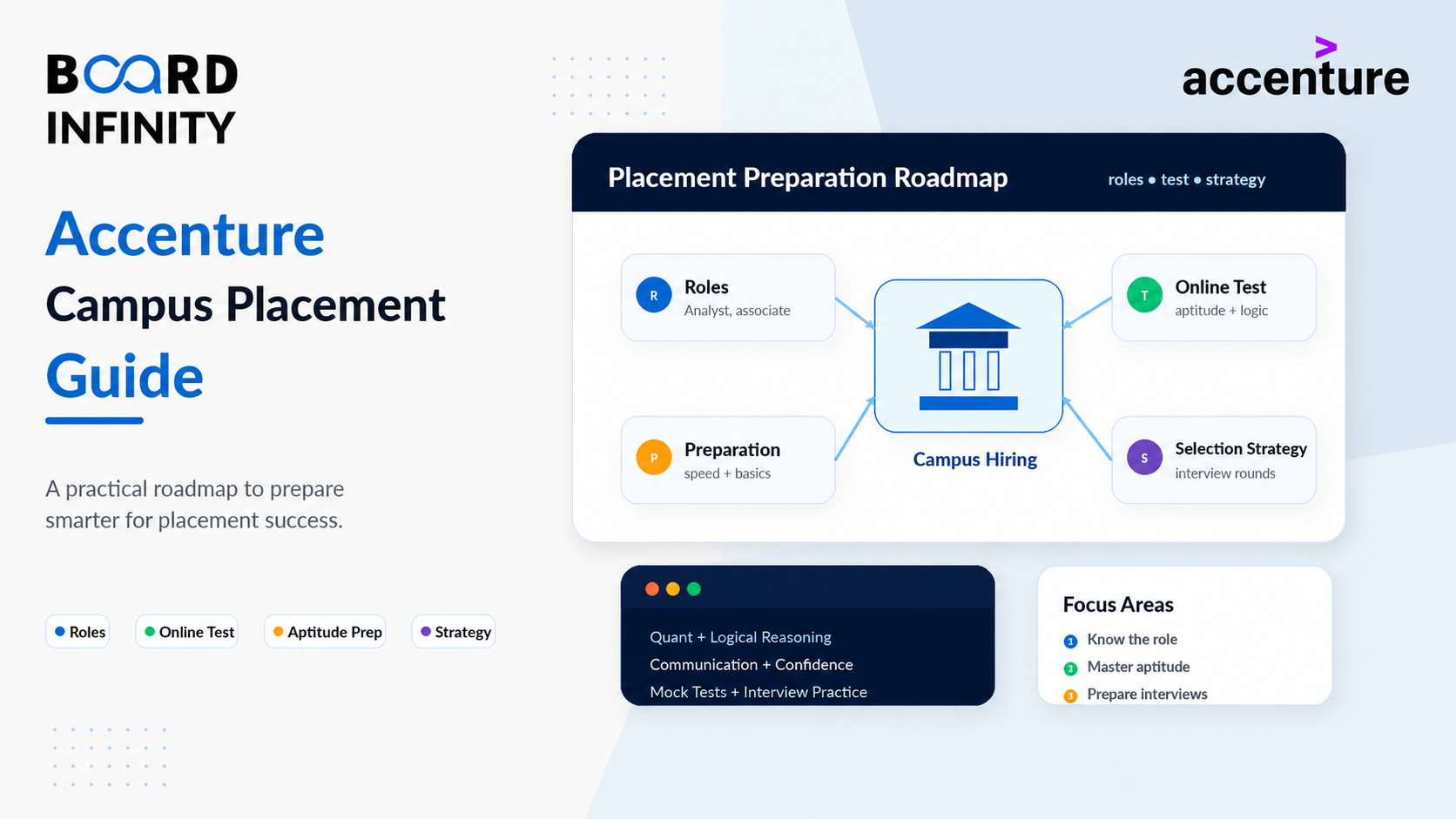
Roles, Online Test Structure, Aptitude Preparation & Selection Strategy
Accenture is one of the most sought-after companies for campus placements, especially for engineering, computer science, and IT students. Every year, thousands of students apply, but only a small percentage successfully clear all rounds. The reason is simple — Accenture evaluates candidates holistically. It does not just test technical knowledge; it evaluates logical thinking, communication, adaptability, and professional attitude.
This detailed guide explains everything you need to know about the Accenture campus hiring process - from job roles and eligibility to online assessment structure, aptitude preparation, interview expectations, and selection strategy. The insights are also aligned with current preparation guidance shared in placement preparation resources.
Understanding Accenture Campus Recruitment
Accenture hires fresh graduates primarily for technology and consulting services. The company works in areas such as:
- Software development
- Cloud computing
- Artificial intelligence
- Cybersecurity
- Data analytics
- IT consulting
- Business transformation
Because of this diverse work environment, Accenture looks for candidates who can learn quickly, solve problems logically, and communicate effectively.
Campus recruitment is typically conducted once or twice per academic year, depending on college partnerships and hiring demand.
Job Roles Offered to Freshers
The exact role offered depends on qualification, performance in assessments, and hiring demand. However, most campus offers fall into technology roles.
- Core Technology Roles
- Associate Software Engineer (ASE)
- Advanced Associate Software Engineer (AASE)
- Software Engineer / Application Development Associate
- Specialized Technology Roles (based on performance)
Eligibility Criteria (Typical Campus Requirements)
While criteria vary slightly across institutions, the general requirements include:
Academic Requirements
- BE / BTech / ME / MTech / MCA / MSc (CS / IT related fields)
- Minimum 60–65% or equivalent CGPA
- No active backlogs
Academic History
- Limited education gap
- Consistent academic performance preferred
Other Requirements
- Good communication skills
- Basic programming knowledge
- Willingness to relocate
Meeting eligibility criteria does not guarantee selection — it only allows you to appear for the assessment.
Complete Step-by-Step Accenture Selection Process
Accenture campus hiring follows a structured multi-stage process.
Stage 1 - Pre-Placement Talk (PPT)
This is an orientation session conducted by the company. It explains:
- Company overview
- Work culture
- Job roles
- Salary structure
- Career growth path
- Selection process
Students also get instructions for registration and test schedule.
This stage is not eliminatory but very important to understand expectations.
Stage 2 - Online Assessment (Major Elimination Round)
This is the most important stage. A large number of candidates are eliminated here.
The assessment is conducted online and is usually proctored (camera monitored). It may be taken from home or test centers depending on the campus drive.
Testing platforms may vary based on hiring campaign, but the structure of evaluation remains similar.
Detailed Online Assessment Structure
Total Assessment Time: Approximately 2.5 hours
The online test is divided into multiple modules. These may be attempted in sequence or separately depending on test format.
Module 1 - Cognitive & Aptitude Assessment
This is the most critical component. It evaluates thinking ability, reasoning, and problem-solving skills.
Quantitative Aptitude
Measures numerical reasoning and calculation ability.
Common topics:
- Percentages
- Ratio and proportion
- Profit and loss
- Time and work
- Time speed distance
- Averages
- Simple and compound interest
- Number system
- Data interpretation
Key skills tested:
- Mathematical understanding
- Logical calculations
- Speed and accuracy
Sample questions:- 1. A trader marks an article 40% above the cost price and allows a 20% discount. Find the overall profit or loss percentage.
2. The ratio of the present ages of A and B is 4 : 5. After 8 years, the ratio becomes 5 : 6. Find their present ages.
3. A can complete a piece of work in 15 days and B in 20 days. They work together for 5 days, after which B leaves. In how many more days will A complete the remaining work?
4. A train 180 meters long crosses a platform 120 meters long in 15 seconds. Find the speed of the train.
5. A sum of money becomes ₹12,100 in 2 years and ₹13,310 in 3 years at compound interest. Find the rate of interest.
6. If A : B = 3 : 4 and B : C = 5 : 6, find A : B : C.
7. A man sells two articles for ₹500 each. On one he gains 25% and on the other he loses 25%. Find his overall profit or loss percentage.
8. The difference between the compound interest and simple interest on a sum for 2 years at 10% per annum is ₹20. Find the principal.
9. A mixture contains milk and water in the ratio 5 : 3. If 16 litres of water are added, the ratio becomes 5 : 7. Find the original quantity of milk.
10. The average age of 30 students in a class is 14 years. If the age of the teacher is added, the average becomes 15 years. Find the age of the teacher.
11. Two trains start at the same time from two stations 300 km apart and move towards each other with speeds 60 km/h and 40 km/h. After how many hours will they meet?
12. A person walks 5 km at 4 km/h and the next 5 km at 6 km/h. Find his average speed for the whole journey.
13. A sum of money doubles itself in 8 years at simple interest. In how many years will it become four times the principal?
14. The ratio of incomes of A and B is 3 : 2, and the ratio of their expenditures is 5 : 3. If each saves ₹2000, find A’s income.
15. A train traveling at 72 km/h crosses a man walking at 6 km/h in the same direction in 12 seconds. Find the length of the train.
16. A and B together can complete a work in 12 days, and B alone can complete it in 30 days. In how many days can A alone complete the work?
17. If the price of sugar increases by 25%, by what percentage must consumption be reduced so that expenditure remains the same?
18. The sum of two numbers is 48 and their difference is 12. Find the numbers.
19. The average of five consecutive even numbers is 36. Find the largest number.
20. A trader mixes 30 kg of rice costing ₹40/kg with 20 kg of rice costing ₹50/kg. Find the cost price per kg of the mixture.
21. A number when divided by 7 leaves a remainder 5. What will be the remainder when the same number is divided by 7² (49)?
22. The present population of a city is 8,00,000. If it increases by 10% annually, what will be the population after 2 years?
23. A person invests ₹10,000 at 8% simple interest and ₹8,000 at 10% simple interest. Find the total interest after 2 years.
24. If (x + 1/x) = 5, find the value of (x² + 1/x²).
25. The average of 10 numbers is 45. If one number 90 is replaced by 50, what will be the new average?
Logical Reasoning
Tests structured thinking and pattern recognition.
Common topics:
- Seating arrangements
- Coding decoding
- Logical puzzles
- Blood relations
- Series completion
- Direction sense
- Syllogisms
Key skills tested:
- Analytical thinking
- Problem structuring
- Deductive reasoning
Sample Questions
- Eight people A, B, C, D, E, F, G, and H are sitting in a row facing north. A sits third to the left of C.D sits immediately to the right of C.B is at one of the extreme ends. E sits between B and F. Who is sitting at the center position?
- In a certain code language, COMPUTER is written as DPNQVUFS. How will LANGUAGE be written in the same code?
- Five persons A, B, C, D, and E live on different floors of a five-storey building (1 lowest, 5 highest). A lives above B. C lives below D.E does not live on the top floor. Who lives on the third floor?
- A is the brother of B. B is the mother of C. D is the father of A. How is D related to C?
- Find the next number in the series:3, 9, 27, 81, ?
- Ravi walks 10 meters north, then 5 meters east, then 10 meters south. How far is he from the starting point?
- Statements: All engineers are graduates.
Some graduates are programmers.
Verbal Ability
Evaluates communication and comprehension.
Common topics:
- Reading comprehension
- Grammar correction
- Sentence completion
- Vocabulary
- Error detection
Key skills tested:
- Language understanding
- Interpretation ability
- Communication clarity
Sample Questions
- Passage: Artificial Intelligence is transforming industries by automating processes and improving decision-making. While organizations benefit from higher efficiency and productivity, concerns remain about job displacement and the need for workforce reskilling.
Question:- According to the passage, what is the primary concern associated with AI adoption?
- Choose the grammatically correct sentence.
A. Each of the employees have submitted their report.
B. Each of the employees has submitted his report.
C. Each of the employees have submitted his report.
D. Each of the employees has submitted their reports. - Fill in the blank with the most appropriate word.
Despite working late into the night, she could not ______ the project on time.
A. completed
B. completing
C. complete
D. completion - Choose the correct word to complete the sentence.
The manager asked the team to remain ______ during the crisis.
A. clam
B. calm
C. claim
D. clime - Identify the part of the sentence with the grammatical error.
The committee (A) have decided (B) to postpone the meeting (C) until next week (D). - Choose the synonym of the word Meticulous.
A. Careless
B. Precise
C. Lazy
D. Aggressive - Choose the word closest in meaning to Enhance.
A. Reduce
B. Improve
C. Delay
D. Ignore - Choose the correct option to complete the sentence.
The new policy aims to ______ transparency in the organization.
A. promote
B. promoting
C. promoted
D. promotes - Identify the error in the sentence.
She (A) is knowing (B) the answer (C) to the question (D). - Choose the antonym of " scarce.
A. Rare
B. Abundant
C. Limited
D. Insufficient - Fill in the blank with the correct word.
The scientist’s discovery was considered ______ because it changed the direction of research.
A. trivial
B. revolutionary
C. ordinary
D. routine - Choose the correct sentence.
A. Neither of the students were present in the class.
B. Neither of the students was present in the class.
C. Neither of the students are present in the class.
D. Neither of the students have been present in the class. - Choose the correct option.
The CEO emphasized that innovation is essential ______ long-term growth.
A. for
B. with
C. on
D. at - Identify the grammatical error.
The number of employees (A) in the company have increased (B) significantly (C) this year (D). - Choose the synonym of Resilient.
A. Weak
B. Fragile
C. Adaptable
D. Slow
Reading Comprehension Tips for Verbal Ability (Accenture Placement)
- Read questions first to know what to look for in the passage.
- Identify the main idea of the passage quickly.
- Focus on keywords like however, therefore, although for important points.
- Use elimination to remove incorrect options.
- Do not assume answers beyond what is written in the passage.
- Manage time well and avoid spending too long on one question.
- Practice skimming and scanning to locate answers faster.
Gamified Cognitive Tests (Modern Assessment Style)
Some hiring drives use game-based cognitive evaluations instead of traditional questions.
Examples include:
- Memory recall games
- Pattern matching tasks
- Reaction speed tests
- Visual logic challenges
These tests measure natural cognitive ability rather than memorized knowledge.
Module 2 - Technical Assessment
This section evaluates computer science fundamentals.
Topics may include:
- Programming logic
- Pseudocode interpretation
- Operating systems basics
- Networking concepts
- Database fundamentals
- Cloud computing basics
- Software engineering principles
Questions are usually multiple choice.
Module 3 - Coding Assessment
Candidates solve programming problems.
Typical format:
- 2 or 3 coding questions
- Medium difficulty
- Multiple language options (Java, Python, C++, etc.)
Skills evaluated:
- Problem solving
- Logic building
- Algorithm design
- Code correctness
Module 4 - Communication Assessment
This is a unique feature in Accenture hiring.
It evaluates English speaking and listening ability through automated systems.
Tasks may include:
- Reading sentences aloud
- Listening and repeating
- Answering spoken questions
- Story narration
- Picture description
Focus areas:
- Pronunciation
- Fluency
- Clarity
- Listening accuracy
Technical Interview Round
Candidates who clear the online assessment are invited for interviews.
Topics commonly asked:
- Programming language fundamentals
- Object oriented programming
- Data structures
- Database queries
- Software development concepts
- Project explanation
Interviewers evaluate:
- Concept clarity
- Logical thinking
- Problem solving approach
- Practical knowledge
HR Interview Round
Final evaluation stage.
Typical discussion areas:
- Self introduction
- Career goals
- Strengths and weaknesses
- Teamwork experience
- Adaptability
- Relocation willingness
HR focuses on personality, attitude, and communication.
Why Aptitude is the Most Important Stage
Among all rounds, aptitude plays the biggest filtering role.
Reasons:
- First elimination round
- Large number of candidates compete
- Limited time increases pressure
- Requires both speed and accuracy
- Tests natural thinking ability
Students who prepare aptitude systematically have a major advantage.
Aptitude Preparation Strategy
Daily Practice Routine (Quant + Reasoning + Verbal)
Total Daily Practice Time: 2–3 Hours
1. Quantitative Aptitude (60–75 minutes)
- Revise formulas and shortcuts (10 minutes)
- Solve 10–15 moderate level questions from one topic (30 minutes)
- Practice 5–10 mixed questions from previous topics (20–30 minutes)
2. Logical Reasoning (40–50 minutes)
- Solve 1 puzzle or seating arrangement question
- Practice 5–8 reasoning questions (coding, series, syllogism, direction)
- Focus on accuracy and structured problem solving
3. Verbal Ability (30–40 minutes)
- Read one short passage and answer comprehension questions
- Practice 5–8 grammar and vocabulary questions
- Learn 5 new vocabulary words
4. Speed Practice (15–20 minutes)
- Attempt a short timed quiz of mixed questions
- Focus on quick calculations and logical thinking
5. Daily Review (10–15 minutes)
- Check incorrect answers
- Note important formulas or concepts
- Identify weak areas for next practice session
Detailed Preparation Strategy
Phase 1 - Concept Building
Understand formulas and logic clearly.
Phase 2 - Topic-Wise Practice
Solve questions from each topic separately.
Phase 3 - Mixed Practice
Combine different topics to simulate a real test.
Phase 4 - Mock Tests
Practice full-length assessments.
Phase 5 - Performance Analysis
Identify mistakes and improve weak areas.
Common Mistakes Students Make
- Ignoring the verbal section
- Practicing without time limits
- Memorizing formulas without understanding
- Not analyzing mock tests
- Avoiding difficult topics
- Neglecting communication assessment
Avoiding these mistakes significantly improves selection chances.
Skills Accenture Evaluates Overall
Beyond academics, Accenture looks for:
- Analytical thinking
- Communication ability
- Problem-solving mindset
- Learning attitude
- Adaptability
- Professional behaviour
These qualities influence final selection decisions.
Realistic Preparation Timeline
2-3 Months Before Placement
- Learn concepts
- Practice basics
1 Month Before Placement
- Solve advanced problems
- Take mock tests
Final 2 Weeks
- Revise formulas
- Practice speed
- Improve communication
Final Selection Strategy
To maximize success:
✔ Master aptitude fundamentals
✔ Practice coding regularly
✔ Prepare technical basics
✔ Improve spoken English
✔ Attempt multiple mock tests
✔ Stay calm during assessment
✔ Be confident in interviews
Final Conclusion
The Accenture campus placement process is designed to evaluate candidates comprehensively - not just academically but intellectually and professionally.
The most decisive stage is the online assessment, particularly the aptitude and cognitive sections. Strong preparation in logical thinking, numerical reasoning, and communication dramatically improves your chances of clearing the process.
With consistent practice, conceptual clarity, and strategic preparation, securing an offer from Accenture is completely achievable.
Approach preparation systematically, stay disciplined, and focus on continuous improvement - success will follow.
Final Preparation Tip:
Start practicing under real exam conditions by taking timed mock tests regularly. This helps improve speed, accuracy, and confidence, which are critical for performing well in the Accenture online assessment.