
Trade-off: Automation versus Human Touch in HR Delivery
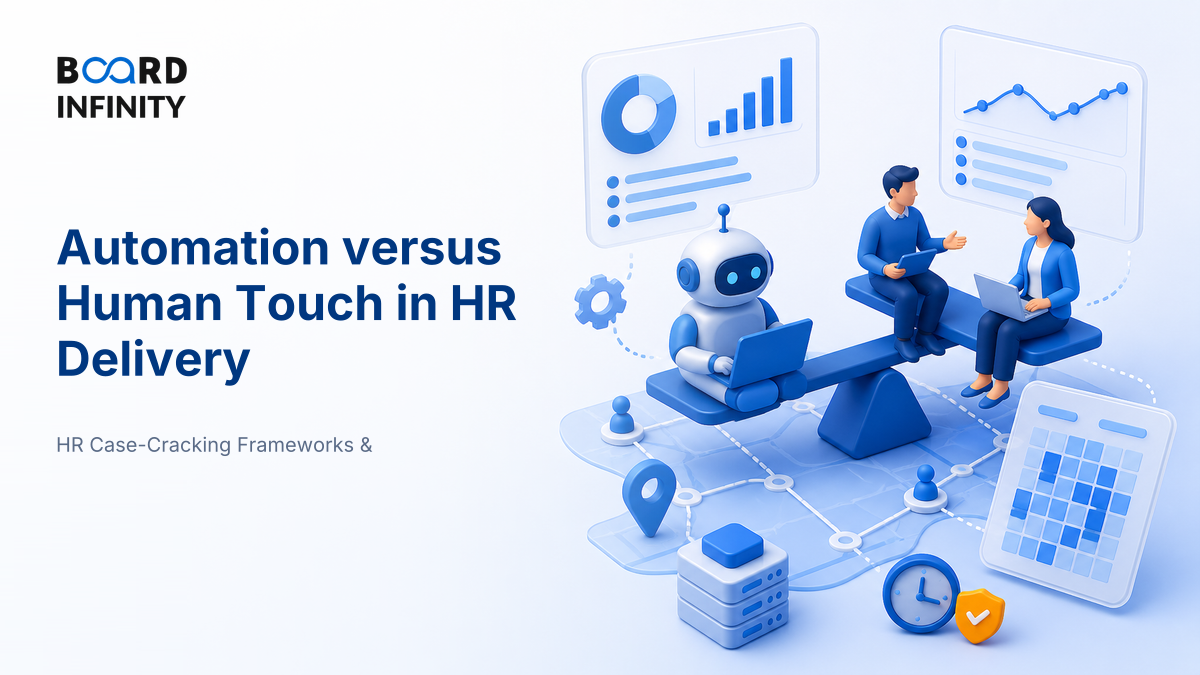
A new joiner opens the HR app at 11:40 pm to download a joining letter - instant automation feels magical. The next morning, another employee walks into HR after a difficult performance conversation - a chatbot would feel insulting. The real HR delivery question is not “Should we automate?” but “Which employee moments can be digitised without damaging trust?”
- Automate high-volume, low-emotion, rule-based HR work: payslips, leave balances, policy FAQs, ticket status, onboarding checklists.
- Keep human touch for high-stakes, ambiguous or emotional situations: exits, grievances, manager conflict, performance issues, return from parental leave.
- The best model is not bot versus HRBP. It is tiered HR delivery: self-service first, escalation when complexity or emotion rises.
- Use a simple rule: automate the transaction, humanise the moment that matters.
- Track both efficiency and experience: cost per case, SLA adherence, first-contact resolution, employee CSAT, escalation rate, and eNPS.
- The biggest interview mistake is treating automation as cost-cutting only. In HR, trust is also a performance variable.
Big Picture: HR Delivery Is a Complexity Filter
Think of HR delivery as a funnel. Most employee needs should be solved quickly through self-service. But as the issue becomes more personal, risky or ambiguous, the funnel must deliberately move the employee toward a trained human.
Core Explanation: The Trade-off Decision Rule
HR delivery is the way employees receive HR services - information, transactions, support, advice and resolution across the employee life cycle.
Automation improves speed, consistency, availability and cost efficiency. It works brilliantly when the answer is standard and the employee need is transactional.
Human touch improves empathy, judgement, fairness perception and trust. It becomes non-negotiable when the issue affects identity, career, dignity, safety or livelihood.
The strongest HR teams do not ask, “Can this be automated?” They ask three sharper questions:
The 2x2: Where Automation Works and Where It Fails
The cleanest interview framework is a 2x2 using two variables: process complexity and employee emotional intensity. This prevents a one-sided answer.
Automation versus Human Touch: What HR Gains and Risks
Automation is not the enemy of employee experience. Bad automation is. A well-designed HR bot reduces waiting time; a poorly designed one makes employees feel abandoned.
TCS employees use Ultimatix as a large-scale digital HR platform for routine employee services such as leave, claims, learning access and internal processes. The strategic point is not that the portal replaces HR; it standardises high-volume transactions so HR leaders and managers can focus more on exceptions, talent conversations and business partnering.
Metrics: How to Prove the Trade-off Is Working
Do not discuss this topic only philosophically. In an interview, show that you can measure both sides: efficiency and employee experience.
The trick is to read metrics together. If cost per case falls but escalation complaints rise, automation is not improving HR delivery - it is merely hiding friction.
Definitions You Can Say in One Breath
- HR delivery: The operating model through which employees receive HR transactions, information, advice and issue resolution.
- HR automation: Using technology to execute repeatable HR tasks with minimal manual intervention.
- Human touch: Deliberate human involvement where empathy, judgement, confidentiality or trust affects the employee outcome.
- Moments that matter: Employee experiences with disproportionate impact on trust, commitment or perception of fairness.
IBM AskHR: Scaling HR Service Without Removing Human Judgement
IBM’s AskHR shows how a large organisation can automate routine employee support while preserving escalation for complex and sensitive HR matters.

Situation: IBM operates across countries, roles and employment contexts, which creates huge volume in HR queries - policies, benefits, payroll, mobility, learning and employee support. A purely manual HR helpdesk would be slow and inconsistent at that scale.
The move: IBM built AI-enabled HR service capabilities such as AskHR to answer common employee questions, guide employees through standard processes and route more complex cases to the right HR expert. The primary driver was scalable, consistent HR service. Supporting drivers included a strong knowledge base, workflow routing, employee self-service design and specialist escalation for cases that need judgement.
The lesson: IBM did not make HR “less human” by automating routine queries. It made human HR more available for higher-value moments - exceptions, manager issues, employee relations and advisory work.
How AI Changes Automation versus Human Touch in HR Delivery
AI makes this trade-off sharper because HR tools can now understand language, classify intent and draft responses. That increases scale - but also increases the risk of invisible bias, privacy leakage and over-automation.
Use NotebookLM before an HR interview: upload the company annual report, careers page and recent HR news, then ask, “Which HR services should this company automate and which should stay human-led? Give me likely interviewer questions.”
Interview Relevance
“Our HR helpdesk is overloaded. Employees complain about slow responses, but leaders want cost reduction. What HR services would you automate, and where would you retain human touch?”
Use the phrase: “I would automate the transaction, not the relationship.” It signals maturity because HR delivery is about efficiency and trust together.
Common Mistake
The most common mistake is saying “automate everything routine” without defining escalation. That costs candidates because HR failures usually happen at the boundary - when a routine-looking case is actually emotional, risky or urgent. Fix: always add a clear human escalation path for ambiguity, emotion and risk.