
Best Language for DSA: C++ vs Java vs Python Decision Guide
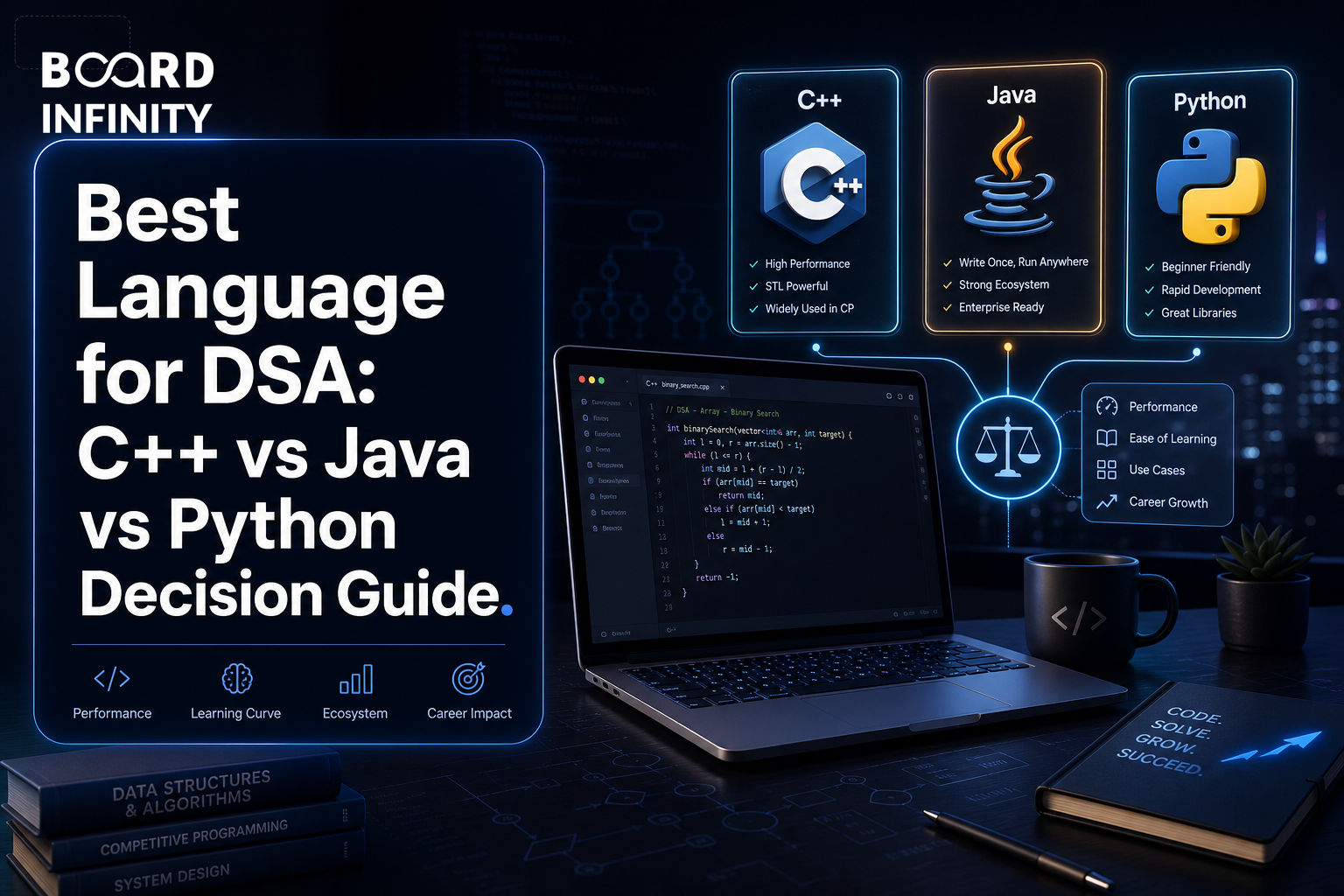
The best language for DSA is the programming language that lets you implement data structures and algorithms accurately, efficiently, and consistently under contest, interview, or exam constraints. It matters because the same graph or dynamic programming solution can pass in C++ but time out in Python if implemented carelessly. After reading, you can choose C++, Java, or Python based on real trade-offs.
Language choice sits between algorithm knowledge and execution discipline. Intermediate and advanced learners already know arrays, trees, heaps, graphs, and DP; the harder question is which language helps them convert that knowledge into accepted, readable, bug-resistant solutions under time pressure.
You will be able to compare dsa in c++, dsa in java, and dsa in python across speed, libraries, memory, syntax, recursion, debugging, and interview suitability, then build a practical preparation plan.
Core Concepts
The best language for dsa is not universal; it depends on constraints. C++ gives maximum control and speed, Java gives strong standard libraries with safer runtime behaviour, and Python gives concise code that helps you focus on algorithmic reasoning. The right choice also depends on recursion depth, input size, integer range, library fluency, and the type of interviews you are targeting.
1.C++ for Speed
C++ is usually the strongest choice when raw runtime, memory control, and advanced standard library usage matter. For dsa in c++, the main advantage is that STL gives fast containers and algorithms while the compiled runtime keeps overhead low. This is why many competitive programmers prefer C++ for graph traversal, shortest path, range queries, and complex data structures.
A familiar example is an IRCTC-style seat-allocation simulator where thousands of booking, cancellation, and waitlist-priority operations must be processed quickly. A priority queue or ordered set in C++ handles these updates efficiently. An industry-specific example is a logistics routing engine that repeatedly computes shortest paths across delivery hubs; C++ helps when millions of edges and strict latency budgets are involved.
The cost is complexity. Iterators, references, integer overflow, custom comparators, and memory-heavy containers can create subtle bugs. C++ rewards learners who understand both algorithm complexity and implementation details.
Code Example
2.Java for Balance
Java is a strong middle path for DSA because it offers reliable performance, strong typing, automatic memory management, and a mature collections framework. For dsa in java, the biggest advantage is that code stays structured and readable while still being fast enough for most interview platforms and many competitive problems.
A familiar example is Aadhaar or PAN-style duplicate detection, where a HashSet can check whether an identifier has already appeared. An industry-specific example is a banking fraud-detection service where transaction relationships form a graph; Java collections such as HashMap, ArrayDeque, and PriorityQueue make graph traversal and shortest-path logic maintainable in production-style code.
Java has more boilerplate than Python and slightly more runtime overhead than C++, but it reduces many low-level mistakes. Its fixed integer types also force you to think about overflow, which is useful in interviews where constraints decide whether int or long is safe.
Code Example
3.Python for Clarity
Python is often the fastest language for expressing an idea correctly. For dsa in python, concise syntax helps you focus on recurrence relations, state transitions, graph traversal logic, and edge cases instead of boilerplate. It is especially comfortable for hash maps, sets, counters, heaps, binary search helpers, and memoised recursion.
A familiar example is UPI transaction reconciliation, where dictionaries can group transaction IDs, statuses, and amounts quickly. An industry-specific example is a healthcare triage dashboard that ranks patient events by urgency; Python’s heapq, dict, and dataclasses can model the algorithm clearly before it is moved to a lower-latency service if required.
The main limitation is speed. Python may struggle with very large nested loops, recursion-heavy graph algorithms, and tight time limits. A Python solution usually needs better constant-factor awareness: use sys.stdin.buffer, avoid unnecessary object creation, prefer iterative traversal when recursion depth is high, and choose built-ins over manual loops where possible.
Code Example
4.Selection Criteria
The practical decision is not “which language is best?” but “which language is best for this constraint set?” If you are solving competitive programming problems with 2-second limits and large graphs, C++ is usually safer. If you are preparing for backend interviews and want readable, type-safe implementations, Java is excellent. If you need to explain algorithms quickly and reduce syntax overhead, Python is highly effective.
A familiar example is a food-delivery ranking system where Zomato-like orders must be sorted by distance, preparation time, and delivery priority. Python may be enough for prototyping the ranking rule, Java may fit a backend interview implementation, and C++ may be preferred for a high-throughput simulation. An industry-specific SaaS example is tenant-level request routing, where heap operations and hash maps appear in rate limiting, caching, and scheduling.
Use one primary language for consistency. Switching languages every week slows pattern recognition because syntax, library names, and debugging habits keep changing. Advanced learners can still read solutions in other languages to understand implementation trade-offs.
Code Example
Learning Path
A strong DSA language plan should reduce decision fatigue. Pick one primary language, master its standard library, implement core data structures, then practise timed problems where language-specific weaknesses become visible.
Frequently Asked Questions
What is the best language for dsa?
The best language for dsa is the one that lets you write correct, efficient, and explainable solutions under your target constraints. C++ is strongest for strict performance, Java is balanced for interviews and backend-style coding, and Python is best for concise reasoning when limits allow it.
Is C++ better than Java for DSA?
C++ is usually faster and gives more control over memory and constants, so it is popular in competitive programming. Java is often easier to structure and safer for large interview solutions because collections, garbage collection, and type checks reduce some low-level risks.
Is Python enough for coding interviews?
Python is enough for many coding interviews, especially when the platform allows it and the interviewer values clear reasoning. You must still know Python-specific performance rules such as using deque for queues, heapq for heaps, and sys.stdin.buffer for large input.
Should I learn dsa in c++ if I already know Python?
You do not need to switch if your goal is standard software interviews and you solve problems fluently in Python. Learn C++ if you want competitive programming, tighter performance control, or deeper understanding of memory and constant-factor optimisation.
Is dsa in java good for placements?
Yes, dsa in java is very suitable for placements because Java is readable, structured, and fast enough for most interview problems. It is especially useful for candidates targeting backend, enterprise, Android, or service-oriented engineering roles.
Which language is best for dynamic programming?
Python is excellent for learning DP because memoisation and state transitions are easy to express. C++ is safer for very large DP tables or strict limits, while Java works well when you carefully manage arrays, long values, and iterative transitions.
What is the common mistake when choosing a DSA language?
The most common mistake is choosing a language only because toppers use it. A language helps only when you know its libraries, edge cases, and debugging patterns; otherwise, you lose more time to syntax than you gain from theoretical speed.
Can I switch languages during DSA preparation?
You can switch early, but frequent switching during serious preparation is inefficient. Once interviews or contests are near, stay with one primary language and build templates for common patterns such as BFS, DFS, heaps, binary search, and DP.
Key Takeaways
C++ is the safest choice for strict time limits and advanced competitive programming. Java is the most balanced option for structured interview code, backend-style roles, and reliable collections. Python is excellent for clear reasoning, fast implementation, and DP-heavy interviews when constraints are reasonable.
For GATE-style reasoning and interviews, the most tested points are asymptotic complexity, constant-factor impact, memory usage, recursion depth, integer overflow, and correct data-structure choice. Language does not change Big-O, but it strongly affects implementation risk and runtime margins.
The natural next step is Greedy Programming v/s Dynamic Programming, because language choice becomes more meaningful when you can first choose the correct algorithmic strategy.
