
Debt Markets & Bonds Explained: India's Fixed Income Backbone
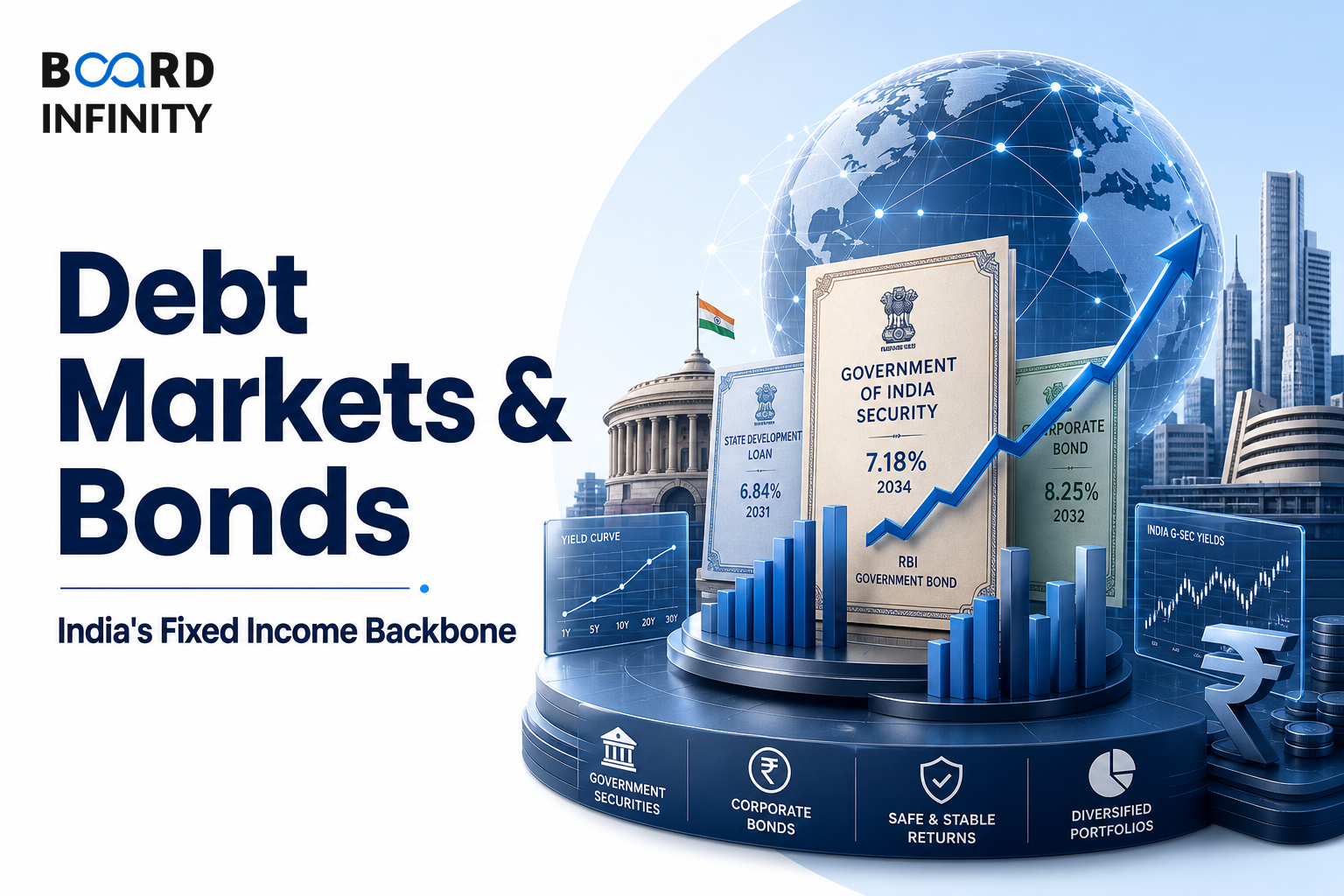
After Equity Markets Explained, the next interview question is what sits behind fixed income and banking roles. India's debt market - comprising government securities, corporate bonds, and money market instruments - is the largest by volume but less liquid than equity markets. It matters because interviewers expect candidates to connect instruments, yields, credit ratings and RBI repo-rate transmission in one coherent answer.
- India's debt market - comprising government securities, corporate bonds, and money market instruments - is the largest by volume but less liquid than equity markets.
- G-Secs are issued by the Union Government with RBI as agent, carry sovereign guarantee, are SLR eligible and the 10Y benchmark trades around 7.0-7.3% in FY24.
- State Development Loans are issued by state governments, typically carry a ~30-40 bps spread over G-Sec and state fiscal quality varies.
- Corporate Bonds are issued by public/private companies and PSUs, are credit rated by CRISIL/ICRA/CARE, and carry a spread over G-Sec based on rating.
- T-Bills, CP and CD are key money market instruments with tenors from days to 1 year.
- The repo rate is the rate at which RBI lends to banks short-term and anchors short-term interest rates.
- Transmission works as: RBI ↑ Repo → Banks' cost of funds ↑ → MCLR ↑ → Loan rates ↑ → Borrowing ↓ → Inflation ↓.
Debt Market Big Picture
India's debt market is critical for understanding fixed income and banking roles. The market spans government securities, state borrowings, corporate borrowings, short-term money-market instruments and bank capital instruments, each differing by issuer, tenor, yield and key features.
A bond is a fixed-income instrument representing a loan from the investor to a borrower (government, corporation, or financial institution). The borrower promises to pay periodic coupon payments and return the face value (par) at maturity.
RBI Repo Rate Mechanism
The repo rate is the rate at which RBI lends to banks short-term. It anchors short-term interest rates.
As of FY2024: Repo = 6.50%, SDF (Standing Deposit Facility) = 6.25%, MSF = 6.75%. RBI MPC raised rates by 250 bps (2022-23) to control post-COVID inflation, then paused.
Yield Curve Types
Yield curve types in the debt market are Normal, Inverted and Flat. They are read by looking at how yield behaves across maturity.
Credit Ratings and Spreads
Corporate Bonds are credit rated by CRISIL/ICRA/CARE, and the spread over G-Sec is based on rating. Credit Spreads represent the additional yield demanded by investors over the risk-free rate (G-Sec) for bearing credit risk.
Credit spread = YTM(Corporate Bond) - YTM(G-Sec of same maturity).
AAA-rated corporate bonds: spread of 50-80 bps over G-Sec. AA-rated: 80-150 bps; A-rated: 150-250 bps; BBB: 250+ bps. During stress (e.g., IL&FS crisis 2018): AA NBFC spreads blew out to 300-400 bps.
Bond Pricing and Yield
Bond Pricing Formula: Price = Σ [C / (1+r)t] + [F / (1+r)n]. Where: C = Coupon payment, F = Face value, r = Discount rate (YTM), n = Years to maturity, t = Period.
Price-Yield Relationship: Inverse - when interest rates rise, bond prices fall, and vice versa. Longer maturity bonds have greater price sensitivity to rate changes.
Current Yield = Annual Coupon / Current Market Price. Simple measure; ignores capital gain/loss. Yield to Maturity (YTM) = IRR of all cash flows (coupons + face value) at current market price. The most complete yield measure. Assumes reinvestment at YTM.
Structuring a Debt Markets & Bonds Explained Interview Answer
"What's happening in the Indian bond market right now?"
The strongest answers do not treat bonds as one bucket. Separate government securities, corporate bonds and money-market instruments, then connect yields, credit spreads and repo transmission.
The most frequent error is stopping at “repo rate goes up, loan rates go up” without showing the full transmission chain. In interviews, that misses the banking logic: RBI ↑ Repo → Banks' cost of funds ↑ → MCLR ↑ → Loan rates ↑ → Borrowing ↓ → Inflation ↓.
Conclusion
India's debt market is the backbone of fixed income, spanning G-Secs, SDLs, T-Bills, corporate bonds, CP, CD, AT1 / Tier 2 bonds and NCDs. For interviews, the final takeaway is to link instruments with issuer, tenor, yield, credit rating and RBI repo-rate transmission.
Mark Lesson Complete (Debt Markets & Bonds Explained: India's Fixed Income Backbone)
Mark Complete
Bookmark