
Financial Markets Explained: Money vs Capital Markets
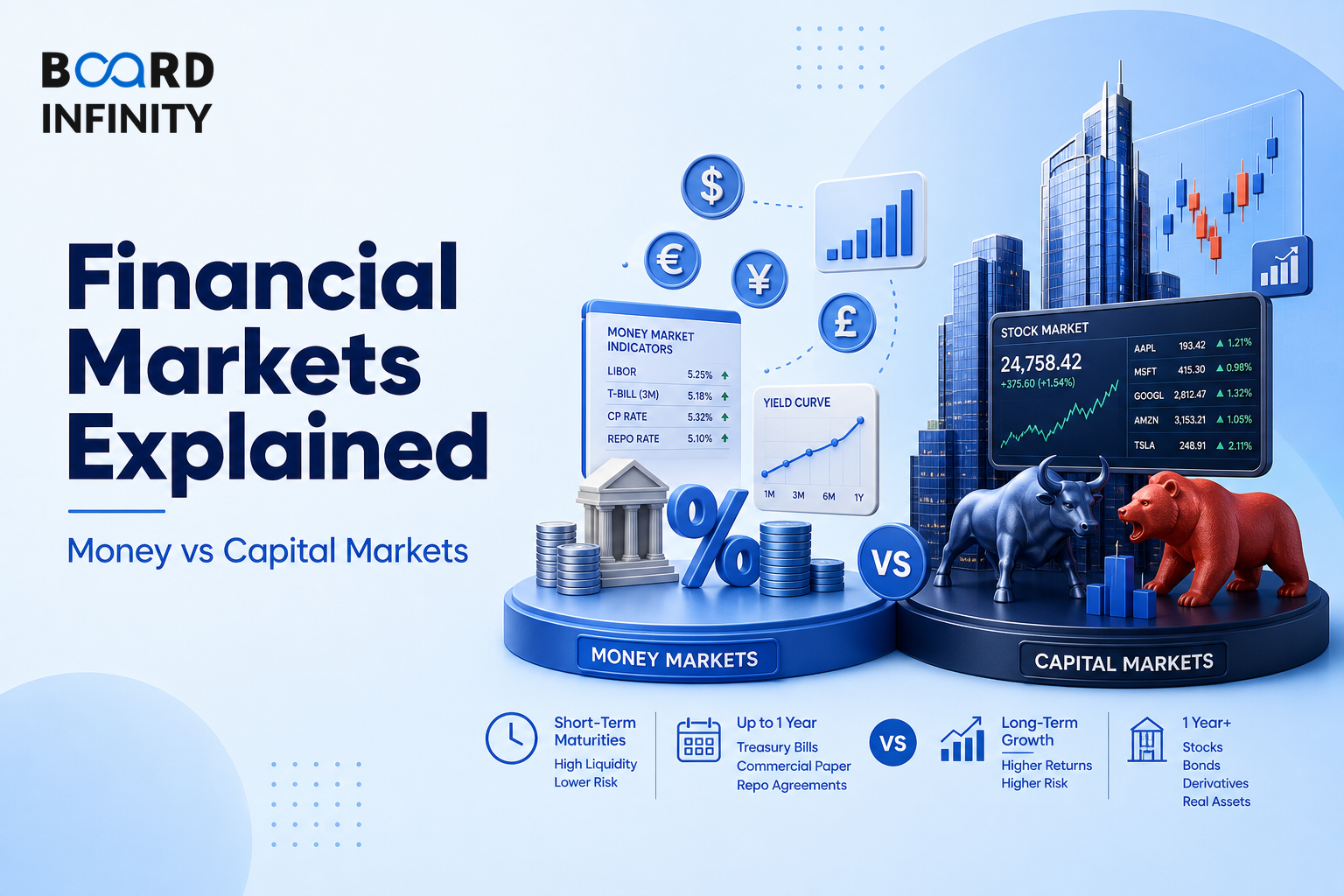
After Risk and Return in Finance Explained, the next question is where financial instruments are actually transacted. Financial markets are the infrastructure that moves money through the economy by connecting buyers and sellers of financial instruments. In interviews, this matters because candidates are often expected to classify markets by maturity, issuance, and asset type, and then connect them to Indian regulators and examples.
- Financial markets are platforms - physical or electronic - where buyers and sellers transact financial instruments.
- They facilitate capital formation, price discovery, risk transfer, and liquidity provision.
- By maturity, markets are classified into Money Market (< 1 year) and Capital Market (> 1 year).
- By issuance, markets are classified into Primary Market and Secondary Market.
- By asset, markets are classified into Debt Market, Forex Market, and Derivatives Market.
- Indian examples include NSE, BSE, LIC IPO (₹21,000 Cr), Hyundai India IPO (2024), Nifty 50, and BSE Sensex.
- Regulator map for interviews: Equity/Mutual Funds/Bonds/IPOs to SEBI, Banking/NBFCs/Forex/G-Secs to RBI, Insurance to IRDAI, Pension to PFRDA, Insolvency to IBBI.
Financial Markets: Big Picture
Financial markets are platforms where financial instruments are transacted. The simplest way to structure them is by maturity, issuance, and asset type.
Financial markets are platforms - physical or electronic - where buyers and sellers transact financial instruments.
What Financial Markets Do
Financial markets facilitate capital formation, price discovery, risk transfer, and liquidity provision. For interview answers, these four functions are the core reason financial markets matter.
Capital formation, price discovery, risk transfer, and liquidity provision also explain why the same broad financial market system includes short-term money markets, longer-term capital markets, primary issuance, secondary trading, debt, forex, and derivatives.
Classification by Maturity: Money Market and Capital Market
By maturity, the Money Market covers instruments with maturity of less than 1 year. Its instruments include T-Bills, CP, CD, Repos, and Call Money, with RBI, scheduled banks, and primary dealers as key institutions, and the Overnight MIBOR rate as an Indian example.
By maturity, the Capital Market covers instruments with maturity of more than 1 year. Its instruments include equities, bonds, debentures, and MFs, with NSE, BSE, and SEBI as key institutions, and Nifty 50 and BSE Sensex as Indian examples.
Classification by Issuance: Primary Market and Secondary Market
By issuance, the Primary Market includes IPOs, FPOs, Rights issues, and OFS. Indian examples include LIC IPO (₹21,000 Cr) and Hyundai India IPO (2024).
By issuance, the Secondary Market covers trading of already issued securities. Indian examples include NSE as the largest equity exchange and T+1 settlement since 2023.
Classification by Asset: Debt, Forex, and Derivatives
By asset, the Debt Market includes G-Secs, SDLs, and corporate bonds. Key institutions and Indian examples include RBI, CCIL, and the 10Y G-Sec yield benchmark ~7%.
The Forex Market includes currency pairs, forwards, and swaps. Indian examples include USD/INR, CCIL, and RBI intervention.
The Derivatives Market includes Futures and Options, including Index and Stock F&O. NSE F&O is the world's largest derivatives exchange by contracts.
Regulator Map for Interviews
Equity/Mutual Funds/Bonds/IPOs to SEBI | Banking/NBFCs/Forex/G-Secs to RBI | Insurance to IRDAI | Pension to PFRDA | Insolvency to IBBI.
This regulator map is a must know for interviews because interviewers love asking: "Who regulates a credit card company?" Answer: RBI (NBFC/bank issuer).
Structuring a Financial Markets Explained Interview Answer
"Explain financial markets and classify them by maturity, issuance, and asset type."
The strongest answer connects classifications to Indian institutions and examples. Do not stop at definitions - add NSE, BSE, LIC IPO (₹21,000 Cr), Hyundai India IPO (2024), T+1 settlement since 2023, and the regulator map.
The most frequent error is treating all financial markets as if one regulator covers everything. This costs points because Equity/Mutual Funds/Bonds/IPOs map to SEBI, while Banking/NBFCs/Forex/G-Secs map to RBI, and a credit card company is regulated by RBI as an NBFC/bank issuer.
Conclusion
Financial markets are the platforms where buyers and sellers transact financial instruments, and they facilitate capital formation, price discovery, risk transfer, and liquidity provision. For interviews, remember the three classification lenses - maturity, issuance, and asset type - and support each with Indian examples and the correct regulator map.