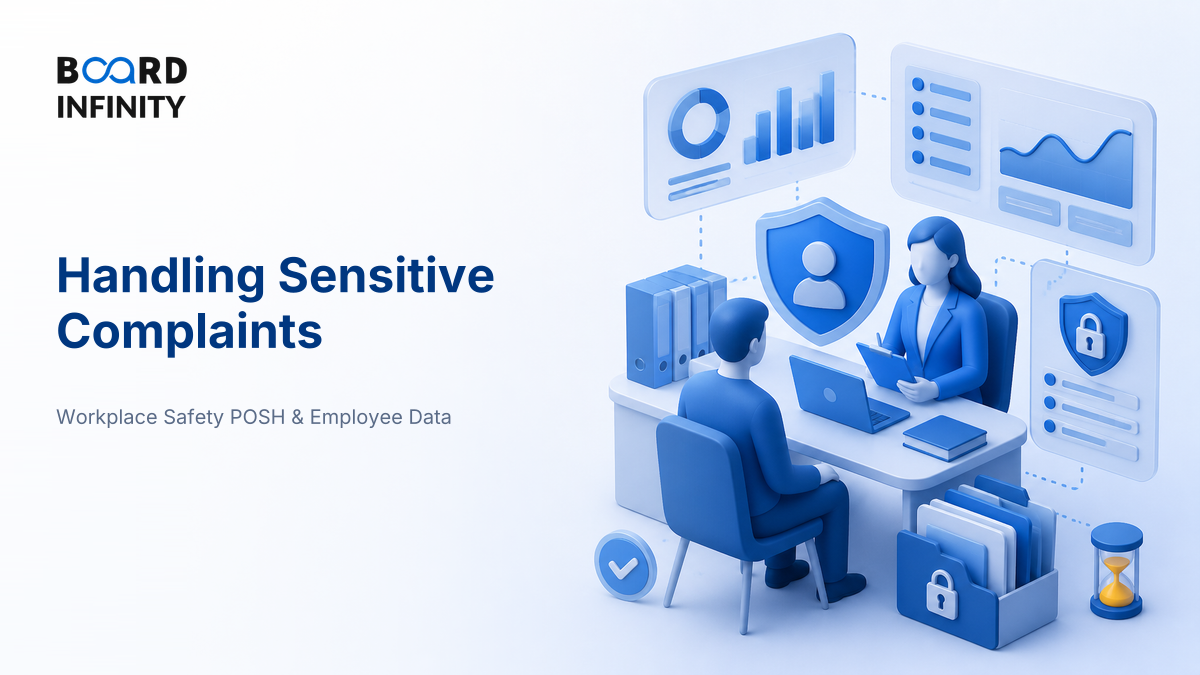
One complaint can move in two completely different directions. In the bad version, a screenshot is forwarded, names leak by lunch, witnesses take sides, and the investigation is poisoned before it begins. In the good version, HR protects identities, preserves evidence, hears both sides, and reaches a decision that people may not like but can still respect.
Confidentiality is not secrecy. It means sharing complaint information only with people who have a legitimate need to know.
Fair process is not being neutral between right and wrong. It means being impartial until facts are tested.
Use the core sequence: receive safely, assess risk, preserve evidence, investigate impartially, decide, communicate, protect against retaliation.
In India, sexual harassment complaints must follow the POSH Act, 2013 where applicable, including Internal Committee process and confidentiality duties.
The complainant deserves safety and dignity; the respondent deserves notice, opportunity to respond and freedom from pre-judgment.
Track process health with SLA adherence, cycle time, retaliation reports, substantiation rate, recurrence and closure quality.
The biggest mistake is promising absolute confidentiality. The correct promise is limited, need-to-know confidentiality.
Big Picture: The HR Balancing Act
A sensitive complaint is not just an employee-relations issue. It is a trust event. HR must protect the person who raises the issue without denying procedural fairness to the person accused. If either side is mishandled, the organisation loses legitimacy.
A good complaint process protects privacy while still allowing facts to be fairly tested.]
<h2>Core Explanation: How to Handle a Sensitive Complaint</h2>
<p>The big idea is simple: <strong>separate care from conclusion</strong>. HR can support the complainant immediately without deciding that the allegation is proven. HR can also treat the respondent fairly without minimising the complaint.</p>
<p>A sensitive complaint may involve harassment, discrimination, bullying, retaliation, misconduct, fraud, whistleblowing or a serious breach of policy. The exact route depends on law and policy, but the management logic remains the same.</p>
[[FIGURE: {"layout":"flow","items":[{"label":"Receive","note":"Listen and record"},{"label":"Stabilise","note":"Assess immediate risk"},{"label":"Investigate","note":"Evidence and interviews"},{"label":"Decide","note":"Reasoned outcome"},{"label":"Protect","note":"No retaliation"}]} | caption: The process must move from safe intake to evidence-based action and post-case protection.]
<h2>The Seven-Step Fair Complaint Process</h2>
<roadmap-steps
data-steps='[
{"title":"Receive the complaint safely","desc":"Listen without judgment, record the facts, explain the process and avoid promising absolute secrecy."},
{"title":"Check immediate risk","desc":"Assess whether interim measures are needed, such as reporting-line changes, leave, access restrictions or safety support."},
{"title":"Classify the route","desc":"Identify whether it is POSH, ethics, disciplinary, grievance, whistleblower or criminal in nature, then apply the right policy and legal process."},
{"title":"Preserve evidence","desc":"Secure emails, chat records, access logs, CCTV where lawful, documents and witness names before memory or records degrade."},
{"title":"Investigate impartially","desc":"Use a trained investigator or committee, interview relevant people, avoid leading questions and give the respondent a fair chance to answer."},
{"title":"Decide with reasons","desc":"Base findings on available evidence and the standard required by policy or law, not on popularity, hierarchy or pressure."},
{"title":"Close and monitor","desc":"Communicate outcome appropriately, implement action, document closure and monitor retaliation or recurrence."}
]'>
</roadmap-steps>
<h2>What Confidentiality Really Means</h2>
<p>Confidentiality is often misunderstood as “nobody will ever know.” That is dangerous. A fair investigation requires some controlled disclosure - for example, to the Internal Committee, investigator, decision-maker, witness or legal adviser.</p>
<data-table
data-headers='["Question", "Weak HR response", "Strong HR response"]'
data-rows='[
["Can you keep this secret?", "Yes, I will not tell anyone.", "I will keep it need-to-know, but I may need to involve the right people to act fairly and safely."],
["Will the accused know?", "No, we can investigate without telling them.", "If formal action is considered, they must know the substance of the allegation and be allowed to respond."],
["Can I stay anonymous?", "Yes, always.", "Anonymous reporting may be possible, but it can limit investigation quality and the ability to take action."],
["Who will see the records?", "HR will handle it.", "Only authorised people such as HR, the committee, investigator, legal or decision-maker should access case records."]
]'>
</data-table>
<h2>Fair Process: The Natural Justice Test</h2>
<p>Fair process has two classic natural justice principles: <strong>hear the other side</strong> and <strong>no one should judge their own case</strong>. In HR language, this means notice, impartiality, evidence, right to respond, documented reasoning and proportionate action.</p>
[[FIGURE: {"layout":"matrix","xAxis":"Evidence strength","yAxis":"Process fairness","items":[{"label":"Strong case","note":"Defensible decision"},{"label":"Overreach risk","note":"Facts good, process weak"},{"label":"Under-action risk","note":"Fair but facts thin"},{"label":"Danger zone","note":"Bias and poor proof"}]} | caption: A decision is defensible only when the evidence is strong and the process is fair.]
<h2>India-Specific Lens: POSH and Workplace Complaints</h2>
<p>For sexual harassment complaints in India, the Sexual Harassment of Women at Workplace (Prevention, Prohibition and Redressal) Act, 2013 matters directly. Organisations covered by the Act must have an Internal Committee, conduct inquiry through the prescribed process and maintain confidentiality around identities, proceedings and recommendations.</p>
<p>Useful POSH timelines to remember: a complaint is generally made within three months of the incident, the inquiry should be completed within 90 days, the report should be submitted within 10 days after completion, and the employer should act on recommendations within 60 days. Do not quote these mechanically in an interview unless the question is about POSH - first show judgment, then law.</p>
<tip-box data-type="info" data-title="Indian Example - POSH Process" data-icon="📌">
<p>If an employee in a Bengaluru tech firm reports harassment by a senior manager, HR should not run an informal “quiet chat” as the main process. The matter should be routed through the Internal Committee where POSH applies, with interim protection, confidentiality, evidence review and a documented finding. The strategic point: law, fairness and trust reinforce each other when the process is disciplined.</p>
</tip-box>
<h2>What HR Should Track Without Creating Perverse Incentives</h2>
<p>Complaint metrics are useful only if they measure process health, not if they pressure HR to suppress complaints. A rising complaint count can be a good sign if employees finally trust the channel. Use metrics to improve responsiveness, fairness and prevention.</p>
<data-table
data-headers='["Metric", "Formula or definition", "Strong signal"]'
data-rows='[
["Acknowledgement time", "Time between complaint receipt and first formal acknowledgement", "Same day or within the organisation SLA is strong for serious complaints."],
["SLA adherence", "Cases closed within policy timeline / total cases x 100", "90%+ within SLA is strong if quality and fairness are not compromised."],
["Investigation cycle time", "Average days from formal complaint to finding or closure", "Shorter than policy maximum is good, but rushed interviews are a red flag."],
["Retaliation reports", "Number of retaliation concerns after complaint closure", "Zero is ideal; any pattern requires immediate leadership attention."],
["Substantiation rate", "Cases with evidence-supported findings / investigated cases x 100", "There is no universal good rate; sudden extremes suggest under-reporting, poor intake or weak investigation."],
["Recurrence rate", "Repeat complaints from same unit or manager / total complaints x 100", "Low and falling is strong when reporting channels remain trusted."]
]'>
</data-table>
<h2>Definitions You Can Say in One Breath</h2>
<tip-box data-type="info" data-title="Core Definitions" data-icon="📘">
<ul>
<li><strong>Confidentiality:</strong> Limiting complaint information to people with a legitimate need to know.</li>
<li><strong>Fair process:</strong> An impartial, evidence-based procedure giving affected parties notice, response opportunity and a reasoned outcome.</li>
<li><strong>Retaliation:</strong> Any adverse action against a person for raising, supporting or participating in a complaint process.</li>
<li><strong>Internal Committee:</strong> The workplace body required under India’s POSH Act to inquire into sexual harassment complaints where the Act applies.</li>
</ul>
</tip-box>
<h2>Case Study: Infosys and the Anonymous Whistleblower Complaint</h2>
<tip-box data-type="info" data-title="Case Study - Infosys" data-icon="🏆">
<p>Infosys faced anonymous whistleblower allegations against senior leadership and responded through board-level review, independent investigation support and public disclosure of the outcome.</p>
</tip-box>
[[GOLD-IMAGE: A quiet corporate boardroom at night with blue-lit laptops, sealed folders, and a glass wall overlooking an Indian tech campus, no logos or readable text | caption: Sensitive complaints demand a process calm enough to protect trust under pressure.
Situation: In 2019, Infosys received anonymous whistleblower allegations concerning senior executives and accounting-related conduct. The matter was sensitive because it involved top leadership, market confidence, employee trust and regulatory attention.
The move: The company’s board and audit committee treated the complaint as a governance matter rather than an informal HR conversation. Publicly available company communications stated that an investigation was undertaken with independent support and that the outcome was disclosed after review. The organisation had to balance confidentiality of the process with disclosure obligations expected from a listed company.
Outcome and lesson: Infosys later said the investigation did not find evidence supporting the key allegations. The lesson is not that every complaint is true or false. The lesson is that sensitive complaints need a process that is credible even when the complainant is anonymous and the respondent is powerful.
The strategic so what: when the accused person is senior, ordinary line-manager handling is not enough. Independence becomes the heart of fairness, and confidentiality must be balanced with regulatory and stakeholder duties.
How AI Changes Handling a Sensitive Complaint
AI can improve speed and consistency, but it also increases privacy and bias risk. In complaint handling, AI should assist human judgment, not replace it.
Student workflow: Load the company’s code of conduct, POSH policy summary and annual report governance section into NotebookLM. Ask it to generate likely interview questions on complaint handling, confidentiality, retaliation and escalation. Then answer using the seven-step process above, not the tool’s wording blindly.
Interview Relevance
“An employee comes to you and says her manager has been harassing her, but she does not want anyone to know. What will you do as HR?”
Use this sentence in interviews: “I would support the complainant immediately, but I would not prejudge the allegation; confidentiality and natural justice must move together.”
Common Mistake
The mistake is saying, “I will keep it completely confidential.” That sounds caring but it can make a fair investigation impossible and may breach legal or safety duties. The fix: promise need-to-know confidentiality, explain the process clearly, and protect both parties from gossip, bias and retaliation.
What to Revise Next
Move next from complaint handling to the two adjacent areas that make HR legally credible: workplace safety duties and employee data discipline.
Mark Lesson Complete (Handling Sensitive Complaints: Confidentiality and Fair Process for HR Interviews)