
The HR Interview Loop: What Each Round Tests
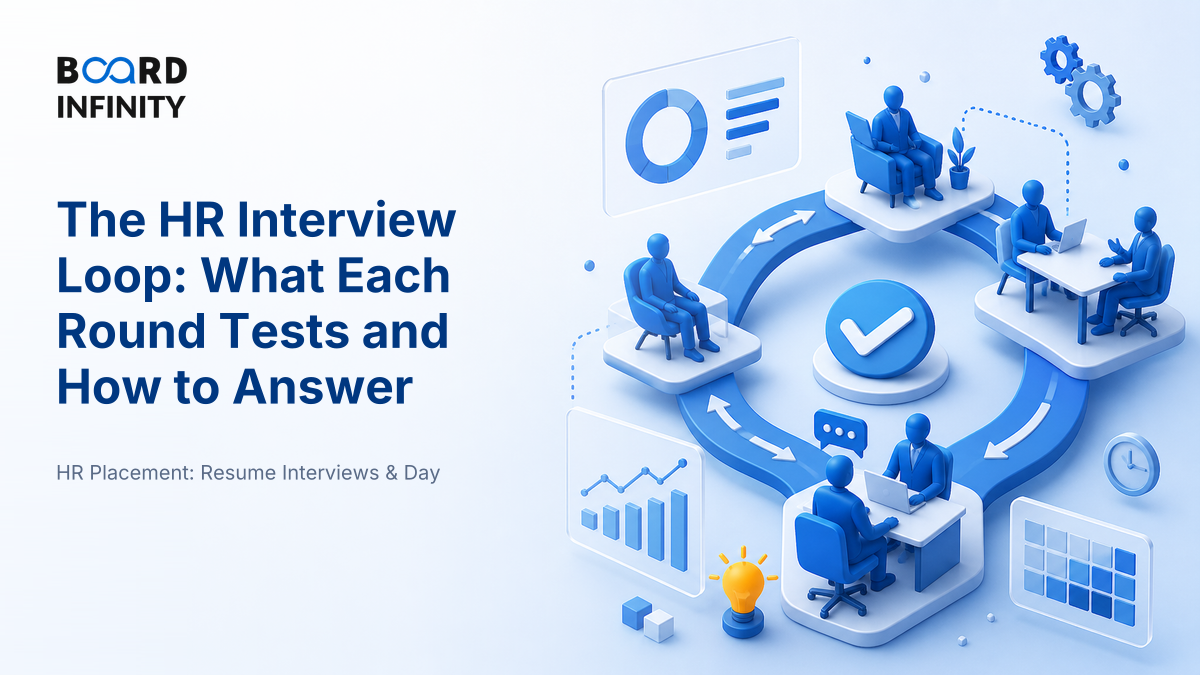
At 7:40 p.m., a hiring panel has two strong finalists on the table. One has sharper technical answers; the other has clearer motivation, cleaner examples, and fewer joining-risk signals. The HR interview loop exists for exactly this moment - to separate skill, fit, intent and risk before the offer goes out.
- The HR interview loop is a sequence of rounds where each interviewer tests a different hiring risk.
- Do not treat every round the same. Screening checks eligibility; functional rounds check capability; HR rounds check motivation, values, stability and offer risk.
- A strong answer has three parts: claim, evidence, relevance to the role.
- The final HR round is rarely “just a formality”; it often tests compensation fit, notice period, seriousness and culture alignment.
- The best candidates repeat their core story consistently, but change the proof depending on the round.
- Interview loops fail when rounds overlap too much, rely on gut feel, or ask questions unrelated to the job.
- Your safest mental model: every round is asking, “What risk are we reducing before we hire this person?”
Big Picture
Think of the interview loop as a risk-reduction ladder. The company does not move from round to round randomly; it climbs from basic eligibility to deeper judgment about whether you can perform, work with others, and actually join.
Core Explanation: What Each Round Actually Tests
The word “HR round” creates confusion because HR appears at multiple points in the loop. Early HR may screen. Mid-loop HR may assess behaviour and motivation. Final HR may negotiate, validate seriousness and close the offer.
The loop sits inside the recruitment lifecycle from requisition to joining, but the interview loop is the part where evidence is collected through conversations, tasks and evaluations.
The Two Questions Behind Every Interview Round
Every interviewer is silently asking two questions. First, “Can this person succeed in the role?” Second, “What could go wrong if we hire them?” Your answers should reduce both doubts.
This is why the same candidate can be loved by one interviewer and rejected by another. A functional interviewer may see capability. HR may see weak motivation. A hiring manager may see low stakeholder maturity. The loop is designed to combine those signals.
How to Answer Differently Across Rounds
Your core story must remain consistent, but the emphasis changes by round. Use this simple rule: answer the interviewer’s risk, not just the question they asked.
If your HR foundation feels shaky, revise what Human Resource Management actually does before practising answers. It will help you move from “I like people” to “I understand the function.”
Metrics Good Recruiters Use to Judge the Interview Loop
Companies do not only evaluate candidates; they also evaluate the hiring process. These metrics help HR identify whether the interview loop is fast, fair and predictive.
For fairness checks, many selection systems also monitor adverse impact, often using the four-fifths rule described in the Uniform Guidelines on Employee Selection Procedures. In simple terms: if a stage disproportionately filters a protected group, HR must investigate whether the selection method is job-related and fair.
Definitions
- Interview loop: A planned sequence of hiring interactions where each round tests a different job-relevant risk before an offer.
- Structured interview: An interview using consistent job-related questions, evidence standards and scoring criteria for comparable candidates.
- Competency: An observable cluster of knowledge, skills, abilities and behaviours that predicts performance in a role.
- Culture fit: Alignment between a candidate’s working style and the organisation’s real norms, values and decision habits.
- Offer risk: The chance that a selected candidate will decline, renegotiate late or fail to join as planned.
For deeper HR evaluation language, revise HR competency frameworks and how HR itself is assessed.
Zoho: A Skills-First Interview Loop in an Indian Company
Zoho shows why a hiring loop should test real capability and learnability, not just pedigree or polished interview speech.

Zoho is a useful Indian case because it has long signalled a belief in building talent beyond only elite-campus hiring. Its Zoho Schools of Learning is a public example of the company’s broader philosophy: identify aptitude, train deeply, and grow people into software and business roles.
Situation: In a competitive talent market, relying only on degrees, college brands and fluent interview performance can miss high-potential candidates. It can also create a loop where each round rewards the same surface signal: confidence.
The move: A skills-first loop separates signals. Early stages look for aptitude and learning ability. Practical assessments or problem-solving discussions test actual capability. Manager conversations test whether the candidate can work in a real team. HR then checks motivation, stability, values and long-term alignment.
Primary driver: The main driver is evidence-based selection - judging candidates on demonstrated ability and learnability. The supporting drivers are structured training, manager involvement, long-term talent development and cultural consistency around building from within.
Outcome or lesson: The case teaches a placement-level point: a strong HR interview loop is not a personality contest. It is a designed evidence system. When each round owns a distinct question, the company reduces hiring risk and the candidate gets a fairer chance to prove fit.
How AI Changes the HR Interview Loop
AI is changing the interview loop in three practical ways, but it does not remove human judgment.
Student workflow: Use NotebookLM or ChatGPT to practise loop-aware preparation. Paste the job description, your resume and the company’s careers page, then ask: “Create a round-wise interview loop for this HR role. For each round, list likely risks, likely questions, and the evidence I should use from my resume.” Then rehearse answers, but rewrite them in your own voice.
Interview Relevance
“Walk me through a typical HR interview loop. What does each round test, and how should a candidate prepare differently for each one?”
If asked this in an HR specialization interview, add one line on fairness: “The loop should be structured enough to compare candidates consistently, but flexible enough to probe role-specific evidence.” That answer sounds like an HR professional, not a candidate guessing the process.
The biggest mistake is treating the HR round as a soft, casual personality chat. It costs candidates because they stop giving evidence exactly when HR is checking motivation, values, stability and joining risk. One-line fix: answer every HR question with a clear claim, a real example and a link back to the role.