
India's Informal Economy: Organised-Unorganised Gross-Up Technique
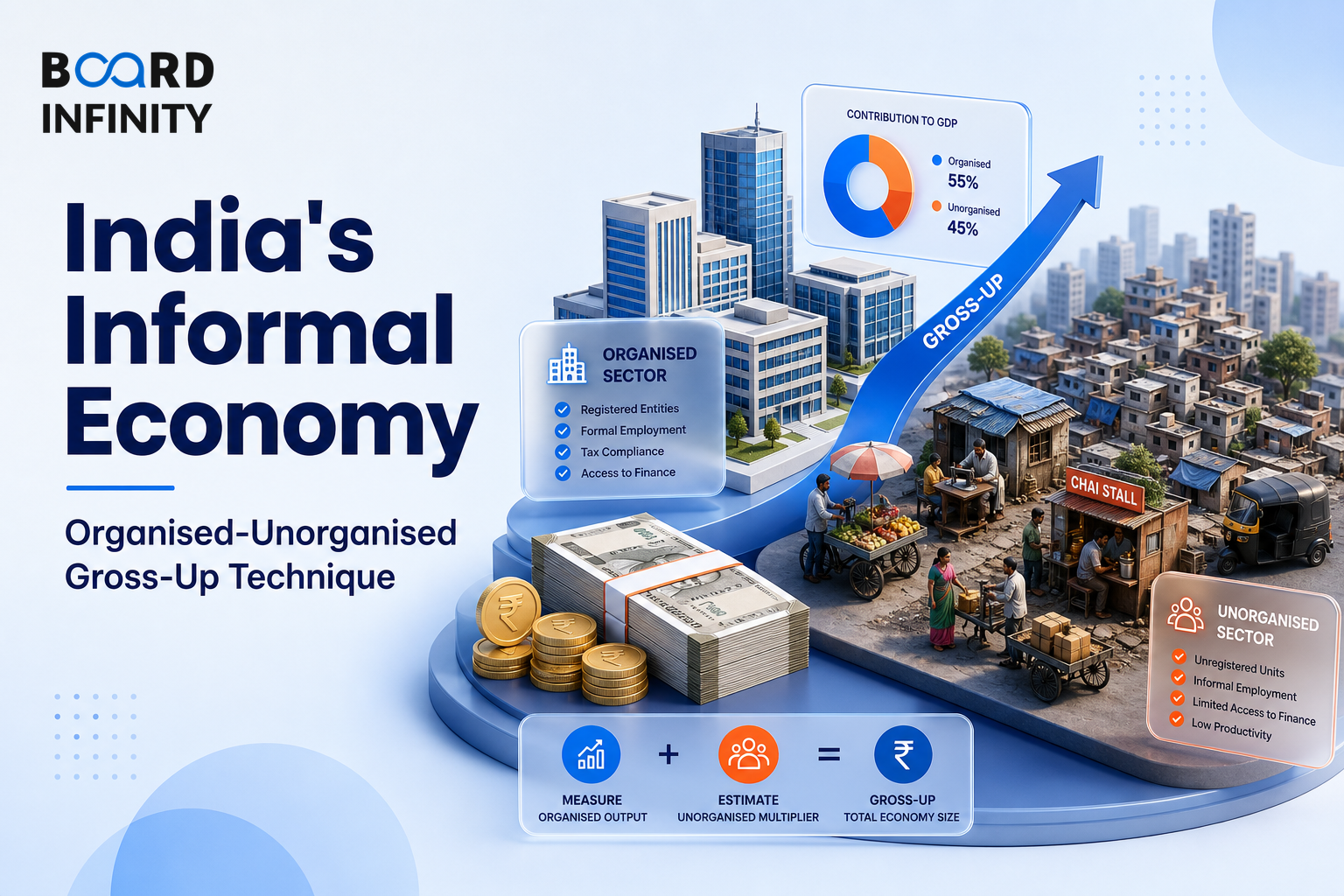
In the previous lesson on common pitfalls, one major failure mode was treating Indian markets as if every sale appears in clean formal data. This lesson answers the next interview question: when the organised number is visible but the informal market is not, how do you estimate the whole market without using a lazy blanket multiplier? In Indian case interviews, this matters because across most consumer categories, the unorganised segment is 40-70% of the market.
- India market-sizing often starts with formal data, but the unorganised segment can be 40-70% of most consumer markets.
- The default technique is organised-unorganised gross-up: estimate the organised slice, identify the sector split, invert the organised share, and sanity-check the result.
- For biscuits, Britannia, Parle, ITC and others are estimated at about ₹38,000 cr organised sales; at a 75% organised share, the total market is about ₹51,000 cr.
- Sector ratios matter: food and grocery retail is about 25% organised, while FMCG packaged products are about 85% organised.
- If there is no organised reference, as in street food, kirana, auto-rickshaw services, or tailoring, use a bottom-up approach instead.
- Strong interview answers cite sources such as NSSO, IBEF, FICCI, or sector reports, bracket uncertainty, and cross-check with consumption logic.
Big Picture: The Organised-Unorganised Gross-Up Logic
The core idea is simple: do not size only what is visible. In India, clean data often captures the organised slice, so your task is to convert that slice into the total market using a sector-specific organised share.
What Informal Means in Indian Market Sizing
Informal means economic activity that does not reliably appear in clean company filings, audited sales numbers, or tax-backed datasets. In this context, it includes non-registered businesses, Goods and Services Tax exempt micro-enterprises, cash-only operations, unbranded local products, and freelance or gig workers outside formal payrolls.
The National Sample Survey Office, or NSSO, is cited in the source for the definition that about 85% of India's workforce is informally employed. The India Brand Equity Foundation, or IBEF, and the Federation of Indian Chambers of Commerce and Industry, or FICCI, are cited for sector studies showing that 40-70% of most consumer markets is unorganised. This is why Western-style market sizing shortcuts often fail in India: they quietly assume formal-economy data is close to total-economy data.
The Gross-Up Formula
Gross-up means expanding a known partial value into a total value using the share that the known part represents. In this lesson, the known part is the organised market, and the missing part is the unorganised market.
Total market = organised market value ÷ organised share. Unorganised market value = total market value - organised market value.
If the organised biscuit market is ₹38,000 cr and the organised share is 75%, the total market is ₹38,000 cr ÷ 0.75, which is about ₹51,000 cr. The interview value is not just the arithmetic; it is the discipline of saying, "This uses a 75:25 split, and if the split is 65:35, the total rises to ₹58,000 cr."
How to Defend the Estimate Under Push-Back
Interviewers know informal-economy numbers are fuzzy. They are usually not testing whether you know a perfect statistic; they are testing whether you understand the uncertainty and can control it.
A placement-ready answer sounds like this: "Per FICCI and IBEF, food retail is roughly 75:25 unorganised to organised. I will use 75% to gross up, and if the real ratio is closer to 65%, my estimate moves down by about 10%." The specific number can be debated, but the structure is robust.
Worked Example: Biscuit Market Gross-Up
Situation: You are asked to estimate India's biscuit market. Problem: organised sales are visible through large branded players, but local biscuits and unbranded sales may not appear in clean datasets. Framework: use the organised-unorganised gross-up technique.
Decision: use ₹51,000 cr as the base estimate, while flagging that the number is sensitive to the organised share. Outcome: the estimate no longer ignores the informal segment, and it remains defensible under challenge. Learning: the best answer is not the most precise-looking one; it is the one that exposes the assumption and cross-checks it.
When the Whole Market Is Informal
The gross-up method breaks down when there is no meaningful organised reference. Markets such as street food, kirana, auto-rickshaw services, and tailoring can be so informal that a formal benchmark would mislead the estimate.
In those cases, use a pure bottom-up method. Bottom-up means building the market from units such as number of vendors, revenue per vendor, operating days, or customers per day, rather than starting from formal market share.
This example shows the key distinction: if a reliable organised slice exists, gross it up; if the market is almost entirely informal, build it from operating units.
Why a Blanket Informal Multiplier Fails
The tempting shortcut is to say "informal economy equals 50% of GDP" and apply a flat multiplier. That is the wrong statistic for market sizing because it confuses labour-force informality with category-level market structure.
Different sectors have very different organised shares. Furniture is about 20% organised, packaged FMCG is about 85% organised, and construction labour is about 10% organised. Applying one multiplier across all three would create a neat-looking answer that is directionally weak.
Structuring a India's Informal Economy Interview Answer
"Estimate the size of India's biscuit market, but make sure you account for informal or unorganised sales."
The number one way candidates get this wrong is by treating the organised number as the total number. The stronger answer names the organised base, applies a category-specific split, and openly defends the uncertainty.
The most frequent error is using one blanket informal-economy multiplier across every Indian market. It costs points because food retail, FMCG, furniture, construction labour, and beauty services have very different organised-unorganised structures.
Conclusion
India market-sizing is often a formal-data problem, not just an arithmetic problem. Estimate the organised slice, gross it up with a sector-specific ratio, and defend the uncertainty clearly - that is what separates a strong India guesstimate from a clean but incomplete one.