
Intrinsic vs Relative Valuation: When to Use Which
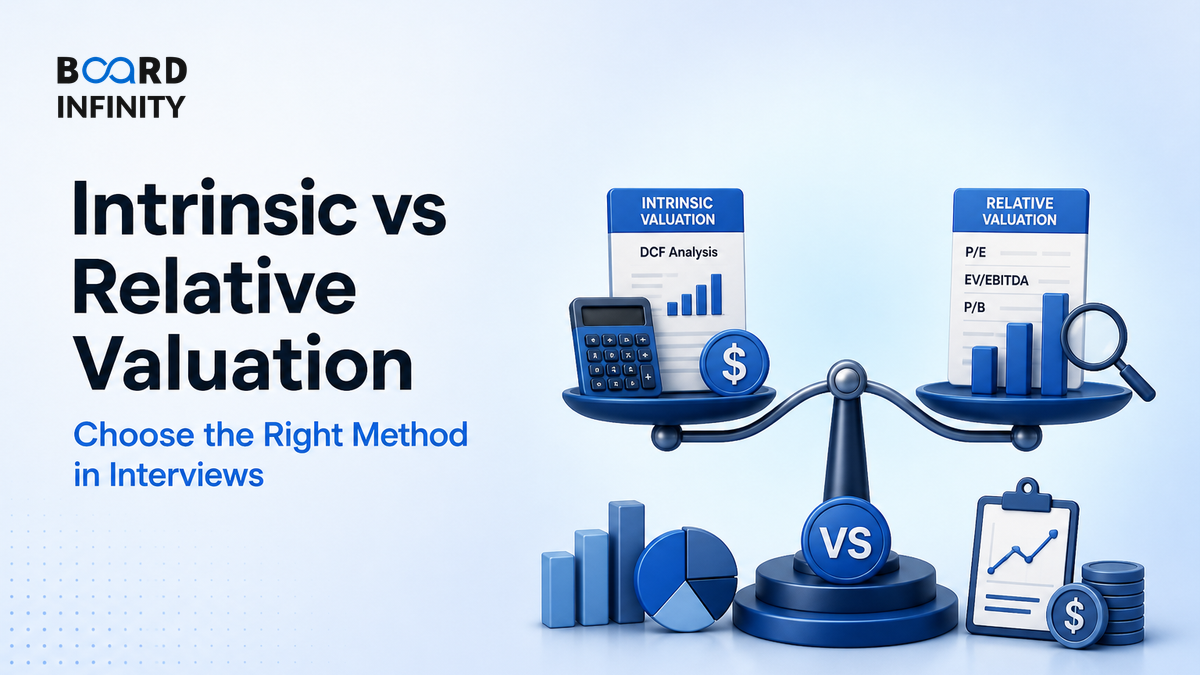
If a company trades at 80 times earnings, is it expensive - or is the market simply pricing a long runway that your spreadsheet has missed? The answer depends on whether you are asking, “What is this business worth?” or “What are similar businesses selling for?”
- Intrinsic valuation estimates value from the company’s own cash flows, growth, reinvestment and risk.
- Relative valuation estimates value by comparing the company with similar companies or transactions using multiples.
- Use intrinsic valuation when cash flows are forecastable, fundamentals matter more than market mood, or peers are poor.
- Use relative valuation when comparable companies exist, market pricing is relevant, and speed or benchmarking matters.
- The best answer is often not “DCF or multiples” but DCF for anchor value, multiples for market reality check.
- Never compare multiples mechanically - adjust for growth, margin, ROIC, leverage, accounting quality and business model differences.
Big Picture: Two Lenses, One Valuation Judgment
Intrinsic valuation looks inward at the economics of the business. Relative valuation looks outward at how the market prices similar businesses. A strong analyst uses both lenses, then explains why one should carry more weight in that situation.
Core Explanation: What Each Method Really Answers
Intrinsic valuation answers: “What is this business worth based on its own ability to generate cash?” The classic method is a discounted cash flow, or DCF, where future free cash flows are discounted back at a rate reflecting risk.
Relative valuation answers: “What should this business be worth if the market prices it like comparable businesses?” The classic method is trading comparables, using multiples such as EV/EBITDA, P/E, P/B or revenue multiples.
The Decision Matrix: When to Use Which
The cleanest decision rule is this: check cash-flow visibility and quality of comparables. High visibility favours intrinsic valuation. Strong comparables favour relative valuation. If both are strong, use both and reconcile. If both are weak, value cautiously and state uncertainty clearly.
How to Choose in Real Situations
Valuation Metrics You Must Know
Multiples are not shortcuts for thinking. Each multiple is a compressed statement about growth, profitability, risk and capital intensity.
Worked Example: Same Company, Two Answers
Assume a company has forecast free cash flow to firm of ₹100 crore next year, WACC of 10%, long-term growth of 4%, net debt of ₹200 crore and 10 crore shares.
The gap is not a problem by itself. It is a question: is the market assigning a higher multiple because peers have better growth, or is your DCF too conservative on future cash flows?
Definitions
Intrinsic valuation: Value estimated from a company’s expected cash flows, growth, reinvestment needs and risk.
Relative valuation: Value inferred from prices of comparable companies or transactions after adjusting for fundamentals.
Multiple: A market value scaled by a financial metric, such as earnings, EBITDA, book value or revenue.
Damodaran’s widely taught valuation taxonomy separates intrinsic valuation, relative valuation and contingent claim valuation. For MBA interviews, the first two are the most frequently tested.
Case Study: Trent and the Premium Multiple Question
Trent shows why a premium valuation multiple may be justified only when the business model, growth runway and execution quality support it.
Trent, the Tata Group retail company behind formats such as Westside and Zudio, became one of India’s most discussed retail valuation stories because the market began pricing it at a premium to many listed retail peers. A surface-level relative valuation answer would stop at: “It trades at a high multiple, so it is expensive.” That is not enough.

The better approach is to use relative valuation to recognize the market premium, then use intrinsic valuation to test whether that premium can be supported by future store expansion, revenue productivity, margins, working-capital discipline and reinvestment needs.
The lesson: when a company trades at a premium, do not instantly call it overvalued. Ask whether the premium is a rational price for higher growth, stronger unit economics and lower execution risk - or just market enthusiasm.
How AI Changes Intrinsic vs Relative Valuation
AI does not remove valuation judgment. It speeds up evidence collection and makes weak assumptions easier to challenge.
Practical student workflow: Load the target company annual report, two peer annual reports and this lesson into NotebookLM. Ask: “Extract the 10 drivers that would matter most in a DCF and the 5 adjustments needed before using peer multiples.” Then verify the numbers manually in the filings before building your model.
Interview Relevance
“You are valuing a high-growth Indian consumer company. Would you use DCF or comparable company multiples?”
A strong answer sounds like this: “I would use both, but DCF as the anchor if cash flows are forecastable, and multiples as a market cross-check. The final weight depends on peer quality and forecast confidence.”
Common Mistake
The biggest mistake is saying “DCF is more accurate” or “multiples are simpler” as if one method is always superior. That costs candidates because valuation method choice is situational. The fix: always link the method to cash-flow visibility, comparable quality and purpose of valuation.
What to Revise Next
Now move from choosing the method to building it properly. Revise Discounted Cash Flow: The Full Structure, Explained Properly first, then Forecasting the Explicit Period: Drivers, Not Guesses. That sequence turns this topic from a conceptual answer into a model-building answer.