
Issue Trees & MECE Thinking for Data Problem Interviews
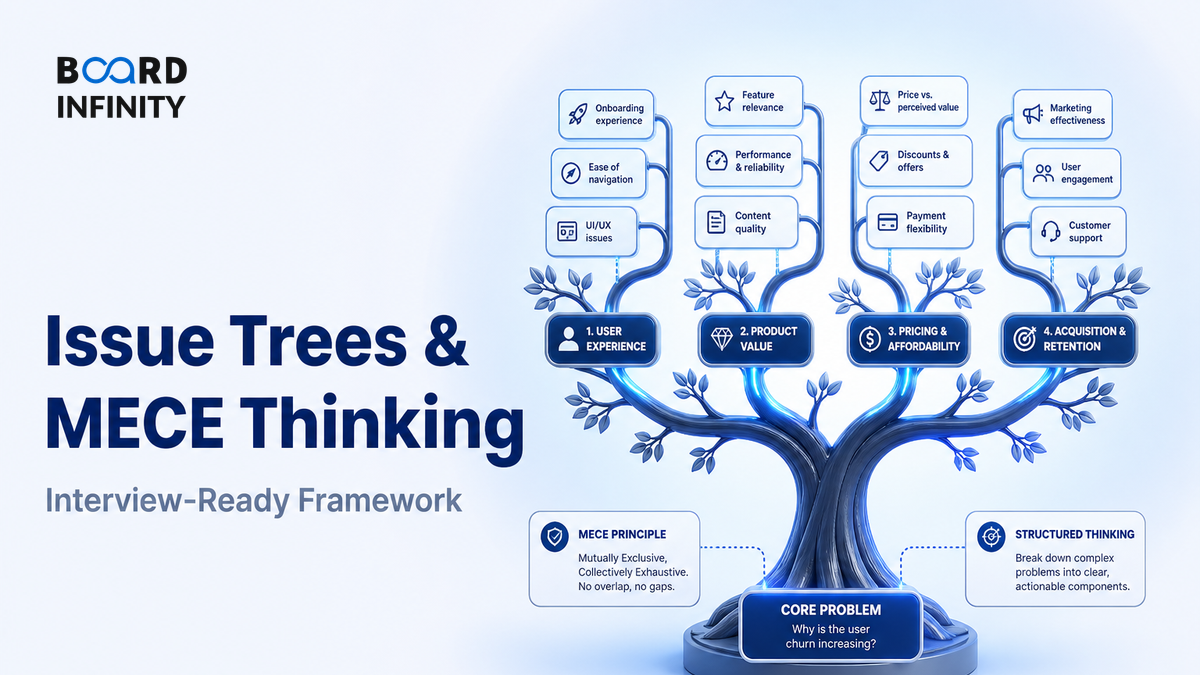
A checkout page freezes for a few seconds, a UPI payment fails, and a customer disappears. The weak analyst says, “Maybe the app is slow.” The strong analyst builds an issue tree and proves exactly where the leak sits - user, device, bank, gateway, payment mode, or merchant flow.
- Issue trees break one messy business question into smaller, answerable questions.
- MECE means branches are mutually exclusive and collectively exhaustive - no overlap, no missing bucket.
- For data problems, start with the metric equation, then split by drivers, segments, time, and controllability.
- A good tree is not just neat - it tells you what data to pull, what analysis to run, and what decision changes.
- Use a hypothesis-led tree when time is short: “The drop is likely from X; I will test X, Y, Z in order.”
- The biggest mistake is making a list of possible causes instead of a structured, non-overlapping diagnosis.
Big Picture: An Issue Tree Turns Confusion Into Testable Logic
An issue tree is the bridge between a vague problem and a clean analysis plan. In analytics interviews, it shows that you can translate “revenue dropped” or “conversion fell” into measurable drivers rather than random guesses.
Core Explanation: How to Build a MECE Issue Tree for Data Problems
The simplest rule: do not start with causes, start with the metric. If the business problem is “orders are down,” define the metric first. Orders could be sessions multiplied by conversion rate, or active users multiplied by orders per active user. Your tree depends on that definition.
Once the metric is clear, split the problem using branches that do not overlap. For example, a revenue drop can be decomposed as:
Revenue = Traffic x Conversion Rate x Average Order Value
That split is strong because each branch can be measured separately. If traffic is flat, conversion is down, and average order value is stable, your investigation narrows immediately.
The Five-Step Process to Build the Tree
MECE Thinking: The Two Tests You Must Pass
MECE stands for mutually exclusive, collectively exhaustive. It is the discipline that prevents double counting and blind spots.
A Mini Worked Example: Diagnosing a Conversion Drop
Suppose an e-commerce app’s weekly orders fell from 10,000 to 8,400. You are told traffic stayed the same at 100,000 visits.
Before: Conversion rate = 10,000 / 100,000 = 10%
After: Conversion rate = 8,400 / 100,000 = 8.4%
Drop: 1.6 percentage points, or 16% relative decline in conversion.
Now create a MECE funnel tree:
- Product discovery - users reaching product pages
- Cart creation - users adding items to cart
- Checkout initiation - users starting payment
- Payment success - users completing payment
If add-to-cart is stable but payment success drops, the issue is not “demand.” It is likely payment mode, gateway, bank uptime, technical errors, or friction in the final payment step.
Quality Metrics: How to Know Your Issue Tree Is Good
You do not need mathematical perfection, but you do need discipline. Use these checks while building your tree:
Definitions
- Issue tree: A hierarchical breakdown of one problem into smaller questions that can be analysed and answered.
- MECE: Mutually exclusive branches do not overlap; collectively exhaustive branches cover the full problem.
- Hypothesis-led analysis: A problem-solving approach that tests the most likely explanation first, then revises with evidence.
- Driver tree: A metric decomposition showing the factors that mathematically or operationally move the outcome.
Case Study: Razorpay and Payment Success Diagnostics
Razorpay shows why payment analytics needs MECE thinking: a failed transaction can come from the user, bank, payment mode, gateway, merchant checkout, or risk controls.

Razorpay operates in India’s complex digital payments ecosystem, where merchants accept UPI, cards, net banking, wallets, and other methods across many banks and payment rails. For a merchant, the visible symptom is simple: “payment failed.” The real cause is rarely simple.
A weak analysis would say, “The gateway is down.” A stronger issue tree separates the problem into non-overlapping buckets:
The strategic move behind products such as payment optimisation is not merely “better technology.” The primary driver is decomposing payment success into measurable failure buckets. Supporting drivers include real-time routing logic, payment-mode alternatives, merchant dashboards, retry flows, and ecosystem visibility across banks and payment methods.
The lesson for interviews: if a metric has many hidden failure points, MECE thinking protects you from blaming the loudest symptom instead of diagnosing the actual driver.
How AI Changes Issue Trees & Mutually Exclusive Thinking for Data Problems
AI does not remove issue trees. It makes bad issue trees faster and good issue trees more powerful.
- AI helps generate first drafts of driver trees. For a problem like “subscription churn increased,” ChatGPT or Claude can suggest possible branches - product usage, pricing, onboarding, support, competition - but you must check MECE discipline.
- AI speeds up data discovery. Natural-language BI tools can help analysts ask, “Show payment success rate by bank and payment mode for the last four weeks,” turning tree branches into queries faster.
- AI improves pattern detection after the tree is built. ML models can surface segments with abnormal drops, such as a device-payment-mode combination, but the issue tree keeps the analysis explainable.
Use Claude or ChatGPT to draft three alternative issue trees for the same problem, then ask: “Identify overlaps, missing buckets, and the first five data cuts to validate this tree.” For company prep, load the company’s annual report or investor presentation into NotebookLM and generate analytics interview questions around growth, retention, or unit economics.
Interview Relevance
“An e-commerce company sees a sudden drop in orders. How would you structure the analysis to find the reason?”
Say the equation aloud before the tree. It signals analytical maturity and prevents you from jumping into random causes.
Common Mistake
The biggest mistake is giving a brainstormed list - “marketing, pricing, app bugs, competition, seasonality” - instead of a MECE structure. It costs you because the interviewer cannot see how you would analyse the data. The fix: start with the metric equation, then branch into non-overlapping drivers.
What to Revise Next
Once issue trees are comfortable, revise the two skills that make them sharper in live interviews: