
The Merger Model and Earnings Impact in Excel
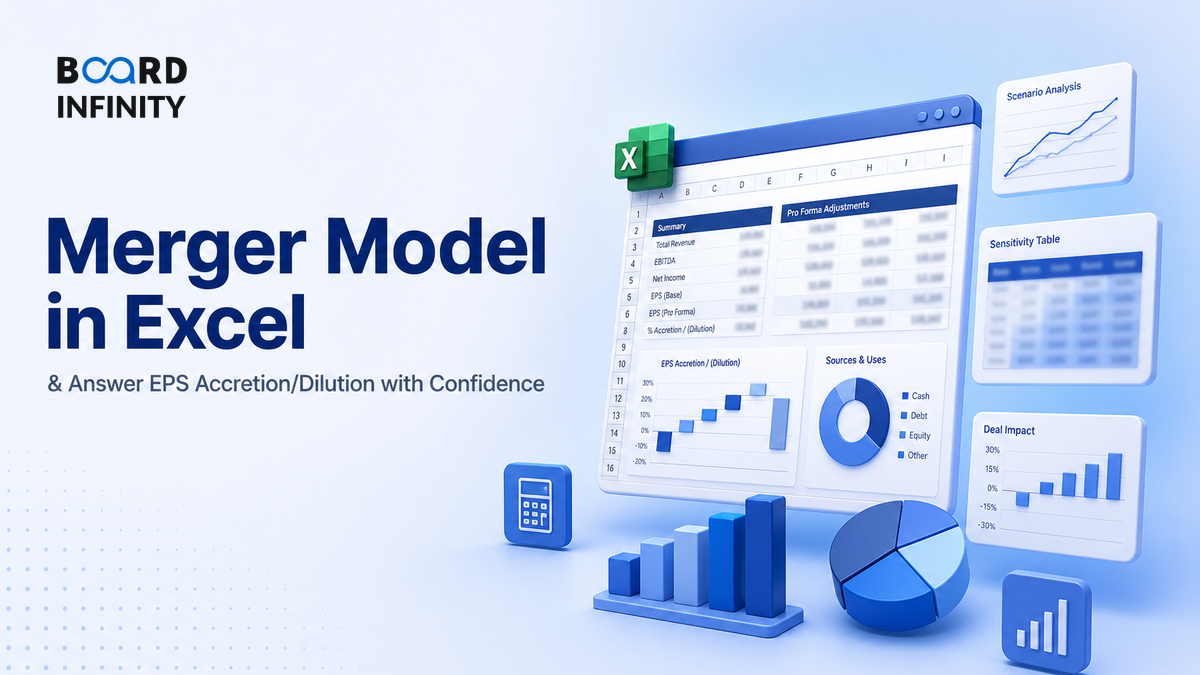
Before a deal, two companies report neat, separate EPS numbers. After the deal, one Excel workbook has to answer the uncomfortable question: will the combined company earn more per share, or did the buyer simply buy growth by diluting shareholders?
- A merger model combines acquirer and target financials to estimate pro forma EPS, leverage, ownership and deal impact.
- The headline output is EPS accretion/dilution: pro forma EPS compared with the acquirer standalone EPS.
- The core Excel flow is: standalone financials - deal terms - financing mix - transaction adjustments - pro forma EPS.
- Cash and debt deals often reduce EPS through lost interest income or new interest expense; stock deals dilute EPS through new shares.
- Synergies can make a deal accretive, but only if they are realistic, recurring and not outweighed by integration costs.
- Accretive does not automatically mean value creating; check ROIC versus WACC, strategic fit and execution risk.
Big Picture: What the Merger Model Is Really Solving
A merger model is not a valuation model first. It is an impact model: it translates a transaction structure into the combined company's earnings per share, debt load and ownership mix. The best mental model is a bridge from two standalone businesses to one pro forma company.
Core Explanation: Build the Model, Then Read the EPS Impact
The cleanest way to understand a merger model is to separate mechanics from judgement. Mechanics tell you whether EPS goes up or down. Judgement tells you whether that EPS movement is meaningful, recurring and worth the risk.
1. The Excel Architecture
A practical merger model usually has five blocks. In interviews, naming these blocks in order makes your answer sound structured immediately.
2. The Two Sides of the Model: Standalone Versus Pro Forma
The acquirer's standalone EPS is the baseline. The pro forma EPS is what shareholders own after the transaction. The model compares these two, after adjusting for financing and deal effects.
3. The EPS Formula That Drives the Model
The output is simple, but the inputs are not:
Pro forma EPS = Pro forma net income / Pro forma shares outstanding
Accretion or dilution % = Pro forma EPS / Acquirer standalone EPS - 1
If the result is positive, the deal is accretive. If negative, it is dilutive. But the model must explain why: target earnings, synergies, financing cost and new shares all fight inside the same number.
4. The Four Levers That Usually Move EPS
Most accretion/dilution analysis comes down to four levers. A strong candidate can explain each without hiding behind Excel.
5. A Worked Example: Accretion/Dilution in 8 Lines
Use this simple example to understand the mechanics. It ignores purchase accounting amortisation and one-time integration costs so the EPS logic is easy to see.
The deal is 7.8% accretive because 10.78 / 10.00 - 1 = 7.8%. The real interview follow-up is: are those synergies credible, and does the deal create value after considering risk?
6. The Metrics You Must Track
Do not stop at the EPS percentage. A finance interviewer expects you to connect earnings impact with funding, risk and value creation.
7. Excel Build Checklist
In Excel, clarity beats complexity. A clean model is easier to defend than a massive workbook with hidden assumptions.
Definitions You Should Be Able to Say Cleanly
- Merger model: An Excel model combining acquirer and target financials to estimate pro forma EPS, leverage, ownership and returns.
- EPS accretion: A deal is accretive when pro forma EPS is higher than the acquirer's standalone EPS.
- EPS dilution: A deal is dilutive when pro forma EPS is lower than the acquirer's standalone EPS.
- IAS 33 basic EPS: Profit attributable to ordinary equity holders divided by weighted average ordinary shares outstanding.
- P/E ratio: Market price per share divided by earnings per share.
PVR INOX: Modelling an All-Stock Merger in a Real Indian Business
PVR and INOX combined through an all-stock merger, making it a useful Indian example for understanding share issuance, scale synergies and EPS uncertainty.

Situation: The Indian multiplex business was emerging from a difficult period: pandemic disruption, changing content consumption, rising OTT competition and uneven movie slates. PVR and INOX were both large multiplex chains, but the sector needed scale, better occupancy and stronger monetisation from advertising, food and beverage, and premium formats.
The move: PVR and INOX announced an all-stock merger that became effective in 2023. Public deal disclosures stated that INOX shareholders would receive 3 shares of PVR for every 10 shares of INOX. In a merger model, that immediately tells you the deal has no new acquisition debt in the same way a cash LBO-style acquisition would, but it does increase the share count.
How the merger model thinking applies: The near-term EPS answer depended on more than adding two net income lines. The primary driver was scale in multiplex exhibition: a wider theatre network and stronger operating leverage. Supporting drivers included landlord negotiations, advertising inventory, F&B monetisation, premium screens and overhead consolidation. The risks were also model-relevant: weak footfalls, lease costs, integration complexity and volatility in film performance.
Outcome or lesson: PVR INOX is memorable because it shows why an all-stock merger can be strategically logical but still sensitive in EPS terms. The model's answer rests on synergy realisation and demand recovery, not only on the share exchange ratio.
How AI Changes The Merger Model and Earnings Impact in Excel
AI is useful in merger modelling, but it should sit around the model, not replace ownership of the model. In 2026, the best finance students use AI to accelerate research, scenario thinking and audit support while keeping final judgement human.
Load the acquirer annual report, target annual report and deal announcement into NotebookLM. Ask: "Extract all assumptions relevant to a merger model: share count, net income, debt, cash, tax rate, financing, synergies and risks." Then build the Excel model yourself and use ChatGPT only to generate a checklist of error checks.
Interview Relevance
"Walk me through how you would build a merger model in Excel and explain how you would determine whether the deal is EPS accretive or dilutive."
If you forget everything else, say this: "I would first compare standalone EPS with pro forma EPS, then explain the movement through target earnings, financing cost, new shares and synergies."
Common Mistake
The mistake: saying "the deal is accretive, so it is good." This costs candidates because EPS accretion can be manufactured through cheap financing, accounting effects or aggressive synergies. The fix: always add, "I would also check ROIC versus WACC, synergy credibility, leverage and integration risk."
What to Revise Next
You now understand how the merger model produces the EPS answer. Next, strengthen the two skills that protect you in real finance work: auditing the model and knowing where AI should not be trusted.