
ML Fundamentals: An Analyst's Perspective
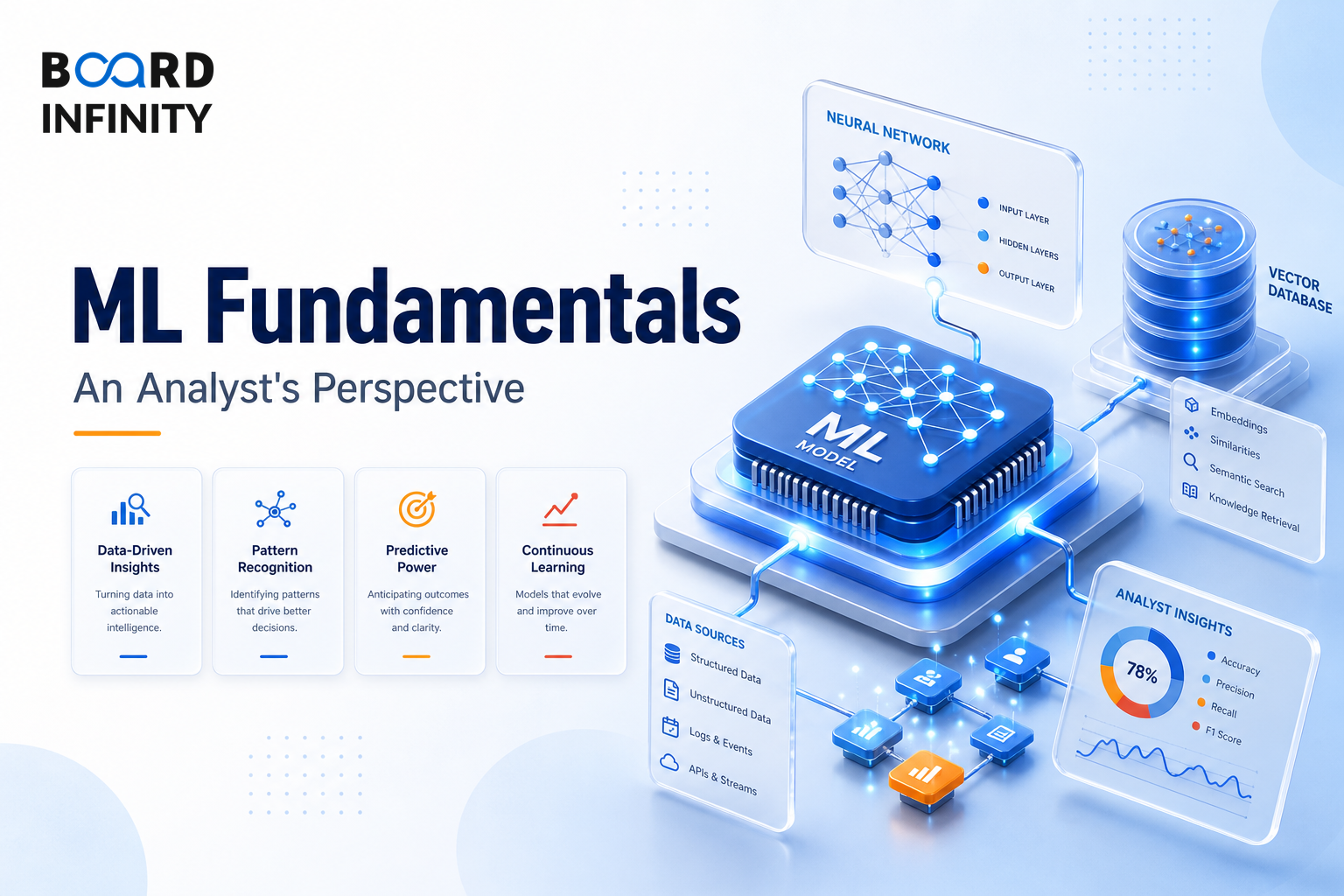
Machine Learning (ML) fundamentals for analysts are about judgment, not building TensorFlow models from scratch. In interviews, the key question is whether you can identify when ML adds value over simpler methods, design data for ML problems, interpret model outputs, and communicate results to business stakeholders. This matters because classification, regression, clustering, association rules, policy learning, and representation learning map directly to business use cases such as HDFC NBFC loan default, Razorpay fraud detection, Myntra customer segmentation, and Uber India dynamic pricing.
- Analyst's ML Mindset: You don't need to build TensorFlow models from scratch.
- You need to identify when ML adds value over simpler methods.
- You need to design data for ML problems and interpret model outputs.
- You need to communicate results to business stakeholders.
- You need to know what questions to ask data scientists.
- Major ML types include Supervised, Unsupervised, Reinforcement Learning, and Self-Supervised / GenAI.
- Knowing WHEN NOT to use ML is as important as knowing how to use it - interviewers test this pragmatic thinking.
The Analyst's ML Mindset
The analyst's perspective on ML is practical: you do not need to build TensorFlow models from scratch. You need to know when ML adds value over simpler methods, how to design data for ML problems, how to interpret model outputs, how to communicate results to business stakeholders, and what questions to ask data scientists.
Analyst's ML Mindset: You don't need to build TensorFlow models from scratch. You need to: (1) Identify when ML adds value over simpler methods, (2) Design data for ML problems, (3) Interpret model outputs, (4) Communicate results to business stakeholders, (5) Know what questions to ask data scientists.
The Big Picture: ML Types for Analysts
The big picture is to map the business question to the right ML type. Supervised learning uses labelled data for classification and regression, unsupervised learning finds structure without labels, reinforcement learning learns through reward and punishment, and self-supervised / GenAI learns from data structure itself.
How the Main ML Families Work
Supervised classification predicts a category label from labelled data. In business terms, this maps to decisions such as loan default (Yes/No) at HDFC NBFC and fraud detection at Razorpay.
Supervised regression predicts a continuous numerical value from labelled data. Examples include house price prediction in Bengaluru (₹ lakh) and demand forecasting at Reliance Retail.
Unsupervised clustering groups unlabelled data into natural clusters. This is used for customer segmentation at Myntra and inventory clustering at Delhivery.
Unsupervised dimensionality reduction compresses high-dimensional data preserving information. Examples include feature compression for credit risk model and text embedding reduction.
Unsupervised association rules find co-occurrence patterns in transactions. A business use case is market basket analysis - "Customers who buy X also buy Y" - at BigBasket.
Reinforcement learning uses policy learning, where an agent learns by reward/punishment in environment. Examples include dynamic pricing at Uber India and recommendation engine at YouTube India.
Self-Supervised / GenAI representation learning learns from data structure itself with no labels. Examples include customer service chatbots at Airtel IQ and AI-assisted analytics at Microsoft Copilot.
When Simpler Methods Should Come First
The Analyst's Most Important Skill: Knowing when NOT to use ML.
ML is powerful but adds complexity, requires large data, is harder to explain, takes time to build, and often underperforms simpler methods on small/clean datasets.
The Analyst's Hierarchy of Solutions should be used in order:
Structuring a ML Fundamentals Interview Answer
"A manager asks you to build a machine learning model to predict sales. What's your first response?"
Knowing WHEN NOT to use ML is as important as knowing how to use it - interviewers test this pragmatic thinking.
Adding ML complexity where a simple IF-THEN rule achieves same result; not explainable. The better alternative is a rule-based system; decision tree with 2-3 splits, such as flag orders > ₹50,000 from new accounts for review - no ML needed.
Conclusion
For analysts, ML fundamentals are about knowing when ML adds value over simpler methods, designing data for ML problems, interpreting model outputs, communicating results to business stakeholders, and asking data scientists the right questions.