
Modern Portfolio Theory and the Efficient Frontier
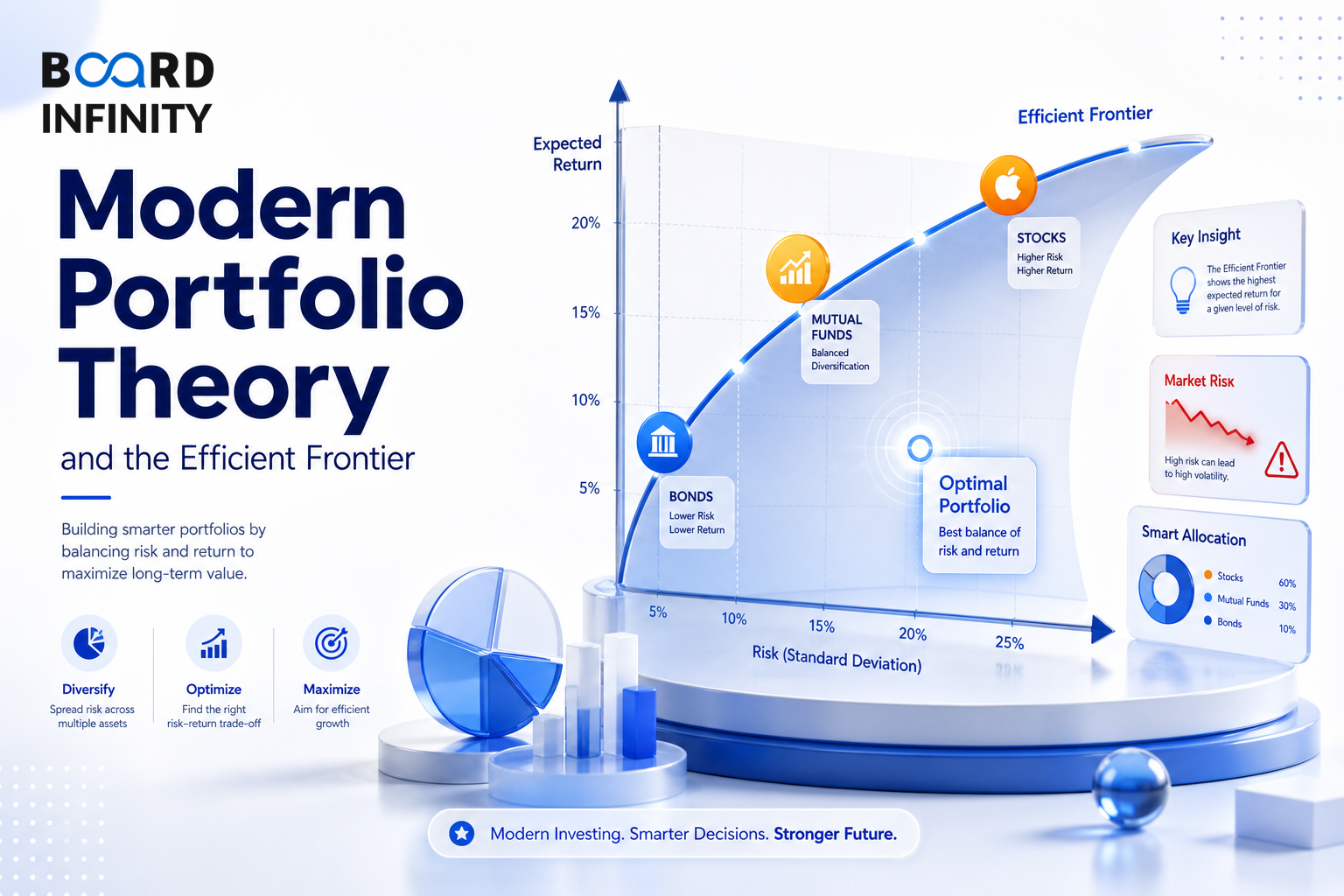
Harry Markowitz (1952) showed that investors can reduce portfolio risk through diversification without sacrificing return - as long as assets are not perfectly correlated. This matters in interviews because Modern Portfolio Theory and the Efficient Frontier explain why a portfolio of assets can be better than looking at each investment in isolation.
- Harry Markowitz (1952) showed that investors can reduce portfolio risk through diversification without sacrificing return - as long as assets are not perfectly correlated.
- The Efficient Frontier plots the optimal portfolios for each level of risk.
- Sharpe Ratio = (Rp - Rf) / σp, with higher being better: >1 is good, >2 is excellent.
- Portfolio of Nifty 50 (60%) + 10Y Govt Bonds (40%) gives Rp = 11.2% in the worked example.
- Portfolio σ depends on correlation, and with ρ ≈ -0.2 for equity-bond, σp ≈ 11.8% in the worked example.
- The residual ~16-18% is systematic market risk - cannot be diversified away.
- CAPM compensates only for systematic risk. Unsystematic risk is "free to eliminate."
Modern Portfolio Theory in One View
Modern Portfolio Theory connects expected return, risk, correlation, diversification and the Efficient Frontier. The big idea is that the Efficient Frontier plots the optimal portfolios for each level of risk, while diversification removes unsystematic risk until the residual systematic market risk remains.
Harry Markowitz (1952) showed that investors can reduce portfolio risk through diversification without sacrificing return - as long as assets are not perfectly correlated.
Efficient Frontier and Optimal Portfolio
The Efficient Frontier plots the optimal portfolios for each level of risk. It is described using Expected Return, Risk (σ), Min Variance, Optimal Portfolio, Rf, CML, Efficient Frontier and Inefficient portfolios.
The efficient frontier maximises Sharpe ratio, which is return per unit of risk. The optimal portfolio is not the highest-return or lowest-variance portfolio.
Sharpe Ratio = (Rp - Rf) / σp [Higher is better: >1 is good, >2 is excellent]
Worked Example: Nifty 50 and 10Y Government Bonds
Worked Example: Portfolio of Nifty 50 (60%) + 10Y Govt Bonds (40%): Rp = 0.6 × 14% + 0.4 × 7% = 8.4% + 2.8% = 11.2%.
Portfolio σ depends on correlation (ρ ≈ -0.2 for equity-bond): σp = √(0.6² × 20² + 0.4² × 5² + 2×0.6×0.4×(-0.2)×20×5) ≈ 11.8%.
Sharpe (Rf=7%) = (11.2 - 7) / 11.8 = 0.36 - reasonable.
Diversification and Risk That Remains
The diversification table shows how portfolio standard deviation falls as the number of stocks increases. The residual ~16-18% is systematic market risk - cannot be diversified away.
CAPM compensates only for systematic risk. Unsystematic risk is "free to eliminate."
Structuring a Modern Portfolio Theory & the Efficient Frontier Interview Answer
"Explain Modern Portfolio Theory and use a Nifty 50 plus 10Y Government Bonds portfolio to show how diversification reduces risk."
Do not call the optimal portfolio simply the highest-return or lowest-variance portfolio. The efficient frontier maximises Sharpe ratio, which is return per unit of risk.
The most frequent error is treating diversification as eliminating all risk. The residual ~16-18% is systematic market risk - cannot be diversified away, and CAPM compensates only for systematic risk.
Conclusion
Modern Portfolio Theory shows that investors can reduce portfolio risk through diversification without sacrificing return when assets are not perfectly correlated. The Efficient Frontier then helps identify the optimal portfolios for each level of risk, while the key interview takeaway is that unsystematic risk is free to eliminate but systematic market risk remains.