
How the Pharmaceuticals & Life Sciences Value Chain Works
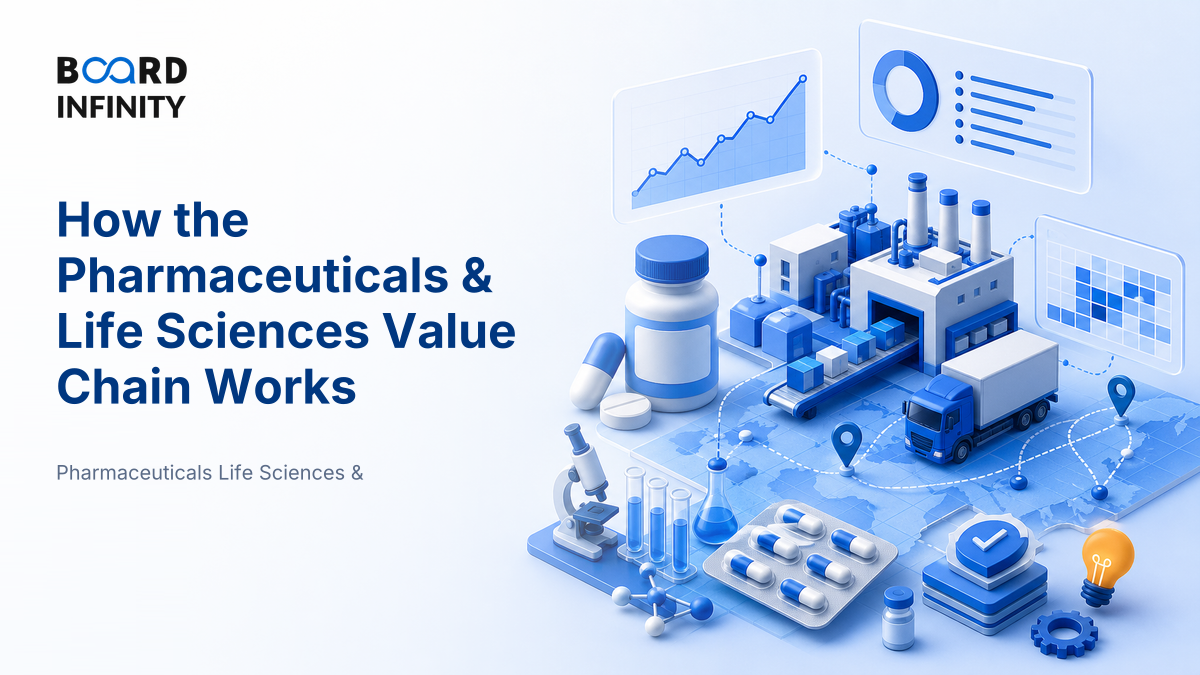
A molecule can begin as a sketch on a scientist's screen and end, years later, as a strip of tablets in a pharmacy or an injectable in a hospital cold chain. The shock is this: the hardest part is not just discovering the medicine - it is proving it works, manufacturing it consistently, getting it approved, reimbursed, prescribed, distributed and monitored safely.
- The pharma value chain converts science into patient outcomes through discovery, development, approval, manufacturing, market access, distribution and post-market safety.
- Innovator pharma takes high R&D and clinical risk to create patented medicines; generic pharma wins through bioequivalence, cost efficiency, scale and regulatory execution.
- Regulation is not a side function - it gates almost every stage, from trials to plant inspections to product labels and pharmacovigilance.
- Manufacturing quality is strategy because one compliance failure can stop supply, damage trust and trigger warning letters or recalls.
- Commercial success needs access: approval alone is not enough; pricing, reimbursement, doctor adoption, hospital formularies and channel reach decide uptake.
- India's strength lies in generics, APIs, vaccines, biosimilars and contract development/manufacturing, supported by scientific talent and scale manufacturing.
- Best interview answer: explain the chain stage by stage, then contrast innovator vs generic economics and name where value and risk concentrate.
Big Picture: One Chain, Many Gates
Think of the pharma and life sciences value chain as a risk-filtering machine. At every gate, the molecule must survive a tougher question: Can it work? Is it safe? Can we make it reliably? Will regulators approve it? Will doctors, hospitals, payers and patients actually use it?
Core Explanation: How the Pharma Value Chain Actually Works
The simplest way to understand the sector is to follow a medicine from idea to patient. Each stage has a different owner, risk, cost driver and success metric.
The US FDA's drug development process shows the same broad logic: discovery, preclinical research, clinical research, regulatory review and post-market safety monitoring. In India, the regulator to know is the Central Drugs Standard Control Organisation, and the broader principle is the same: approvals, clinical trials, imports, manufacturing permissions and safety oversight sit close to the regulator; if you need a quick map, revise locating the regulator and what it controls.
The Two-Sided Pharma Value Chain: Innovator vs Generic
Most candidates describe pharma as if every company follows the same model. That is the trap. An innovator company and a generic company may both sell medicines, but they win at very different points of the value chain.
For example, a company developing a first-in-class cancer therapy is primarily managing science and clinical risk. A company launching a generic tablet after patent expiry is primarily managing filing speed, plant quality, procurement, manufacturing yield and channel economics.
Where Value Is Created in the Chain
Value does not sit evenly across the chain. In innovator pharma, value concentrates around intellectual property, clinical differentiation and market access. In generics, value concentrates around regulatory speed, cost-efficient manufacturing, portfolio selection and dependable supply.
This is why pharma is not merely a manufacturing sector. It is a science-regulation-operations-commercial sector. A brilliant molecule without access may not sell. A low-cost generic with poor quality systems may not survive inspection. A patented product with weak evidence may struggle to win payer or doctor confidence.
Key Players Across the Pharma and Life Sciences Value Chain
The value chain is an ecosystem, not a single company's assembly line. Different specialists enter at different stages.
If you are reading an annual report, map each business segment to the chain: APIs, formulations, biologics, vaccines, consumer health, diagnostics, CDMO, branded generics and emerging-market sales all sit at different points. A useful next skill is reading an annual report for sector insight without getting lost in company jargon.
Metrics Interviewers Expect You to Track
Pharma metrics must be interpreted by segment. A biosimilar company, a branded innovator, a generic exporter and a diagnostic chain should not be judged with the same benchmark. Use these measures as interview anchors and compare them against peers, not across unrelated models.
Do not quote a universal "good" number unless the interviewer gives a segment and peer set. For pharma, a strong answer says: "I would benchmark R&D intensity, gross margin, inventory turns, service level and inspection outcomes against comparable companies in the same model."
Definitions You Should Be Able to Say in One Breath
- Pharma value chain: The sequence of activities that converts scientific discovery into approved, manufactured, distributed and monitored patient therapy.
- API: The active pharmaceutical ingredient is the biologically active substance responsible for the medicine's therapeutic effect.
- Formulation: The finished dosage form, such as a tablet, capsule, injectable or inhaler, that delivers the API to patients.
- Bioequivalence: Evidence that a generic product delivers the active ingredient at a comparable rate and extent to the reference drug.
- Biosimilar: The FDA describes a biosimilar as highly similar to an approved biologic with no clinically meaningful differences, as explained in its biosimilars overview.
- Pharmacovigilance: The detection, assessment, understanding and prevention of adverse effects or other medicine-related problems after use.
Case Study: Biocon Biologics and the Biosimilars Value Chain
Biocon Biologics shows how an Indian life sciences company can compete by integrating complex biologics development, manufacturing, regulatory execution and global commercial access.

Situation: India became globally competitive in small-molecule generics, but biologics are harder. They are large, complex molecules made in living systems, so the challenge is not just copying a chemical formula. A biosimilar company must prove high similarity, control process variability, run comparative studies, satisfy regulators and maintain reliable cold-chain-sensitive supply.
The move: Biocon Biologics focused on biosimilars rather than only conventional generics. That means its value chain had to cover cell-line and process development, biologics manufacturing, quality analytics, clinical comparability, regulatory filings, medical affairs, commercial partnerships and patient access. The company's strategic choice was not "low-cost India" alone; the primary driver was integrated biologics capability, supported by focused portfolios, regulatory experience, manufacturing discipline and market-access partnerships.
The lesson: Biosimilars sit between classic innovator pharma and commodity generics. They need scientific depth and clinical evidence like innovators, but also cost efficiency and scale like generics. That hybrid position is exactly why the value chain matters: if any link is weak - comparability data, plant quality, regulatory response, cold chain or doctor confidence - the commercial opportunity suffers.
So what for interviews: Use Biocon Biologics to show that Indian pharma is not only about low-cost tablets. The sector increasingly includes complex generics, biologics, biosimilars, vaccines, CDMO services and regulated-market execution.
How AI Changes the Pharmaceuticals and Life Sciences Value Chain
AI does not remove regulation or clinical proof. It changes speed, prioritisation and decision quality across the chain.
Practical student workflow: Put a pharma company annual report, investor presentation and regulator notes into NotebookLM. Ask it to produce a value-chain map with three columns: "stage," "evidence from the documents" and "interview implication." Then verify every claim against the original source before using it. For safe research habits, revise using AI to research a sector without importing its errors.
Interview Relevance
"Walk me through the pharmaceuticals and life sciences value chain. Where do companies make money, and where do the biggest risks sit?"
If you get a sector-comparison question, compare pharma with FMCG or banking on value-chain risk. Pharma has a much heavier regulatory and scientific gate before revenue begins. For a clean comparison method, use comparing two sectors on the same framework.
Common Mistake
The biggest mistake is treating pharma as "R&D plus manufacturing" and ignoring regulatory approval, market access and post-market safety. That costs candidates because it makes the answer sound like a factory tour, not a business model. Fix: always say, "A medicine creates value only when science, approval, quality supply and patient access all work together."